
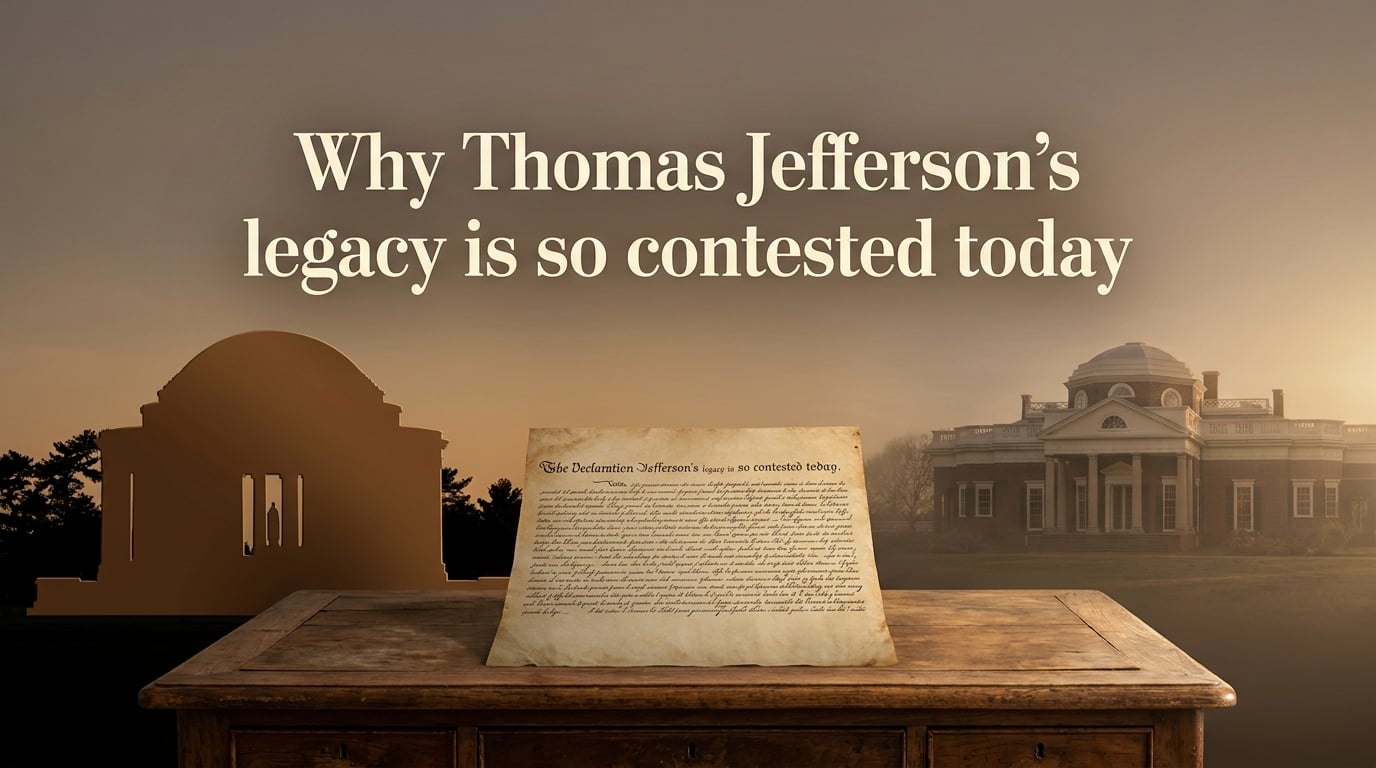
Few Americans are praised and attacked with equal intensity. Thomas Jefferson wrote the sentence that defines American self-image, “all men are created equal,” and he also held more than 600 human beings in slavery for life. That single tension is why Thomas Jefferson’s legacy is so contested today, and it is the reason a man dead since 1826 still sits at the center of America’s argument with itself.
I have spent years reading Jefferson’s letters, his draft of the Declaration, his Notes on the State of Virginia, and the modern scholarship from Monticello’s historians. The more I read, the more convinced I become that the debate over his legacy is really a debate over what kind of country America is supposed to be. Here is what I have found, and why I think his contested legacy is not going away any time soon.
Table of Contents
Thomas Jefferson’s Legacy Is Contested Because His Words and Actions Pulled in Opposite Directions
No other founder is judged by such a wide gap between stated principle and lived practice. George Washington freed his slaves in his will. John Adams never owned any. Jefferson wrote the document that promised liberty to all, and he spent his entire adult life presiding over a plantation labor system that depended on human bondage.
The Founding Father Who Authored ‘All Men Are Created Equal’
Jefferson’s pen gave America its founding idea. In 1776, at age 33, he drafted the Declaration of Independence and folded Enlightenment philosophy into a revolutionary argument: that governments exist to protect unalienable rights, and that people have the right to alter or abolish destructive power.
That single document reshaped world history. It also became the standard by which Jefferson himself would later be measured, and found wanting.
The Man Who Held Over 600 People in Bondage for Life
Over his lifetime, Jefferson owned around 606 enslaved people, according to Monticello’s records. He inherited about 175 from his father and father-in-law, and he acquired or inherited dozens more through his lifetime. He only freed seven enslaved people in his entire life, and only two during his own lifetime.
When he died, more than 100 people on his plantation were sold in his will to pay his crushing debts. That number still shocks readers, and it is one of the clearest reasons why Thomas Jefferson’s legacy is so contested today.
Jefferson Wrote the Declaration of Independence While Holding People in Slavery
It is not just that Jefferson wrote about liberty while owning slaves. It is that he edited his own document to remove an explicit condemnation of the slave trade. That editorial choice tells us more about the man than any of his surviving letters.
The Removed Clause on the Slave Trade
Jefferson’s original draft of the Declaration included a long passage condemning King George III for the slave trade. It accused the king of waging “cruel war against human nature itself” by enslaving African people and forcing them across the Atlantic.
Delegates from South Carolina, Georgia, and even some northern merchants objected. Jefferson did not fight hard to keep the clause. He deleted it. The final document contains no mention of slavery at all, and that silence is one of the loudest things about it.
Notes on the State of Virginia: Liberty Theory Meets Racial Hierarchy
In his only full-length book, Notes on the State of Virginia (1785), Jefferson laid out a theory of natural rights and then described Black people in language that reads as deeply racist to modern readers. He argued for the abolition of slavery while speculating that Black people were mentally inferior and that emancipation would create conflict.
This combination, abolitionist in theory and racist in detail, is the heart of why scholars still argue over what Jefferson really believed. I think the honest answer is that he believed both things, and that holding both at once was the personal cost of his position.
Jefferson Owning Over 600 Slaves Is the Core of the Modern Controversy
The numbers do the work that arguments cannot. Jefferson held more enslaved people than almost any other American of his time, and he lived in a state where freeing slaves was legally and economically complicated. Understanding those constraints is essential to understanding why he did what he did.
Why Jefferson Could Not or Would Not Free His Slaves
Jefferson claimed publicly that he opposed slavery on principle. In private letters he described it as a “moral depravity” and a “hideous blot” on the nation. Yet he never organized a large-scale manumission, and he actively opposed emancipation efforts in Virginia.
He told Edward Coles in 1814 that freeing his own slaves would only scatter them to worse fates elsewhere, and that the real solution had to be systemic. He also warned that premature emancipation would lead to a race war. To Coles, Jefferson wrote that the two races could not live together in the same country, and he preferred exiling freed Black Americans to Africa or the Caribbean.
His finances mattered too. Jefferson lived beyond his means for most of his life. Monticello, his books, his wine, and his scientific instruments consumed money faster than his crops and salary could replace. Enslaved labor was both an economic engine and a status symbol, and freeing enslaved workers would have collapsed his way of life.
The Economic and Legal Reality of Slave Ownership in Virginia
Virginia law in Jefferson’s time made freeing enslaved people difficult. State legislators in 1806 actually rolled back earlier manumission rights, requiring freed people to leave the state within a year or be re-enslaved.
Jefferson sat in the Virginia legislature in the 1770s and 1780s and pushed through his Statute for Religious Freedom, but he never sponsored sweeping emancipation legislation. He was skilled at drafting documents and weak at building political coalitions for them. That imbalance helps explain why his anti-slavery views never produced anti-slavery laws.
The Sally Hemings Relationship Forces a Reckoning With Jefferson’s Personal Conduct
The Sally Hemings story is the most personal and most contested part of Jefferson’s legacy. It is also where the gap between public and private life becomes impossible to ignore.
What the DNA Evidence Confirmed
In 1998, a team led by Dr. Eugene Foster used DNA testing to settle a long-running question: did Thomas Jefferson father children with Sally Hemings, an enslaved woman at Monticello who was the half-sister of Jefferson’s late wife Martha?
The test could not prove that Jefferson himself was the father. It proved that a Jefferson male in his line had fathered at least one of Hemings’s known children. Most historians, including those at Monticello, accept that Thomas Jefferson was the father of all six of Hemings’s children recorded at Monticello: Beverly, Harriet, Madison, Eston, Hemings, and another daughter lost to history.
The Thomas Jefferson Foundation at Monticello formally acknowledged this in 2000. A small group of dissenters still argues that Jefferson’s brother Randolph, or one of his nephews, was the father, but that view is now a minority position.
The Children of Sally Hemings and Their Lives After Monticello
Hemings’s children had different fates. Beverly and Harriet were allowed to leave Monticello at age 21 and disappeared into white society. Madison and Eston later lived in Washington and Wisconsin, respectively. Eston Hemings Jefferson married and changed his surname, and his descendants identified as white.
Two of Hemings’s children, Beverly and an unnamed daughter, are believed to have been fathered by Peter Carr, a close Jefferson relative. The other four are widely attributed to Thomas Jefferson himself. That mixed record is one reason why the question of paternity has lingered for two centuries.
Jefferson’s Presidential Record Adds Both Luster and Stain to His Reputation
Strip away the slavery question for a moment, and Jefferson’s presidency looks strong. Strip away the presidency, and the slavery question becomes even sharper. Both halves of his record matter.
The Louisiana Purchase and Westward Expansion
In 1803, Jefferson doubled the size of the United States by purchasing the Louisiana Territory from Napoleon for about $15 million. The deal also raised the constitutional question he had spent years avoiding: did the president have the power to add territory at all?
Jefferson, the strict constructionist, accepted the purchase even though the Constitution said nothing about buying land from foreign powers. He wrote privately that the Constitution should be stretched “to all cases not directly forbidden.” The same flexibility that allowed him to grab an empire also shaped his broader political philosophy.
The Lewis and Clark Expedition and the Doctrine of Discovery
Jefferson sent Meriwether Lewis and William Clark west in 1804, opening the continent to American settlement. The expedition also brought settlers into direct conflict with Native nations who held the land.
Jefferson’s instructions to Lewis included language about treating Native people as equal negotiating partners. In practice, Jefferson also pushed for Native removal when it suited American settlers, and his letters to William Henry Harrison in 1803 described Native Americans as obstacles to be cleared. That dual posture toward Indigenous people is another reason his legacy is contested.
Why His Opponents Called Him the ‘Negro President’
Federalist critics in the 1800 election spread the rumor that Jefferson had fathered children with Sally Hemings and that he favored Black equality. They called him the “Negro president” as an insult. The slur backfired on the Federalists, who lost the election badly, but it shows how race was already weaponized in early American politics.
That moment is small by itself, but it marks the first time Jefferson’s personal conduct with enslaved women became a political issue. Two centuries later, the same tension still shapes American political debate.
How Jefferson’s Legacy Is Interpreted and Politicized Today
The fight over Jefferson’s reputation is no longer about facts alone. It is about what those facts mean, and which America gets to claim him.
The Statues, Monuments, and Campus Debates
Across the country, Jefferson statues have been removed, vandalized, or relocated. His name has been stripped from buildings at some universities, including his own University of Virginia, where students and faculty pushed for fuller acknowledgment of his slaveholding past.
At UVA, the President’s Commission on Slavery and the University published a report in 2018 documenting the labor of enslaved people on campus grounds. The university renamed buildings and created the Memorial for Enslaved Laborers in 2020. That kind of institutional reckoning is happening at almost every major Jefferson landmark.
Modern Political Appropriations and the Question of Original Meaning
Conservatives tend to claim Jefferson as a champion of limited government and religious freedom. Progressives tend to cite his eloquent anti-slavery writing and his letter to the Baptist association of Danbury, which is often credited with inventing the phrase “wall of separation between church and state.”
Both readings are partial. Jefferson would probably reject most uses of his name today. He distrusted large standing armies, public debt, central banks, and entangling alliances, and he also favored policies modern conservatives and progressives would both find extreme. His philosophy does not fit neatly into any current party, which is exactly why both sides reach for him.
That constant reinterpretation is, in my view, what keeps his legacy contested. Jefferson did not leave a single, clean record. He left a stack of letters, drafts, and policies that almost anyone can cite for almost any cause. The contest is not just over him. It is over what America wants to say about itself.
Frequently Asked Questions About Thomas Jefferson’s Contested Legacy
How is Thomas Jefferson remembered today?
Thomas Jefferson is remembered today as both the eloquent author of the Declaration of Independence and a slaveholder who owned more than 600 people across his lifetime. His face is on Mount Rushmore and the nickel, and his name is on buildings and monuments nationwide, but his legacy is contested because of the gap between his stated ideals of liberty and his lived practice of slavery.
Why did Thomas Jefferson have slaves if he was against slavery?
Jefferson called slavery a moral depravity and a hideous blot in private letters, yet he never freed his enslaved workers and blocked emancipation efforts in Virginia. The gap came from a mix of personal dependence on slave labor, the legal restrictions Virginia placed on manumission, his lifelong debt problems, and his belief that freed Black people could not safely remain in the United States.
Did Thomas Jefferson father children with Sally Hemings?
Yes, most historians, including the Thomas Jefferson Foundation at Monticello, accept that Jefferson fathered six children with Sally Hemings, an enslaved woman who was the half-sister of his late wife Martha Wayles Jefferson. A 1998 DNA study confirmed that a Jefferson male fathered at least one of her known children, and a small minority of scholars still argue that a Jefferson nephew was the actual father.
Why was Jefferson called the ‘Negro president’?
Federalist opponents of Jefferson called him the Negro president during the bitter 1800 election to mock the rumor that he had fathered children with Sally Hemings and to attack his reputation for sympathy toward Black Americans. The slur did not stop him from winning the election, but it marked the first major political use of Jefferson’s personal life against him.
What did Thomas Jefferson actually accomplish as president?
As the third president from 1801 to 1809, Jefferson cut the national debt, completed the Louisiana Purchase in 1803 to double the size of the country, sponsored the Lewis and Clark Expedition, and ended the Barbary pirate conflict. His presidency was defined by territorial expansion, smaller federal government, and the deep contradiction of pursuing liberty while protecting slavery.
Should Thomas Jefferson’s legacy be honored or condemned?
There is no single right answer, and that is exactly why his legacy remains contested. Honoring Jefferson means recognizing his role in articulating American ideals of equality and religious freedom, while condemning him requires reckoning with the reality that he held more than 600 people in slavery and fathered children with an enslaved woman he could not legally marry. Most serious historians argue for holding both truths at the same time, and that tension is at the heart of the modern Jefferson debate.
The Real Answer to Why Thomas Jefferson’s Legacy Is So Contested Today
Thomas Jefferson’s legacy is contested today because the man himself was contested. He wrote the language of American freedom and he lived inside American slavery, and he never resolved that contradiction. He left us a Declaration that promises equal rights and an estate built on enslaved labor. He left us a Statute for Religious Freedom and racist passages in Notes on the State of Virginia. He left us a university built by enslaved brickmakers and a presidency that doubled the nation while expanding the slave system that would later tear it apart.
I do not think we will settle the Jefferson question in 2026, and I do not think we should. The point of studying him is not to find a verdict. It is to keep asking the question. If we cannot hold the highest American ideals and the worst American realities in the same mind at the same time, we are not yet ready to understand the country we actually live in.
That is why I keep coming back to his letters, his drafts, and his contradictions. They are not just the record of one man. They are the record of America trying, and still trying, to be what it says it is.