
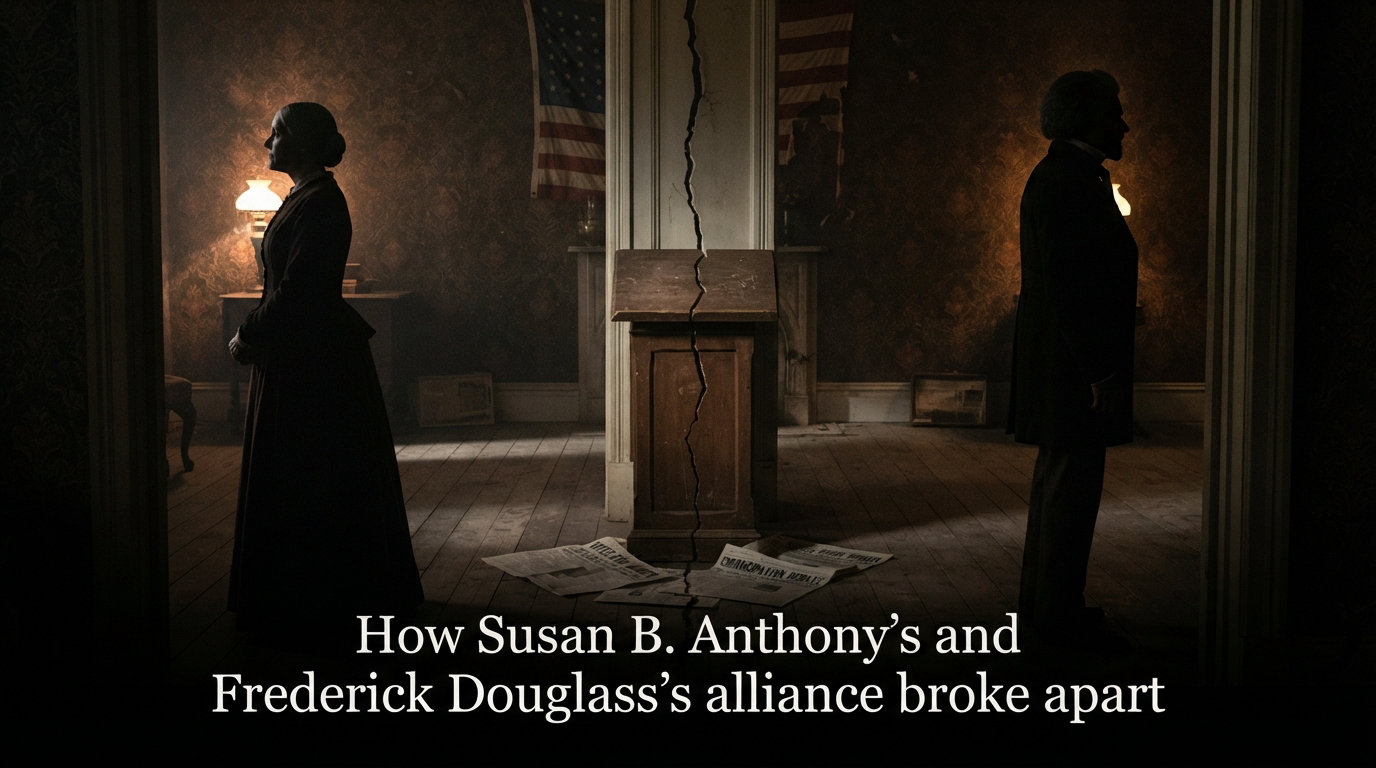
Susan B. Anthony and Frederick Douglass shared one of the most consequential friendships in American reform history. For 45 years, from a Rochester meeting in 1849 until Douglass’s death in 1895, they marched, spoke, and organized side by side for abolition and equal rights. Yet that same alliance nearly collapsed when the 15th Amendment landed before Congress in 1869.
If you have ever wondered how Susan B. Anthony’s and Frederick Douglass’s alliance broke apart, the short answer is this: they both wanted universal suffrage, but they disagreed about who deserved the ballot first. Douglass argued that formerly enslaved Black men could not wait another generation. Anthony countered that a “woman’s hour” had already struck, and that any amendment leaving women out was a betrayal. Their split reshaped the suffrage movement for decades.
I have spent weeks reading letters, journals, and meeting minutes from the American Equal Rights Association, and the story is more personal, and more instructive, than most textbook accounts suggest. Let me walk you through the full arc — from that first meeting in a Rochester parlor to the funeral in 1895 where the two movements tried, and failed, to stand together one last time.
Table of Contents
How Susan B. Anthony and Frederick Douglass Built Their 45-Year Alliance
Susan B. Anthony first met Frederick Douglass in August 1849 at a meeting in Rochester, New York. She had been corresponding with him about women’s rights, and he had been corresponding with her about abolition. The meeting was electric. Within months they were sharing lecture platforms and trading drafts of petitions.
Both came from Quaker-rooted reform communities that treated moral suasion as a serious tool. Anthony had cut her teeth on temperance and anti-slavery organizing in upstate New York. Douglass had become the most famous Black orator in the country after escaping slavery in 1838. They shared a suspicion of parties that compromised on human freedom, and a stubborn faith in petitions, lectures, and the printed word.
Between 1850 and 1865 they worked the same circuits. Anthony raised money for Douglass’s North Star newspaper. Douglass spoke at women’s rights conventions in Syracuse and Seneca Falls. He stood behind her when she was booed at an 1853 convention for the sin of insisting that women deserved the vote alongside Black men. There was no tension between these causes, in their view, because they were the same cause.
That shared conviction led them, in May 1866, to co-found the American Equal Rights Association (AERA). Anthony served as the chief organizing agent. Douglass served as the senior vice president. The AERA’s stated mission was “to secure Equal Rights to all American citizens, especially the right of suffrage.” Elizabeth Cady Stanton and Lucy Stone joined the leadership. For a brief window, the abolitionist and women’s rights wings of reform operated as a single machine.
The Underground Railroad Bond That Predated AERA
Long before AERA, Anthony and Douglass had quietly worked the Underground Railroad together. Anthony’s family home in Rochester hosted freedom seekers, and Douglass, then based in nearby Rochester as well, helped move people north to Canada. This is the part of the friendship that often gets left out of the political story, and it matters. When Reconstruction-era arguments later turned sharp, both had personal memories of Black families who had trusted them with their lives.
Reconstruction and the Race Against Time for Black Americans
To understand why Douglass shifted in late 1867, you have to understand what was happening to freedpeople in the South. The 13th Amendment abolished slavery in 1865, but the Black Codes were already restricting what freedom actually meant. Black citizens were being arrested for vagrancy, forced into apprenticeships, and killed with near-impunity. By 1867, Radical Reconstruction was underway, but its gains depended on Black men being able to vote and hold office.
Douglass read the South carefully. He knew that another decade of waiting could mean another decade of terror. He also knew that the Republican Party — the only party willing to back Reconstruction — was prepared to enfranchise Black men but was deeply nervous about adding women to the same amendment. Adding women, in their view, might kill the whole measure.
This is the strategic reality that made the coming fight so bitter. Anthony and Stanton accused Republicans of cowardice. Douglass accused Anthony and Stanton of privileging their own cause at the moment when Black Americans were most exposed. Both accusations had truth in them, which is why the wound never quite closed even when the two reconciled.
The 15th Amendment: Where Their Alliance Began to Crack
The 15th Amendment, proposed in February 1869 and ratified in February 1870, banned the denial of voting rights “on account of race, color, or previous condition of servitude.” It said nothing about sex. That omission was the fuse.
Douglass supported the amendment as written. His reasoning was straightforward: Black men in the South were facing organized political violence right now. A perfect amendment that took another ten years to pass was worse than an imperfect one that took effect next year. He also believed, candidly, that once Black men held the ballot, they would use it to help women.
Anthony and Stanton opposed the amendment. They argued that enshrining male-only suffrage in the Constitution would lock women out for a generation. They preferred no amendment to a partial one, and they said so loudly. At the May 1869 AERA meeting, Stanton told the audience that if white women could not vote, they might as well see “the educated negroes, the negroes who own property, who are intelligent and civilized” take their place — a remark that has echoed painfully through the centuries.
The crack in the alliance widened fast. Douglass walked out of the AERA convention in protest. Anthony published a stinging editorial accusing him of “sacrificing” women. The two organizations that replaced AERA — the National Woman Suffrage Association, led by Anthony and Stanton, and the American Woman Suffrage Association, led by Lucy Stone — carried the split forward for two decades.
The Hard Question: Why Douglass Prioritized Black Male Suffrage
This is the part of the story where modern readers most often bristle. Why would a man who loved Anthony and shared her goals choose to prioritize Black men? The honest answer is that Douglass did not see it as a choice between Black men and white women. He saw it as a choice between Black men’s immediate physical safety and white women’s slower political progress.
He also believed — and this part is uncomfortable — that Black men, freshly emancipated, needed the ballot as a shield against re-enslavement by law. White women, by contrast, had social power, education, and family networks. They were wronged, but they were not endangered in the same way. It was a calculation that Anthony never accepted, and that she would revisit in her diary decades later.
Politics of Precedence: Why Neither Would Yield Their First Cause
The phrase “politics of precedence” comes from the National Susan B. Anthony Museum, and it captures the deadlock neatly. Anthony fought for Black rights. Douglass fought for women’s rights. Each did so vigorously. But neither would subordinate their first cause to the other’s, even when a joint campaign would have moved both forward.
That refusal was rooted in identity as much as strategy. Douglass had spent his whole life arguing that Black Americans were not a problem to be solved later. Anthony had spent hers arguing that women were not a footnote to be added later. Asking either to step aside was asking them to deny who they were.
The result was a tragedy of the reform left: two people who wanted almost the same future, arguing about the order in which it should arrive. For more than a decade, their disagreement shaped who allied with whom, who lectured where, and which state legislatures took women’s suffrage seriously.
The 1869 Confrontation That Nearly Ended Their Friendship
The emotional peak of the split came in the spring of 1869, at the AERA’s annual meeting. According to National Park Service records of the confrontation, Douglass, still a sitting vice president, rose to defend the 15th Amendment. Anthony moved that the organization repudiate any constitutional change that left women out.
What followed, by multiple eyewitness accounts, was a near-shouting match on the convention floor. Douglass accused Anthony and Stanton of attempting to “kill” the amendment by withholding support. Anthony accused Douglass of siding with a Republican Party that had no intention of ever enfranchising women. Stanton reportedly told Douglass that she was “sick and tired” of being told that Black men’s rights were more urgent than hers.
Douglass left the meeting a changed man in relation to Anthony. He continued to support the 15th Amendment publicly. He also privately told friends that he had never felt so misunderstood by someone he loved. Anthony, for her part, wrote to a friend that she “could not have believed” that Douglass would “be made the instrument of our defeat.”
For the next four years, the two barely spoke. Their correspondence, which had been voluminous, slowed to a trickle. When they were in the same room, they were courteous, but the old warmth was gone.
Primary Source: Anthony’s Anger in Print
The break was not only personal. Anthony used The Revolution, the newspaper she had founded in 1868, to argue openly against the 15th Amendment and, by implication, against Douglass’s position. The paper’s editorial line framed the amendment as a betrayal of universal suffrage by both parties. Readers on both sides of the dispute picked up the paper hoping to find a path back to unity, and instead found a sharper line drawn every week.
Two Suffrage Organizations, Two Strategies
The alliance that had built AERA did not just crack in 1869. It split into two rival organizations that competed for two decades. The National Woman Suffrage Association (NWSA), founded in May 1869 by Anthony and Stanton, was willing to court controversy and to attack the Republican Party directly. The American Woman Suffrage Association (AWSA), founded in November 1869 by Lucy Stone and Julia Ward Howe, preferred state-by-state work and a friendlier posture toward Republicans.
Douglass stayed closer to the AWSA wing in the early 1870s, partly because he could not afford to alienate the Republican Party that protected Reconstruction. Anthony built the NWSA into a national pressure machine, with headquarters in New York and a newspaper of her own. They were still nominally working for the same goal, but they were no longer working together.
How Anthony and Douglass Found Their Way Back to Each Other
The reconciliation began in the late 1870s, and it happened in stages rather than in a single dramatic moment. In 1877, when federal troops were pulled out of the South and Reconstruction effectively ended, the old urgency that had pushed Douglass toward the 15th Amendment lost some of its force. Black disenfranchisement was now happening anyway, through poll taxes, literacy tests, and violence. The argument that Black men would soon help women looked weaker every year.
Douglass returned to women’s rights work publicly. He spoke at NWSA conventions. He allowed his wife, Helen Pitts Douglass, to work closely with Anthony. He even testified in favor of women’s suffrage in the 1880s when the issue returned to state legislatures. Anthony, in turn, was increasingly willing to acknowledge that her 1869 stance had hardened her against Black men at a time when they needed allies.
By the time Douglass celebrated his 77th birthday in 1894, Anthony was helping to organize the event. They corresponded again, though more briefly. The old warmth came back, although it never fully recovered the intensity of the early years. When Douglass died of a heart attack on February 20, 1895, Anthony was asked to speak at his memorial. She said yes without hesitation.
Douglass’s Funeral and the Limits of Reconciliation
The funeral at Metzerott’s Music Hall in Washington, D.C., is often cited as the final chapter of the friendship. Anthony did speak. But the program revealed how the racial divide persisted even in mourning. Some white suffragists objected to integrated seating. Anthony, by all accounts, wanted full integration. The compromise that resulted pleased no one, and Anthony later said privately that the funeral had broken her heart as much as Douglass’s death had.
What the Anthony-Douglass Rift Taught Future Movements
Looking back from 2026, the story of the Anthony-Douglass split is less a simple tale of betrayal than a case study in coalition politics. Two reformers who loved each other watched their alliance collapse because each refused to subordinate their first cause to the other’s. Both sides had morally serious reasons. Both sides also made avoidable mistakes.
The lesson that later civil rights coalitions tried to absorb is that prioritization arguments are not just tactical. They are identity arguments, and they need to be handled with patience, clear language, and an acknowledgment that the group asking to wait is also taking a real risk. Douglass and Anthony learned that the hard way. Their successors have been learning it ever since.
FAQs
What was the relationship between Susan B. Anthony and Frederick Douglass?
They were close friends and political allies for 45 years, from 1849 until Douglass’s death in 1895. They co-founded the American Equal Rights Association in 1866 and worked together on abolition, women’s rights, and the Underground Railroad.
Why did Susan B. Anthony not support the 15th Amendment?
Anthony believed the amendment, by granting voting rights to Black men only, would lock women out of the Constitution for a generation. She preferred no amendment to a partial one and accused the Republican Party of sacrificing women to win Reconstruction.
Were Frederick Douglass and Susan B. Anthony friends?
Yes. They were friends from 1849, considered each other among their closest allies, and continued a personal relationship until Douglass died in 1895, even after a bitter political split in 1869.
What caused the split between Anthony and Douglass?
Their disagreement over whether to support the 15th Amendment, which enfranchised Black men but excluded women. Douglass supported it as a strategic necessity for freedpeople in the South. Anthony opposed it as a betrayal of universal suffrage.
How did the 15th Amendment divide suffragists?
It split the American Equal Rights Association into two rival wings. Anthony and Elizabeth Cady Stanton founded the National Woman Suffrage Association in 1869 to oppose the amendment. Lucy Stone and Julia Ward Howe founded the American Woman Suffrage Association the same year to support a state-by-state approach.
When did Susan B. Anthony and Frederick Douglass reconcile?
Reconciliation was gradual, beginning in the late 1870s after Reconstruction collapsed. Douglass returned to speaking at women’s suffrage conventions, corresponded again with Anthony, and the two publicly reconnected by the mid-1880s, even as the personal closeness of the early years never fully returned.
The Story Behind the Split — A Final Reflection
The story of how Susan B. Anthony’s and Frederick Douglass’s alliance broke apart is not a story of villains. It is a story of two reformers who loved each other, who shared a vision of universal rights, and who could not agree on the order in which those rights should arrive. Their split reshaped the suffrage movement for two decades and left a scar that even Douglass’s funeral could not quite cover.
What I take from the record, and what I think most readers take with them, is that coalition politics is rarely about bad faith. It is usually about impossible prioritization decisions made under impossible time pressure. Anthony and Douglass made their decisions honestly. They paid for them personally. They found each other again at the end. That is the version of the story worth carrying into the next argument about who deserves the ballot, and when.