
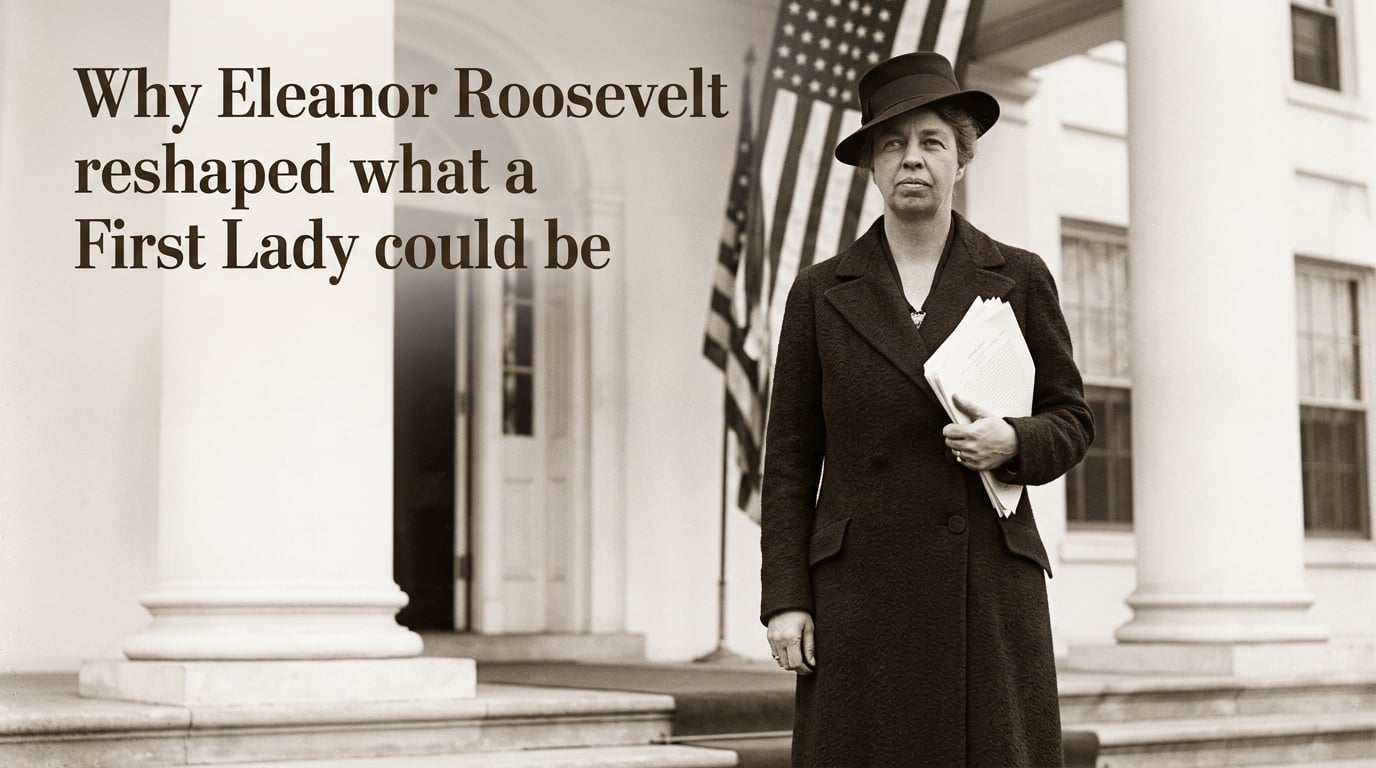
When Eleanor Roosevelt stepped into the White House in March 1933, the role of First Lady was largely ceremonial. By the time she left in April 1945, she had rewritten the job description forever. Eleanor Roosevelt reshaped what a First Lady could be by turning a social position into a platform for civil rights advocacy, women’s rights, and human rights on a global scale.
As the longest-serving First Lady of the United States during two of the most difficult decades in modern history, she held her own press conferences, traveled to war zones, wrote a daily newspaper column, and helped draft the Universal Declaration of Human Rights. Her work still influences how Americans understand the office of First Lady today.
Table of Contents
How Eleanor Roosevelt Changed the First Lady’s Role
Eleanor Roosevelt transformed the First Lady role from a ceremonial hosting position into an active policy and advocacy role. Before her tenure, presidential wives were expected to manage the social calendar of the White House and little else. Eleanor refused that narrow definition.
She used her position to influence public opinion, lobby members of Franklin D. Roosevelt’s cabinet, and represent constituencies that the president himself could not openly champion. Her transformation made the First Lady a political actor in her own right rather than a symbol of her husband.
Many historians trace this shift directly to Eleanor’s own sense of obligation. She had promised Louis Howe, FDR’s longtime political adviser, that she would keep the president’s mind on people who were struggling. She carried that promise into every room she entered from 1933 to 1945.
The Traditional Role She Inherited
Earlier First Ladies such as Lou Henry Hoover and Grace Coolidge largely followed a script of teas, dinners, and patronage of the arts. Their public influence came through quiet diplomacy, not direct advocacy. The First Lady was expected to remain above political fray.
Eleanor rejected that script almost immediately. When First Lady, she testified before Congress, wrote a syndicated column, and lent her name to political causes. She was, in many ways, the first presidential spouse to operate as a public figure with her own agenda.
Press Conferences for Women Journalists: Breaking a Barrier
One of Eleanor Roosevelt’s most lasting innovations was opening White House press conferences to women journalists only. Beginning in 1933, she held 348 press conferences restricted to female reporters, a move that gave women in journalism access they had never had.
The rule came from practical necessity. White House male reporters at the time refused to cover a First Lady. By limiting the audience to women, Eleanor guaranteed coverage and forced newspaper editors to hire or promote female correspondents just to keep up with her.
The result was a measurable expansion of women’s roles in American media. Many of the women who covered Eleanor went on to senior editorial positions at major newspapers. Decades later, historians credit her with helping to break one of the toughest glass ceilings in mid-twentieth-century journalism.
The Lasting Impact on Women in the Press
Eleanor ended the women-only rule in 1939 once the major papers had hired women reporters as a routine matter. By then, the principle that a First Lady could command serious press coverage had been established. She continued holding regular press conferences for both men and women until she left the White House.
Eleanor Everywhere: Travel and Advocacy During the Depression and WWII
Press coverage of Eleanor Roosevelt during her twelve years in the White House earned her the nickname Eleanor Everywhere. She logged more than 40,000 miles of travel in 1934 alone, inspecting New Deal work relief programs, visiting coal miners, and meeting with rural Americans who had been hardest hit by the Great Depression.
Her travel served a clear strategic purpose. Because Franklin D. Roosevelt could not leave Washington easily, Eleanor became his eyes and ears. She reported back on conditions in Appalachian mining towns, sharecropper communities in the South, and migrant worker camps in California. Many of the changes she recommended found their way into New Deal policy.
The 1943 Pacific Tour and Wartime Diplomacy
Eleanor’s most ambitious wartime journey came in August 1943, when she became the first First Lady to visit a combat zone. Her 25,000-mile tour of the South Pacific took her to military hospitals, troop camps, and battlefield memorials across Australia, New Zealand, and several islands.
She visited wounded soldiers, distributed supplies, and reported on morale and conditions. The trip also exposed her to the realities of segregation in the U.S. military, an experience that hardened her commitment to civil rights. She later used her standing as First Lady to push the War Department to integrate officer training programs and equalize treatment of Black troops.
During the war, Eleanor also became the first American president’s wife to address a national party convention on her own. She spoke at the 1940 Democratic National Convention in support of admitting Black delegates from the South, a step the party had long resisted.
Civil Rights Advocacy: Marian Anderson and the Lincoln Memorial
Few episodes capture Eleanor Roosevelt’s moral courage better than her stand on Marian Anderson. In 1939, the Daughters of the American Revolution refused to let the celebrated African American contralto sing at Constitution Hall in Washington. The DAR was a private organization, but its decision was national news.
Eleanor responded by publicly resigning from the DAR and helping to arrange an alternative concert at the Lincoln Memorial on Easter Sunday, 1939. The performance drew an integrated crowd of 75,000 people on the steps of the memorial and a radio audience of millions.
A Lifelong Anti-Racism Commitment
The Anderson episode was not an isolated gesture. Eleanor had been pushing the Roosevelt administration on civil rights since the early New Deal years. She supported the antilynching campaign, backed the 1944 GI Bill provisions that opened higher education to Black veterans, and worked with A. Philip Randolph on the threat of a March on Washington that led to Executive Order 8802 banning discrimination in defense industries.
She also used her public platform to call out racism directly. When a senator from Mississippi tried to block Black reporters from Senate press galleries, she wrote in My Day that the incident showed a continued attempt to deny basic American rights to a whole group of citizens.
My Day: Speaking Directly to the American Public
From 1935 to 1962, Eleanor Roosevelt wrote a newspaper column called My Day, six days a week, reaching an estimated four million readers at its peak. The column covered everything from family memories and recipes to war policy and the Universal Declaration of Human Rights.
My Day was revolutionary because it treated American readers as intelligent adults who could handle a First Lady’s honest opinions. She used the column to argue for civil rights, to defend Social Security, and to push back against isolationism in the late 1930s. She also used it to confess her own mistakes, which was rare for a public figure of her era.
A Direct Line to the Public
My Day allowed Eleanor to maintain a personal relationship with the public that bypassed traditional gatekeepers. Editors and columnists often disagreed with her politics, but they could not ignore the audience she had built. The column’s influence was so great that the FBI kept a file on it for years, watching for any sign of subversive content.
More than any other single tool, My Day made Eleanor Roosevelt the first modern First Lady. It was her own medium, on her own schedule, reaching the American people directly.
Beyond the White House: Human Rights and Lasting Legacy
Eleanor Roosevelt’s transformation of the First Lady role did not end when she left the White House. In December 1945, President Harry Truman appointed her as a delegate to the newly formed United Nations. She became the first chair of the UN Commission on Human Rights, the body that drafted the Universal Declaration of Human Rights, adopted in Paris in December 1948.
The Declaration’s opening language, that recognition of the inherent dignity and of the equal and inalienable rights of all members of the human family is the foundation of freedom, justice, and peace in the world, owes much to her drafting and editing.
Influence on Subsequent First Ladies
Every modern First Lady who has used the office as a platform owes a debt to Eleanor Roosevelt. Lady Bird Johnson’s environmental work, Nancy Reagan’s Just Say No campaign, Hillary Clinton’s policy advocacy, Michelle Obama’s healthy eating initiatives, and Jill Biden’s continuation of teaching all build on the path Eleanor carved.
So does the rise of presidential daughters and sisters who take on public roles of their own. The expectation that a presidential family member can be a political actor rather than a backdrop is something Eleanor Roosevelt established by example.
Historians consistently rank her among the most influential First Ladies in American history. In a 2014 Siena College survey of presidential scholars, she was named the most influential First Lady of the twentieth century, ahead of Jacqueline Kennedy, Eleanor’s closest competitor.
Frequently Asked Questions About Eleanor Roosevelt’s Transformation of the First Lady Role
How did Eleanor Roosevelt change the First Lady’s role?
Eleanor Roosevelt turned the First Lady’s role from a ceremonial hosting position into a platform for political action. She held her own press conferences, traveled to inspect government programs, publicly advocated for civil rights and human rights, and wrote a daily newspaper column called My Day. She proved that the spouse of a president could be an independent political voice.
Why was Eleanor Roosevelt criticized?
Eleanor Roosevelt was criticized by political opponents, traditionalists, and the press for being too outspoken. Her public stands on civil rights, her 1939 resignation from the Daughters of the American Revolution over the Marian Anderson incident, and her support for labor unions and the New Deal all drew sharp attacks. Critics also questioned her personal life and accused her of overstepping the traditional boundaries of the First Lady role.
What did Eleanor Roosevelt do as First Lady?
As First Lady from 1933 to 1945, Eleanor Roosevelt held 348 press conferences for women journalists, traveled more than 40,000 miles in a single year to inspect New Deal programs, wrote the My Day newspaper column, advocated for civil rights and anti-lynching legislation, visited wounded soldiers in the South Pacific during WWII, and used her platform to push for women’s rights and labor protections.
Why is Eleanor Roosevelt important to history?
Eleanor Roosevelt is important to history because she redefined the First Lady role and helped shape modern human rights. She chaired the UN Commission on Human Rights that drafted the Universal Declaration of Human Rights in 1948. She was also a leading American voice for civil rights during the New Deal and World War II eras, decades before the modern civil rights movement gained mainstream support.
How did Eleanor Roosevelt’s activism influence later First Ladies?
Eleanor Roosevelt’s activism established the template that later First Ladies built on. Her willingness to take public positions on policy made it acceptable for Lady Bird Johnson to campaign for the Highway Beautification Act, for Hillary Clinton to lead health care reform efforts, and for Michelle Obama to focus on childhood obesity. Every modern First Lady who has used the office as an advocacy platform stands on the ground Eleanor cleared.
The Lasting Transformation Eleanor Roosevelt Left Behind
Why Eleanor Roosevelt reshaped what a First Lady could be comes down to a simple but powerful choice. She refused to be a background figure in her husband’s administration and built a public role of her own. The press conferences, the travels, the column, the resignation from the DAR, and the work on the Universal Declaration of Human Rights all added up to something Americans had never seen before, a First Lady with her own political voice.
Her legacy is not a single policy or a single speech. It is the standard that the office of the First Lady is now expected to do more than host teas. Every modern First Lady who has championed a cause, traveled on a mission, or written a column stands on the path Eleanor Roosevelt cleared during the era of the Great Depression and the Second World War.