
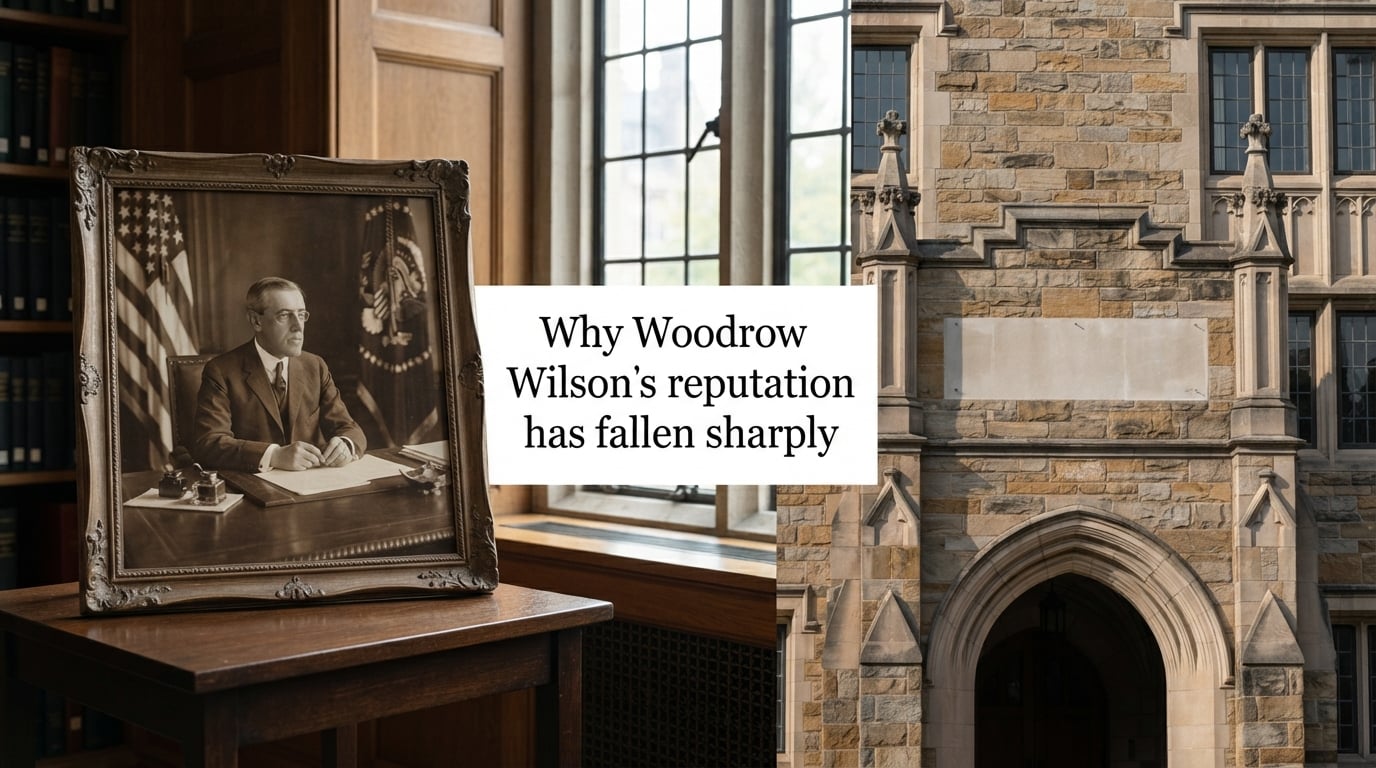
Woodrow Wilson’s reputation has fallen sharply because historians, students, and the broader public rediscovered his deep-seated racism, his role in segregating the federal government, and his sweeping suppression of civil liberties during World War I.
Once ranked among the top ten U.S. presidents by major historian surveys, Wilson now sits near the middle of the pack, with several recent polls placing him outside the top twenty. I have spent the past several weeks reading through Wilson scholarship from across the political spectrum, and the same three themes keep surfacing: segregation, censorship, and the collapse of his post-war vision for peace.
This article walks through each of those themes. I will cover what Wilson actually did, what his own writings reveal, how his reputation shifted decade by decade, and why both conservative and liberal critics now agree that the 28th president deserves a far harsher verdict than he once received. The goal is a complete picture, not a hit piece, because Wilson’s accomplishments were real even as his failures were devastating.
Table of Contents
Who Was Woodrow Wilson and Why Was He Once Highly Ranked
Woodrow Wilson was the 28th president of the United States, serving from 1913 to 1921, and he once enjoyed an unusually strong reputation among historians and political scientists.
Wilson came to the White House from the presidency of Princeton University, where he had tried and failed to reshape undergraduate life around a residential college model. He was elected governor of New Jersey in 1910 on a reform platform, and then won the presidency in 1912 as a compromise candidate after a split in the Republican Party.
During his first term, Wilson signed into law some of the most ambitious reforms of the Progressive Era. The Federal Reserve Act of 1913 created the modern central banking system. The Clayton Antitrust Act of 1914 strengthened rules against monopolies. The Federal Trade Commission Act of 1914 created the FTC itself, and the Federal Farm Loan Act of 1916 extended credit to farmers at reasonable rates.
Wilson’s first-term record helped him win re-election in 1916 with the slogan “He kept us out of war.” The historian surveys of the mid-20th century, particularly the Schlesinger rankings and the Siena College survey, repeatedly placed him in the upper tier of presidents. That high standing is precisely what makes his current fall so dramatic.
Wilson’s Path From Princeton to the Presidency
Wilson’s academic and political trajectory was unusually fast for a man with no executive experience before 1910.
Born in Virginia in 1856 to a Presbyterian family with deep Confederate roots, Wilson spent most of his career as a political science professor before becoming president of Princeton in 1902. His academic writings, especially Congressional Government (1885) and The State (1889), made him a leading voice on constitutional reform.
Wilson’s Racist Policies and Segregation of the Federal Government
Wilson’s record on race is the single biggest reason his reputation has fallen sharply, and it is also the area where his personal views, his policy choices, and his public actions align most damningly.
Within months of taking office, Wilson began rolling back the modest integration that had existed in federal agencies under previous administrations. Cabinet departments re-segregated their restrooms, cafeterias, and work spaces. Black federal employees in Washington were dismissed or downgraded, and hiring for new positions became explicitly racial again.
The man who directed much of this change was Wilson’s Postmaster General, Albert Burleson, who personally segregated the railway mail service. Treasury Secretary William McAdoo segregated the Bureau of Engraving and Printing and the Treasury building itself. Wilson did not merely tolerate these moves. He endorsed them in private correspondence and defended them in Cabinet meetings.
Birth of a Nation at the White House
One specific event has come to symbolize Wilson’s racial views more than any other: the White House screening of The Birth of a Nation in February 1915.
D.W. Griffith’s film was a three-hour celebration of the Ku Klux Klan and a vicious distortion of Reconstruction. Wilson reportedly told friends that the film was “like writing history with lightning.” Whether or not he used those exact words, the screening itself is documented, and his administration’s endorsement helped the film become a mainstream success.
Critics across the political spectrum now point to this screening as a moment when Wilson chose to validate white supremacist mythology from the highest office in the land.
Wilson’s Published Views and Personal Writings
The screening was not an isolated lapse. Wilson’s own academic writings show a pattern of white supremacist thought that long predated his presidency.
In A History of the American People (1902), Wilson described Reconstruction as a period when “the negroes were deriving a great deal of benefit from the new conditions” while “the white men” suffered. He praised the Klan as a force for restoration of “civilized government.” He wrote approvingly of efforts to keep Black Americans from voting.
His doctoral dissertation at Johns Hopkins, Congressional Government, contains similar language, and his public speeches as president repeatedly used the language of “civilization” to defend Western expansion and racial hierarchy. These writings matter because they show that Wilson’s racial views were not improvised for political purposes. They were central to his worldview from early adulthood.
Suppression of Civil Liberties During World War I
Wilson’s record on civil liberties during World War I is the second major reason his reputation has fallen sharply, and it is an area where the long-term damage to American law is still debated.
Two pieces of legislation define this chapter. The Espionage Act of 1917 made it a crime to obstruct military recruitment or to support enemies of the United States during wartime. The Sedition Act of 1918 went further, criminalizing any speech deemed “disloyal, profane, scurrilous, or abusive” about the U.S. government, the flag, or the armed forces.
Notable Prosecutions and Cases
The Wilson administration used these statutes aggressively. Socialist leader Eugene V. Debs was sentenced to ten years in prison for a speech that simply encouraged resistance to the draft. He ran for president from his prison cell in 1920 and received nearly one million votes.
Charles Schenck, a Socialist Party official, was convicted under the Espionage Act for distributing leaflets opposing the draft. The Supreme Court upheld his conviction unanimously in Schenck v. United States (1919), producing the famous phrase about shouting “fire” in a crowded theater.
Journalists, labor organizers, antiwar ministers, and German-language newspaper editors were all targeted. The postmaster general revoked mailing privileges for publications deemed disloyal. For a man who won a Nobel Peace Prize in 1919, the domestic repression of those years is a striking contradiction.
Long-Term Impact on Free Speech Doctrine
The legal architecture that Wilson helped build did not vanish after the war. Schenck remained good law until 1969, when the Supreme Court finally narrowed it in Brandenburg v. Ohio.
Justice Oliver Wendell Holmes dissented in Abrams v. United States (1919), warning about the “marketplace of ideas” and government censorship. That dissent, not the Wilson-era majority, eventually carried the day. But for half a century, the wartime precedents gave federal prosecutors wide latitude to punish speech they disliked.
The League of Nations Failure and Its Long Shadow
The collapse of the League of Nations is the third major reason Woodrow Wilson’s reputation has fallen sharply, and it is a failure Wilson largely inflicted on himself.
Wilson had championed the League as the centerpiece of his Fourteen Points, the post-war peace framework he unveiled in January 1918. He took personal control of the American delegation to the Paris Peace Conference in 1919, despite suffering what historians believe was the beginning of a series of strokes.
When Wilson returned home with the Treaty of Versailles in hand, he refused to compromise with Senate Republicans who wanted modifications. Senator Henry Cabot Lodge led the opposition, and Wilson took his case directly to the American people on a cross-country speaking tour.
The Stroke and the Senate Vote
That tour broke Wilson physically. He suffered a major stroke in October 1919 that left the left side of his body paralyzed and impaired his judgment for the remaining seventeen months of his presidency. His wife and his physician, Dr. Cary Grayson, effectively shielded the country from the full extent of his disability.
The Senate never ratified the Treaty of Versailles, the United States never joined the League, and Wilson’s vision of a cooperative post-war order died with that vote in November 1919. Historians still debate whether a more flexible negotiator could have saved the League in some form. Wilson’s rigidity is the dominant explanation.
The League itself proved weak without American participation. It could not stop Japanese expansion in Manchuria, Italian aggression in Ethiopia, or the steady march toward World War II. Many of the Wilson-era institutions had to be reinvented after 1945 under American leadership, this time with the United Nations.
How Wilson’s Reputation Changed Across Each Decade
Wilson’s reputation did not collapse overnight. It eroded slowly, then fell off a cliff in the past five years.
Through the 1940s and 1950s, most mainstream histories treated Wilson as a great reforming president whose idealism had been frustrated by the Senate and his own health. The civil rights movement of the 1960s did not yet focus on Wilson, and segregationist Southern historians continued to praise him into the 1970s.
The first major reassessment came in the 1980s and 1990s. Black historians such as John Hope Franklin and August Meier documented Wilson’s record on federal segregation in detail. David W. Southern’s The Malignant Heritage (1999) examined Wilson’s intervention in Haiti and the long-term damage of those occupation policies.
The 2020 Turning Point
The 2020 racial reckoning, sparked by the murder of George Floyd, brought Wilson’s record into the open in a way it had never been before.
In June 2020, Princeton University’s Board of Trustees voted to remove Wilson’s name from the School of Public and International Affairs, reversing an earlier decision. The school was renamed the Princeton School of Public and International Affairs.
That same year, Monmouth University in New Jersey removed Wilson’s name from one of its buildings. Cities and public schools across the country began debating similar decisions. Wilson went from being a respected presidential portrait on classroom walls to a contested figure almost overnight.
By the time the C-SPAN historians survey of 2021 was released, Wilson had dropped from sixth place to nineteenth, the largest single-decade fall in that survey’s history.
Conservative and Liberal Criticisms of Woodrow Wilson
One of the more unusual features of Wilson’s fall is that both conservative and liberal critics now make similar arguments about him, even though they reach those arguments from different starting points.
Conservative critics led the modern reassessment. Glenn Beck’s The Original Argument (2011) and the Cato Institute’s 2014 essay on Wilson’s “Great Mistake” framed him as an arrogant progressive who wrecked the American century. Critics like Beck argued that Wilson expanded executive power beyond the Constitution and that his racial views were the predictable result of his elitism.
Liberal and Left-Wing Critiques
Liberal and left-wing critics have focused more on race and class. The Jacobin magazine essay “Don’t Be So Quick to Laud Woodrow Wilson” argued that Wilson’s technocratic progressivism was always hostile to mass democracy and that his racism was inseparable from his elitism.
Civil rights historians pointed out that Wilson’s progressivism excluded Black Americans by design. The Federal Reserve system Wilson created had no Black bankers in leadership. The Federal Trade Commission did not include a single Black commissioner during his tenure. The labor protections he championed often excluded Black workers.
Common Ground Between the Two Sides
Both groups now agree on several basic facts. Wilson was a committed white supremacist who acted on those views in office. He expanded federal power in ways that the Founders would not have recognized. He suppressed dissent during wartime in ways that harmed American civil liberties for decades. He failed in his central post-war goal of building a peaceful international order.
Where they disagree is on what to do with Wilson’s Progressive Era accomplishments. Some conservatives would scrap the Federal Reserve entirely. Some left-wing critics would nationalize it. But almost nobody on the political spectrum now defends Wilson as a straightforwardly great president.
Frequently Asked Questions About Woodrow Wilson’s Reputation
What was the issue with Woodrow Wilson?
The main issue with Woodrow Wilson was his deep-seated racism, which he translated into policy by segregating federal agencies, screening Birth of a Nation at the White House, and defending white supremacist views in his academic writings. He also used the Espionage and Sedition Acts to jail Americans who opposed World War I.
What mistakes did Woodrow Wilson make?
Wilson’s biggest mistakes were segregating the federal government, screening Birth of a Nation at the White House, signing the Espionage and Sedition Acts that suppressed free speech, and refusing to compromise with the Senate over the League of Nations. Each of these decisions caused damage that lasted for decades.
Why did Woodrow Wilson get canceled?
Princeton University removed Wilson’s name from its School of Public and International Affairs in 2026 after years of student activism over his segregation policies. That decision, along with similar moves at other institutions and his sharp fall in the C-SPAN historians survey, marked the moment when Wilson’s reputation was broadly reassessed.
Was Woodrow Wilson considered a good president?
Wilson was considered a good president for most of the twentieth century, ranking as high as sixth in the C-SPAN historians survey. By 2021 he had fallen to nineteenth, and most historians now rate him as average or below average because his racial policies and civil liberties record outweigh his Progressive Era accomplishments.
The Lessons From Wilson’s Fall
Woodrow Wilson’s reputation has fallen sharply because modern audiences finally weighed his full record, including the racism, segregation, censorship, and personal arrogance that earlier historians tended to soften.
His Progressive Era accomplishments were real. The Federal Reserve, the Federal Trade Commission, the Clayton Antitrust Act, and the graduated income tax are still part of the American system. But those accomplishments no longer outweigh his segregation of the federal government, his White House screening of The Birth of a Nation, his imprisonment of Eugene Debs, and his stubbornness that killed the League of Nations.
The lesson is not that the Founders got everything right, or that the progressive tradition is worthless. The lesson is that great institutions can be built by flawed people, and that a full accounting requires reading the record honestly. As we move through 2026, Wilson’s name on buildings, schools, and monuments will continue to be debated, and that debate is healthy. It is how a democracy keeps its history honest.
If you want to dig deeper, start with The History of the American People by Wilson himself, which lays bare his racial views in his own words. Pair that with John Milton Cooper Jr.’s biography The Warrior and the Priest for a balanced portrait, and David W. Southern’s The Malignant Heritage for the foreign policy critique. Together, those three books give you the case for and against Wilson without the spin.