
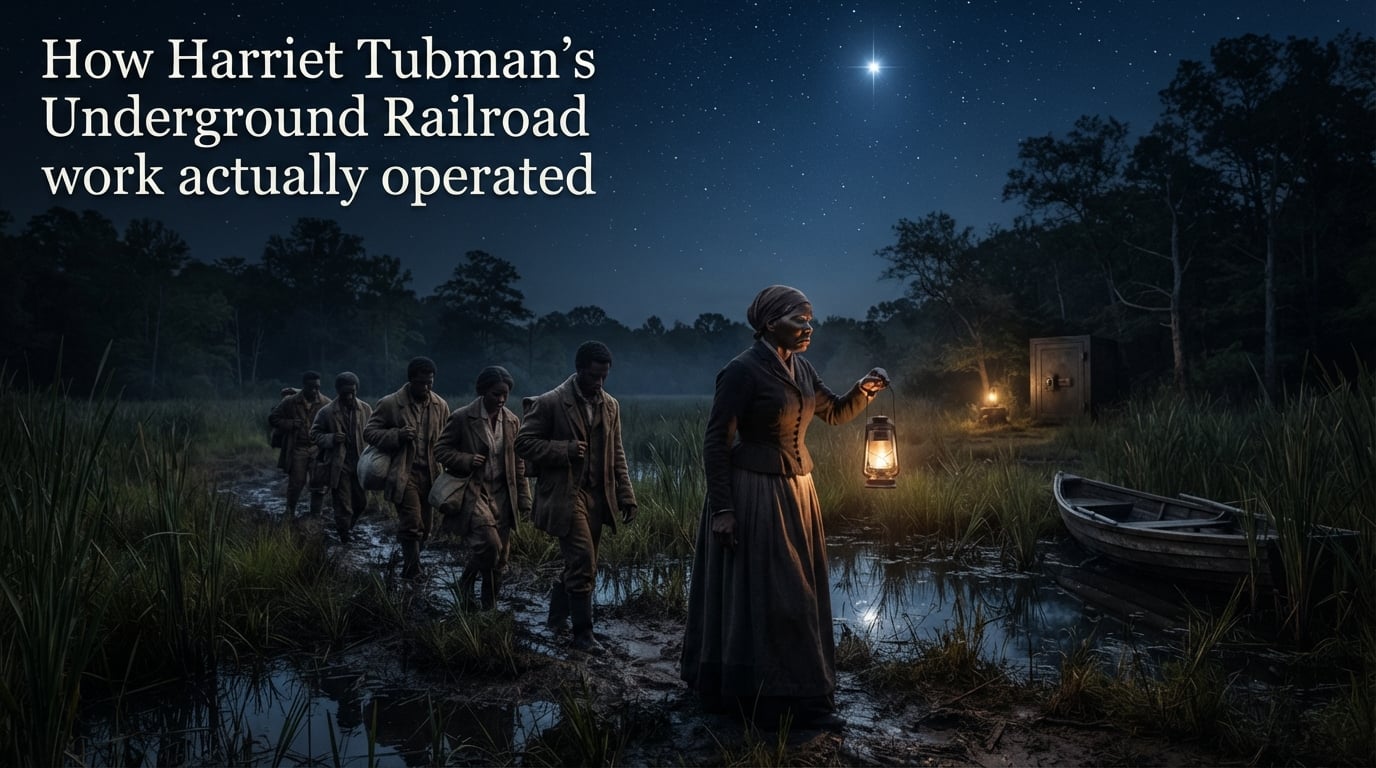
When I first looked into how Harriet Tubman’s Underground Railroad work actually operated, I expected Hollywood legends. What I found was stranger, harder, and more impressive than any movie: a one-eyed woman with a pistol, a hymnal, and a working knowledge of Maryland marshes who smuggled roughly 70 people north through the antebellum South, and never lost a single passenger she was personally guiding.
Most articles skip over the mechanics. They tell you she was a “conductor” on the “Underground Railroad” and leave it there. I’m going to fill that gap. In this guide, I will walk you through exactly how the Harriet Tubman Underground Railroad operation functioned: the network of antislavery activists, the safe houses, the coded communications, the routes through the marshlands of Dorchester County, Maryland, and the methods she used to never get caught.
You will also see the myths many sites still repeat, including the opium claim and the $20 bill story, separated from what historians actually verify. By the end, you will understand not just who Harriet Tubman was, but how her Underground Railroad machine actually moved human beings out of bondage, why the Fugitive Slave Act of 1850 changed everything, and how her methods translated into military service during the Civil War.
Table of Contents
From Araminta Ross to Harriet Tubman: Her Early Life in Bondage
Harriet Tubman was born Araminta “Minty” Ross around 1822 on the Anthony Thompson plantation in Dorchester County, Maryland, on the Eastern Shore. Her childhood gave her almost everything she would later need to run the Underground Railroad. Understanding her early life is the key to understanding how she later operated, because her skills as a conductor came directly from her life in bondage.
Dorchester County sits south of the Mason-Dixon line, surrounded by the Chesapeake Bay’s tidal marshes. Tubman worked the timber fields, hauled logs, drove oxen, plowed the heavy clay soil, and helped her father Ben Ross cut wood at Stewart’s Canal just outside today’s Blackwater National Wildlife Refuge. She learned to read water, swampland, weather signs, and the stars at night. That same marshland expertise would later save dozens of lives as she guided freedom seekers through territory slave catchers could not cross on horseback.
Around age 13, an overseer threw a two-pound iron weight at another enslaved person and hit Tubman in the head. The injury caused lifelong narcolepsy, severe headaches, and visionary spells. Decades later, she told interviewers that God spoke to her in those visions, and that she followed them as a divine map. She carried that interpretation of divine guidance for the rest of her life, and it became fuel for her antislavery work.
She married John Tubman, a free Black man, around 1844, and took his first name. Around the same time, her owner Edward Brodess began renting her out to neighboring farms and timber camps. The brutal labor she performed as a child and teenager left her small, scarred, and hardened. She could outwork many men on the timber crew, and she could navigate the waterways by memory. Those skills were both practical and spiritual preparation for what came next.
After Brodess died in 1849, Tubman learned that her three brothers were about to be sold south to the Deep South, where conditions were even worse and family separation was permanent. She refused to watch. On September 17, 1849, she escaped alone, using the North Star and help from the Underground Railroad network, and walked roughly 90 miles to Philadelphia. Her brothers chose to turn back. She never would.
Once she reached Philadelphia, she worked as a domestic and a hotel cook, saving every spare dollar. She also connected with abolitionist networks, particularly William Still, who ran the Philadelphia Vigilance Committee. It was Still who urged her in 1850 to return to Maryland and bring her family north. That single decision turned Harriet Tubman from a runaway into a conductor, and her Underground Railroad operation grew from there.
How the Harriet Tubman Underground Railroad Actually Operated
The Underground Railroad was not a railroad. It was not underground. There were no tracks or tunnels, and the “stations” were ordinary homes, barns, churches, and shops run by antislavery activists. Harriet Tubman’s Underground Railroad work operated inside this informal network, and she became its most famous conductor between roughly 1850 and 1860.
Here is how the network actually functioned during the 1850s:
- Conductors were the guides who traveled into the slave states to lead freedom seekers north. Tubman was one of them, and she is widely credited with personally conducting roughly 70 people out of bondage across about 13 missions.
- Stationmasters ran the safe houses. Many were formerly enslaved people themselves, like William Still in Philadelphia, who kept careful records and helped reunite families after freedom.
- Sympathizers and financiers opened their homes, churches, and businesses as stations along the route. Quakers, Methodists, Baptists, and free Black communities in places like Wilmington, Delaware, and Carlisle, Pennsylvania, were the backbone of the network.
- Routes zigzagged north to avoid patrols. Most Eastern Shore escapees moved through Delaware, into Pennsylvania, then up to New York, Buffalo, and onward to Canada. Some went by boat on the Chesapeake Bay, some on foot through forests, and some hidden in wagons carrying farm goods.
- Communication relied on whispered messages, trusted messengers, and coded spirituals. Songs like “Steal Away” and “Wade in the Water” reportedly carried double meanings, warning that a conductor was on the way or that a route was being watched by slave catchers.
Tubman did not run this entire system. She contributed to it, expanded it, and risked her life inside it. Between roughly 1850 and 1860, she returned to Maryland at least 13 times. She moved family members, friends, and complete strangers. The Library of Congress notes that on one trip she indirectly helped 44 people escape by giving detailed written and verbal instructions to a group brave enough to make the journey without her personal guidance.
Her operations centered on the Dorchester County plantations, the marshlands of the Choptank River, and the crossings into Delaware. She knew the swamp paths, the oyster boats, the crossing points on the Choptank, and the safe cabins. That local knowledge is what made her different from most other conductors, who operated only outside the slave states. Tubman willingly re-entered the most dangerous territory to retrieve the people she loved and the strangers who trusted her.
Her base during this period split between two locations. In Philadelphia, she worked with William Still and the Vigilance Committee. In St. Catharines, Ontario, she lived part of the year after the Fugitive Slave Act made even northern freedom unsafe. That dual residence became a key part of how her Underground Railroad operation actually operated: she could move people from Maryland to either Pennsylvania or Canada, depending on the political weather of the moment.
She also recruited allies along the way. Frederick Douglass sheltered her and, despite his own reservations about returning south, helped fund some of her missions. John Brown met her in 1858 and recruited her to help plan his raid on Harpers Ferry. The Quaker abolitionist Thomas Garrett in Wilmington, Delaware, opened his home to hundreds of escapees, and Tubman used his station frequently. None of these people operated alone. The Harriet Tubman Underground Railroad operation was, by definition, a team effort.
The Methods She Used to Never Lose a Passenger
How did Harriet Tubman not get caught, and how did she keep the people she led out of trouble? Historians have pieced together a clear picture from interviews she gave near the end of her life, particularly through her conversations with Sarah Bradford, who wrote the first Tubman biography in 1869.
She traveled at night and hid by day. Tubman moved freedom seekers on Saturdays, because runaway notices could not be posted in newspapers until Monday. That gave her a 24-hour head start before slave catchers even learned who had escaped.
She used the landscape. The Dorchester County marshes, the Blackwater Refuge, and the Parson Creek area were riddled with paths too soft for horses and too remote for white patrols. She had worked these swamps since childhood. When bloodhounds were brought in, Tubman would carry bags of raw onions to throw off the scent, a trick she reportedly learned from her father.
She used spirituals as code. Songs like “Steal Away to Jesus” and “Swing Low, Sweet Chariot” carried coded messages. A particular verse meant she had arrived. Another meant a route was unsafe. Freedom seekers used them to recognize friends without alerting slave catchers, and they also functioned as emotional reassurance on a terrifying journey.
She carried a pistol. Tubman told Bradford that she threatened to shoot any freedom seeker who tried to turn back, because turning back endangered the entire group. She also threatened anyone who wanted to give up, faint, or complain loudly. The pistol was also a defensive weapon against slave catchers and their dogs. The famous photo of her holding a pistol in later life is a direct visual echo of this practice.
She used drugs on small children, but not the way most retellings claim. This is the myth worth correcting. Tubman did sometimes give paregoric, a tincture of opium, to infants and small children to keep them quiet during dangerous passages. But this was not routine drugging. It was a calculated, last-resort strategy used on babies who would have given the whole group away by crying during a swamp crossing or a midnight walk past a plantation. It does not compare to modern opioid addiction, and it was not applied to adults. The historical record does not support the more dramatic version of this claim repeated on some social media posts.
She changed her appearance and used disguises. She sometimes dressed as an old man, sometimes as a free Black woman with a written pass from a northern white employer. She altered her gait, her voice, and her name depending on the town. She carried a copy of her husband’s free papers, which she used as identification to pass through checkpoints.
She had a complete escape manual in her head. She carried the Fugitive Slave Act of 1850 backwards and forwards in her memory, knew which stations were still safe, and could adapt a route on the fly when slave catchers were spotted. She knew which river crossings were shallow, which swamps would hide footprints, and which farms would shelter a tired child.
She built and maintained personal relationships with conductors. She did not operate in isolation. She relied on a network of mostly Black helpers, many of them women, who fed her, hid her, and passed information. Without those local contacts, none of her escapes would have worked.
Her record is striking. She made roughly 13 missions and personally guided about 70 people to freedom. She never lost a passenger on a trip she led. Even her famous quote, “I was the conductor of the Underground Railroad for eight years, and I can say what most conductors can’t say — I never ran my train off the track and I never lost a passenger,” captures that perfect record.
The Fugitive Slave Act of 1850 and the Push North to Canada
The mechanics of the Underground Railroad changed dramatically after 1850. The Fugitive Slave Act, passed as part of the Compromise of 1850, made it a federal crime to help anyone escape slavery. It also forced northern citizens to help capture runaways or face fines and imprisonment. It denied accused freedom seekers the right to a jury trial or the right to testify on their own behalf.
That law effectively ended the safe haven of Pennsylvania. Even northern states like New York and Massachusetts now had to return freedom seekers to their owners. Tubman recognized this immediately. She redirected many of her later rescue missions to St. Catharines, Ontario, where Canada had no such obligation and no slave catchers could legally operate.
She moved her parents, her brothers, and many others across the Niagara region. About 30,000 freedom seekers ultimately settled in Canada during this period, and St. Catharines became known as one of the key termini of the Underground Railroad. Tubman also recruited John Brown, helped him plan his raid on Harpers Ferry, and recruited Black soldiers for the Union Army when the Civil War broke out.
Her understanding of the law was also tactical. She knew exactly what protections the act still left intact, what counts a federal commissioner could be paid to reject, and what the practical risks were for a particular escapee in a particular town. This kind of operational planning is part of how the Harriet Tubman Underground Railroad network actually operated: legal knowledge, not just moral courage.
Beyond the Railroad: Civil War Spy and the Combahee River Raid
When the Civil War started, Tubman did not retire. She served the Union Army as a nurse, a cook, a spy, and a scout. She worked behind Confederate lines in South Carolina, recruited Black soldiers, and guided Union Colonel James Montgomery’s forces. She was also active in supporting formerly enslaved people in Union-controlled territory, helping set up schools and hospitals.
On June 1, 1863, she helped plan and participated in the Combahee River Raid. Union ships moved up the Combahee River in South Carolina and evacuated enslaved people from surrounding plantations. Tubman’s intelligence about Confederate mines, patrol locations, and the layout of the rice plantations made the raid possible. The operation destroyed Confederate supplies and liberated more than 700 enslaved people, more than she had freed in nearly a decade of Underground Railroad work combined.
She led a Black regiment, the 2nd Carolina Colored Infantry, into battle near Fort Wagner. She later became one of the first women in American history to lead an armed military expedition. After the war, she settled in Auburn, New York, where she had bought property before the war. She spent her later years fighting for women’s suffrage, caring for family members, and pushing for a military pension that took decades to arrive. She received only a small widow’s pension for many years, and her cause was taken up by suffragists who saw the injustice of her treatment.
She died on March 10, 1913, leaving behind a legacy that generations of Americans still study.
Frequently Asked Questions About Harriet Tubman and the Underground Railroad
Did Harriet Tubman actually run the Underground Railroad?
Harriet Tubman did not run the entire Underground Railroad. She was one of its most famous conductors, personally guiding roughly 70 people out of bondage across about 13 missions between 1850 and 1860. The Underground Railroad was a decentralized network of thousands of antislavery activists, not a single organization.
How did the Underground Railroad actually work?
The Underground Railroad worked as a secret network of safe houses, called stations, run by abolitionists, free Black families, and Quaker congregations. Conductors like Harriet Tubman led freedom seekers north at night, often 10 to 20 miles at a time, between stations. They used coded spirituals, written notes, and trusted messengers to communicate. Routes typically ended in Pennsylvania, New York, or, after the Fugitive Slave Act of 1850, Canada.
Did Harriet Tubman ever get caught on the Underground Railroad?
No. Harriet Tubman was never captured during any of her roughly 13 rescue missions. She evaded slave catchers, bloodhounds, and patrols by traveling at night, using the marshlands, and changing her appearance. Her family and several passengers were caught at other times, but Tubman herself was never reintroduced into slavery.
How did Harriet not get caught?
Harriet Tubman avoided capture through several methods: she traveled on Saturday nights so notices could not be posted until Monday, moved through Dorchester County marshes, used coded spirituals as signals, carried a pistol for protection, dressed in disguises, and built an extensive mental map of safe houses and routes. She also relied on a network of antislavery contacts who warned her of patrols.
How many slaves did Harriet Tubman free?
Historians estimate that Harriet Tubman personally freed approximately 70 people across about 13 missions. She also helped rescue or instruct an additional 44 people through the Underground Railroad without personally guiding them. During the Civil War, she helped liberate more than 700 enslaved people during the Combahee River Raid in South Carolina.
Are they still putting Harriet Tubman on the $20 bill?
Plans to put Harriet Tubman on the $20 bill were announced in 2016 under the Obama administration, originally for 2020. The Trump administration in 2019 delayed the redesign, and no Harriet Tubman $20 bill has been put into circulation as of 2026. The initiative remains officially delayed rather than canceled.
What did Harriet Tubman say before she died?
Harriet Tubman’s last reported words in March 1913 were about the location of her family and her home. According to attendants, she said, I go to prepare a place for you. She also reportedly sang one last verse of Go Down Moses shortly before her death at age 93 in Auburn, New York.
The Real Shape of Her Work
The Harriet Tubman Underground Railroad operation was not a single dramatic act. It was a working system of marshland lore, coded spirituals, antislavery activists, safe houses, and ordinary courage, repeatedly applied, mission after mission, year after year.
The framework she built in Maryland, the routes she opened, the families she reconnected, and the networks she strengthened continued to operate through the Civil War. The Combahee River Raid, with more than 700 people freed in a single night, was the same Underground Railroad logic scaled up to military scale.
Next, if you want to dig deeper, visit the Harriet Tubman Underground Railroad National Historical Park in Maryland, read Sarah Bradford’s 1869 biography, or visit the National Museum of African American History and Culture. Then take the lessons of how the Harriet Tubman Underground Railroad actually operated and share them. Many people still cannot separate the myths from the mechanics.