
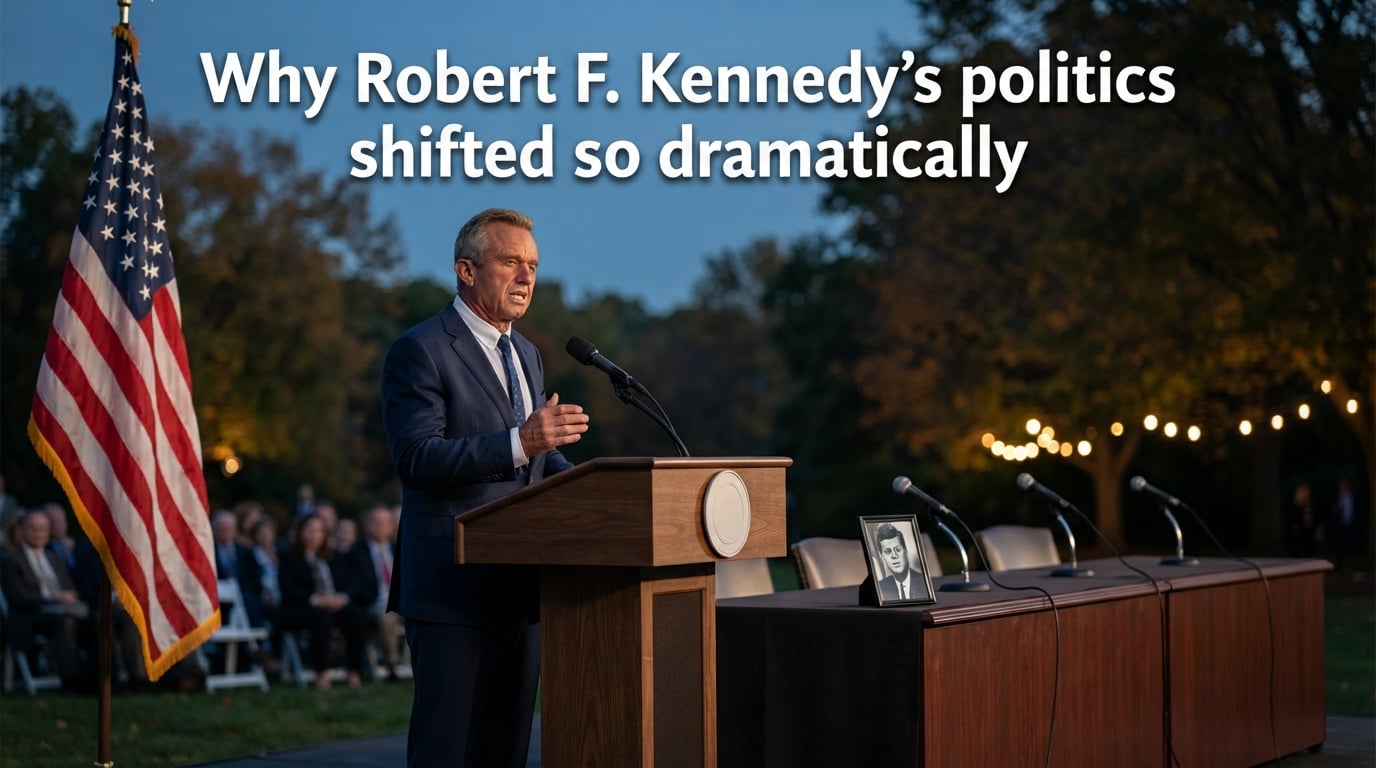
Robert F. Kennedy Jr.’s politics shifted so dramatically because a long-running collision between three forces, his family’s liberal legacy, two decades of environmental legal work against corporate polluters, and increasingly vocal vaccine skepticism, finally broke through the Democratic Party’s tolerance for him by 2023. What had been a tolerated contradiction inside the party became, after COVID-19, a disqualifying one.
I have spent weeks reading primary interviews, court filings, and family statements to map the arc. Below is the clearest picture I can give you of how the heir to one of America’s most famous Democratic dynasties ended up serving in a Republican administration and running the federal Department of Health and Human Services.
This is a story with no single villain. It is the sum of family pressure, persistent litigation against corporations the Democratic Party had come to view as allies, a pandemic that turned a private obsession into a public identity, and a Republican Party that recognized a useful convert when it saw one. Understanding the shift matters because it tells us something about how political coalitions form and break in the modern era.
Table of Contents
Why Robert F. Kennedy Jr.’s Politics Shifted So Dramatically
The short answer: Kennedy’s shift happened gradually over twenty years and then accelerated fast. The Kennedy family name bought him credibility, but it never constrained his positions. By the time he launched a 2024 presidential campaign, his views on vaccines, public health agencies, and corporate power sat well outside Democratic Party orthodoxy. He tried to win as a Democrat, failed, ran as an independent, dropped out, endorsed Donald Trump, and is now HHS Secretary. Each step made sense only if you understood the previous twenty years.
Here is the breakdown of what changed, when, and why.
Before we get into the timeline, one framing point. People often describe Kennedy’s transformation as either a betrayal of his family’s legacy or a principled break with corruption. Both readings flatten a complicated story. The real arc is more interesting: a man with an inherited public service obligation spent decades trying to honor it through environmental litigation, found himself increasingly alienated from the institutions meant to support that work, and finally crossed party lines when those institutions explicitly rejected him.
Early Life and the Kennedy Family Legacy
Robert Francis Kennedy Jr. was born on January 17, 1954, into what Americans still call “Camelot lite.” His father was Senator Robert F. Kennedy, attorney general under JFK and a Democratic icon murdered on the campaign trail in 1968. His uncle was President John F. Kennedy, assassinated in Dallas in 1963. He grew up at Hickory Hill in McLean, Virginia, a house famous for backyard touch football games and relentless political conversation at the dinner table.
Two formative events shaped his sense of family identity before he was a teenager. His uncle was assassinated in 1963, when Bobby Jr. was nine. His father was assassinated in 1968, when he was fourteen. After RFK Sr.’s death, Bobby Jr. lived at Hickory Hill with his mother Ethel and his grandfather, Joseph P. Kennedy, a strict and demanding figure who insisted the family carry its public service obligation forward.
That obligation had a specific political color. For most of the twentieth century, the Kennedy instruction pointed straight at the Democratic Party: civil rights, labor, environmental protection, immigration, and a robust welfare state. Bobby Jr. absorbed the obligation but, as we will see, not always the content. He would carry the family name into every fight of his career, and the name gave him permission to break rules that would have sunk anyone else.
Friends from his Harvard and University of Virginia Law School years recall a young man with a serious streak and a contrarian one. He read widely, argued relentlessly, and bristled at the assumption that he would simply inherit his father’s politics. Those who watched him closely say the seeds of his later independence were already visible in his early twenties.
Hickory Hill itself mattered. The house was a nonstop salon of Democratic politics, civil rights organizing, and anti-war activism. But it was also a place where the children were encouraged to argue back, to challenge adults, to find their own ground. Bobby Jr. took that lesson seriously. He learned that disagreeing with the consensus was not just allowed but expected of a Kennedy, provided the disagreement came from a place of conviction.
Building a Career on the Environment
After Georgetown University and the University of Virginia School of Law, Kennedy joined the environmental group Riverkeeper in 1984. He later served as chief prosecuting attorney for the Hudson Riverkeeper and helped found the Waterkeeper Alliance, an umbrella organization for river and bay keepers around the world. From the mid-1990s onward, he built a national reputation suing polluters, often on the same side as Democratic state attorneys general.
This is where the contradictions begin. His environmental work was, by any measure, progressive. He pushed to clean up the Hudson River, opposed corporate influence in government, and fought the pharmaceutical industry on drug pricing. At the same time, he was publishing articles questioning vaccine safety, starting with a 2005 piece in Rolling Stone and Salon about thimerosal and autism. Both activities were happening inside a Democratic Party identity.
For years, the party looked the other way. Kennedy had powerful friends, a famous name, and a useful adversarial relationship with Big Pharma on environmental issues. Inside that coalition, his vaccine skepticism was treated as a quirky personal view, not a political problem. Democratic candidates still wanted him at fundraisers. Major environmental groups still listed him on advisory boards.
The thing to understand about Kennedy’s environmental career is that it trained him to see large corporations, especially pharmaceutical and chemical companies, as adversaries of the public interest. That adversarial framework would eventually place him in conflict with a Democratic Party that, by the 2010s, had grown comfortable working with those same companies on drug pricing reform, vaccine distribution, and pandemic response.
Kennedy also picked up a second habit from his environmental work that would matter later: a willingness to use litigation as a political tool. He sued General Electric over PCBs in the Hudson. He sued coal companies over emissions. He sued the FDA over drug approvals. Lawsuits were how he pressured institutions, and that instinct carried directly into his later battles with public health agencies.
The First Visible Cracks
The first real signs of strain appeared around 2005 and 2006. Kennedy’s thimerosal article was retracted by Salon in 2011 after multiple factual errors were documented. His 2014 book “Thimerosal: Let the Science Speak” was met with sharp criticism from public health researchers, including his own family. His sister, Kathleen Kennedy Townsend, and his brother, Joseph P. Kennedy II, publicly asked him to stop publicly repeating claims they said were unsupported.
None of that changed his behavior. Kennedy continued speaking at anti-vaccine conferences, donating to groups that challenged vaccine policy, and litigating against state vaccination requirements. This is the period when I think the seeds of the later political break were planted. Kennedy had decided, well before the culture war heated up, that he understood public health better than the agencies charged with running it.
The other piece of this period that often gets missed is Kennedy’s growing distrust of mainstream media. He came to see journalists who questioned his vaccine claims not as skeptics doing their job but as participants in a coordinated campaign to suppress dissent. That distrust would later become a defining feature of his political identity and a major bridge to the MAGA coalition, which had built its own deep skepticism of legacy press.
Through all of this, Kennedy remained a registered Democrat. He still attended party events, donated to Democratic candidates, and spoke the language of environmental justice. But the gap between his private convictions and the party’s public positions was widening every year.
The COVID-19 Turning Point
COVID-19 turned an inconvenient personal view into a national political identity. Between 2020 and 2022, Kennedy became one of the most prominent voices questioning lockdowns, masks, and especially vaccines. He founded Children’s Health Defense, a group dedicated to challenging vaccine mandates and pharmaceutical industry influence.
His book “The Real Anthony Fauci” (2021) spent weeks on bestseller lists. His podcast appearances reached audiences who had never heard of the Kennedy family. By the time the mRNA vaccines were widely available, Kennedy was a fixed feature of the anti-vaccine movement and a target of intense criticism from within the Democratic Party.
This is also when Democratic leaders began openly distancing themselves. Senators, members of Congress, and major donors started saying publicly what they had only said privately: that Kennedy’s claims about vaccines were outside mainstream science and damaging to public health. The break that had been forming for fifteen years became impossible to ignore.
Several things happened at once that explain the speed of the break. First, the pandemic made vaccine policy a central political question, not a peripheral one. Second, the Biden administration and Democratic governors were actively defending mandates, which put them in direct opposition to Kennedy’s loudest message. Third, social media platforms began removing some of Kennedy’s posts for what they called medical misinformation, which Kennedy interpreted as proof that the system was rigged against dissent.
By 2022, Kennedy was no longer a tolerated liberal eccentric. He was, in the eyes of most Democratic leaders, a liability. The party’s coalition had consolidated around support for public health agencies and vaccines, and Kennedy’s continued public presence made it harder to maintain that consensus. The stage was set for his presidential run.
The 2024 Presidential Run
In April 2023, Kennedy declared his candidacy for the Democratic presidential nomination. He campaigned on three pillars: ending what he called the “chronic disease epidemic” in children, cleaning up government corruption, and restoring free speech. Within months, his campaign was drawing large crowds, but Democratic voters were skeptical.
In October 2023, he switched to running as an independent. The decision reflected his growing sense that the Democratic Party had moved away from him, and that there was an opening for an outsider candidacy drawing from both left and right. He relaunched as an independent in October 2024, picking Nicole Shanahan, a Silicon Valley lawyer, as his running mate.
The independent run was the most visible sign of his break with the Democratic establishment. His family was largely silent or openly critical. Four of his siblings and a nephew published a statement in 2024 calling his candidacy “dangerous” because of his vaccine views. That public rebuke was something no previous Kennedy campaign had faced.
The independent run also revealed the political coalition Kennedy was actually building. His crowds were a mix of disaffected liberals angry at corporate power, libertarians angry at government mandates, vaccine skeptics who had been politically homeless, and conservative-leaning voters who liked his willingness to attack the FDA and CDC. That coalition did not fit any existing party, and it could not have won a national election. But it was real, and it was the audience that would carry him into the Trump orbit.
Polls at various points in 2024 showed Kennedy pulling between 8 and 15 percent in national trial heats. His strongest support came from voters under 35, a demographic the Democratic Party had counted on. That fact alone made him a serious strategic problem for the Biden, and later Harris, campaign.
The Trump Endorsement and the HHS Role
In August 2024, Kennedy suspended his campaign and endorsed Donald Trump. The endorsement was framed by Kennedy as a deal: Trump promised Kennedy a major role in public health if he won. After Trump’s victory, Kennedy was nominated and confirmed as Secretary of Health and Human Services, taking office in 2026.
This was the moment the political transformation became complete. A Kennedy, heir to one of America’s most famous Democratic families, was now a member of a Republican presidential administration and the head of the department that oversees the FDA, CDC, and NIH.
The symbolism was enormous and so were the practical consequences. Kennedy immediately moved to restructure vaccine advisory panels, reassign senior officials, and reopen debates over settled public health questions. Critics called it a public health disaster. Supporters called it a long-overdue reform.
For Trump, the endorsement solved two problems at once. It removed a spoiler candidate who was drawing more from his coalition than from the Democrats in some swing states, and it brought a famous Democratic name into his orbit at exactly the moment he wanted to project bipartisan credibility. For Kennedy, the endorsement was the only path to actual executive power over the agencies he had spent twenty years attacking.
The HHS role has given Kennedy something his independent campaign never could have: the power to actually reshape the institutions he spent decades criticizing. Whether you see that as a vindication or a catastrophe depends almost entirely on what you thought of his vaccine skepticism in the first place.
What Actually Drove the Shift
If you read the speeches, the podcasts, and the court filings, several consistent drivers show up.
First, Kennedy had spent decades fighting a small number of specific enemies: corporate polluters and pharmaceutical companies. The Democratic Party increasingly saw those institutions as allies on climate, drug pricing, and pandemic response. Kennedy saw them as the same targets as before, which put him in direct conflict with the party’s new allies.
Second, his vaccine skepticism hardened over time. What started as a research question became an identity, and an identity becomes a political tribe. By the early 2020s, Kennedy was not just a vaccine skeptic; he was the most famous vaccine skeptic, and his audience was largely outside the Democratic coalition.
Third, the Kennedy family name gave him permission to break with the party. A lesser-known Democrat who broke with the party would have been forgotten. Bobby Jr. could not be ignored, so when he left, the whole country watched.
Fourth, the right offered him a home. The MAGA movement was actively looking for credible voices willing to challenge public health agencies, and Kennedy was the most credentialed critic available. The fit was not natural ideologically, but it was natural strategically.
Fifth, and this is the part people miss, Kennedy’s view of his own father gave him a template for the break. RFK Sr. had run for president in 1968 as an anti-establishment figure within the Democratic Party, challenging a sitting president of his own party on the war in Vietnam and on poverty. Bobby Jr. has spoken often about his father’s willingness to break with party leadership. In his own mind, his shift is not a betrayal of the Kennedy tradition but a continuation of it.
The Psychological and Relational Cost
People close to the Kennedy family describe the political shift as having real costs inside the family. Most of Bobby Jr.’s siblings have stayed in the Democratic fold. Several have spoken publicly about their disagreement with his positions. The 2024 statement from four siblings and a nephew was the most visible rupture, but it was not the only one.
The relational cost matters because it shows that Kennedy was not navigating toward a more comfortable political home. He was burning bridges he had grown up crossing every day. That suggests the shift was driven by genuine conviction, however controversial, more than by simple opportunism.
Psychologically, the shift also reflects something common in long-term activists. People who fight the same enemy for decades often come to see every institution that defends that enemy as corrupt. Kennedy had sued pharmaceutical companies for twenty years. Once the Democratic Party and major media outlets began defending those same companies on vaccines, Kennedy applied the same adversarial lens to them.
What This Means Going Forward
It is hard to overstate how unusual this shift is in American political history. Political dynasties usually drift toward the center of their party’s coalition, not across the aisle. The Kennedys, the Bushes, the Clintons all stayed within their parties. Robert F. Kennedy Jr. is the first Kennedy to lead a major federal department under a Republican president.
Whether his shift represents a coherent new ideology or a series of personal convictions finding a political vehicle is still debated. His supporters see a man willing to break with power to fight for children. His critics see someone whose contrarianism became its own kind of orthodoxy.
There are signs that the Kennedy brand itself is changing. Members of the next generation, including some of Bobby Jr.’s own children, have publicly disagreed with him. The family political identity that once pointed uniformly toward the Democratic Party is now split in a way it has never been before.
What is clear is that the question of why Robert F. Kennedy’s politics shifted so dramatically does not have a single answer. It is the sum of family expectation, environmental lawsuits, vaccine skepticism, a pandemic, a contested Democratic primary, and a Republican Party willing to welcome him. Each step made the next one more likely, and the cumulative effect is the political figure we see today.
For anyone trying to understand American politics in 2026, Kennedy’s arc is worth studying closely. It shows how single-issue movements can reshape party coalitions, how inherited political capital can be spent in unexpected ways, and how the line between principled dissent and political realignment is often drawn only in retrospect.
Frequently Asked Questions
What caused Robert F. Kennedy Jr. to leave the Democratic Party?
Kennedy left the Democratic Party in October 2023 after his White House bid struggled to gain traction within the party’s primary. Years of public criticism over his vaccine skepticism, combined with his perception that the party had grown too close to pharmaceutical and corporate interests, made an independent run and eventual alignment with Republicans more appealing.
How did RFK Jr.’s views on vaccines affect his political career?
His vaccine skepticism moved him from being a tolerated liberal voice in the early 2000s to a polarizing figure by 2020. As Democratic leaders distanced themselves from his views, his political base shifted toward anti-establishment and eventually Republican-aligned audiences.
Why did RFK Jr. endorse Trump after running as an independent?
Kennedy endorsed Donald Trump in August 2024 after suspending his independent campaign. He stated that Trump had committed to giving him an influential role in public health policy. After winning the election, Trump nominated Kennedy to lead HHS, a position he now holds.
How has RFK Jr. changed government health agencies?
Since becoming HHS Secretary, Kennedy has moved to restructure federal vaccine advisory panels, replace senior officials at the FDA and NIH, and reopen public debates over vaccine safety and chronic disease. Supporters view these moves as long-overdue reforms, while critics warn they undermine established public health consensus.
Would JFK or RFK Sr. have supported RFK Jr.’s political shift?
Based on their public records, both President Kennedy and Senator Kennedy supported robust public health institutions and bipartisan vaccination efforts. Family members, including Kathleen Kennedy Townsend and Joseph P. Kennedy II, have publicly opposed Bobby Jr.’s positions, saying his views do not reflect the family’s political tradition.