
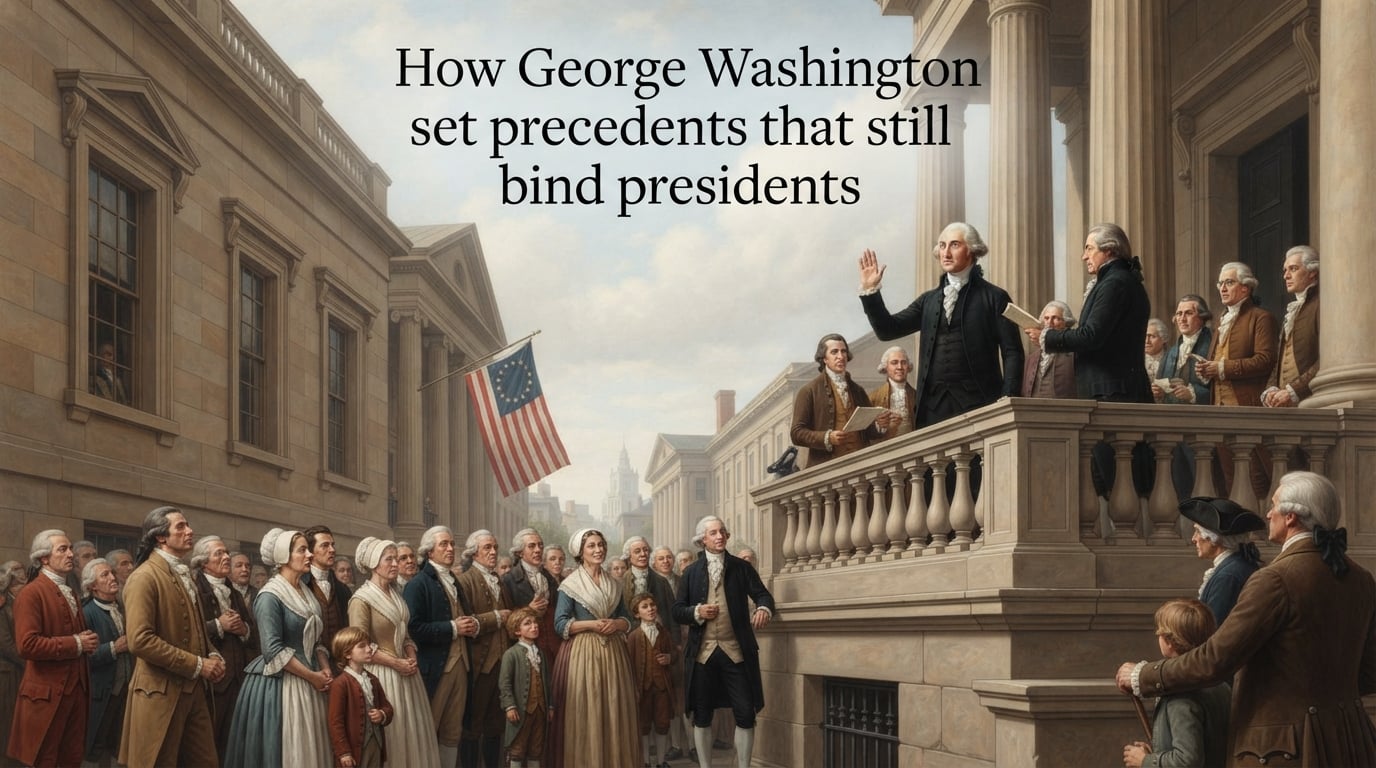
George Washington set precedents that still bind presidents today by being the first to act in nearly every area the Constitution left undefined. When he took the oath of office on April 30, 1789, there was no playbook for the American presidency. Washington wrote that playbook himself, and every president since has followed it, sometimes by choice and sometimes by constitutional requirement.
I have studied Washington’s presidency for years, and what strikes me most is how deliberately he approached each decision. He knew future presidents would copy him, so he treated every choice as a constitutional act. That mindset is why the precedents he set in the 1790s still shape the Oval Office in 2026.
His most important precedents include the two-term limit, the cabinet system, the neutrality doctrine, and the simple title “Mr. President.” Each one started as a personal choice and grew into either law, tradition, or both. This article walks through how Washington created these precedents and explains why they remain binding on every modern president.
Table of Contents
The Two-Term Presidency Precedent
Washington’s two-term precedent is the clearest example of a personal choice becoming binding constitutional law. After winning election in 1788 and 1792, Washington voluntarily stepped down in March 1797, refusing to seek a third term even though his popularity would have guaranteed victory.
His famous Farewell Address laid out the reasoning. He warned that long tenure in office “would amount to a species of monarchy.” Every president followed this example for the next 144 years. Thomas Jefferson, James Madison, and their successors honored Washington’s retirement as a republican virtue worth preserving.
The precedent stayed voluntary until Franklin Roosevelt won four elections between 1932 and 1944. The reaction was swift. In 1951, Congress passed and the states ratified the Twenty-Second Amendment, which now binds every president to two terms. Washington’s voluntary choice had become hard constitutional law.
This is why the two-term precedent still binds in 2026. It moved from tradition to constitutional text. Any president today who wanted to serve longer would face a legal barrier Washington chose to avoid in 1797. His preference now governs the office through the amendment process.
Why This Precedent Stuck
Many of Washington’s warnings were ignored. Political parties formed almost immediately despite his farewell address caution. Yet the two-term limit became law. The reason is that two-term retirement was concrete and enforceable, while warnings about parties were abstract and easy to dismiss.
Washington’s Cabinet System
Washington created the cabinet system by asking trusted advisors to meet with him regularly on executive decisions. The Constitution mentions “departments” but says nothing about a cabinet. Washington invented the practice when he invited Secretary of State Thomas Jefferson, Secretary of the Treasury Alexander Hamilton, and Secretary of War Henry Knox to consult on policy.
The early cabinet was small but consequential. Jefferson and Hamilton famously clashed over the national bank, foreign policy, and the scope of federal power. Their arguments played out in Washington’s office, forcing him to mediate between competing visions of America.
That mediation pattern still defines the modern presidency. Today’s cabinet is much larger, with 15 executive departments. But every president still gathers their secretaries for advice, debate, and decision-making in the same basic format Washington pioneered. The tradition is so strong that no president has ever tried to govern without a cabinet.
How the Cabinet Precedent Functions Today
Modern presidents rely on their cabinets for policy execution, political advice, and interagency coordination. Cabinet meetings are formal events documented in presidential records. Department heads testify before Congress and shape public debate. None of this existed before Washington decided to consult with Jefferson, Hamilton, and Knox in 1789.
The Neutrality Doctrine and Farewell Address
Washington issued the Neutrality Proclamation of 1793 to keep America out of the war between France and Britain. France had been America’s ally in the Revolution, but Washington judged that the new nation was too weak to fight another European war. His proclamation declared that America would “adopt and pursue a conduct friendly and impartial toward the belligerent powers.”
The Neutrality Doctrine set a precedent that presidents can shape foreign policy without congressional approval in emergencies. It also established a tradition of avoiding European conflicts that shaped American foreign policy for over a century. Washington returned to this theme in his Farewell Address, warning against “entangling alliances” with foreign nations.
Modern presidents still navigate this tension. The doctrine has been stretched by world wars, NATO commitments, and global trade, but the core idea that the president must weigh foreign entanglements remains Washingtonian. Every president who wrestles with deploying troops abroad is working within the framework Washington created in 1793.
The “Mr. President” Title
Washington rejected monarchical titles when he took office. The Senate initially proposed calling him “His Highness” or other noble-sounding names. Washington preferred simple dignity and asked to be addressed as “Mr. President.”
This choice was politically symbolic. America had just fought a revolution against a king. Adopting royal-sounding titles would undermine the republican experiment. By choosing “Mr. President,” Washington tied the office to civilian, egalitarian values rather than monarchy.
The precedent stuck completely. Every American president since has used “Mr. President” or “Madam President” in formal address. No president has ever revived the monarchical suggestions the Senate floated in 1789. The simplicity of the title reflects Washington’s belief that the presidency derives power from the Constitution, not from royal tradition.
Other Enduring Precedents Washington Set
Beyond the four headline precedents, Washington established several smaller practices that still govern the presidency.
Commander in Chief Authority
Washington personally led the militia to suppress the Whiskey Rebellion in 1794. That decision confirmed the president can use military force to enforce federal law within U.S. borders. Modern presidents continue to invoke this precedent when deploying troops domestically during civil disturbances.
Recognition of Foreign Governments
By receiving the French ambassador in 1793, Washington established that the president alone decides which foreign governments America officially recognizes. This power was never written into the Constitution but came from Washington’s early action. Presidents still exercise this recognition power today without congressional approval.
Inaugural Oath and Federal Hall Ceremony
Washington took the oath of office on the balcony of Federal Hall in New York City. That public ceremony established the practice of a visible, accessible inauguration. Modern presidents still swear the oath in a public setting, although they typically use the Capitol steps rather than a balcony.
The State of the Union Address
Washington delivered the first State of the Union speech to Congress in person in 1790. Thomas Jefferson later switched to a written message, but Woodrow Wilson restored the in-person speech in 1913. Every modern president continues Washington’s practice of addressing Congress directly on the state of the nation.
Frequently Asked Questions
How did George Washington set precedents as President?
Washington set precedents by being the first president to act in areas the Constitution left undefined. He voluntarily retired after two terms, created a cabinet of advisors, issued the Neutrality Proclamation of 1793, and chose the title Mr. President. Each decision became a model that future presidents followed and that Congress later wrote into law.
What precedent did George Washington set regarding presidential terms?
Washington established the two-term limit by voluntarily stepping down in 1797 after serving two terms. This voluntary tradition held for 144 years until Congress passed the Twenty-Second Amendment in 1951, which now legally limits presidents to two terms. Washington chose the precedent that became binding constitutional law.
What was the most important precedent set by George Washington?
Many historians consider the two-term precedent the most important because it became constitutional law through the Twenty-Second Amendment. Others argue the cabinet system had the largest practical impact since every modern president relies on a cabinet to govern. The choice of Mr. President as the official title also ranks among the most lasting precedents.
How did Washington’s cabinet set a precedent for future presidents?
Washington created the cabinet by inviting Secretary of State Thomas Jefferson, Secretary of the Treasury Alexander Hamilton, and Secretary of War Henry Knox to advise him on policy. The Constitution did not require a cabinet, but Washington’s practice became the standard. Every modern president meets regularly with their department heads to coordinate policy and make decisions.
Why These Precedents Still Bind Presidents Today
Washington’s precedents still bind modern presidents for three distinct reasons. Some became constitutional law, some became institutional norms, and some became cultural expectations. Understanding which is which helps explain why these founding choices remain powerful in 2026.
Constitutionalized Precedents
The two-term limit is now the Twenty-Second Amendment. Presidents cannot legally serve more than two terms no matter how popular they become. FDR’s four wins forced this codification, and every modern president must accept the constitutional ceiling Washington chose voluntarily in 1797.
Institutional Norms
The cabinet system, the State of the Union address, and the recognition of foreign governments are institutional norms that no president has tried to abandon. Cabinet meetings, joint sessions, and ambassador credentials all trace back to Washington’s first term. These practices work so well that overturning them would create chaos rather than reform.
Cultural Expectations
The Mr. President title and the civilian character of the office belong to American political culture. Americans expect their president to behave as a republican citizen, not a monarch. Washington set that tone by refusing titles and by regularly returning to Mount Vernon. Modern presidents face similar pressure to appear accessible even while exercising enormous power.
Conclusion
George Washington set precedents that still bind presidents in 2026 because he understood that the Constitution alone could not define the presidency. The founders left the office intentionally vague, trusting the first president to fill in the details with wisdom and restraint. Washington answered that trust by retiring after two terms, building a cabinet, choosing neutrality, and rejecting royal titles.
Some of his choices became law, like the Twenty-Second Amendment. Some became institutional norms, like the cabinet system. Some became cultural expectations, like the Mr. President title. Together they form the unwritten constitution of the American presidency, layered on top of the written one.
The lesson for modern presidents is that founding-era decisions still carry weight more than 230 years later. Any president who tries to claim powers Washington did not claim will face legal and political resistance. Any president who follows Washington’s restraint will find the office easier to defend. That is the lasting legacy of the first president: he built a presidency that has outlasted every challenge to its legitimacy.
For anyone studying the American presidency, the precedents Washington set are the starting point. Without his two-term retirement, his cabinet, his neutrality, and his Mr. President title, the office would look very different today. With them, the presidency remains recognizably the institution Washington shaped between 1789 and 1797.