
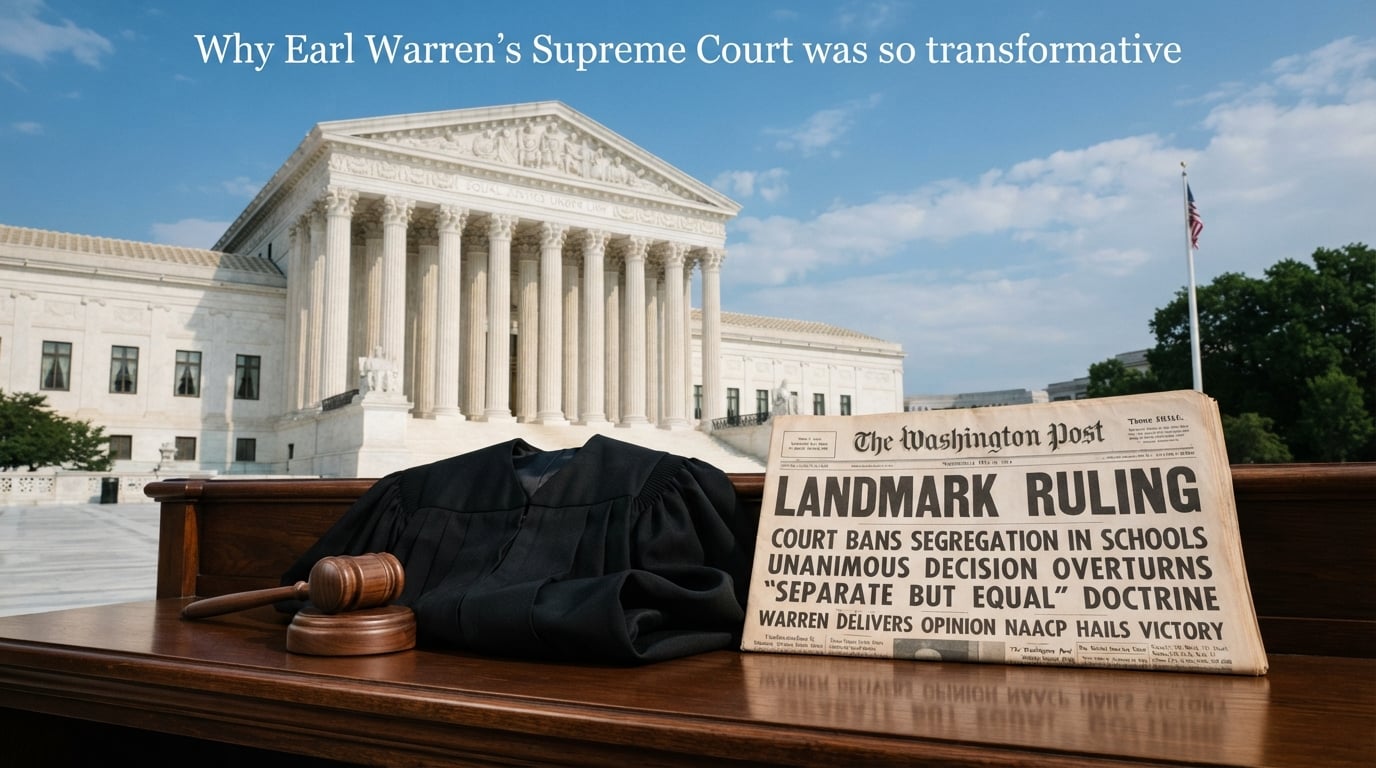
The Warren Court (1953-1969) was the period when Chief Justice Earl Warren led the United States Supreme Court through a revolution in constitutional law. During those sixteen years, the Court ended legal segregation in public schools, transformed police procedure, mandated equal legislative representation, and protected interracial marriage. These rulings did not just update legal precedent; they reshaped the daily realities of every American citizen.
In this article, I walk through the key decisions, the man behind them, and why this era of the Supreme Court remains the most consequential in modern American history. You will see exactly why Earl Warren’s Supreme Court was so transformative, and why its rulings still shape your rights today.
Table of Contents
How Earl Warren Became Chief Justice: A Conservative’s Unexpected Rise
Earl Warren’s appointment to the Supreme Court was supposed to be one of President Dwight D. Eisenhower’s safest moves. Eisenhower expected a conservative jurist who shared his centrist Republican instincts. What he got instead was a Chief Justice who became the most consequential liberal force in twentieth-century American law.
Warren’s Early Career in Law Enforcement
Earl Warren was born in Los Angeles in 1891 to Norwegian immigrant parents. He built his early career as a prosecutor, serving as a deputy district attorney in Alameda County and later as California’s Attorney General. Warren earned a reputation as a tough-on-crime administrator who favored broad police powers and quick prosecution. He won three terms as Governor of California on a Republican ticket before setting his sights on the White House.
Warren ran for the Republican presidential nomination in 1952 but lost to Eisenhower. That defeat, paradoxically, set up his Supreme Court appointment. Warren’s record as a law-and-order prosecutor made him seem ideologically safe to a Republican president looking to nominate a Chief Justice.
Eisenhower’s Recess Appointment in 1953
Chief Justice Fred Vinson died unexpectedly in September 1953. Eisenhower needed a fast replacement and chose Warren, the former California governor whose political career was winding down. Because the Senate was in recess, Eisenhower made the appointment without confirmation hearings. Warren was sworn in on October 5, 1953.
The recess appointment was meant to be uncontroversial. Eisenhower reportedly told his attorney general that Warren was “the biggest damn fool mistake” he had ever made after Warren issued some of his most liberal rulings. The remark captures the irony at the heart of Warren’s tenure: a president got exactly the opposite of what he had bargained for.
Did Eisenhower Regret Appointing Earl Warren?
Yes, Eisenhower openly regretted the appointment in his later years. He reportedly told friends that appointing Warren was “the biggest damned-fool mistake I ever made.” Some historians have pointed to a remark Eisenhower allegedly made that “we lost our nation” with the Warren Court decisions. While the exact wording varies across sources, Eisenhower’s regret is well documented.
What Eisenhower did not anticipate was that Warren would undergo a profound philosophical shift once seated on the bench. The prosecutor turned progressive jurist became a defining figure of mid-century liberalism, and Eisenhower’s party spent decades reckoning with the consequences.
Brown v. Board of Education: The Decision That Shocked a Nation
Brown v. Board of Education (1954) was the Warren Court’s first and most explosive ruling. The unanimous decision declared racial segregation in public schools unconstitutional, overturning the sixty-year-old doctrine of “separate but equal” established by Plessy v. Ferguson (1896). No single ruling better illustrates why Earl Warren’s Supreme Court was so transformative.
Unanimous Ruling Against Separate But Equal
Brown consolidated five cases from four states (Kansas, South Carolina, Virginia, and Delaware) plus the District of Columbia. The plaintiffs argued that separate schools for Black and white children were inherently unequal, even if buildings, textbooks, and salaries were matched dollar-for-dollar. Warren personally wrote the opinion and worked tirelessly to keep it unanimous.
Warren believed a unanimous ruling carried moral weight that a divided decision could not. He convinced Justices from both the liberal and conservative wings of the Court to sign on. The opinion’s now-famous conclusion stated that “in the field of public education the doctrine of ‘separate but equal’ has no place. Separate educational facilities are inherently unequal.”
The unanimity mattered. A 9-0 ruling sent an unmistakable signal that the highest Court in the land rejected segregation as fundamentally incompatible with the Fourteenth Amendment’s Equal Protection Clause.
Why Brown v. Board Was So Controversial
Brown did not merely announce a legal principle; it detonated a political bomb. Across the South, politicians promised “massive resistance” to the ruling. The “Southern Manifesto” of 1956, signed by nineteen senators and eighty-two representatives, condemned the decision as an abuse of judicial power. State legislatures passed interposition resolutions claiming the authority to nullify federal rulings.
The controversy went beyond the South. Some legal scholars, including several who would later become prominent conservatives, argued that the Court had overstepped its role. They pointed to social science data cited in Brown as evidence that the justices had engaged in legislative reasoning rather than legal interpretation.
Resistance and the Path to Enforcement
Brown was followed by a reluctant enforcement phase that lasted another decade. The 1957 Little Rock Crisis required federal troops to escort Black students into Central High School in Arkansas. It was not until the Civil Rights Act of 1964 and the Elementary and Secondary Education Act of 1965 that meaningful school desegregation began across the South.
Yet despite slow enforcement, Brown’s symbolic impact was immediate. It gave the burgeoning civil rights movement a constitutional foundation. Lawyers like Thurgood Marshall used Brown to argue subsequent cases involving transportation, public accommodations, and voting rights. The Warren Court’s willingness to confront racial caste set the legal stage for the broader civil rights revolution of the 1960s.
Revolutionizing Criminal Procedure: Miranda, Gideon, and Mapp
The Warren Court’s overhaul of American criminal procedure stands as one of the most far-reaching transformations of the modern era. Before 1961, suspects in many states had virtually no constitutional protection during police interrogations. By 1966, the Warren Court had established the rights most Americans now take for granted.
Mapp v. Ohio and the Exclusionary Rule
Mapp v. Ohio (1961) extended the exclusionary rule to state courts. The doctrine, originally applied only to federal cases in Weeks v. United States (1914), required judges to throw out evidence obtained through illegal searches. Dollree Mapp had been convicted after police raided her home looking for a bombing suspect without a proper warrant and found obscene materials instead.
Warren’s majority opinion declared that “all evidence obtained by searches and seizures in violation of the Constitution is, by that same authority, inadmissible in a state court.” The ruling forced state police departments to overhaul their practices. Critics argued it would allow guilty defendants to walk free on “technicalities,” but the Warren Court considered the rule essential to deter illegal searches.
Gideon v. Wainwright and the Right to Counsel
Gideon v. Wainwright (1963) guaranteed every criminal defendant the right to a lawyer, even if they could not afford one. Clarence Earl Gideon had been convicted of breaking into a Florida pool hall after a trial where he was forced to defend himself because Florida only provided counsel to indigent defendants in capital cases.
The Court’s unanimous ruling declared that the Sixth Amendment’s right to counsel was “fundamental and essential to fair trials.” Warren’s opinion held that without a lawyer, a poor defendant faced an unfair playing field against trained prosecutors. After Gideon, states had to provide public defenders to indigent defendants in serious criminal cases.
Miranda v. Arizona and Police Interrogation
Miranda v. Arizona (1966) produced what may be the single most recognizable legal phrase in American culture: “You have the right to remain silent.” Ernesto Miranda had confessed to kidnapping and assault after a two-hour police interrogation without being told he could have a lawyer present.
Warren’s opinion held that the Fifth Amendment’s protection against self-incrimination applied during police custody. Suspects had to be warned of their rights to silence, legal counsel, and the fact that anything they said could be used against them. The “Miranda warning” became a fixture of American policing.
Critics argued Miranda would handcuff police and let dangerous criminals escape prosecution. Studies since have shown mixed results, but the Warren Court considered the rights of the accused a constitutional priority. The ruling remains the law today, though the Court has allowed limited exceptions in cases of public safety.
Voting Rights and Reynolds v. Sims: One Person, One Vote
The Warren Court’s voting rights decisions reshaped the political geography of the United States. Before 1964, state legislatures were malapportioned in ways that gave rural voters disproportionate power over urban populations. That changed with one of the most consequential reapportionment rulings in American history.
Malapportioned Legislatures Before 1964
For decades, state legislative districts had not been redrawn to reflect population shifts. In many states, a single rural county held as many seats as a sprawling urban county with ten times the population. Alabama had refused to redistrict since 1901, leaving its legislature wildly out of step with where Alabamians actually lived. Urban voters, particularly Black voters concentrated in cities, were systematically underrepresented.
The Reynolds v. Sims Decision
Reynolds v. Sims (1964) required both houses of state legislatures to be apportioned on the basis of population. Warren’s majority opinion declared that “the right to vote freely for the candidate of one’s choice is of the essence of a democratic society, and any restrictions on that right strike at the heart of representative government.”
The phrase “one person, one vote” entered common usage to describe the principle. The ruling forced states to redraw district lines and shifted political power toward metropolitan areas. Some rural interests complained about losing their traditional influence, but Warren saw political equality as inseparable from constitutional equality under the Fourteenth Amendment.
Loving v. Virginia and the Expansion of Civil Rights
Loving v. Virginia (1967) struck down laws banning interracial marriage in sixteen states. The case arose when Richard and Mildred Loving, a white man and Black woman from Virginia, were convicted of violating the state’s Racial Integrity Act after marrying in Washington, D.C. The Supreme Court unanimously agreed that anti-miscegenation laws violated the Equal Protection Clause and the Due Process Clause of the Fourteenth Amendment.
Warren’s opinion, written by the Chief Justice, declared that “the freedom to marry has long been recognized as one of the vital personal rights essential to the orderly pursuit of happiness by free men.” Marriage was a “fundamental freedom” that the state could not deny based on race.
The ruling invalidated laws that had stood in some Southern states since the colonial era. It also dismantled one of the last legal pillars of the Jim Crow system. Within months, an estimated 70,000 marriages involving Black and white couples were taking place across the South, including the Lovings themselves, who returned to Virginia and lived there with their three children.
Other Landmark Warren Court Decisions Worth Knowing
The Warren Court issued far more transformative rulings than just the most famous ones. Several additional decisions extended rights in ways that still affect American life today.
Engel v. Vitale and School Prayer
Engel v. Vitale (1962) struck down official school-sponsored prayer in public schools. The New Hyde Park school district in New York had composed a nondenominational prayer to be recited each morning. The Court ruled that government-composed prayers violated the Establishment Clause of the First Amendment. The decision remains controversial, particularly among religious conservatives, but the Warren Court considered state-mandated religious exercises a clear violation of church-state separation.
Griswold v. Connecticut and Privacy Rights
Griswold v. Connecticut (1965) struck down a state law banning the use of contraceptives by married couples. In striking down the law, the Court recognized a constitutional right to privacy that, while not explicitly mentioned in the Constitution, was found in the “penumbras” and “emanations” of several amendments. The right would later be extended to unmarried couples (Eisenstadt v. Baird, 1972) and become the foundation for Roe v. Wade (1973).
Brandenburg v. Ohio and Free Speech
Brandenburg v. Ohio (1969) protected inflammatory speech from government suppression unless it incited imminent lawless action. The ruling overturned the conviction of a Ku Klux Klan leader who had made threatening statements at a rally. The case set the modern standard for First Amendment protection of even hateful speech.
Tinker v. Des Moines and Student Rights
Tinker v. Des Moines (1969) ruled that students do not shed their constitutional rights at the schoolhouse gate. The case involved students suspended for wearing black armbands to protest the Vietnam War. The Warren Court’s late-term ruling protected symbolic speech in schools and remains a foundational student rights case.
The Warren Commission and the JFK Assassination
Chief Justice Warren’s most consequential non-judicial act was leading the investigation into the assassination of President John F. Kennedy. On November 22, 1963, JFK was shot and killed in Dallas, Texas. Within days, President Lyndon Johnson appointed Warren to chair a special commission to investigate the assassination and any possible conspiracy.
Leading the Investigation
The Warren Commission spent ten months interviewing witnesses, reviewing physical evidence, and analyzing the films and photographs from Dealey Plaza. Warren personally directed the inquiry despite acknowledging it would be a heavy distraction from his judicial duties. He considered it a patriotic obligation. The commission’s 888-page report, released in September 1964, concluded that Lee Harvey Oswald acted alone in assassinating Kennedy and that Jack Ruby also acted alone in killing Oswald.
Findings and Controversy
The “single bullet theory” and other conclusions have been debated ever since. Public confidence in the findings has fluctuated over the decades, with conspiracy theories persisting in American culture. Warren himself was reportedly troubled by the report’s reception in some quarters. Yet the commission’s work set the framework for how the United States investigates presidential assassinations, and the document remains the foundational account of the event.
Why Critics Call the Warren Court “Judicially Activist”
No discussion of Earl Warren’s Supreme Court is complete without addressing the persistent criticism of judicial activism. From the day Brown v. Board was decided, opponents accused the Warren Court of overstepping the judicial role and making law from the bench.
The Activism Debate
Critics argue that the Warren Court invented constitutional rights that the framers never envisioned. Where the Constitution says nothing about segregation, police interrogation, or apportionment, the Court found prohibitions through expansive readings of the Equal Protection and Due Process Clauses. To originalists, this is legislation, not interpretation. They point to Brown, Miranda, and Griswold as evidence that justices were imposing policy preferences on the country.
Barry Goldwater campaigned for the presidency in 1964 partly on a platform of curbing the Court. Richard Nixon and Ronald Reagan built political careers on similar criticisms. In 2026, the legacy of those critiques continues to shape debates over judicial nominations.
Defenders of the Warren Court
Defenders counter that the Constitution is a living document whose meaning must adapt to changing times. They point out that Brown addressed a moral evil that the text’s framers would have supported ending had they lived in 1954. Miranda and Gideon responded to abuses that had become entrenched in American policing. The Court’s decisions, defenders argue, brought the Constitution closer to its stated ideals rather than rewriting it.
Scholars like Alexander Bickel and John Hart Ely wrote influential defenses of Warren Court jurisprudence, arguing that the rulings protected democratic participation and the rights of marginalized groups who had been excluded from political processes.
Living Constitution vs. Originalism
The Warren Court’s decisions became the central example in the modern debate between living constitutionalism and originalism. Originalists like Robert Bork and Antonin Scalia built careers opposing the Warren Court’s methodology. The debate has continued in federal courts, law schools, and presidential administrations ever since.
Whatever your view, the Warren Court forced the country to confront a question that remains unresolved in 2026: should judges interpret the Constitution according to its original public meaning, or should they adapt its principles to contemporary circumstances?
Warren’s Personal Transformation: From Prosecutor to Progressive
One of the most remarkable aspects of Earl Warren’s tenure is how much he himself changed. The man who led the Court through its liberal revolution was not the same jurist who had been sworn in in 1953.
Early Conservative Record
Warren arrived at the Court with a background as a prosecutor who had overseen executions as Attorney General. He had run for president on a conservative Republican platform. Some early observers expected him to be a reliable conservative vote alongside justices like Felix Frankfurter. During his first years, he generally aligned with the more conservative wing on cases involving national security and labor law.
Evolution on the Court
Warren’s views shifted gradually but decisively. Brown v. Board was the turning point. The work of writing and defending that opinion transformed how he thought about the Court’s role. He came to see the judiciary as a guardian of fundamental fairness, particularly for those who lacked political power.
By the end of his tenure, Warren was openly progressive on civil rights, criminal procedure, religious freedom, and political representation. His personal journey illustrates how the Court’s institutional culture can shape individual justices. The collegial atmosphere and the moral weight of cases like Brown turned a former prosecutor into the leader of a judicial revolution.
The Lasting Legacy of the Warren Court on Modern America
The Warren Court’s decisions are not historical curiosities. They are part of the legal fabric of the United States in 2026.
Influence on Subsequent Courts
The Burger Court that succeeded Warren in 1969 did not reverse the Warren Court’s major rulings. Miranda warnings still appear on every television cop show. Gideon still guarantees public defenders to the poor. Brown remains the law. The Burger, Rehnquist, and Roberts Courts narrowed some Warren-era precedents, but the core holdings have remained remarkably stable.
This durability is itself evidence of transformation. The Warren Court changed American expectations about what constitutional government should provide. Even when later Courts trimmed the edges of those decisions, they could not return to the pre-Warren status quo.
Enduring Impact on Daily Life
Every American student attends a desegregated school because of Brown. Every criminal suspect hears Miranda warnings. Every voter casts a roughly equal-value ballot because of Reynolds v. Sims. Every interracial couple can marry legally because of Loving. Every public school student in America lacks a state-mandated prayer because of Engel. Every married couple can use contraception because of Griswold.
These are not abstract legal principles. They shape the texture of American daily life. The Warren Court did not just interpret the Constitution; it reshaped the country.
Frequently Asked Questions About the Warren Court
How did Earl Warren change the Supreme Court?
Earl Warren changed the Supreme Court by transforming it into an engine of civil rights and individual liberties. As Chief Justice from 1953 to 1969, he led unanimous rulings that ended school segregation, expanded criminal defendant rights, mandated equal legislative representation, and protected interracial marriage. Warren’s collegial leadership and willingness to confront entrenched injustice set the modern direction of constitutional law.
Did Eisenhower regret appointing Earl Warren?
Yes, Eisenhower openly regretted appointing Earl Warren. He reportedly told friends and associates that naming Warren to the Court was the biggest mistake of his presidency. Eisenhower had expected a conservative jurist but got a Chief Justice who led the most consequential liberal transformation of constitutional law in American history.
Who is considered the best Supreme Court justice of all time?
Surveys of legal scholars consistently place Earl Warren, John Marshall, and Thurgood Marshall among the most influential Chief Justices. Warren is often ranked near the top specifically for his role in Brown v. Board of Education and the broader civil rights revolution. However, scholarly rankings vary widely and depend on whether one emphasizes jurisprudential impact or constitutional philosophy.
How did the Warren Court fundamentally change America?
The Warren Court fundamentally changed America by ending legal segregation, establishing Miranda rights for criminal suspects, guaranteeing counsel to indigent defendants, requiring legislative districts of equal population, and striking down laws against interracial marriage. Together, these rulings transformed daily life for ordinary Americans and set the legal framework for modern civil rights.
What was significant about Earl Warren’s leadership?
Earl Warren’s leadership was significant for his emphasis on unanimity in landmark cases, his willingness to confront entrenched injustice, and his ability to forge consensus among ideologically divided justices. He personally wrote Brown v. Board of Education, chaired the Warren Commission on the JFK assassination, and presided over a Court whose rulings reshaped American law for generations.
Conclusion: Why Earl Warren’s Court Still Matters Today
Earl Warren’s Supreme Court was so transformative because it used judicial power to confront the moral failures of American society at a moment when the political branches would not. From Brown v. Board to Miranda to Loving v. Virginia, the Warren Court expanded constitutional rights in ways that still define American life in 2026. Whether you see those rulings as principled constitutionalism or judicial activism, they reshaped the country in ways no other Court has matched. The Warren Court’s legacy is not a historical artifact. It is the law you live under right now.