
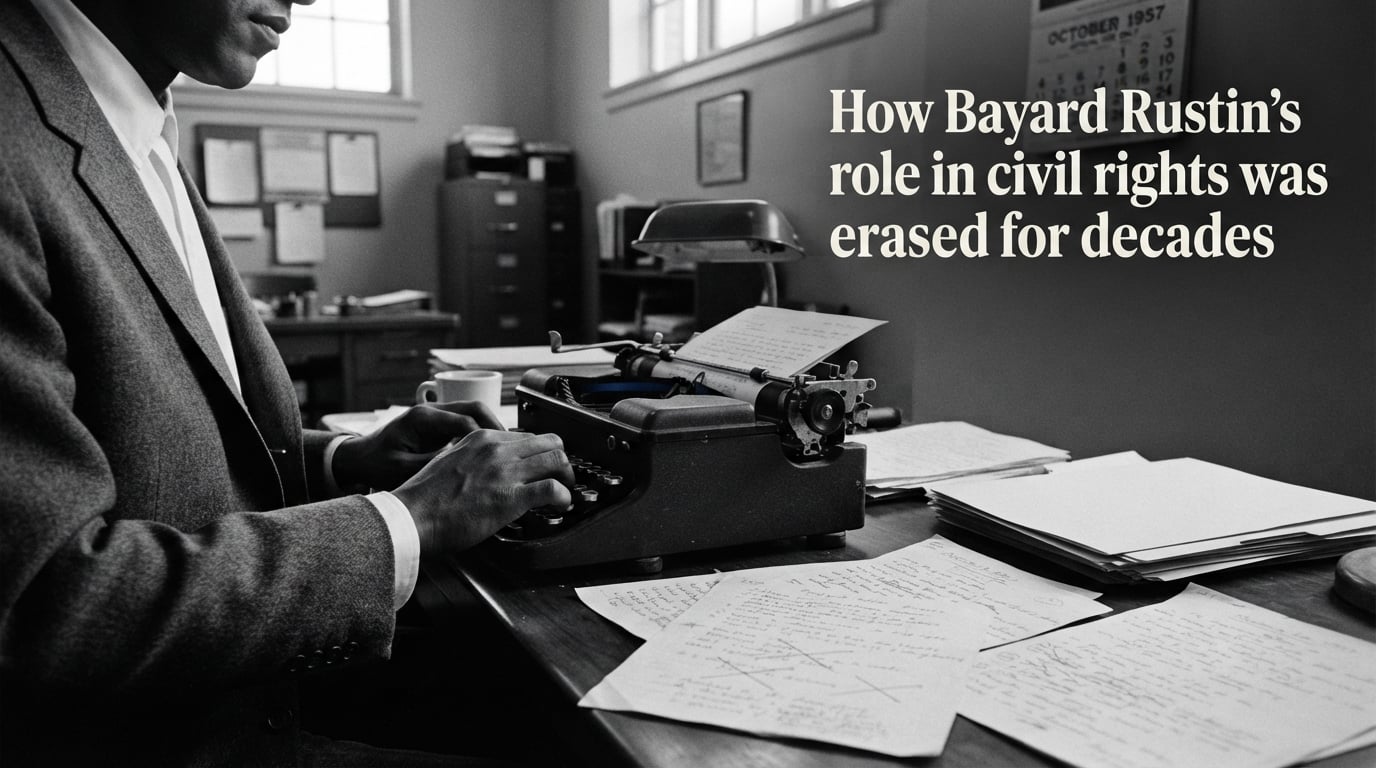
Bayard Rustin organized the 1963 March on Washington, taught Martin Luther King Jr. the philosophy of nonviolent resistance, and helped draft the strategy that ended legal segregation in the American South. Despite these achievements, his name was systematically removed from the dominant story of the civil rights movement for nearly half a century. The reasons behind that erasure reveal as much about American history as they do about Rustin himself.
I spent the past several weeks digging into archival material, museum collections, and contemporary scholarship to map exactly how a Black gay man who reshaped the twentieth-century American freedom struggle became one of its most famous unknowns. The story is not a simple case of accidental forgetting. It was a deliberate political project that combined anti-gay prejudice, anti-communist suspicion, and the movement’s own hunger for respectability.
If you have ever wondered why Bayard Rustin’s name rarely appeared in your textbook, why he never quite made it into the film montage, and why so many people discover him as adults and react with surprise, this guide walks through the full arc of his work, his suppression, and the slow restoration of his place in American history.
Bayard Rustin (1912-1987) was an American civil rights activist who served as Martin Luther King Jr.’s chief advisor on nonviolent resistance and organized the 1963 March on Washington. His open homosexuality and socialist politics led civil rights leaders, federal agencies, and historians to minimize his contributions for decades.
Table of Contents
Who Was Bayard Rustin? A Biographical Overview
Bayard Rustin was born on March 17, 1912, in West Chester, Pennsylvania. He was raised largely by his maternal grandmother, Julia Davis Rustin, a Quaker who had been active in the National Association of Colored Women. Her moral seriousness and her pacifist tradition shaped the young man in ways that would later shape a national movement.
As a teenager, Rustin excelled in athletics, sang in local performances, and read voraciously in philosophy and religion. He attended Wilberforce University in Ohio before transferring to Cheyney State Teachers College, eventually graduating from the latter in 1937. He then entered Wilberforce again as a student teacher and later worked briefly for the Young Communist League in the late 1930s.
The Communist Party affiliation was brief and disillusioning. Rustin left the party when it downplayed racial justice in favor of broader Popular Front priorities in 1941. That break set the stage for a lifelong commitment to nonviolence and democratic socialism rather than Soviet-aligned communism.
During World War II, Rustin registered as a conscientious objector. His refusal to serve led to a prison sentence in 1944, which he served at the Federal Correctional Institution in Ashland, Kentucky. His time behind bars only sharpened his commitment to Gandhian methods.
In 1947, Rustin helped organize one of America’s first Freedom Rides, then called the Journey of Reconciliation. After a nonviolent protest at a white restaurant in Durham, North Carolina, he was arrested and sentenced to thirty days on a chain gang. He refused to cut his hair and was beaten for the offense.
These early experiences established a pattern that would follow Rustin for the rest of his career. He put his body and his reputation on the line for tactics that others later received credit for.
How Rustin Formed His Philosophy of Nonviolent Resistance
Rustin first encountered Gandhian nonviolence through the writings of Krishnalal Shridharani and the work of the Fellowship of Reconciliation (FOR), a Christian pacifist organization founded in 1914. He joined FOR in 1941 and quickly rose through its ranks, becoming one of the leading theorists of nonviolence in the United States.
That same year, Rustin was a co-founder of the Congress of Racial Equality (CORE), an interracial direct action group modeled on Gandhian campaigns in India. CORE would later organize the Freedom Rides of 1961, but it began as a small committee operating out of Chicago with Rustin among its key voices.
In 1948, after the assassination of Mahatma Gandhi, Rustin traveled to India to study Gandhian nonviolent resistance at its source. He spent several weeks meeting with activists, observing ashrams, and deepening his understanding of how a doctrine of passive resistance could mobilize mass movements under brutal repression.
The India trip transformed Rustin. He returned convinced that nonviolence was not simply a tactic but a strategic framework that could disarm opponents, expose the moral bankruptcy of segregation, and protect the moral authority of the movement. He wrote up his observations in a series of essays that circulated widely among pacifist and civil rights circles.
By the early 1950s, Rustin had become one of the most sought-after trainers and strategists in the Gandhian movement in the United States. He taught workshops on nonviolent direct action for organizations including the American Friends Service Committee, FOR affiliates, and emerging Black civil rights groups in the South.
He was also, by this point, openly gay in private and increasingly in public, which would soon become the central fact used against him.
How Bayard Rustin Mentored Martin Luther King Jr. on Nonviolence
Bayard Rustin became Martin Luther King Jr.’s informal tutor on nonviolence during the Montgomery Bus Boycott of 1955 to 1956. King, then a twenty-six-year-old pastor, was thrust into leadership when Rosa Parks refused to surrender her bus seat. He initially kept armed guards around his home and doubted that passive resistance could win against armed white resistance.
Rustin traveled to Montgomery in early 1956 to give a series of workshops on Gandhian nonviolence. He convinced King that armed self-defense would hand segregationists a propaganda victory and that disciplined nonviolence would, over time, force national attention to the moral contradiction at the heart of segregation.
King later credited Rustin with teaching him how to conduct a nonviolent campaign. In his 1958 book Stride Toward Freedom, King wrote that Rustin’s instruction helped him understand nonviolence as both a method and a way of life.
Rustin helped draft the founding documents of the Southern Christian Leadership Conference (SCLC), the civil rights organization that King headed from 1957 onward. He was the principal architect of SCLC’s strategic plan, its press strategy, and its first major voter registration drives.
Behind the scenes, Rustin also wrote early drafts of King’s speeches and advised him on coalition politics. Some scholars credit Rustin with shaping the rhetorical structure of the most famous passages in King’s early oratory.
The relationship was not without tension. Senior SCLC figures, including Stanley Levison and others, worried that Rustin’s open homosexuality and past Communist ties made him a liability in the conservative Black church. King valued Rustin’s strategic mind but faced pressure to keep him in the shadows.
How Rustin Organized the 1963 March on Washington
The March on Washington for Jobs and Freedom on August 28, 1963, was Bayard Rustin’s most visible triumph. He served as deputy director under the titular leadership of A. Philip Randolph, the labor organizer who had first proposed the march in 1941 and revived the idea in 1963.
Rustin built the entire logistics operation. He coordinated bus routes for 250,000 people, arranged portable toilets, designed the sound system that would carry King’s voice to the Lincoln Memorial, and negotiated permits with the federal government.
He wrote an organizational manual of more than sixty pages that detailed everything from press strategy to medical stations. Contemporary organizers still cite that manual as a template for mass action logistics.
The decision to keep Randolph as the public face of the march was not accidental. Randolph, an older Black union leader with a long and untainted public record, could appear before Congress and the press in ways that Rustin could not. The arrangement was a deliberate protection of both the movement’s credibility and Rustin’s safety.
Senator Strom Thurmond of South Carolina recognized what was happening. On the floor of the Senate, he denounced Rustin by name as a “communist, draft-dodger, and homosexual.” Thurmond’s attack was meant to discredit the march itself and to pressure King and Randolph to drop Rustin from the organizing team.
King and Randolph refused to remove Rustin, but the public pressure did real damage. It contributed to a long-running pattern in which Rustin’s name was quietly omitted from press coverage, biographies, and movement histories even as the strategies he designed were celebrated.
The march itself became one of the defining events of the twentieth century. King’s “I Have a Dream” speech, delivered at the event Rustin built, became a permanent fixture of American political memory. Rustin, watching from the steps of the Lincoln Memorial, was almost never mentioned in the photographs, the newsreels, or the historical retellings.
Why Bayard Rustin’s Role Was Erased for Decades
The erasure of Bayard Rustin was not an accident of history. It was the product of three forces working together: anti-gay prejudice, anti-communist politics, and the civil rights movement’s strategic decision to pursue respectability over radical honesty.
In 1953, Rustin was arrested in Pasadena, California, on a “morals charge” after a sexual encounter in a parked car. He pleaded guilty to a misdemeanor charge of “sex perversion” and served sixty days in jail. The arrest became public knowledge in 1960 when it was used by political opponents to force his resignation from SCLC.
During the 1960s, every reference to Rustin’s sexuality was treated as a vulnerability that segregationists and their northern liberal allies could exploit. Congressman Adam Clayton Powell Jr. of New York threatened to publicize the Pasadena arrest unless King pushed Rustin aside. White liberal donors told King that Rustin’s open homosexuality was a fundraising liability.
The Cold War compounded the problem. Rustin’s brief Communist affiliation from the late 1930s had been magnified in FBI files and conservative newspapers into a career of Soviet espionage. Even though he had broken with the party in 1941, the label stuck. The Federal Bureau of Investigation kept an active file on him for decades.
Within the movement itself, leaders faced a brutal strategic choice. They could defend Rustin, fight homophobia openly, and risk losing white allies, or they could quietly remove him from the front lines. Most chose the latter. Some, like King, privately admired Rustin’s courage and publicly distanced themselves from him.
Rustin accepted a kind of internal exile. He continued to advise King off the books, wrote op-eds under other names, and threw himself into projects that white donors considered safe, especially labor-civil rights coalitions and the A. Philip Randolph Institute.
After King’s assassination in 1968, the situation worsened. The dominant narrative of the civil rights movement consolidated around a small group of martyred male leaders, with King at the center. Rustin’s contributions were absorbed into the King story without attribution, while his name and face were edited out of the standard historical accounts.
For the next two decades, school textbooks, television documentaries, and museum exhibits repeated the same compressed version of civil rights history. Rustin appeared, if at all, as a footnote. By the time a new generation asked the question of who organized the March on Washington in the 1980s, the answer was largely forgotten.
The pattern continued. Rustin died of cardiac arrest on August 24, 1987, having never received major recognition from the civil rights establishment. His obituaries were short, his New York Times notice ran only a few paragraphs, and his work on nonviolence was attributed to other figures in most subsequent histories.
How FBI Surveillance Shaped Rustin’s Marginalization
The Federal Bureau of Investigation opened a file on Bayard Rustin in the early 1940s, partly because of his Communist past and partly because of his work with FOR and CORE. The file grew throughout the McCarthy era and continued expanding through the 1960s.
FBI informants attended Rustin’s workshops, tailed him on speaking trips, and reported on his meetings with King. The bureau used the Pasadena arrest and his sexuality as leverage in ways that have been confirmed by historians working from declassified files.
Under J. Edgar Hoover, the FBI classified Rustin as a moral and political risk to the civil rights movement. Bureau memos characterized him as a pervert and a communist, and field offices shared information about him with conservative members of Congress.
The surveillance intersected with COINTELPRO, the FBI’s counter-intelligence program that targeted civil rights and Black nationalist organizations. While Rustin was never the primary target, his position inside King’s circle made him a useful instrument for discrediting King himself.
When Strom Thurmond read the FBI-supplied information about Rustin into the Senate record in August 1963, the move was not coincidental. It was the visible edge of a long-running federal effort to undermine nonviolent civil rights leadership by associating it with sexual and political nonconformity.
Historians such as John D’Emilio have argued that the FBI’s role in surfacing and circulating Rustin’s sexuality was a decisive factor in his marginalization. The agency treated his open gay life as a national security matter in a way that made sustained public leadership nearly impossible.
Rustin’s Later Career and Continued Activism
After stepping back from the SCLC, Rustin threw himself into labor organizing and coalition politics. He was a key figure in the founding of the A. Philip Randolph Institute in 1965, an organization dedicated to linking the labor movement and the civil rights movement.
In 1966, Rustin co-authored the Freedom Budget for All Americans, an ambitious proposal to eliminate poverty through federal investment and full employment. The Freedom Budget influenced the policy debates of the late 1960s, even though its full vision was never adopted.
Through the 1970s, Rustin continued to write and organize. He argued consistently that civil rights goals could only be secured through economic redistribution and strong unions. His commitment to democratic socialism sometimes put him at odds with both Black nationalists and Cold War liberals.
From the early 1980s, Rustin returned to the issue of gay rights with renewed energy. He testified before New York City Council in support of a gay rights bill, gave interviews to gay publications, and became an elder voice in the movement for lesbian, gay, bisexual, and transgender equality.
He also worked on AIDS education during the early years of the epidemic. He framed the AIDS crisis as a civil rights and human rights issue, and he argued that the gay community’s response to the epidemic was, in his words, “another form of nonviolent direct action.”
Rustin lived for more than a decade with his partner, Walter Naegle. Because New York law at the time did not recognize same-sex marriage or partnership, Rustin adopted Naegle in 1982 so that Naegle could inherit his estate and visit him in the hospital. The arrangement was one of the earliest documented same-sex legal adoptions used as a form of family protection.
How Contemporary Scholars Are Restoring Bayard Rustin’s Legacy
The rehabilitation of Bayard Rustin’s place in American history began in the 1980s and accelerated sharply after his death in 1987. A new generation of historians, activists, and filmmakers set out to recover the man and his contributions.
Historian John D’Emilio published the biography Lost Prophet: The Life and Times of Bayard Rustin in 2003, followed by a second edition in 2021 that incorporated new archival material. D’Emilio’s work made it impossible for serious historians to continue treating Rustin as a footnote.
The 2003 documentary Brother Outsider, produced by the California Newsreel collective, introduced Rustin to a broader audience. The film highlighted his strategic genius and his open gay life at a moment when both qualities were still routinely minimized.
In 2013, President Barack Obama awarded Rustin the Presidential Medal of Freedom posthumously. The citation recognized his organizing of the March on Washington and his lifelong commitment to nonviolence, and it marked the first time a sitting president had publicly honored Rustin.
In 2026, public recognition of Rustin continues to grow. Schools in West Chester, Pennsylvania, and in several other cities have been renamed in his honor. State legislatures have issued resolutions recognizing his contributions. The National Museum of African American History and Culture has incorporated Rustin into its central narrative.
In November 2023, Netflix released the film Rustin, starring Colman Domingo as Bayard Rustin. The film dramatized the organizing of the March on Washington and explicitly addressed the role of Rustin’s sexuality in his political suppression. Critics and historians generally praised the film for restoring Rustin’s centrality.
New books, podcasts, and educational curricula continue to bring Rustin into American classrooms. Younger readers are now encountering him as a major figure rather than as a passing reference in a chapter on the March on Washington.
The work of recovery is not yet complete. Many Americans still cannot name Rustin, and many textbooks still under-represent his role. But the trajectory of restoration has clearly shifted. Where Rustin was once edited out of the story, he is now increasingly centered in it.
Conclusion
Bayard Rustin’s erasure from the dominant narrative of the civil rights movement was neither accidental nor inevitable. It was the product of specific choices made by political opponents, federal agencies, the press, and even some of his own colleagues. They chose, at decisive moments, to value respectability over honesty, Cold War loyalty over strategic brilliance, and a sanitized story over the full truth.
Reclaiming Rustin is not simply an exercise in historical correction. It is a way of restoring the full complexity of the civil rights movement and of recognizing the contributions of Black gay activists who paid a steep price for living openly. The recovery of his name and his methods is part of the unfinished work of American democracy.
If you want to go deeper, I would suggest starting with John D’Emilio’s biography, the documentary Brother Outsider, and the 2023 Netflix film. Together they offer a richer, more honest picture of how a Black gay Quaker pacifist quietly shaped the most important social movement of the twentieth century.
Bayard Rustin’s role in civil rights was erased for decades, but in 2026 his place in the story is finally being restored, one biography, one classroom, and one documentary at a time.
Frequently Asked Questions
How did Bayard Rustin affect other civil rights leaders?
Bayard Rustin served as a strategic advisor to most of the major civil rights leaders of his era. He mentored Martin Luther King Jr. on Gandhian nonviolence during the Montgomery Bus Boycott, helped draft the founding documents of the Southern Christian Leadership Conference, and advised A. Philip Randolph on the structure of the March on Washington. Behind the scenes, Rustin shaped the tactical playbook that drove the movement’s most visible victories.
Why is Bayard Rustin important to history?
Rustin is important because he combined three things no other major figure of his era combined. He was the leading American theorist of Gandhian nonviolence, the chief organizer of the 1963 March on Washington, and an openly gay Black man living at a time when both his race and his sexuality were criminalized. His story shows how the civil rights movement actually worked and what it cost those who pushed its boundaries.
Was Bayard Rustin behind the scenes of the civil rights movement?
Yes, Rustin operated mostly behind the scenes. He served as a strategic advisor to King, helped write speeches, designed protest campaigns, and built coalitions among labor, religious, and civil rights groups. His open homosexuality and Communist past made him politically radioactive, so movement leaders often kept him out of public view even when they relied on his judgment.
How did Bayard Rustin influence MLK?
Rustin influenced King by teaching him Gandhian nonviolence during the Montgomery Bus Boycott and by serving as a long-term strategic advisor. He helped King understand that disciplined nonviolence would expose the moral ugliness of segregation in ways that armed resistance could not. He also helped draft SCLC’s founding documents and contributed to the structure of King’s most famous oratory.
Why is Bayard Rustin not well known?
Rustin was marginalized for three main reasons. His 1953 arrest for a homosexual act made him a target of political blackmail. His brief Communist affiliation in the 1930s made him a Cold War liability. And the civil rights movement chose to prioritize respectability with white donors and Black clergy over defending one of its most capable strategists. Those forces combined to push his name out of the dominant historical narrative for decades.
What impact did Bayard Rustin have on the civil rights movement?
Rustin had an outsize impact on the movement’s strategic direction. He taught the leading nonviolent activists of his generation, organized the 1963 March on Washington, helped build the coalitions between labor and civil rights groups, and shaped the legal strategy behind major victories. Even when his name was removed from the story, the methods he designed remained central to how the movement won.
Was Bayard Rustin LGBTQ?
Yes, Bayard Rustin was an openly gay man at a time when homosexual acts were criminalized in every U.S. state. He never hid his sexuality, and his openness was a regular target of political opponents who tried to use it to discredit the civil rights movement. He was a partner to Walter Naegle for more than a decade and adopted Naegle in 1982 to secure legal protections for their relationship.