
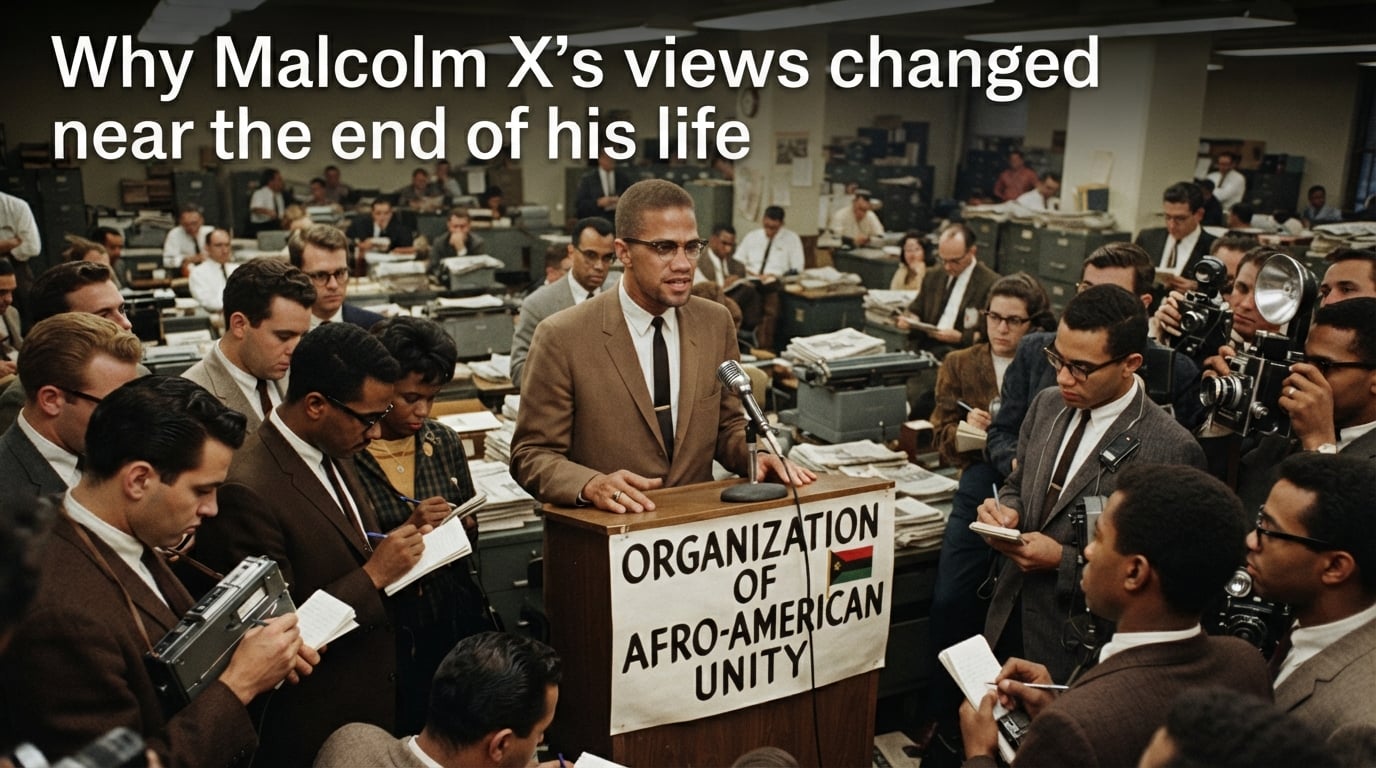
Few figures in American history have sparked as much debate about personal growth as Malcolm X. When people ask why Malcolm X’s views changed near the end of his life, they are really asking how a man once known for blunt separatist rhetoric softened toward a broader human rights vision. The answer spans religion, betrayal, world travel, and a single pilgrimage that rewired his worldview.
I have spent years studying his speeches, his autobiography, and the letters he wrote in the months before his death. What I found is not a story of a man abandoning his past. It is a story of a man who refused to let his past own him. In this guide, I will walk you through the moments, people, and ideas that reshaped Malcolm X between 1963 and 1965.
You will learn how the Nation of Islam shaped his early activism, why the pilgrimage to Mecca proved so transformative, what drove his split with Elijah Muhammad, and how his final organizations reflected a new, more inclusive vision of justice.
Table of Contents
Who Was Malcolm X Before His Transformation
To understand why Malcolm X’s views changed, you have to start with the Malcolm who existed before the shift. He was born Malcolm Little in 1925 in Omaha, Nebraska, and his childhood was marked by violence, including the murder of his father by white supremacists and his mother’s eventual institutionalization.
After moving to Boston and later New York, he lived a life that few would have predicted for a future civil rights icon. By his early twenties, he was running hustles in Harlem and serving time in prison for burglary. That prison sentence became the first catalyst.
While incarcerated, Malcolm encountered the teachings of Elijah Muhammad and the Nation of Islam. He copied the dictionary from cover to cover, joined the NOI, and was released in 1952 as a changed man. He took the name Malcolm X, rejecting what he called the slave name given to his ancestors by white society.
Within a decade, Malcolm X became the most visible spokesperson for the Nation of Islam, drawing thousands of new members and challenging both white racism and the nonviolent integrationist wing of the civil rights movement led by Martin Luther King Jr.
His voice was sharp, his analysis of white supremacy was unflinching, and his call for Black self-defense was uncompromising. This was the Malcolm X most Americans came to know. It was also the Malcolm X who would later admit he had been wrong about some things.
What Malcolm X Believed as a Member of the Nation of Islam
To grasp why Malcolm X’s views changed later, you need to understand what he taught in the early 1960s. The Nation of Islam, founded by Wallace Fard Muhammad and led by Elijah Muhammad, taught a distinct brand of Islam mixed with Black Nationalist theology. Its core doctrines shaped Malcolm’s public stance during this period.
First, the NOI taught that Black people were the original people of the earth and that white people were a race created by a black scientist named Yakub. This origin story framed white society as fundamentally unnatural and inherently racist.
Second, the NOI advocated complete Black separation from white America. Malcolm X argued that integration was impossible in a society built on white supremacy, and that Black Americans needed their own land, economy, and government.
Third, the NOI supported armed self-defense against racial violence. Malcolm X famously said that nonviolence was a moral high ground Black people could not afford when their lives were under attack.
“I am not a racist. I am against every form of racism and segregation, every form of discrimination. I believe in human kind, and I believe in human beings, but I don’t believe in any particular race.”
This quote, from early press conferences, hints at a tension that grew as Malcolm began to wrestle with his own public stance. Many of his most quoted statements came from this NOI period, and that is why understanding it is essential to understanding his later transformation.
By the late 1950s, he had moderated some public statements in response to perceived media attention, but the underlying NOI ideology remained his foundation. That foundation began to crack in late 1963.
How the Pilgrimage to Mecca Changed Malcolm X
The single most important event in understanding why Malcolm X’s views changed is his pilgrimage to Mecca in April 1964. The journey, known as the Hajj, is one of the Five Pillars of Islam and requires pilgrims to travel to the holy city of Saudi Arabia. For Malcolm, the experience demolished many of the NOI doctrines he had spent years defending.
I have read the letters and speeches Malcolm wrote after this trip, and they describe a man genuinely stunned by what he witnessed. At Mecca, he met Muslims of every race, skin tone, and nationality, all performing the same rituals and standing shoulder to shoulder as equals. White pilgrims and Black pilgrims prayed together. Arab pilgrims and African pilgrims broke bread together.
“There were tens of thousands of pilgrims, from all over the world. They were of all colors, from blue-eyed blonds to black-skinned Africans. But we were all participating in the same ritual, displaying a spirit of unity and brotherhood like my experience in America had led me to believe could never exist between the white and the non-white.”
On April 13, 1964, he wrote his famous letter from Mecca describing the pilgrimage. He wrote that he had eaten with people whose skin was the same as his, and with people whose skin was the whitest of whites, and that both had been completely brotherly. He called the experience a completely new world.
He adopted the name El-Hajj Malik El-Shabazz in honor of the journey. He also began openly questioning the NOI’s racial theology, signaling that his framework had fundamentally shifted.
For Malcolm, the pilgrimage did not erase his commitment to Black liberation. It reframed it. He realized that the problem was not white skin but systemic racism, and that any honest fight against racism had to be global rather than separatist.
Why Malcolm X Broke From the Nation of Islam
No discussion of why Malcolm X’s views changed can skip the rupture with Elijah Muhammad. While the pilgrimage opened his eyes, the Nation of Islam’s response to his new public positions ultimately forced a complete break.
In December 1963, after Malcolm made remarks about the assassination of President John F. Kennedy that were widely criticized, Elijah Muhammad suspended him from speaking for the NOI. This suspension, which Malcolm viewed as politically motivated, opened the door to deeper conflicts.
The breaking point came when Malcolm learned that Elijah Muhammad was secretly fathering children with several of his secretaries, a serious violation of NOI moral teachings. Malcolm publicly confronted this hypocrisy, knowing it would cost him everything.
On March 8, 1964, Malcolm formally announced his break from the Nation of Islam. He founded two new organizations, declaring that he would continue his work without the NOI’s constraints. Within months, his former NOI colleagues turned against him.
Death threats came daily. The New York Police Department, under informant Ali, tracked him closely. The NOI, through figures like Louis Farrakhan, openly mocked his transformation. Malcolm operated under constant surveillance and constant danger during his final year.
What I find striking when I revisit this period is how clearly Malcolm understood the cost. He told friends he would not live to see forty. He left instructions about his family. He wrote and revised speeches at a pace that reflected a man who knew his time was short.
How Muslim Mosque Inc. and the OAAU Reflected His New Vision
After his break with the NOI, Malcolm needed institutional homes for two different visions of his future activism. He founded them in March and June of 1964, and together they reveal the substance of his transformation.
Muslim Mosque Inc., founded first, was a religious organization devoted to Islamic practice and teachings. It represented Malcolm’s commitment to orthodox Sunni Islam, the same tradition he had experienced at Mecca. Through this group, he intended to guide Black Americans toward mainstream Islamic practice.
The Organization of Afro-American Unity, modeled on the Organization of African Unity, was the political arm. Malcolm designed it to internationalize the civil rights struggle, framing Black American freedom as part of a global fight against colonialism and white supremacy.
Through the OAAU, Malcolm began reaching out to African heads of state, the Organization of African Unity, and sympathetic governments in the developing world. He framed American racism as a human rights violation worthy of international attention, decades before that framing became standard.
He also pursued coalition work that would have been unthinkable during his NOI years. He met with Martin Luther King Jr. in person in March 1964, and the two had a candid exchange. He worked with the Student Nonviolent Coordinating Committee. He courted contacts in the Muslim world, including Egypt and Saudi Arabia.
This coalition-building was the practical expression of his transformed worldview. He was no longer preaching separatism. He was seeking allies.
How Malcolm X’s Views on Race and White People Changed
Ask a casual reader about why Malcolm X’s views changed, and they will often point to the way he talked about white people. This is also the area where he was most misunderstood, both in his lifetime and since.
During his NOI period, Malcolm X consistently described white people as a unified oppressor class. His speeches identified whiteness itself as the problem. This was the rhetoric that made him both celebrated and feared.
After Mecca, Malcolm moved toward a more differentiated view. He began describing racism as a problem, not as an inherent trait of any group. He actively distinguished between individual white people he met and the broader system of white supremacy that America had built.
“I was brainwashed into believing that I could have unity with the so-called white race before I was able to see what it was really about.”
Importantly, he did not abandon Black Nationalist principles entirely. He still emphasized the centrality of Black self-determination, Black pride, and Black control of Black communities. What changed was his willingness to work alongside non-Black allies to achieve those goals.
In a 1965 speech, he told supporters that he was not anti-white, he was anti-injustice, and that white people who opposed racism had a place in his movement. This represented a tonal shift that many in his audience could not accept and that NOI rivals exploited for propaganda.
If you take nothing else from this section, take this: Malcolm X’s evolution was not a surrender. It was a more sophisticated attack on the same enemy, achieved through broader alliances.
What Malcolm X’s Global Perspective Shift Looked Like
The final chapter in understanding why Malcolm X’s views changed has to do with the world beyond America. From late 1964 through early 1965, Malcolm traveled extensively, and each trip layered new insight on top of what Mecca had begun.
In 1964, he toured African nations including Egypt, Ethiopia, Tanganyika (now Tanzania), Nigeria, Ghana, Senegal, Liberia, and Morocco. He met heads of state, addressed parliaments, and began building the network that would eventually become the OAAU’s international spine.
His February 1965 speech to the Organization of African Unity in Cairo is widely considered the capstone of his internationalist vision. He presented a petition outlining the United States’ human rights violations against Black Americans and asked African governments to bring those violations before the United Nations.
He also traveled through the Middle East, meeting with officials in Saudi Arabia, Egypt, and other states. These travels convinced him that the Black American struggle could not be won in isolation. It had to be a global struggle with global allies.
By the time of his assassination on February 21, 1965, he had largely replaced Black separatism with Pan-African internationalism. He had replaced NOI theology with orthodox Islam. He had replaced rigid racial categorization with rigorous moral analysis. These shifts did not happen overnight. They happened through cumulative exposure to a wider world.
FAQs
How did Malcolm X’s views on civil rights change throughout his life?
Malcolm X moved through three major phases. In his early Nation of Islam years, he preached Black separatism and armed self-defense. After his 1964 pilgrimage to Mecca, he embraced orthodox Islam and a more inclusive human rights vision. After breaking from the Nation of Islam in March 1964, he founded the Organization of Afro-American Unity and pursued international coalition-building. By 1965, he described himself as anti-injustice rather than anti-white, and worked to bring civil rights issues before the United Nations.
What were Malcolm X’s controversial views during the Nation of Islam period?
During his Nation of Islam period, Malcolm X taught that Black Americans should separate from white society entirely, that armed self-defense was justified against racial violence, and that white people as a group benefited from systemic racism. He also repeated the NOI racial origin story that framed white people as a created race. Many of these positions softened after his 1964 pilgrimage to Mecca and his break from the NOI.
How did Malcolm X’s life end?
Malcolm X was assassinated on February 21, 1965, while speaking at the Audubon Ballroom in Manhattan. He had been publicly threatened by Nation of Islam members throughout 1964, and three gunmen attacked him during his speech. He was 39 years old. His death came at the height of his intellectual and political transformation, just weeks after delivering his famous speech to the Organization of African Unity.
Did Malcolm X abandon Black Nationalism completely?
No, Malcolm X did not abandon Black Nationalism entirely. He continued to emphasize Black self-determination, Black control of Black communities, and Black pride throughout his final years. What changed was the framework around those commitments. He moved from separatism to Pan-African internationalism, working to connect Black American struggles with African independence movements and global human rights campaigns. The substance of his Black empowerment commitments remained, but the tactical approach broadened.
What did Malcolm X learn at Mecca?
At Mecca in April 1964, Malcolm X encountered a multiracial Muslim community that lived out the Islamic principle of equality before God. He saw pilgrims of every race, color, and nationality praying together and breaking bread together. In letters and speeches after the pilgrimage, he described the experience as showing him a completely new world and discredited the Nation of Islam teaching that white people were inherently racist. He adopted the name El-Hajj Malik El-Shabazz in honor of the journey and began publicly questioning NOI racial theology.
Conclusion
The story of why Malcolm X’s views changed near the end of his life is not a story of weakness. It is a story of intellectual honesty at the highest level. Malcolm X looked at his own beliefs, encountered new evidence through the Mecca pilgrimage and global travel, and revised his conclusions in public.
If you remember nothing else from this guide in 2026, remember these three turning points. The Mecca pilgrimage in April 1964 shattered the racial theology that had defined him. The break from the Nation of Islam in March 1964 freed him to pursue new alliances. The founding of Muslim Mosque Inc. and the Organization of Afro-American Unity gave him new institutions for his new vision.
Modern movements for racial justice still draw on his evolution as a model. The lesson is not that separatist ideas were wrong for all time. The lesson is that a thoughtful person, given new information, can change their mind publicly and grow stronger for it. Malcolm X, more than most, demonstrated that.
To keep learning, pick up a copy of The Autobiography of Malcolm X and read his speeches from late 1964 and early 1965. The transformation is there to see, in his own words, if you know where to look.