
When I first studied constitutional law, the terms “original jurisdiction” and “appellate jurisdiction” looked like jargon meant for someone else. They are not. The difference between original and appellate jurisdiction shapes every lawsuit in the United States, from a small claims dispute at the county courthouse to a high-profile case argued before the Supreme Court. This guide breaks down both concepts in plain language, shows how they fit together in the federal and state court systems, and explains the one major exception that catches most people off guard.
The short answer: original jurisdiction is the power of a court to hear a case for the first time, while appellate jurisdiction is the power of a higher court to review a lower court’s decision. Keep reading for the full definitions, a side-by-side comparison, and real examples.
Table of Contents
What Is Original Jurisdiction in Simple Terms?
Original jurisdiction is the authority of a court to hear and decide a case when it is first filed. The court that takes the case first is sometimes called the court of first resort or trial court. At this stage, the court gathers the facts, hears testimony from witnesses, considers physical evidence, and applies the relevant law to reach a verdict or judgment.
I find it helps to remember why it is called “original.” The word original points to the origin of the case. It is the very first court where the legal dispute begins, before any appeal is filed. Federal district courts, state superior courts, and county-level trial courts all generally exercise original jurisdiction over the matters they handle.
For example, if you and your neighbor argue over a property line and you file a lawsuit, your case begins in a trial court with original jurisdiction. The judge (or jury) listens to both sides, looks at the deed, and decides who is right. That entire process is the original jurisdiction phase of your case.
Where You Will Find Original Jurisdiction
- Federal district courts (the trial courts of the federal system)
- State trial courts (superior, circuit, or district courts depending on the state)
- County and municipal courts handling small claims and misdemeanors
- Specialized courts like bankruptcy court at the trial level
What Is Appellate Jurisdiction in Simple Terms?
Appellate jurisdiction is the authority of a higher court to review the decision of a lower court. The higher court does not hold a new trial. It does not hear fresh testimony from witnesses. Instead, the appellate court reviews the record from the trial court and decides whether the law was applied correctly.
The word appellate comes from the Latin appellare, meaning “to call upon.” When you appeal a case, you are calling on a higher court to look at what happened below. That higher court exercises appellate jurisdiction when it considers your appeal.
Going back to the property line example: if you lose at the trial court and believe the judge made a legal error, you can appeal to a higher court. That higher court will not re-measure your land or call your witnesses again. It will read the transcript, review the legal rulings, and decide whether to affirm, reverse, or remand the decision. That review is the appellate jurisdiction phase.
Where You Will Find Appellate Jurisdiction
- Federal circuit courts of appeal (reviewing federal district court decisions)
- State courts of appeal and state supreme courts
- The U.S. Supreme Court when reviewing decisions of lower federal or state courts
Original vs Appellate Jurisdiction: Side-by-Side Comparison
Comparing original and appellate jurisdiction side by side is the fastest way to lock in the difference. Both types of jurisdiction can exist in the same court system, and they often work together as a case moves through the courts.
| Feature | Original Jurisdiction | Appellate Jurisdiction |
|---|---|---|
| Stage of case | First time the case is heard | Review of a lower court’s decision |
| Court type | Trial court (court of first resort) | Appellate or higher court |
| Function | Find facts, weigh evidence, apply law | Review the record for legal error |
| New evidence | Yes, witnesses and exhibits are presented | Generally no, only the trial record is reviewed |
| Typical outcome | Verdict or judgment for the parties | Affirm, reverse, remand, or modify |
| Examples | U.S. District Court, state superior court | U.S. Circuit Courts of Appeal, state supreme court |
The biggest practical difference is what happens inside the courtroom. In a court exercising original jurisdiction, the case is built from scratch. In a court exercising appellate jurisdiction, the case is examined for mistakes. As one Reddit user in r/LawSchool put it, “Original jurisdiction is where the story gets told. Appellate jurisdiction is where someone checks whether the story was told correctly.”
How the Court Hierarchy Uses Both Types of Jurisdiction
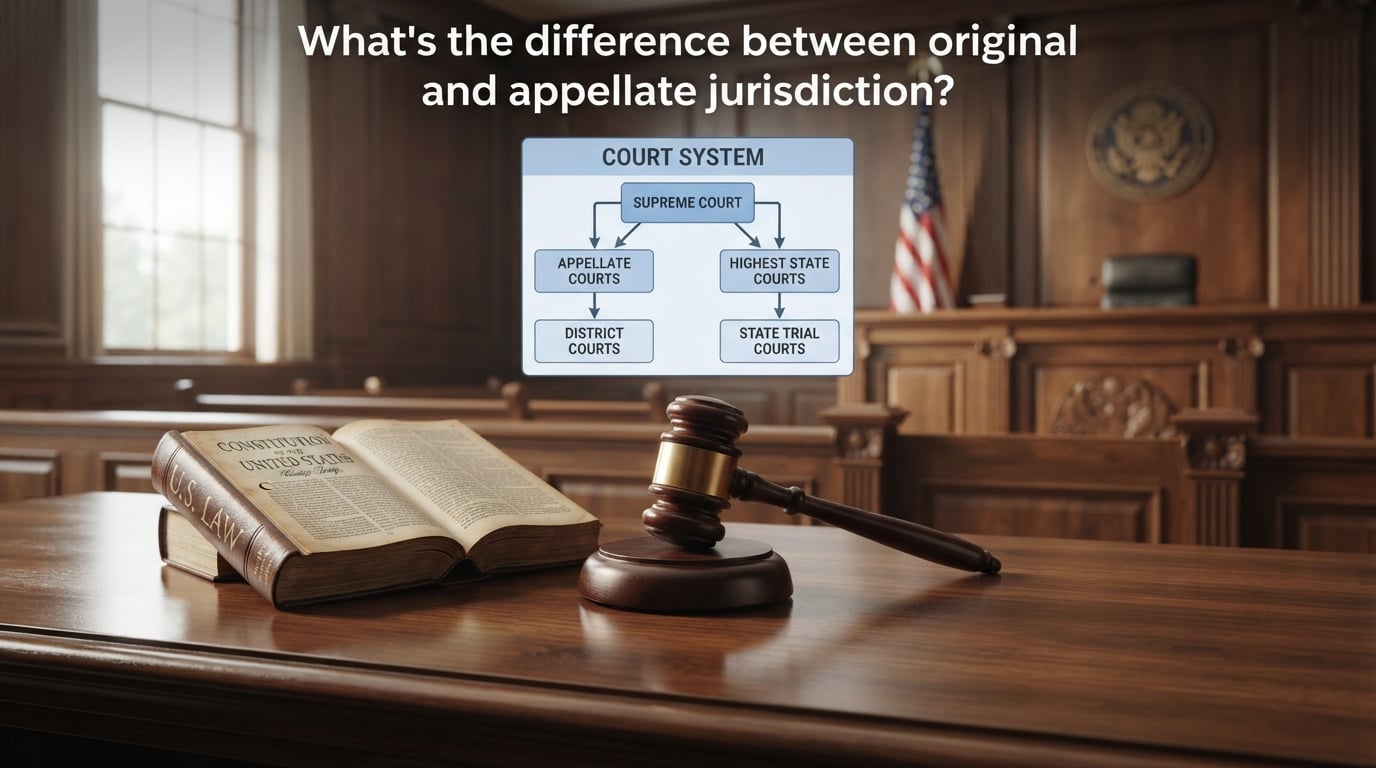
The U.S. court system is built as a pyramid. At the bottom are courts with original jurisdiction. In the middle are courts with appellate jurisdiction. At the very top sits the U.S. Supreme Court, which mostly hears appeals but has a small slice of original jurisdiction reserved by the Constitution.
The Federal Court System
In the federal system, the structure works like this:
- U.S. District Courts exercise original jurisdiction over federal criminal cases, federal civil cases, and diversity cases where the parties are from different states and the amount in controversy exceeds the statutory threshold.
- U.S. Circuit Courts of Appeal exercise appellate jurisdiction over the district courts within their geographic circuit. There are 13 circuit courts, including the Federal Circuit, which handles specialized subject matter.
- The U.S. Supreme Court mostly exercises appellate jurisdiction, reviewing decisions from the circuit courts and the highest state courts. It also has a narrow band of original jurisdiction, which I cover in the next section.
The State Court System
State court systems mirror this structure but with different names. A typical state system includes:
- Trial courts (justice, municipal, superior, or circuit courts) with original jurisdiction
- An intermediate appellate court (court of appeal or appellate division) with appellate jurisdiction
- A state supreme court (or court of appeals in some states) at the top, generally with appellate jurisdiction
When someone files a lawsuit, the case starts in the trial court with original jurisdiction. If either side is unhappy with the result, they appeal to the next level up. That appeal triggers the appellate jurisdiction of the higher court. Most cases stop there. Only a small fraction ever reach a state supreme court or the U.S. Supreme Court.
The Supreme Court Original Jurisdiction Exception
Here is the part that surprises most readers. The U.S. Supreme Court, the highest appellate court in the country, also has original jurisdiction in a narrow set of cases. This is the only federal court whose original jurisdiction is spelled out directly in the Constitution.
Article III, Section 2 of the Constitution gives the Supreme Court original jurisdiction in cases affecting ambassadors, other public ministers and consuls, and those in which a state is a party. In plain language, this means the Supreme Court acts as a trial court in two main situations: disputes involving foreign diplomats, and lawsuits between two or more U.S. states.
When the Supreme Court exercises original jurisdiction, there is no lower court to appeal from. The case begins and ends at the Supreme Court. This is rare. The vast majority of cases the Supreme Court hears come to it on appeal, through appellate jurisdiction, after the litigants first lost in a lower court and then asked the Supreme Court to review the case by filing a writ of certiorari.
Historically, the most famous exercise of original jurisdiction involved the dispute between New Jersey and New York over Ellis Island in New Jersey v. New York (1998). The Supreme Court took the case directly because both states were parties. The case shows how the original jurisdiction exception still matters when two states cannot agree.
Key Terms You Will Hear in Appellate Courts
Once you understand that appellate courts review rather than retry, the next step is learning the small set of words used to describe what they do. These terms come up constantly in appellate opinions and news coverage.
- Affirm: the appellate court agrees with the lower court’s decision and lets it stand.
- Reverse: the appellate court disagrees and overturns the lower court’s decision.
- Remand: the appellate court sends the case back to the lower court for further proceedings consistent with its ruling.
- Modify: the appellate court changes part of the lower court’s decision but leaves the rest intact.
- Writ of certiorari: an order from a higher court, usually the Supreme Court, agreeing to hear an appeal from a lower court. Most Supreme Court cases start with this writ.
When a court “grants cert,” it means the justices have agreed to take the case under their appellate jurisdiction. When a court “denies cert,” the lower court’s decision stands and there is no further appeal.
Concurrent Jurisdiction and Related Concepts
Many readers confuse original jurisdiction with subject matter jurisdiction or concurrent jurisdiction. They are related but not the same thing, and clearing this up prevents real confusion later.
Subject matter jurisdiction is the authority of a court to hear a particular type of case. A probate court has subject matter jurisdiction over wills and estates. A bankruptcy court has subject matter jurisdiction over bankruptcy filings. Original jurisdiction refers to the stage of the case, not the subject matter.
Concurrent jurisdiction describes situations where two different courts (often a federal court and a state court) both have authority to hear the same type of case. The plaintiff may be able to choose where to file. Exclusive jurisdiction is the opposite: only one court system can hear the case, such as bankruptcy matters in federal court.
Understanding all of these together gives you the full picture. Original and appellate jurisdiction tell you at what stage a court acts. Subject matter jurisdiction tells you what kinds of cases the court can handle. Concurrent and exclusive jurisdiction tell you who gets to decide when more than one court could potentially hear the matter.
Frequently Asked Questions
What is original jurisdiction in simple terms?
Original jurisdiction is the authority of a court to hear and decide a case for the first time. Trial courts use original jurisdiction when a lawsuit is first filed, gathering facts, hearing witnesses, and applying the law to reach a verdict.
What is appellate jurisdiction in simple terms?
Appellate jurisdiction is the authority of a higher court to review the decision of a lower court. Appellate courts do not hold new trials. They read the record, check for legal errors, and either affirm, reverse, remand, or modify the lower court’s ruling.
What is a key difference between courts with original jurisdiction and those with appellate jurisdiction?
The key difference is what happens inside the courtroom. Courts with original jurisdiction take evidence, hear testimony, and decide facts. Courts with appellate jurisdiction review the record from the trial court and decide whether the law was applied correctly.
Does the Supreme Court have original jurisdiction?
Yes, but only in a narrow set of cases. Under Article III, Section 2 of the Constitution, the Supreme Court has original jurisdiction in cases involving ambassadors, public ministers, consuls, and disputes where a state is a party. Almost all of its other cases come through its appellate jurisdiction on a writ of certiorari.
Final Thoughts on the Original and Appellate Jurisdiction Difference
The original and appellate jurisdiction difference is one of the most useful building blocks in American law. Original jurisdiction is where cases start, at the trial court, with live evidence and a fresh look at the facts. Appellate jurisdiction is where cases are checked, at a higher court, with a careful review of what happened below. The Supreme Court’s tiny slice of original jurisdiction proves that even the highest appellate court can act as a trial court when the Constitution says it must.
For deeper reading, Marbury v. Madison (1803) is the classic case that established how federal courts interpret the Constitution, and it remains a great next step for anyone who wants to see how jurisdiction questions play out in real life. Once you have these basics down, the rest of the federal or state court system becomes much easier to follow.