
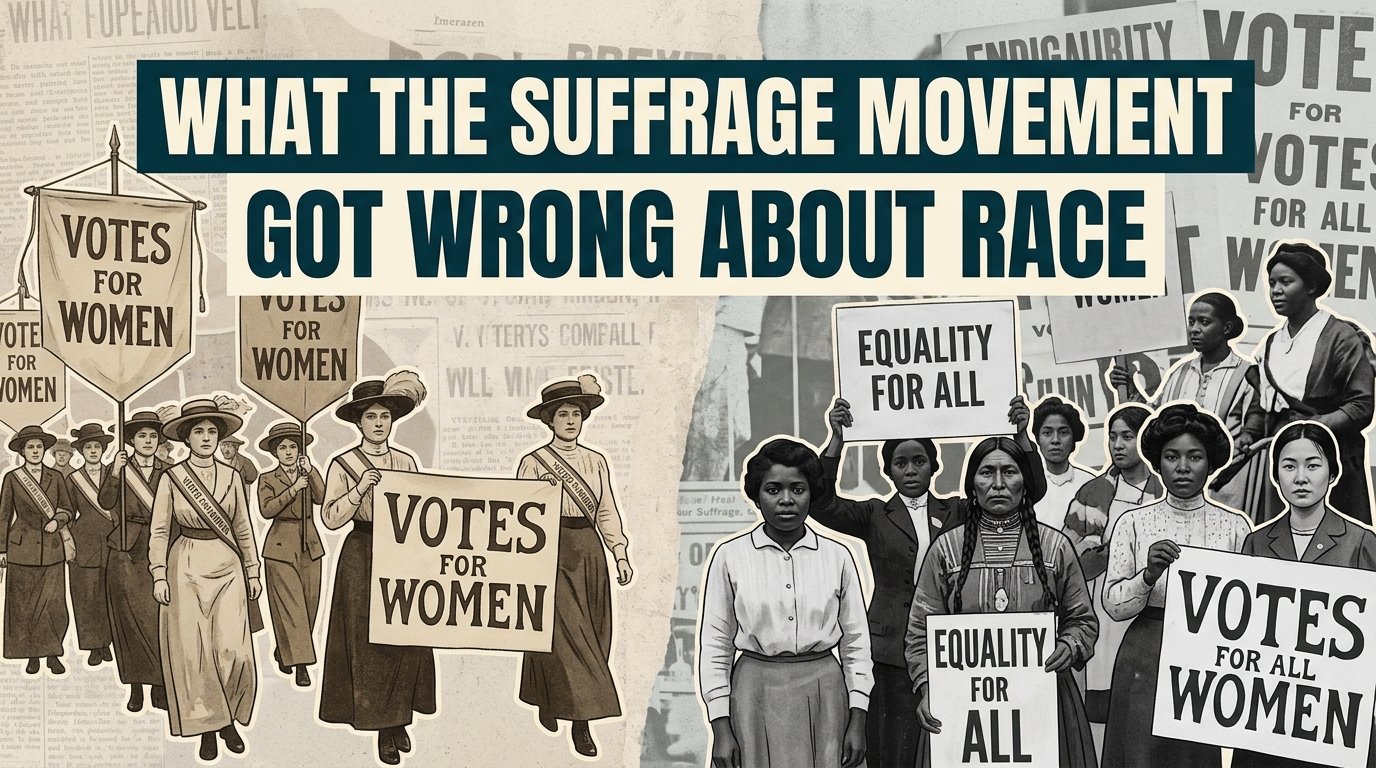
The women’s suffrage movement won white women the vote in 1920, but it got race profoundly wrong. White suffrage leaders excluded Black women from conventions, used racist appeals to win Southern support, and treated Black women’s voting rights as expendable bargaining chips. The result was a movement that advanced some women by sacrificing others.
For 2026 readers revisiting this history, the picture is uncomfortable but necessary. The 19th Amendment, celebrated as a triumph for “women,” actually enfranchised white women at scale while Black women in the South remained locked out for another 45 years. Understanding what the suffrage movement got wrong about race means looking at specific decisions, specific leaders, and specific women who were pushed aside.
I have spent years studying this history, and what stands out is that the racial failures were not accidents. They were strategies. Leaders like Elizabeth Cady Stanton and Carrie Chapman Catt made calculated choices to appeal to racism when it served the cause of white women’s votes. Meanwhile, Black women built their own parallel movement because the mainstream one would not make room for them.
This article walks through the core failures, the key figures, and the lasting consequences. We will look at Seneca Falls, the Fifteenth Amendment split, racist statements by suffrage leaders, the 1913 parade segregation, the fabricated Sojourner Truth speech, and how Jim Crow stole the Nineteenth Amendment from Black women.
Table of Contents
What the Suffrage Movement Got Wrong About Race: The Core Failures
The racial failures of the suffrage movement can be grouped into three deliberate patterns. Each one compounded the others and shaped who actually benefited from women’s enfranchisement.
1. Excluding Black women from leadership and events. From Seneca Falls in 1848 through the major conventions of the late 1800s, Black women were either absent, tokenized, or actively barred. When they did show up, they were often segregated or silenced.
2. Making racist appeals to win white votes. After the Civil War, suffrage leaders argued that white women deserved the vote more than Black men. They told Southern politicians that white women voters would dilute Black political power. This was not coded language. It was explicit.
3. Treating Black women’s rights as expendable. When strategic choices arose, white suffragists repeatedly sacrificed Black women’s interests. The 1913 Washington parade segregation order is the most famous example, but the pattern runs through decades of decisions.
These three failures are not separate incidents. They are connected strategies that reveal how a movement for justice can itself perpetuate deep injustice.
Seneca Falls and the Original Exclusion
The 1848 Seneca Falls Convention is celebrated as the birthplace of the American women’s rights movement. Roughly 300 people gathered in upstate New York to demand women’s social, civil, and political rights. But the foundational event of the movement was, in practice, an event organized by and for white women.
There were no Black women among the signers of the Declaration of Sentiments. The convention’s leadership, including Elizabeth Cady Stanton and Lucretia Mott, did not actively recruit Black women to participate. The movement that emerged from Seneca Falls carried that demographic narrowness forward for decades.
Frederick Douglass stood out as the lone prominent Black voice at Seneca Falls. He was the only man to publicly support the resolution demanding women’s right to vote. His backing was decisive. The suffrage resolution passed by a narrow margin, largely because Douglass argued that he could not deny women rights he himself was fighting to secure.
Douglass’s presence is often cited to suggest the early movement was racially inclusive. It was not. His inclusion at one convention does not erase the systematic absence of Black women from the movement’s founding institutions. The template set at Seneca Falls, a white-led movement where Black participation was exceptional rather than central, defined the suffrage cause for the next seven decades.
The Fifteenth Amendment Split That Broke the Movement
The deepest rupture over race came after the Civil War, when Congress debated the Fifteenth Amendment. Ratified in 1870, the Fifteenth Amendment prohibited denying male citizens the right to vote based on race, color, or previous condition of servitude. In practice, it enfranchised Black men. It said nothing about women of any race.
Elizabeth Cady Stanton and Susan B. Anthony were furious. They had expected the postwar amendments to include women. When Republican leaders chose to push Black male suffrage first, arguing the country was not ready for women’s voting rights, Stanton and Anthony turned bitterly against the amendment.
Their opposition was not just principled disagreement over timing. It turned openly racist. Stanton argued that the vote should go to “educated” women, not to what she called “ignorant” Black men and immigrant men. In her publication The Revolution, she warned that white women of “wealth, education, and refinement” were being made subordinate to men she described in degrading racial terms.
Anthony made a similar calculation. She had spent years working alongside abolitionists, but when the Fifteenth Amendment prioritized Black men’s votes over all women’s suffrage, she declared she would cut ties with the abolitionist movement if it did not support women’s suffrage too. The betrayal Black activists felt was immediate and lasting.
The Fifteenth Amendment fight split the suffrage movement in two. Stanton and Anthony formed the National Woman Suffrage Association, which opposed the amendment. A rival group, the American Woman Suffrage Association led by Lucy Stone, supported it. The two factions did not reunite until 1890, forming the National American Woman Suffrage Association, or NAWSA. By then, the racial damage was done.
Frederick Douglass, who had stood with Stanton at Seneca Falls, was among those who broke with her over the Fifteenth Amendment. He argued that Black men, freshly emerged from slavery, faced the most immediate danger and deserved the vote first. Stanton’s response, laced with racial disdain, ended what had been a powerful alliance.
Racist Statements by Suffrage Leaders
The history of suffrage movement racism is not a matter of implication. It is documented in the words of the movement’s most celebrated leaders. Reading their statements directly is the clearest way to understand what went wrong.
Elizabeth Cady Stanton argued during the Fifteenth Amendment debate that if the vote were extended to Black men before white women, it would mean “an arrogance of the educated and refined over the ignorant.” She wrote that “Patrick and Sambo and Hans and Yung Tung” did not deserve to make laws for women like herself. The racial framing was deliberate, an appeal to white superiority to argue for white women’s votes.
Susan B. Anthony took a more complicated but ultimately damning position. She is sometimes defended as less explicitly racist than Stanton, but her strategic choices told a different story. Anthony prioritized a federal suffrage amendment that would benefit white women, and she declined to push hard against the Southern state-level disenfranchisement that kept Black women from voting even after the Nineteenth Amendment passed.
Carrie Chapman Catt, who led NAWSA during the final push for the Nineteenth Amendment, pursued what historians call the “Southern Strategy.” She argued that giving white women the vote would help preserve white political dominance in the South. Her approach was pragmatic rather than openly hateful, but it explicitly used racial logic to win Southern support.
Belle Kearney, a Southern suffragist, made the appeal even more explicit. In 1903 she told a NAWSA convention that granting white women the vote would guarantee “the supremacy of the white race” in the South. The convention did not repudiate her. The room largely agreed.
These statements are not isolated quotes pulled out of context. They were central to the suffrage movement’s strategy for decades. When modern audiences celebrate these leaders, the racial dimension of their work cannot be separated from the achievements.
NAWSA’s Southern Strategy
By the early 1900s, NAWSA had made a calculated decision to court Southern politicians. The South was the hardest region to win for women’s suffrage, and NAWSA leaders believed the only way to break through was to make the case in racial terms.
The pitch was simple and brutal. White women voters, the argument went, would outnumber and offset Black male voters. Granting white women suffrage would preserve white political control. This was not a fringe argument within the movement. It was NAWSA’s official approach to the South.
Kate Gordon of Louisiana became one of the most vocal Southern suffragists. She argued that states should control their own suffrage rules precisely because federal oversight threatened white supremacy. She eventually broke with NAWSA over its push for a federal amendment, not because she opposed suffrage but because she feared a federal amendment might eventually force Southern states to let Black women vote too.
The Southern Strategy worked in the sense that it helped build Southern support. But it cemented the movement’s identity as a white women’s movement. By the time the Nineteenth Amendment passed, NAWSA had spent years telling Southern politicians that white women voters would help maintain racial hierarchy. The same logic meant that when the amendment passed, Southern states used Jim Crow laws to keep Black women from actually exercising the right NAWSA had just won.
This is the connection too few accounts make. NAWSA’s Southern Strategy did not just exclude Black women from the movement. It built the rhetorical framework that Southern states used to exclude Black women from the franchise afterward.
The 1913 Washington DC Parade Incident
One event crystallizes the suffrage movement’s racial failures more than any other: the 1913 Women’s Suffrage Parade in Washington, DC. Organized by Alice Paul and the Congressional Union, the parade was held the day before Woodrow Wilson’s inauguration. It was designed to be a massive, visible demonstration for a federal suffrage amendment.
The problem emerged immediately. Black women wanted to march. Some Southern delegates threatened to withdraw if Black women participated in integrated delegations. Alice Paul faced a choice: stand for integration or appease the Southern delegations.
Paul chose appeasement. She issued an order that Black women should march in a segregated section at the back of the parade. The official stance was that Black women were “not excluded,” but the reality was segregation by another name.
Ida B. Wells refused. Wells, the legendary anti-lynching journalist and suffrage advocate, had traveled to Washington as part of the Illinois delegation. When told that Black women from Illinois should march in the segregated section, Wells explicitly rejected the order. She waited in the crowd until the Illinois delegation passed, then stepped out and marched with them, arm in arm with white colleagues who supported her.
Wells’s defiance was not just personal courage. It was a public rejection of the suffrage movement’s willingness to sacrifice Black women for white women’s comfort. The image of Wells marching where she chose became a defining moment in the history of Black women’s resistance to exclusion.
Mary Church Terrell also marched, leading a delegation of Black women from the National Association of Colored Women. Members of Delta Sigma Theta, the newly founded Black sorority from Howard University, marched as well. They chose participation despite the segregation order, on the grounds that Black women’s presence in the suffrage fight could not be erased even by hostile organizers.
The 1913 parade exposed the central contradiction. The movement demanded equality for women while practicing inequality among women. Black women showed up anyway, but the message from white leadership was unmistakable: this movement was not built for them.
Sojourner Truth and the Fabricated Speech
Few stories reveal the racial dynamics of women’s rights history more disturbingly than the case of Sojourner Truth’s famous “Ain’t I a Woman?” speech. The version most people know is, in significant part, a fabrication.
Truth, a formerly enslaved Black woman, spoke at the 1851 Women’s Rights Convention in Akron, Ohio. She was the only Black woman present. Her remarks challenged the prevailing idea that women were inherently frail and needed protection. She pointed out that no one had protected her from the brutal labor and violence of slavery.
The problem is that the version of the speech taught in schools was published 12 years later, in 1863, by Frances Gage, a white abolitionist. Gage’s version put the words in a heavy, stereotyped Southern dialect that Truth, who grew up speaking Dutch in New York, almost certainly did not use. Gage also invented dramatic details, including a hostile crowd that the original records do not support.
The earlier account, published in 1851 by Marius Robinson, a journalist who attended the convention, tells a different story. Robinson’s version records Truth speaking in plain, forceful English without dialect. The content is powerful but the language is not the caricatured voice Gage invented.
Why does this matter? Because Gage’s fabricated version does two harmful things. First, it distorts Truth’s actual voice, replacing her real words with a white woman’s invention of how a Black woman should sound. Second, it became the version that survived in history, meaning the most famous speech by a Black woman in the suffrage era was shaped, edited, and partly invented by a white woman.
This is not a minor historical footnote. It is a concrete example of how Black women’s contributions to women’s rights were mediated, altered, and owned by white narrators. Recovering Truth’s actual words is part of recovering the truth of what the suffrage movement got wrong about race.
Black Women Built Their Own Suffrage Movement
Because the mainstream suffrage movement would not make room for them, Black women organized their own institutions, clubs, and campaigns for voting rights. This parallel movement is one of the most important and least told parts of suffrage history.
Mary Church Terrell was among the most prominent. Born to formerly enslaved parents who became wealthy, Terrell earned a master’s degree, taught in Washington, DC, and became a founding president of the National Association of Colored Women, or NACW, in 1896. The NACW organized Black women across the country around suffrage, education, and anti-lynching work. Terrell marched in the 1913 parade and continued advocating for Black women’s voting rights long after the Nineteenth Amendment passed.
Ida B. Wells founded the Alpha Suffrage Club in Chicago in 1913, one of the first Black women’s suffrage organizations in the country. The club registered Black women voters, educated them about candidates, and mobilized them at the polls. Wells understood that the vote was meaningless without organization, so she built the infrastructure herself.
Nannie Helen Burroughs led the Women’s Convention of the National Baptist Convention, the largest Black women’s organization in the country. She trained thousands of Black women in political activism and argued that the vote was essential to combating both racism and sexism. Her school in Washington, DC, the National Training School for Women and Girls, produced generations of Black women leaders.
Frances Ellen Watkins Harper, a Black poet and lecturer, was decades ahead of her white suffrage counterparts in articulating what would later be called intersectionality. At the 1866 Women’s Rights Convention, Harper warned white suffragists that they did not understand the double burden Black women carried. She told them, “You white women speak here of rights. I speak of wrongs.” Harper recognized that a movement built only around white women’s experience would never serve Black women.
These women and their organizations did the actual work of enfranchising Black women, often with no support, and sometimes active opposition, from the mainstream movement. Their history is the counter-narrative to the simplified story of suffrage as a unified women’s cause.
Jim Crow Stole the 19th Amendment From Black Women
When the Nineteenth Amendment was ratified on August 26, 1920, it prohibited denying the right to vote on the basis of sex. In theory, Black women were now voters. In practice, especially in the South, the amendment changed almost nothing for them.
Southern states had spent decades building a wall of Jim Crow disenfranchisement: poll taxes, literacy tests, grandfather clauses, white primaries, and outright violence. These tools had been designed to strip Black men of the vote after the Fifteenth Amendment. They worked just as effectively against Black women after the Nineteenth Amendment.
The evidence is immediate and grim. In the fall of 1920, Black women across the South attempted to register to vote. Many were turned away. In Mississippi, local officials simply refused to process Black women’s registrations. Some Black women who tried to register faced threats, economic retaliation, or physical violence. The federal government did nothing.
White suffrage leaders largely moved on. Having secured the amendment, NAWSA and its successor organizations did not mount a serious campaign to enforce Black women’s right to vote. The Southern Strategy that had won the amendment also made enforcement politically unthinkable. NAWSA had told Southern politicians that white women’s votes would preserve white supremacy; demanding federal intervention to protect Black women’s votes would have contradicted that entire pitch.
For Black women in the Jim Crow South, real voting rights did not arrive until the Voting Rights Act of 1965. That is 45 years after the Nineteenth Amendment. When modern celebrations mark “100 years of women voting” or “women got the vote in 1920,” that framing erases the Black women who could not actually vote for nearly another half century.
The economic dimensions of this exclusion matter too. Poll taxes were not just legal barriers; they were financial ones. Black women, often working in low-paid domestic or agricultural labor, were least able to pay. Literacy tests were administered subjectively, with Black applicants held to impossible standards while white applicants were waved through. The system was designed to look race-neutral while functioning as a racial filter.
Intersectionality and Why This History Still Matters
The framework that best explains the suffrage movement’s racial failures is intersectionality, a term coined by legal scholar Kimberle Crenshaw in 1989. Intersectionality describes how race and gender (and other identities) overlap to create distinct forms of discrimination that neither single-axis analysis can capture.
For Black women in the suffrage era, this meant they were excluded from white-dominated women’s movements because of their race, and excluded from Black-led civil rights organizations that often centered male leadership. Their interests fell into a gap that neither movement prioritized.
This is why the simplified narrative of “women won the vote in 1920” is misleading. White women won the vote. Black women in the South had to fight 45 more years for the same right. The 19th Amendment centennial in 2020 prompted a long-overdue reckoning with this gap, but the mainstream story still often defaults to whitewashed celebration.
Understanding what the suffrage movement got wrong about race also matters for movements today. The pattern repeats whenever a cause for justice decides that some people’s rights can be deferred for strategic convenience. The suffrage leaders who argued “we will come back for Black women later” never actually came back. The deferral became permanent.
Frequently Asked Questions
What were the failures of the women’s suffrage movement?
The suffrage movement’s main failures were excluding Black women from leadership and events, making racist appeals to Southern politicians to win support, and treating Black women’s voting rights as expendable. These strategic choices meant the 19th Amendment primarily benefited white women while Black women in the South were blocked from voting for another 45 years.
What role did race play in the suffrage movement?
Race was central, not peripheral, to the suffrage movement. After the Fifteenth Amendment granted Black men the vote in 1870, white suffrage leaders like Elizabeth Cady Stanton used racist arguments to push for white women’s suffrage instead. NAWSA later adopted a Southern Strategy that explicitly promised white women voters would offset Black political power. Race shaped the movement’s strategy, rhetoric, and outcomes.
Was women’s suffrage racist?
Yes. The mainstream American women’s suffrage movement, particularly after the Civil War, used racist appeals as a core strategy. Leaders including Elizabeth Cady Stanton and Carrie Chapman Catt argued that white women deserved the vote more than Black men, and that white women voters would preserve white supremacy in the South. The movement also excluded Black women from conventions and segregated them at events like the 1913 Washington parade.
Did the suffragettes exclude Black women?
Yes. Black women were excluded from Seneca Falls in 1848 and from major suffrage organizations for decades. At the 1913 Washington DC suffrage parade, organizer Alice Paul ordered Black women to march in a segregated section. Ida B. Wells defied this order and marched with the Illinois delegation. Black women responded by building their own suffrage organizations, including the NACW and the Alpha Suffrage Club.
Did Susan B. Anthony only want white women to vote?
Susan B. Anthony’s record on race is complicated. She worked with abolitionists early in her career, but she opposed the Fifteenth Amendment because it excluded women. While Anthony was less overtly racist in her language than Elizabeth Cady Stanton, her strategic choices consistently prioritized a federal amendment that would benefit white women, and she did not push against the Southern disenfranchisement that kept Black women from voting after 1920.
When did Black women actually get the right to vote?
Black women technically gained the right to vote with the 19th Amendment in 1920, but in practice most Black women in the South were blocked from voting by poll taxes, literacy tests, and racial violence until the Voting Rights Act of 1965. That means Black women waited 45 years after white women to actually exercise voting rights.
How were Black women excluded from the suffrage movement?
Black women were excluded through multiple mechanisms: they were not invited to founding events like Seneca Falls, they were barred or segregated at major conventions and parades, they were denied leadership roles in organizations like NAWSA, and their interests were sacrificed in strategic deals with Southern politicians. When they pushed back, as Ida B. Wells did at the 1913 parade, white leaders often treated them as problems rather than partners.
Conclusion: What We Still Need to Learn
So what did the suffrage movement get wrong about race? It built a movement for women’s rights on a foundation of racial exclusion, and it never fully reckoned with that choice. White suffrage leaders excluded Black women from their conventions, used racist appeals to win political support, and then walked away when Black women needed enforcement of the very rights they had just won.
This history is complicated. Many of the same women who fought bravely for their own rights also participated in systems that denied those rights to others. Stanton and Anthony were genuinely courageous in their fight for women’s votes. They were also genuinely racist in how they fought. Both things are true at once.
The lesson is not that the suffrage movement was worthless. The lesson is that movements for justice fail when they treat some people’s rights as deferrable. The suffragists who promised to come back for Black women never did. The Black women who built their own organizations, from Mary Church Terrell’s NACW to Ida B. Wells’s Alpha Suffrage Club, had to finish the work the mainstream movement abandoned.
For readers in 2026, the relevance is direct. Every time a movement today faces a choice about whose rights come first, the suffrage era offers a warning. Strategic compromise that sacrifices one group’s freedom tends to become permanent. The 45-year gap between the Nineteenth Amendment and the Voting Rights Act is the price of that compromise.
If you want to go deeper, start with the primary sources. Read Stanton’s actual writings from the Fifteenth Amendment debate. Read Marius Robinson’s 1851 account of Sojourner Truth’s speech alongside Frances Gage’s fabricated 1863 version. Read Ida B. Wells’s own words about the 1913 parade. The history is there, and it is more honest than the simplified version most of us were taught.