
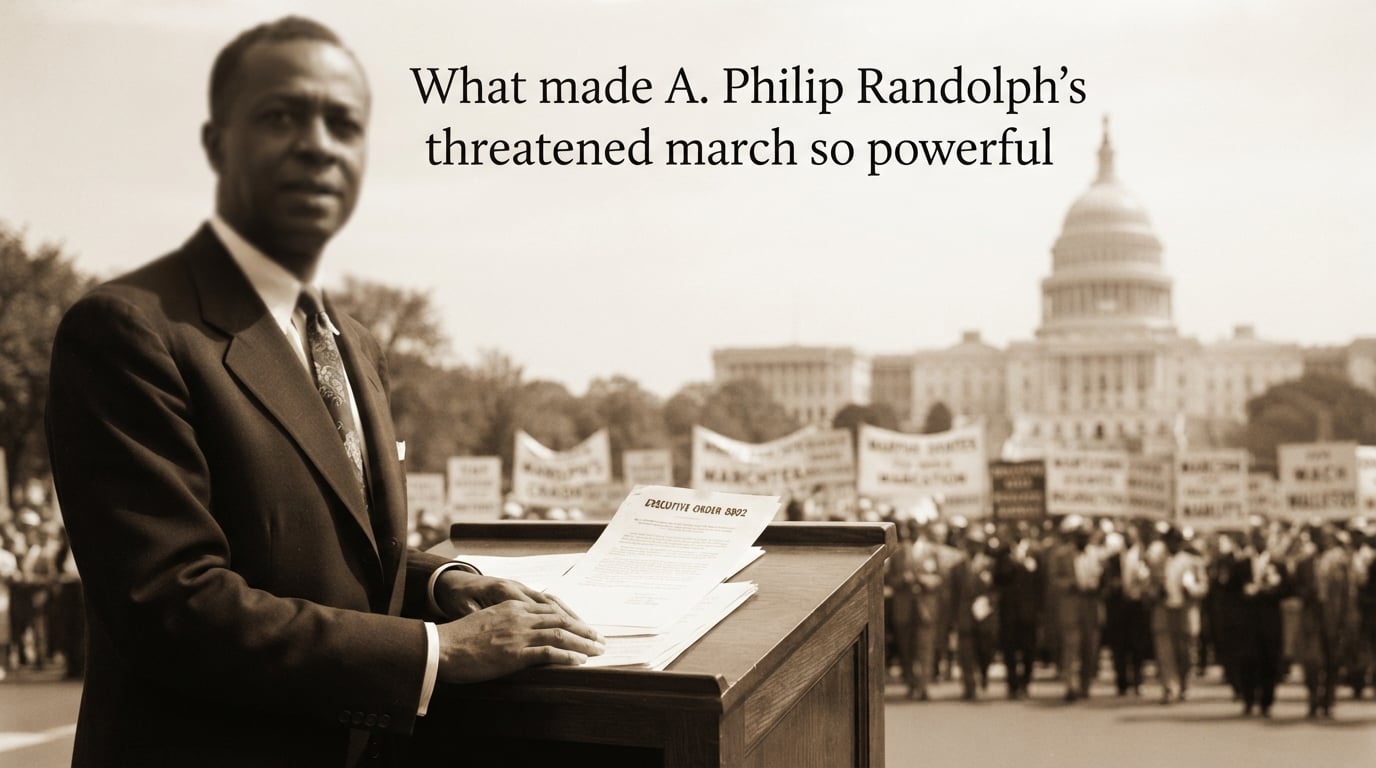
A. Philip Randolph’s threatened 1941 March on Washington was so powerful because it demonstrated that 100,000 Black Americans could mobilize as a unified political force and descend on the nation’s capital, a threat so credible that FDR had to act before a single marcher arrived. The threat alone forced President Franklin D. Roosevelt to issue Executive Order 8802 on June 25, 1941, banning racial discrimination in defense industries and creating the Fair Employment Practices Committee. No blood was shed. No march actually occurred. Yet the policy changed anyway, because Randolph turned the possibility of mass protest into political leverage that no wartime president could afford to absorb.
I want to walk you through the full picture, because this story is often skipped in classrooms. Randolph is a labor organizer who bent the most powerful office in the country to his knees without firing a shot. Understanding why the threat worked tells us something important about how movements pressure governments, and that lesson still applies to activism in 2026.
Table of Contents
Who Was A. Philip Randolph?
A. Philip Randolph was the most consequential labor organizer of his generation, and his credibility is the first reason his threat carried weight. Randolph was born in Crescent City, Florida, in 1889, the son of a Methodist minister and a seamstress. He moved to New York, studied at the City College of New York, and co-founded The Messenger magazine in 1917 with Chandler Owen. The magazine promoted socialism and Black self-determination during and after World War I.
The Brotherhood of Sleeping Car Porters
Randolph’s real authority came from leading the Brotherhood of Sleeping Car Porters (BSCP), which he organized starting in 1925. The Pullman Company employed Black men as porters but refused to recognize their union for over a decade. Randolph held the line through the Great Depression, when Black workers had no leverage to spare.
By 1937 the BSCP won a contract with the Pullman Company, the first major agreement between a Black union and a major U.S. corporation. That single victory made Randolph the most respected Black labor leader in the country. When he spoke about workers’ rights, he had receipts. When he called for a march, Black workers had already seen him win.
World War II and Defense Industry Discrimination
World War II created the conditions that made the threatened march necessary. After Germany invaded Poland in September 1939, the United States began a massive industrial mobilization. Factories in Detroit, Pittsburgh, and Los Angeles hired hundreds of thousands of workers to produce airplanes, tanks, and munitions. Federal contracts flowed through the same companies that openly refused to hire Black workers.
Even skilled Black workers watched white colleagues receive training and promotions while they were stuck in menial roles. Unions like the AFL maintained segregated locals in many cities. The federal government funded this system through defense contracts, even as Black men were being drafted through the Selective Service Act of 1940.
Randolph saw the contradiction clearly. Black Americans were being asked to fight fascism abroad while being treated as second-class citizens at home. In September 1940, he met with Roosevelt at the White House and asked for federal action against discrimination in defense plants. FDR gave him a polite non-answer. Randolph left the meeting and decided a march was the only path forward.
The January 1941 Call to March on Washington
On January 25, 1941, Randolph made the official call for a March on Washington. He declared that 100,000 African Americans would descend on the capital on July 1, 1941, to demand an end to segregation in defense industries and equal access to jobs in the war economy. The march would be peaceful, but its scale would be unprecedented.
Randolph spent the next five months organizing. He built the March on Washington Movement, a coalition of Black labor, civic, and religious organizations. He recruited Bayard Rustin, a young pacifist and brilliant tactician, as his chief organizer. He raised funds, arranged transportation by train and bus, and prepared plans to feed and house marchers in segregated Washington, D.C., where Black visitors could not stay in most hotels.
The logistical challenge was staggering. Randolph had to coordinate housing, food, sanitation, and medical care for tens of thousands of people in a city that openly discriminated against them. The fact that he pulled off this organizational feat, and the federal government knew it, is a key part of why the threat worked. By June 1941, state march committees had formed across the country. The march had real momentum, not just rhetoric.
Why the Threat Held Real Political Power
The threat was psychologically powerful for three reasons that go beyond the obvious headline.
Mass Mobilization That FDR Could Not Ignore
FDR was a master political calculator. He understood that 100,000 Black Americans marching on Pennsylvania Avenue would dominate news coverage, overshadow any war message, and create scenes of confrontation that his administration would have to manage. The image of Black veterans and workers being beaten or arrested by federal forces would have been politically catastrophic, especially as the U.S. was preparing to enter a war against Nazi racism.
Credibility Built Over a Decade
Randolph was not a fringe voice. He had already won the Pullman strike. He had already organized one of the largest Black voter registration drives in 1940. When he said 100,000 people would come, federal officials believed him. That credibility is what converted a march into a threat rather than a wish.
The Threat Could Be Withdrawn at a Price
The genius of the tactic was that both sides had room to negotiate. Randolph could call off the march if FDR met his demands. FDR could avoid the march by issuing an executive order. This made the threat an offer rather than a challenge. FDR could back down without appearing to surrender to mob pressure, and Randolph could declare victory without bloodshed.
Eleanor Roosevelt and the White House Negotiations
As July 1 approached, the Roosevelt administration scrambled. Eleanor Roosevelt met secretly with Randolph in early June 1941 to find a compromise. She offered a watered-down executive order and asked Randolph to call off the march. Randolph refused. He wanted the order to include real enforcement, including a permanent Fair Employment Practices Committee with subpoena power.
Eleanor warned her husband that the march would go forward if he did not act. FDR continued to resist until the last possible moment. He reportedly told aides that he could not afford to give in to “pressure from a bunch of Negroes.” His advisors, including several members of the Black Cabinet, made clear that the political damage from a hostile march would be far worse than the political cost of a moderate executive order.
Executive Order 8802: The Concession
On June 25, 1941, six days before the scheduled march, FDR signed Executive Order 8802. The order declared that there should be no discrimination in the employment of workers in defense industries or government because of race, creed, color, or national origin. It established the Fair Employment Practices Committee (FEPC) to investigate complaints and recommend enforcement.
This was the first federal action toward equal employment opportunity in U.S. history. It did not desegregate the military, and it did not end Jim Crow. The FEPC had no real enforcement power and was starved of funding. Randolph knew the order was incomplete. He called it a “second-class” executive order at the time.
Yet he canceled the march. The threat had produced the only civil rights victory of its kind during the Roosevelt administration, and it had done so without a single demonstrator setting foot in Washington.
Why Bayard Rustin Counseled Randolph to Keep the March Alive
Bayard Rustin, who would later help organize the 1963 March on Washington, advised Randolph not to fully disband the March on Washington Movement. Rustin understood that the FEPC was weak and that the threat’s power depended on the movement remaining visible and ready to march again.
The movement continued organizing, staging smaller demonstrations and voter drives, even after the executive order. When the FEPC was weakened in 1943 and 1944, Randolph threatened renewed mass action. The threat had staying power because the movement refused to disappear.
Legacy of the 1941 Threat
The 1941 threatened march established a tactical template that shaped the rest of the 20th century civil rights movement. The basic playbook, mobilize a large constituency, frame the demand clearly, pick a politically damaging target date, negotiate from a position of credible mass action, was refined by Randolph, then adopted by the 1963 March on Washington leaders.
Randolph himself helped organize the 1963 March, where Martin Luther King Jr. delivered “I Have a Dream.” Randolph stood on the steps of the Lincoln Memorial that day, decades after his own threat had proven the formula.
For modern activists, the lesson is simple. The threat of a mass demonstration, when paired with credible organization and clear demands, can force policy change without anyone getting hurt. Randolph’s 1941 march shows that the most powerful protest is sometimes the one that never has to happen.
Frequently Asked Questions About A. Philip Randolph’s 1941 March Threat
What did Philip Randolph threaten to do?
Randolph threatened to lead 100,000 African Americans in a March on Washington on July 1, 1941, to protest racial discrimination in defense industries during World War II.
Why did Randolph threaten a March on Washington during WWII?
Randolph threatened the march because Black Americans were being drafted to fight fascism abroad while being excluded from well-paid jobs in the U.S. defense industry. He wanted federal action to ban discrimination in defense plants.
What was one direct effect of A. Philip Randolph’s threatened March on Washington?
The most direct effect was that President Franklin D. Roosevelt signed Executive Order 8802 on June 25, 1941, which banned racial discrimination in defense industries and created the Fair Employment Practices Committee (FEPC).
Why was A. Philip Randolph important?
Randolph was important because he organized the Brotherhood of Sleeping Car Porters, the first major Black labor union to win a contract with a major U.S. corporation, and because his 1941 threatened march established a tactical blueprint for the entire civil rights movement.
What were two direct results of Philip Randolph’s threat?
Two direct results were Executive Order 8802, which banned discrimination in defense industries, and the creation of the Fair Employment Practices Committee (FEPC), the first federal body tasked with enforcing equal employment opportunity.
Did the 1941 March on Washington actually happen?
No. The march was canceled after Roosevelt issued Executive Order 8802 six days before the planned July 1, 1941, date. Randolph still organized a smaller July 1 rally to celebrate the executive order, but the mass march never took place.
The Power of a Threat That Never Marched
The story of A. Philip Randolph’s threatened 1941 March on Washington is one I keep coming back to. The march was powerful because it was real, organized, and ready to descend on Washington, yet flexible enough for both sides to walk away with a deal. Randolph demonstrated that the threat of mass nonviolent action can move presidents more effectively than violence ever could.
If you want to understand how civil rights victories actually happen, study the moments when they didn’t have to. Executive Order 8802 came from pressure that never had to be physically applied. The Fair Employment Practices Committee existed because Randolph was willing to march, and FDR was wise enough to let him call it off.
For students, educators, and anyone studying movement politics in 2026, the lesson is the same. Build the crowd. Set the date. Name the demand. Then let the threat do the work.