
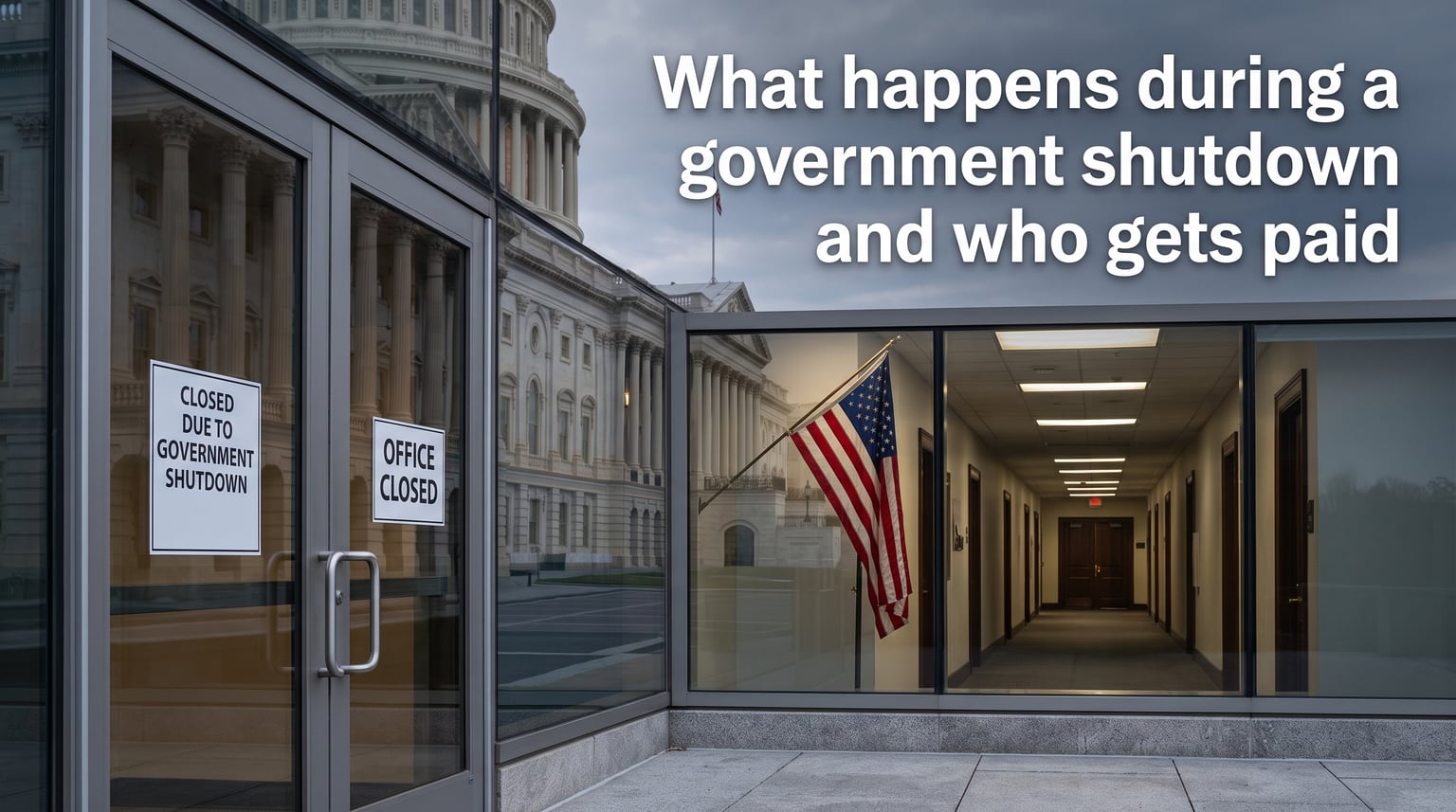
When Congress fails to agree on a spending plan, the result is a government shutdown — a funding lapse that forces federal agencies to shutter non-essential operations and send hundreds of thousands of workers home without a paycheck. If you’ve ever wondered what happens during a government shutdown and who gets paid, you’re not alone. After the 43-day shutdown that began on October 1, 2025 — the longest in American history at that point — millions of people searched for answers to exactly these questions.
This guide breaks down how a shutdown actually works, who keeps their job and receives (or waits for) a paycheck, which government services stop running, and what the law says about back pay for federal workers. Whether you’re a federal employee trying to plan ahead or just a citizen trying to understand what’s happening in Washington, this explainer covers everything you need to know.
The short answer: essential federal employees keep working but don’t get paid on time. Non-essential employees are sent home and also don’t get paid on time. Under a 2019 law, all federal employees are guaranteed back pay once the shutdown ends. Federal contractors, however, have no such guarantee.
Table of Contents
What Is a Government Shutdown?
A government shutdown occurs when Congress fails to pass appropriations bills — or the president refuses to sign them — before existing funding expires. The result is a “funding gap” that legally prevents most federal agencies from operating.
The U.S. federal government runs on a fiscal year that begins October 1 and ends September 30. By the end of each September, Congress is supposed to pass 12 separate spending bills covering every corner of the federal government — from defense and transportation to housing and education. When those bills aren’t passed and signed into law by midnight on September 30, the government runs out of spending authority.
The legal backbone of shutdowns is the Antideficiency Act, a law that prohibits federal agencies from spending or obligating money that hasn’t been appropriated by Congress. This isn’t optional — agencies that violate it face serious legal penalties. So when funding runs out, agencies must stop spending. That means stopping work.
A “partial shutdown” occurs when some appropriations bills have been passed (covering certain agencies) but others haven’t. In a partial shutdown, funded agencies continue operating normally while unfunded ones must shut down. The 2025 shutdown was a full shutdown, meaning no appropriations bills had been signed by the October 1 deadline.
The government doesn’t shut down like a retail store flipping a “closed” sign. Some operations — called “excepted” or essential services — must continue regardless of a funding lapse. Everything else stops until Congress passes new legislation and the president signs it.
Essential vs. Non-Essential: How Agencies Decide Who Works
During a government shutdown, every federal agency must review its entire workforce and split employees into two categories. This process is guided by rules from the Office of Management and Budget (OMB) and the Office of Personnel Management (OPM), but agencies have significant flexibility in how they apply them.
“Excepted” employees — sometimes called essential personnel — are required to keep working even without funding authority. They show up, do their jobs, and don’t get paid until the shutdown ends and Congress passes a funding bill. Their paychecks are delayed, not canceled.
“Furloughed” employees are sent home and prohibited from working. This is a critical point many people miss: furloughed workers aren’t just asked to stay home voluntarily. They are legally prohibited from checking email, making work calls, or doing any job-related work. Doing so would violate the Antideficiency Act. Their pay is also delayed until the shutdown ends.
Each agency is required to maintain a “shutdown contingency plan” — a document prepared in advance that identifies which positions must remain filled during a funding lapse. These plans are updated regularly and filed with OMB.
The general categories of workers classified as excepted (essential) include:
Workers protecting life and safety — Border Patrol agents, TSA officers, air traffic controllers, Coast Guard personnel, active-duty military
Law enforcement officers — FBI agents, DEA officers, federal marshals, Secret Service agents
Workers guarding federal property and preventing its deterioration
Prison staff at federal correctional facilities
Emergency medical and crisis response personnel
Employees funded through multi-year appropriations or user fees rather than annual discretionary spending
Workers supporting functions authorized by statutes that don’t require annual appropriations
Typically, somewhere between 60 and 70 percent of the federal civilian workforce continues working during a shutdown, though this varies widely by agency. The Department of Defense and Department of Homeland Security continue operating at high capacity. The National Park Service, EPA, and many administrative agencies operate with skeleton crews or close entirely.
Some agencies are almost entirely excepted. The Transportation Security Administration, for example, continues airport screening operations because the safety function is considered essential. TSA agents worked throughout the 2025 shutdown — without pay — for weeks before Congress acted.
What Happens During a Government Shutdown and Who Gets Paid
This is the question that matters most for the millions of people affected by a shutdown, and the answer is more nuanced than a simple yes or no.
Excepted Employees (Essential Workers)
Excepted employees report to work as normal during a shutdown. They perform all their regular duties. What they don’t do is receive their regular paychecks on schedule. Their pay is withheld until Congress passes new appropriations legislation and the shutdown ends.
Under the Government Employee Fair Treatment Act of 2019, back pay for these workers is now automatic. The moment a shutdown ends, excepted employees are legally guaranteed to receive all back pay covering every missed pay period. That back pay typically arrives within one to two pay cycles after funding is restored.
Furloughed Employees (Non-Essential Workers)
Furloughed employees don’t work and don’t get paid during the shutdown. However, they are also covered by the Government Employee Fair Treatment Act of 2019. This means furloughed employees are guaranteed back pay for the entire duration of the shutdown once it ends — they will be compensated for the time they were forced to stay home.
This was not always the case. Before 2019, back pay for furloughed workers required a separate act of Congress after each shutdown. Congress always voted to provide it, but there was no legal guarantee until the 2019 law made it permanent and automatic.
When Paychecks Stop
Federal civilian employees are typically paid on a biweekly schedule. If a shutdown begins on October 1, the first missed paycheck usually hits about two weeks into the shutdown. During the 2025 shutdown, many federal workers received a $0.00 paycheck around October 17 — the first pay date after the shutdown began.
One federal worker described the experience in an online forum during the 2025 shutdown: “My paycheck was $0.00. Rent is due soon. I’m terrified.” The back pay guarantee matters enormously, but it doesn’t prevent the immediate financial pressure that comes from missing a paycheck.
Military Personnel
Active-duty military members continue reporting to duty during a government shutdown — there is no scenario where the military stops operating. However, their pay status is more complicated.
Military pay is NOT automatically protected from a shutdown the way federal civilian pay is. Without an emergency appropriations act covering military compensation, active-duty service members would technically go without pay until the shutdown ends. Congress has frequently passed narrow emergency legislation specifically to continue military pay during shutdowns, but this is not guaranteed — it requires a separate political agreement.
National Guard members and reservists are affected based on whether they are currently on active-duty orders. If they are activated to active-duty status, their pay follows the same rules as active-duty military. If they are in their traditional reserve role and called up during the shutdown, the payment of those orders becomes uncertain.
Federal Contractors
Federal contractors — the millions of workers employed by private companies with government contracts — are in the most precarious position during a shutdown. They are NOT covered by the back pay guarantee that protects federal employees. If their company’s contract is suspended during a shutdown, those workers may receive no pay and have no legal right to back pay afterward.
This affects a huge range of workers: food service employees in federal buildings, IT contractors at agencies, maintenance workers, defense contractors, and countless others. Some employers continue paying their employees out of reserves during a short shutdown, but an extended lapse — like the 43-day 2025 shutdown — puts real strain on contractor finances and workforce.
Members of Congress and the President
Members of Congress and the president continue receiving their salaries during a government shutdown. Congressional pay is funded through a permanent, indefinite appropriation rather than annual discretionary spending, which means it doesn’t expire at the end of the fiscal year. Some lawmakers have voluntarily donated their shutdown-period pay to charity or declined to accept it, but they are under no legal obligation to do so.
Which Government Services Close and Which Stay Open
A government shutdown does not shut down the entire federal government. The impact varies dramatically depending on how each program is funded and whether it serves a function classified as essential.
Services and Functions That Typically CLOSE or Operate at Reduced Capacity
National Parks and federal recreation areas are among the most visible casualties of a shutdown. Most national parks either close entirely or operate with dramatically reduced staff, meaning entrance gates go unstaffed, visitor centers lock their doors, campgrounds shut down, and maintenance stops.
Passport and visa processing slows significantly. Applications for new passports may face severe delays because State Department processing staff are furloughed. In a long shutdown, this can leave travelers unable to get a passport in time for planned trips.
The IRS and tax-related services slow dramatically. Tax audits are typically suspended, refund processing is delayed, and taxpayer assistance lines go understaffed. In an extended shutdown, this can affect the timing of tax refund checks for millions of Americans.
Small Business Administration (SBA) loan processing halts. New SBA loan applications cannot be processed, which hits small business owners waiting on funding for operations or expansion.
Federal Housing Administration (FHA) loan approvals slow down or stop, which can freeze home purchases for buyers relying on FHA-backed mortgages. This ripples into the broader housing market.
Environmental and workplace safety inspections are suspended. EPA and OSHA routine inspections stop during a shutdown, which means workplaces don’t get checked and environmental monitoring gaps emerge.
Federal museums and Smithsonian Institution properties close to the public. NASA suspends most research and administrative work, though mission-critical operations (like monitoring active space missions) continue.
Services and Programs That CONTINUE During a Shutdown
Many of the programs Americans depend on most are funded through “mandatory spending” — money that flows automatically by statute rather than through annual appropriations bills. These programs continue without interruption during a shutdown.
Social Security benefit payments continue going out. The Social Security Administration maintains a small staff of excepted employees to ensure benefit checks are sent on schedule. However, Social Security offices may reduce hours and customer service may be slower.
Medicare and Medicaid payments to hospitals, doctors, and care facilities continue. These programs operate under mandatory spending authority, so providers continue receiving reimbursements even when other government functions halt.
SNAP benefits (food stamps) continue for at least the first 30 days of a shutdown, funded by reserves from the prior year. An extended shutdown of more than 30 days can threaten SNAP funding and has historically prompted emergency congressional action to protect benefits.
Veterans’ benefits payments — including disability compensation, pensions, and education benefits — continue because VA benefit programs are funded through advance appropriations. The VA made a point of this during the 2025 shutdown to reassure veterans that their checks were protected.
The U.S. Postal Service operates normally. USPS is self-funded through postage revenue and does not rely on congressional appropriations, so mail and package delivery continue uninterrupted.
Banks and private financial institutions stay open. The federal government’s shutdown has no direct effect on commercial banks, credit unions, or ATMs. However, some banking regulatory functions handled by the FDIC or OCC may operate at reduced capacity.
TSA airport screening continues. TSA officers are classified as excepted employees because screening is an essential safety function. They keep airports running — without pay, in many cases — until the shutdown ends.
Air traffic control operates normally. FAA air traffic controllers are also excepted employees. Flights continue on schedule; the FAA does not shut down air traffic management during a funding lapse.
Active military operations continue. The armed forces do not stand down during a government shutdown. Border Patrol, Coast Guard, and emergency response operations continue as well.
Does a Government Shutdown Actually Save Money?
A persistent misconception about government shutdowns is that they save taxpayers money by cutting government spending. In reality, shutdowns cost more than they save.
When the government shuts down and eventually reopens, furloughed employees receive back pay for the days they didn’t work. The government ends up paying workers for days when no work was produced — the opposite of savings.
The Congressional Budget Office estimated that the 35-day 2018-2019 shutdown cost $11 billion in total economic damage, with approximately $3 billion permanently lost to the economy. That figure included lost productivity, delayed contracts, back pay for workers, and disrupted services that couldn’t be fully recovered.
The 43-day 2025 shutdown was even longer and likely cost significantly more — preliminary estimates suggested total economic losses in the range of $20 to $30 billion when accounting for delayed government contracts, lost productivity across federal agencies, back pay for furloughed workers, and damage to long-term agency planning.
Shutdowns also create compounding inefficiency that extends well beyond their end date. Projects that were paused don’t restart instantly. Contractors who couldn’t meet government deadlines face penalties or renegotiations. Agencies that lost trained staff to private sector jobs during the uncertainty take months to rebuild capacity.
Recent Government Shutdowns: A Look at 2025 and 2026
Government shutdowns have become more frequent in recent decades. The United States has now experienced more than 20 funding lapses since 1976, with the pace accelerating as partisan divisions over spending levels have deepened.
The 2025 Shutdown: 43 Days
On October 1, 2025, the federal government entered a full shutdown after Congress failed to pass either appropriations bills or a continuing resolution before the fiscal year deadline. The shutdown lasted 43 days — the longest in American history — ending in mid-November 2025.
During those 43 days, approximately 800,000 to 1 million federal civilian employees were furloughed. Hundreds of thousands more continued working as excepted employees without regular paychecks. Federal workers began missing paychecks around October 17, 2025 — about two weeks into the shutdown.
National parks closed, passport processing slowed, and many federal services operated at reduced capacity or stopped entirely. Federal workers who had lived through previous shutdowns described the 2025 event as far more financially damaging simply because of its duration. A 35-day shutdown means missing two full biweekly paychecks; 43 days meant the third paycheck was also at risk for many workers.
The 2026 Shutdowns
In 2026, the pattern continued. Two separate government shutdowns occurred in 2026, reflecting the ongoing difficulty Congress faces in agreeing on annual spending levels. Each shutdown brought the same cycle: excepted employees working without pay, furloughed employees sent home, essential services continuing while non-essential ones stopped, and eventual back pay once Congress acted.
Historical Shutdown Timeline
For context, here are the most significant modern shutdowns before 2025:
1995-1996 (21 days): The longest shutdown before the Trump era, stemming from a budget standoff between President Clinton and the Republican-led Congress
2013 (16 days): The Obama-era shutdown, triggered by disagreements over the Affordable Care Act
2018-2019 (35 days): The previous record holder, caused by a dispute over border wall funding — ending only when the political cost of a prolonged shutdown became too great for either party to sustain
2025 (43 days): The new record, now the longest in American history
How a Government Shutdown Ends: Appropriations and Continuing Resolutions
A government shutdown ends when the president signs legislation that restores funding authority to the federal government. There are two main paths to ending a shutdown.
The first is passing full appropriations bills — actual completed budgets for the relevant agencies. This is the proper solution but also the hardest one politically, since it requires Congress to agree on specific spending levels for hundreds of programs.
The second — and far more common — path is a Continuing Resolution, or CR. A CR is a stopgap measure that funds the government at existing or slightly modified levels for a defined short period, typically a few weeks to a few months. CRs don’t resolve underlying budget disagreements; they defer them. This is why shutdown threats often recur multiple times within a single fiscal year.
What is a Continuing Resolution, exactly? It’s a temporary spending bill that tells agencies: “Keep operating at roughly the same level you were funded at last year, until we figure out the new budget.” CRs allow the government to reopen quickly without requiring full agreement on contentious spending decisions.
The downside of CRs is significant. Agencies can’t start new programs, increase spending on priorities, or plan effectively when they’re operating on temporary funding that expires every few months. Long-term contracts become harder to manage. Defense acquisition programs that require multi-year commitments suffer delays. The Committee for a Responsible Federal Budget has documented that Congress has passed 49 CRs over a 20-year period — a pattern that keeps the government perpetually operating in short-term budget mode.
Back Pay Rights: What Federal Employees Need to Know
The single most important law protecting federal employees during a shutdown is the Government Employee Fair Treatment Act of 2019, signed by President Trump in January 2019 during the 35-day shutdown. Before this law, back pay for furloughed workers required Congress to pass a separate authorization after each shutdown — it always happened, but it was never legally guaranteed until it did.
Under the 2019 law, back pay is now automatic. The moment a shutdown ends and appropriations are signed, both excepted and furloughed federal employees are entitled to receive all pay they missed. Here is what the back pay guarantee covers:
All missed pay periods for both furloughed and excepted employees
Back pay calculated at the same rate as regular pay (no penalty or reduction)
Payment typically within one to two pay cycles after the shutdown ends
Here is what the back pay guarantee does NOT cover:
Interest on late payments — if you missed a mortgage payment because your paycheck was delayed, the government does not compensate you for late fees or interest charges
Lost income from canceled leave — if you had approved vacation time scheduled during the shutdown, you may not be compensated for that in the same way
Federal contractors — the back pay guarantee applies only to federal employees, not to the private-sector workers employed by companies that contract with the government
Forum discussions from federal workers during the 2025 shutdown revealed a consistent theme: even knowing that back pay was coming, many workers experienced severe financial stress. Those living paycheck to paycheck had no buffer to cover rent, car payments, or utilities while waiting for the shutdown to end. Some workers took on credit card debt, dipped into emergency savings, or turned to family for help. A few reached out to their states’ unemployment offices — though eligibility for unemployment benefits during a shutdown varies by state and many states ruled furloughed federal workers ineligible.
If you’re a federal employee facing a shutdown, financial advisors and federal employee unions recommend: contact lenders proactively to explain your situation (many offer hardship deferments), check whether your state allows furloughed federal workers to file for temporary unemployment, and review your agency’s union agreements, which may provide additional protections.
Frequently Asked Questions
Do I still get paid when the government shuts down?
It depends on your role. Excepted (essential) employees continue working but have their paychecks delayed until the shutdown ends. Furloughed (non-essential) employees are sent home and also have their pay withheld. Under the Government Employee Fair Treatment Act of 2019, all federal employees are guaranteed back pay for every missed pay period once funding is restored. Federal contractors, however, are not covered by this guarantee.
Do banks close if the government shuts down?
No. Banks are privately owned institutions and are not closed by a government shutdown. Commercial banks, credit unions, and ATMs continue operating normally. Some federal banking regulatory functions — handled by agencies like the FDIC or the Office of the Comptroller of the Currency — may operate at reduced capacity, but this does not affect your ability to access your money or use banking services.
Who gets affected if the government shuts down?
A government shutdown affects a broad range of people. Federal civilian employees face delayed paychecks, with furloughed workers sent home. Federal contractors may lose income with no back pay guarantee. Anyone relying on non-essential government services — like processing a new passport, visiting a national park, or applying for an SBA loan — will face delays or service closures. Programs like Social Security, Medicare, SNAP, and VA benefits continue, but with reduced staff support.
Who is not getting paid during a government shutdown?
During a shutdown, no federal employee receives a paycheck on their normal schedule — both essential workers and furloughed workers have pay withheld until the shutdown ends. Federal contractors are in the worst position: they may lose income entirely with no guaranteed back pay. Members of Congress and the president continue receiving salaries because their pay comes from a permanent appropriation that does not expire annually.
Does the military get paid during a government shutdown?
Active-duty military members continue reporting for duty during a government shutdown, but their pay is not automatically protected. Military pay requires either an emergency appropriations act specifically covering compensation or the shutdown to end. Congress has historically passed narrow legislation to continue military pay during shutdowns, but this is not automatic or guaranteed — it requires a separate political agreement. If Congress does not act, service members work without pay until funding is restored.
How long can a government shutdown last?
A government shutdown can technically last indefinitely — it ends only when Congress passes and the president signs new funding legislation. In practice, political pressure builds quickly as visible services stop and hundreds of thousands of workers miss paychecks. The longest shutdown in U.S. history was the 2025 shutdown, which lasted 43 days. The previous record was 35 days (2018-2019). Most shutdowns in history lasted fewer than 5 days, though the trend toward longer shutdowns has grown in recent decades.
Can I get unemployment benefits during a government shutdown?
Possibly, but it depends on your state. Eligibility for state unemployment benefits during a federal shutdown varies significantly. Some states allow furloughed federal workers to file for temporary unemployment during a shutdown. Others do not, on the grounds that back pay is guaranteed under the 2019 law. It is worth contacting your state’s unemployment office at the start of a shutdown to understand your eligibility, since waiting to apply could delay benefits if you do qualify.
Conclusion
Government shutdowns are never simple or painless. They ripple outward from Washington in ways that touch federal workers, military families, government contractors, national park visitors, first-time homebuyers, and anyone who depends on a federal agency for a time-sensitive service.
Understanding what happens during a government shutdown and who gets paid comes down to a few core facts. Essential employees keep working but wait for their paychecks. Non-essential workers are sent home and also wait for their paychecks. The Government Employee Fair Treatment Act of 2019 guarantees back pay for all federal employees once funding is restored. Federal contractors have no such protection. Programs like Social Security, Medicare, and VA benefits continue because they’re funded through mandatory spending rather than annual appropriations. And shutdowns don’t save money — they cost it.
In 2026, with the memory of the 2025 43-day shutdown still fresh and two more shutdowns having already occurred in 2026, the pattern is clear. Funding fights have become a recurring feature of the federal budget process. Knowing how shutdowns work — who gets paid, what closes, and what rights workers have — is no longer just background knowledge for policy wonks. It’s practical information that millions of Americans need every time Congress approaches a budget deadline.