
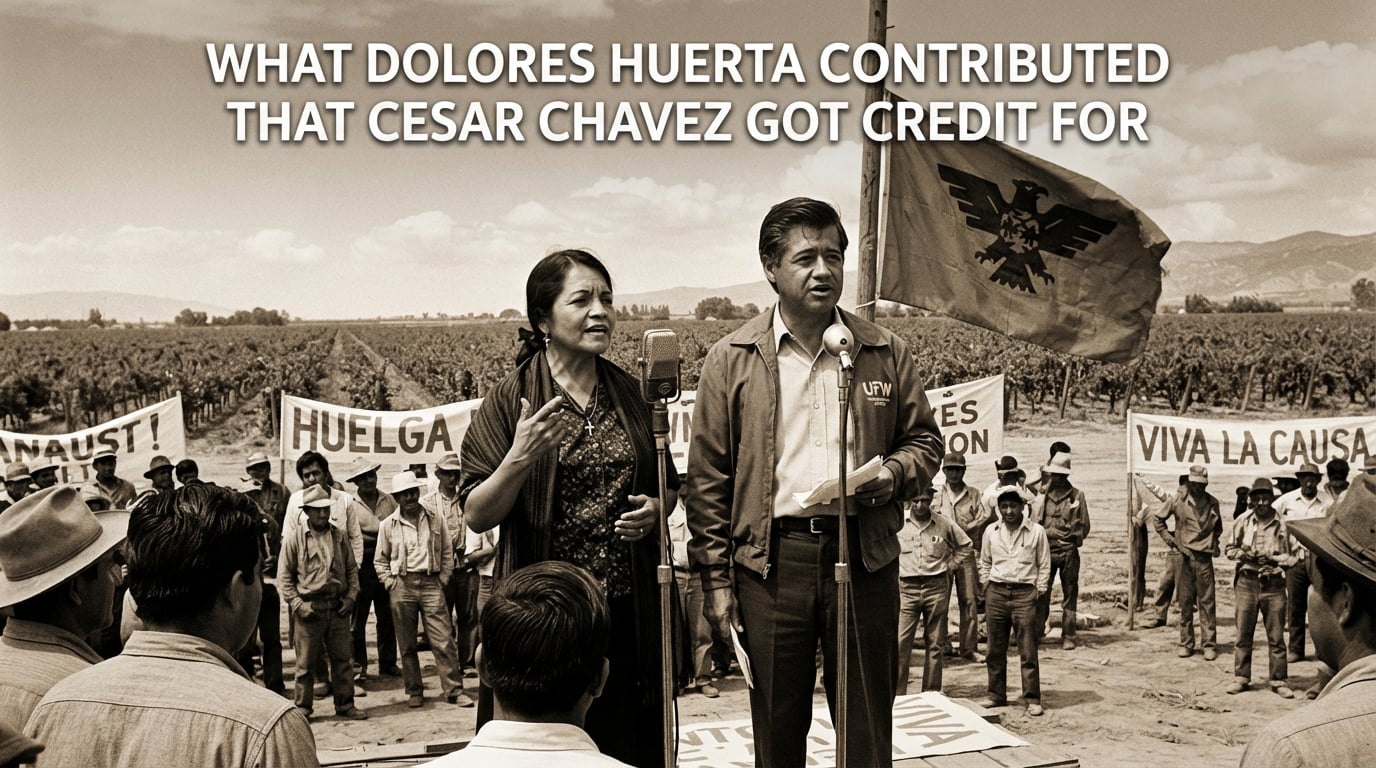
Dolores Huerta co-founded the National Farm Workers Association in 1962, coined the rallying cry “Si Se Puede” in 1972, and negotiated the contracts that turned farm workers into a recognized labor force. Cesar Chavez was the public face of that movement, and history tends to remember him while her name gets left out of the headline. This guide lays out exactly what Dolores Huerta contributed that Cesar Chavez received credit for, drawing on the documented record from labor historians, the U.S. Department of Labor, and the Dolores Huerta Foundation itself.
The story is not about taking credit from Chavez, who was a genuine organizer in his own right. It is about correcting a record that flattened a partnership into a single name. Huerta did the structural, legislative, and negotiating work that made the farm worker movement real, and for most of the twentieth century that work was filed under Chavez’s name in textbooks, news archives, and even union publicity.
Table of Contents
Who Were Cesar Chavez and Dolores Huerta
Cesar Chavez was born near Yuma, Arizona in 1927 and grew up as a migrant farm worker after his family lost their ranch during the Great Depression.
That experience pushed him into community organizing, first with the Community Service Organization (CSO) in the 1950s, where he worked to register Mexican American voters and push for better wages in barrios across California.
Dolores Huerta was born in 1930 in Dawson, New Mexico, and was raised in Stockton, California by a mother who ran a hotel and quietly organized workers alongside the Community Service Organization.
She earned a teaching degree from Delta Community College but left the classroom because she felt she could do more for low-wage workers through organizing than through a schoolbook.
By the late 1950s, both had built a name in California civil rights work. Huerta had already founded the Agricultural Workers Association in 1960 and was running voter registration drives in the San Joaquin Valley. Chavez was running the CSO’s Sacramento office.
They did not build the farm worker movement alone, and they did not build it as rivals. The labor movement they built together is where the credit split between them began, and it is where this article starts.
It is also where the distinction between public-facing leadership and behind-the-scenes organizing starts to matter. Chavez was a faster, a marcher, a presence on the lawn of a grower’s mansion. Huerta was the one drafting the policy paper before the march.
How Dolores Huerta Co-Founded the National Farm Workers Association
Dolores Huerta was the first person Cesar Chavez approached to help create the National Farm Workers Association (NFWA) in 1962.
The Bill of Rights Institute confirms that Chavez identified Huerta early as the partner he needed for the new organization, and the U.S. Department of Labor Hall of Honor lists her as a co-founder alongside him.
Huerta had already built a track record of organizing that Chavez respected. She had run her own Agricultural Workers Association, registered thousands of voters, and pushed CSO leadership to take farm worker issues seriously.
When the NFWA was launched in 1962, she took on the drafting, the bylaws, the meeting minutes, and the back-office structure of a new union with no paid staff and no money.
She traveled from town to town in California’s agricultural valleys, recruiting members by hand, often out of her own pocket. Within two years the NFWA had over 1,000 dues-paying families, and most of those memberships came through Huerta’s door-to-door work.
Without her, there was no organization to put on a map. The co-founding credit is the most basic place where Huerta’s contribution has been folded into Chavez’s name in popular accounts.
The union she helped build also became the backbone for a generation of Chicano civil rights activism in California, with UFW halls doubling as voter registration centers, English language classrooms, and meeting spaces for other organizing campaigns across the Southwest.
The ‘Si Se Puede’ Slogan Origin: Huerta, Not Chavez
“Si Se Puede” — meaning “Yes We Can” — was coined by Dolores Huerta in 1972, not by Cesar Chavez, despite years of public misattribution.
She originally used the phrase during a planning meeting for Chavez’s 25-day hunger strike protesting Arizona’s SB 1354, a law that banned farm worker boycotts and restricted picketing during harvest seasons.
Huerta has said the slogan was meant to lift the spirits of organizers facing aggressive opposition from growers, the state government, and law enforcement on every picket line.
It spread quickly through United Farm Workers (UFW) rallies, was picked up by the broader Chicano civil rights movement, and traveled decades later to President Barack Obama’s 2008 campaign slogan “Yes We Can.”
For most of the twentieth century, the phrase was tied to Chavez in popular memory, even though the UFW itself, the Smithsonian, and multiple historians credit Huerta as its creator.
The misattribution is one of the clearest examples of how Huerta’s specific contributions have been absorbed into the larger Chavez brand. The slogan is everywhere. Her name on it is rarely mentioned.
The phrase also outlived the movement that produced it. By the 1980s, “Si Se Puede” was a rallying cry at pro-immigration marches, in feminist organizing, and in school walkouts — none of which had anything to do with the UFW, but all of which traced back to Huerta’s original 1972 meeting room.
Aid for Dependent Families and Disability Insurance for Farm Workers
In 1963, Dolores Huerta helped secure state-backed Aid for Dependent Families and disability insurance for injured California farm workers.
This came out of NFWA legislative work that she led directly, lobbying Sacramento legislators and writing the policy language that became law.
Before this, farm workers were excluded from most state safety net programs because they were classified as independent contractors rather than employees. Huerta’s legal work changed that.
These were the first concrete wins the new union could point to, and they delivered real monthly checks to families who had nothing before. Disabled field laborers, for the first time, had a path to compensation.
Most articles about the farm worker movement skip past 1963 and jump straight to the 1965 Delano strike, which is why this victory rarely shows up next to Chavez’s name in casual retellings.
The U.S. Department of Labor credits both figures for the legislative push, but the policy detail work was Huerta’s, and it has been quietly rolled into the broader Chavez narrative ever since.
It was also the first proof that the new union could deliver for members without waiting for a contract. By the time the Delano strike started two years later, farm worker families already had direct experience with Huerta’s negotiating.
The Delano Grape Strike, Boycotts, and Contract Negotiations
Huerta was the lead negotiator for the Delano grape strike that began in 1965 and the table grape contracts that followed.
The strike started with Filipino American farm workers led by Larry Itliong of the Agricultural Workers Organizing Committee, and it was Huerta who helped merge Itliong’s AWOC with Chavez’s NFWA into a single strike committee.
She designed the national boycott of California table grapes that ran from 1968 to 1970, organizing caravans, dock worker agreements in Portland and Seattle, and city-by-city campaigns that cost growers an estimated 20 percent of their normal sales.
By the time growers signed the first contracts in 1970, Huerta had already done the bargaining. Historians describe her as more skilled at organization and detail than Chavez, and at the table, she was the one who knew the numbers.
The first UFW contracts covered wages, pesticides, hiring halls, and union recognition. They were signed in front of cameras with Chavez. They were written, clause by clause, by Huerta.
When the Sacramento and Coachella Valley contracts were announced in 1970, Chavez stood in front of the cameras and addressed the crowd. The contracts themselves were Huerta’s work.
It was during this same period that Huerta helped push through the Agricultural Labor Relations Act of 1975, the first law in U.S. history granting farm workers the right to collective bargaining. That landmark bill is often filed under Chavez’s name in school textbooks.
Why Cesar Chavez Got the Credit and Huerta Did Not
Cesar Chavez got the credit for the farm worker movement because he was the movement’s public speaker, its fasting leader, and its image in front of cameras.
Huerta did the structural work, the legislative drafting, and the contract negotiation that turned marches into signed agreements, and that work has historically been less visible to the public.
The press of the 1960s and 1970s also tended to elevate a single charismatic male leader over the women who organized alongside him, a pattern repeated across civil rights and labor movements of the era.
Huerta herself has pointed out that the union’s newsletters, posters, and internal communications often featured Chavez front and center while she ran the operation behind the scenes.
She also shouldered a larger personal cost. In 1988, Huerta was beaten by San Francisco police during a peaceful protest of the Bush campaign and suffered six broken ribs and a ruptured spleen. The assault made headlines but rarely as part of her own story.
Over time, recognition has caught up. Huerta received the Presidential Medal of Freedom in 2012 from President Obama and remains active through the Dolores Huerta Foundation. Still, the early decades of credit for co-founding the UFW, coining Si Se Puede, and securing the first contracts sit largely with Chavez.
In California, schools teach Cesar Chavez Day as a state holiday. There is no equivalent Dolores Huerta Day. That asymmetry is a useful shorthand for the recognition gap this article is trying to name and explain.
Frequently Asked Questions
What contributions did Dolores Huerta make?
Dolores Huerta co-founded the National Farm Workers Association in 1962, coined the slogan Si Se Puede in 1972, secured Aid for Dependent Families and disability insurance for California farm workers in 1963, served as lead negotiator during the Delano grape strike, and designed the national table grape boycott that ran from 1968 to 1970.
Who really coined the slogan Si Se Puede?
Dolores Huerta coined Si Se Puede in 1972 during planning for Cesar Chavez’s 25-day hunger strike against Arizona’s SB 1354, a state law banning farm worker boycotts. The slogan spread through United Farm Workers rallies, was adopted by the broader Chicano movement, and later influenced President Barack Obama’s 2008 campaign phrase Yes We Can.
Why does Cesar Chavez get more credit than Dolores Huerta?
Cesar Chavez was the movement’s public face, fasting leader, and main speaker at rallies, while Dolores Huerta handled legislative drafting, contract negotiation, and union operations behind the scenes. Press coverage of the 1960s and 1970s tended to elevate a single male spokesperson over the women organizing alongside him, which contributed to the recognition gap that persists today.
What did Dolores Huerta fight for?
Dolores Huerta fought for farm worker rights, including collective bargaining, disability insurance, voter registration for agricultural workers, and protections against dangerous pesticide exposure. She also pushed for immigrant rights, women’s rights, and broader civil rights legislation throughout her career and continues to advocate through the Dolores Huerta Foundation in 2026.
Did Dolores Huerta found the United Farm Workers?
Dolores Huerta co-founded the National Farm Workers Association in 1962 alongside Cesar Chavez, and the organization later became the United Farm Workers (UFW) in 1966 after merging with the Agricultural Workers Organizing Committee led by Larry Itliong. The U.S. Department of Labor Hall of Honor and the Dolores Huerta Foundation both list her as a co-founder.
What was Dolores Huerta’s role in the Delano grape strike?
Dolores Huerta served as lead negotiator during the Delano grape strike that began in 1965 and designed the national boycott of California table grapes that ran from 1968 to 1970. Her work at the bargaining table produced the first UFW contracts signed by growers in 1970, covering wages, pesticides, hiring halls, and union recognition.
Conclusion
Dolores Huerta contributed the co-founding of the National Farm Workers Association, the Si Se Puede slogan, the 1963 Aid for Dependent Families and disability insurance victories, the contract negotiations that ended the Delano grape strike, and the legislative work that produced the Agricultural Labor Relations Act of 1975. Cesar Chavez got the credit because he was the movement’s public face during decades when a single charismatic leader tended to absorb the recognition.
The history of farm worker rights in the United States is a shared story, and writing Dolores Huerta back into it is overdue. If you want to read more, the Dolores Huerta Foundation, the U.S. Department of Labor Hall of Honor, and the PBS American Experience documentary on Cesar Chavez all treat her role in detail and are good next steps for anyone studying labor history in 2026.
California public schools now teach both names side by side, and younger generations are more likely to learn the full partnership than older textbooks ever did. That shift matters, because the labor rights farm workers have today — collective bargaining, safer pesticide rules, minimum wage coverage — were won by both of them, and the historical record should reflect that. Correcting the credit is not about rewriting Chavez. It is about restoring Huerta.