
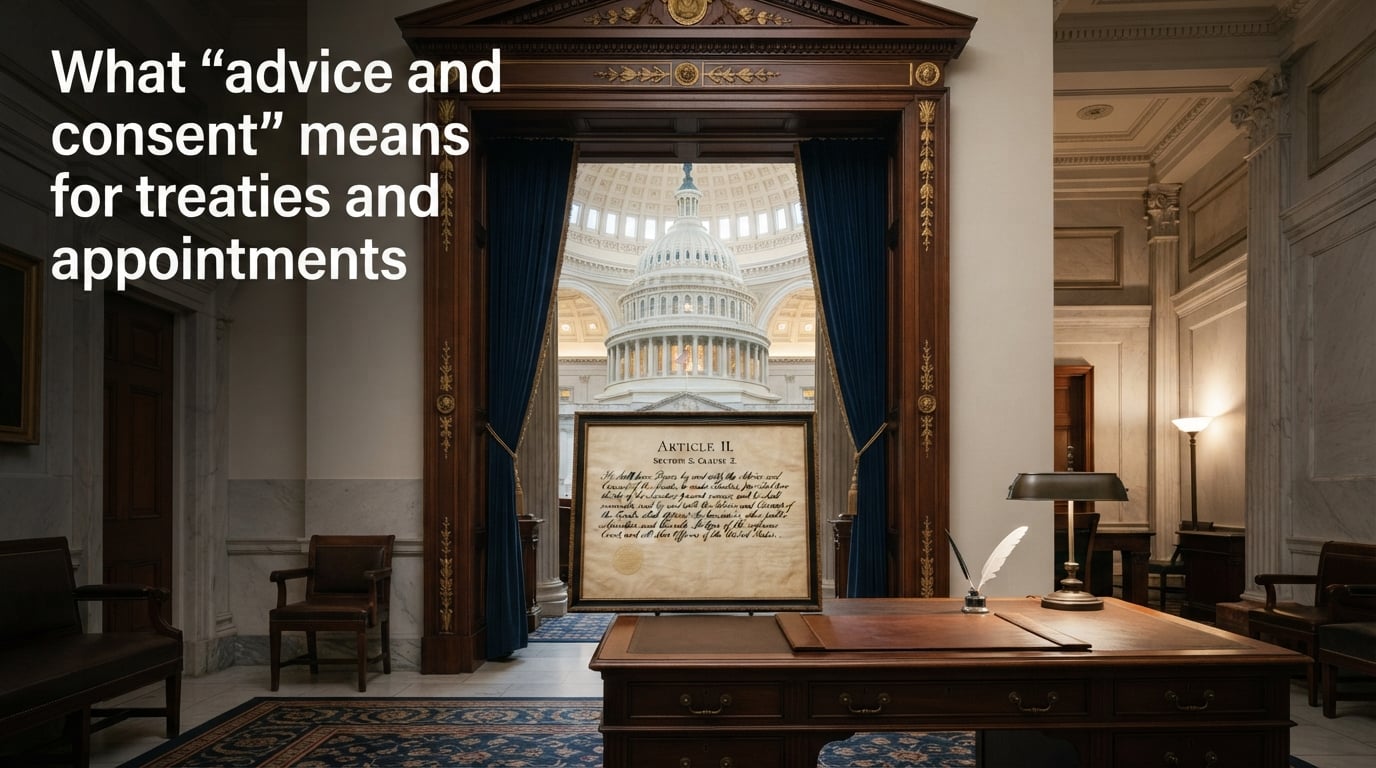
Advice and consent is the constitutional power of the United States Senate to approve treaties and confirm presidential appointments to the highest offices in government. It comes directly from Article II, Section 2, Clause 2 of the U.S. Constitution, and it serves as one of the most important checks the legislative branch holds over the executive branch.
I have spent weeks studying Senate procedure, reading the Federalist Papers, and reviewing recent confirmation battles to put together this guide. My goal is to walk you through exactly what advice and consent means, how it works in practice for both treaties and appointments, and why this clause matters more than ever in 2026.
Whether you are a student, a concerned citizen, or simply trying to understand a Senate vote you saw on the news, this article will give you the full picture without the legal jargon. We will start with the constitutional text itself, then move through how the Senate exercises these powers today, and finish with answers to the most common questions readers ask.
Throughout the piece I will reference historical examples, real procedural steps, and the practical consequences of this clause in modern politics. By the end, you will have a clear and accurate mental model of how the Senate’s advice and consent role actually functions.
Table of Contents
The Constitutional Source: Article II, Section 2, Clause 2
The advice and consent clause sits inside Article II of the Constitution, the article that defines the powers of the presidency. The full text reads: “He shall have Power, by and with the Advice and Consent of the Senate, to make Treaties, provided two thirds of the Senators present concur; and he shall nominate, and by and with the Advice and Consent of the Senate, shall appoint Ambassadors, other public Ministers and Consuls, Judges of the supreme Court, and all other Officers of the United States.”
This single sentence covers three major powers the Senate shares with the president. First, the Senate can approve or reject treaties. Second, the Senate can approve or reject presidential nominations for top government positions. Third, the Senate effectively becomes a gatekeeper for the federal judiciary, since federal judges cannot serve without Senate confirmation.
The framers placed this clause in the Constitution on purpose. They had just fought a war against a king who acted alone, and they wanted to prevent any single American leader from making binding international agreements or filling the government with loyal friends. By requiring the Senate to participate, the Constitution forces presidents to negotiate and persuade rather than dictate.
James Madison wrote in the Federalist Papers that the Senate’s role in appointments was designed to provide a “salutary check” against corruption and favoritism. The treaty power was split for similar reasons, ensuring that major foreign commitments would have the backing of representatives selected by state legislatures.
Alexander Hamilton echoed this view in Federalist No. 75, arguing that the Senate was uniquely suited to handle treaties because senators would serve longer terms, have more institutional memory, and operate with less day-to-day political pressure than members of the House. The combination of presidential initiative and Senate approval was, in Hamilton’s words, the best way to combine “the advantages of monarchy and republic” while avoiding the dangers of each.
Article II, Section 2 is sometimes called the Appointments Clause, although the broader term “advice and consent” is used to cover both the treaty power and the appointments power. Both powers sit in the same sentence for a reason: they are two halves of the same constitutional idea, that major executive decisions deserve a second look by elected representatives.
What ‘Advice’ Means Versus ‘Consent’
The phrase “advice and consent” sounds like one action, but it is really two separate powers working together. Understanding the difference is essential for anyone trying to follow how the Senate actually shapes policy. Most people hear the term and assume it is just a formal vote, but the “advice” half is where much of the real work happens.
Advice refers to the Senate’s informal role in shaping decisions before the president acts. Senators meet with the president, host hearings, and signal what kind of treaties or nominees will be politically acceptable. In practice, advice happens through committee hearings, private meetings, and public pressure. Senators can shape a nominee’s policy positions long before a confirmation vote by asking pointed questions and demanding written commitments.
Consent refers to the formal vote. Once the president submits a treaty or a nomination, the Senate must give its consent through a recorded vote. Without that vote, the action fails. Consent is binary: the Senate either approves or rejects. There is no middle ground, no partial approval, and no negotiated outcome that the Constitution recognizes.
Here is the clearest way to think about it. Advice is the conversation. Consent is the decision. Both happen, but they operate through different mechanisms and at different stages of the process. Advice shapes what reaches the floor; consent determines whether it actually passes.
For treaties, the Constitution specifies that two-thirds of Senators present must concur. For most nominations, only a simple majority is required. This dual standard reflects the framers’ view that treaties bind the entire nation across generations, while individual appointments affect specific offices that can be filled again if the next president chooses differently.
In modern practice, the “advice” side has expanded well beyond what the framers probably imagined. Senators now routinely use confirmation hearings to extract policy commitments, shape judicial philosophies, and force public statements from nominees. While the Constitution does not give the Senate power to amend treaties or rewrite nomination packages, the influence of advice has grown alongside the political weight of confirmation battles.
Advice and Consent for Treaties
When the president signs a treaty with a foreign nation, that treaty is not yet binding on the United States. It must return to Washington for Senate review, and the Senate must approve it by a two-thirds vote before it can take effect. This requirement applies to every formal treaty the executive branch enters into, regardless of subject matter, duration, or scope.
The treaty process generally follows these steps:
- The president, often through the State Department, negotiates a treaty with another country.
- The president signs the treaty and submits it to the Senate for its advice and consent.
- The treaty is referred to the Senate Foreign Relations Committee for hearings.
- The committee holds hearings, takes testimony, and votes on whether to recommend approval.
- If approved by committee, the treaty is sent to the full Senate floor.
- The Senate debates the treaty and votes on a resolution of ratification.
- If two-thirds of Senators present vote yes, the treaty moves forward to the president for final signature.
- The treaty enters into force only after instruments of ratification are exchanged with the foreign country.
The two-thirds threshold is high for a reason. It means a treaty cannot pass unless it has support from both political parties and a wide range of states. This forces the president to negotiate bipartisan deals rather than partisan ones. It also means treaties tend to last longer than executive agreements, because they reflect broader national consensus.
It is worth noting that presidents sometimes skip the treaty process entirely. When they do, they use executive agreements, which do not require Senate approval. Executive agreements have been used for trade deals, arms control arrangements, and many other international commitments. Critics argue this sidesteps the constitutional check, while supporters argue it allows for more flexible diplomacy.
Recent examples of Senate treaty action include arms control agreements, defense cooperation pacts, and environmental accords. In some years, the Senate approves dozens of treaties. In other years, no treaties come up for a vote at all. The pace depends heavily on the political relationship between the president and the Senate.
It is also worth understanding the role of reservations, understandings, and declarations, sometimes called RUDs. The Senate can attach these to a resolution of ratification. They allow senators to declare what the treaty means, how it should be interpreted, or what conditions the United States is attaching. Other countries must accept these conditions for the treaty to enter into force. This is one of the more powerful tools the advice and consent power gives to individual senators.
Treaties can also fail. If two-thirds of Senators present do not vote to ratify, the treaty dies. The most famous example is the Treaty of Versailles in 1919, which would have ended World War I and created the League of Nations. The Senate rejected it, the United States never joined the League, and the political fallout shaped world history for decades.
Advice and Consent for Presidential Appointments
The appointments side of advice and consent is what most Americans encounter in the news. Every time a president names a new Supreme Court justice, a Cabinet secretary, or a federal judge, the Senate must vote to confirm that person before they can take office. This power affects every major branch of the federal government, from the Cabinet to the courts to ambassadors around the world.
The Constitution specifies several categories of appointments that require Senate approval:
- Cabinet secretaries and other heads of executive departments
- Supreme Court justices and federal judges
- Ambassadors, public ministers, and consuls
- Heads of independent agencies
- Other “principal officers” of the United States
The confirmation process works like this:
- The president announces a nomination, often months before formal paperwork is filed.
- The nomination is sent to the Senate and referred to the relevant committee.
- The committee holds hearings, often televised, where the nominee answers questions and presents their views.
- The committee votes on whether to recommend confirmation to the full Senate.
- The full Senate debates the nomination and votes on confirmation.
- If a simple majority votes yes, the nominee is confirmed and can be sworn in.
Unlike treaties, most nominations only need a simple majority to be confirmed. This means a president whose party controls the Senate can usually confirm their choices, though individual Senators can sometimes block nominees by using procedural holds or filibusters. The filibuster rule has changed over time, and the modern Senate has adjusted cloture thresholds for executive and judicial nominations.
For Supreme Court nominations, the threshold has historically been higher in practice. Justices must clear a 60-vote cloture hurdle in the modern Senate, although this rule has been adjusted by majority votes. Recent nomination battles over the Supreme Court have shown just how politically charged the advice and consent power can become.
The Senate can also reject a nominee outright. There are many historical examples of failed nominations, where the Senate voted no and the president had to send up a different candidate. Sometimes nominees withdraw before a vote because they lack the votes to be confirmed. Withdrawing is often the kinder option, sparing the nominee a public defeat.
The Senate can also use its advice and consent power to delay. There is no firm deadline for a confirmation vote, and a single senator can place a hold that prevents a nomination from reaching the floor. The nuclear option, a rules change that lowered cloture thresholds for many nominations, was used in 2013 and 2017 to limit the power of the filibuster in confirmation votes.
It is important to remember that not every appointment goes through the Senate. The Constitution lets Congress decide whether inferior officers require Senate confirmation, and Congress has chosen to exempt many lower-level positions from the process. This allows the executive branch to fill thousands of positions without Senate involvement, which keeps the government running while preserving Senate attention for the most consequential nominees.
The Senate Committee Role in the Process
Before any treaty or nomination reaches the Senate floor, it goes through a committee. Committees are where the real work of advice happens. Senators on these committees hold hearings, review documents, and question nominees in depth. Committee members often specialize in particular subject areas and develop real expertise on the agencies and treaties they oversee.
For treaties, the Senate Foreign Relations Committee has jurisdiction. This committee, currently composed of members from both parties, holds hearings on each major treaty. The committee chair and ranking member play especially important roles in shaping whether a treaty moves forward. They can speed up consideration, slow it down, or bury it entirely.
For nominations, the relevant committee depends on the position. Supreme Court nominees go to the Senate Judiciary Committee. Cabinet secretaries usually appear before the committee that oversees their department. Ambassadors typically appear before the Foreign Relations Committee. Independent agency heads appear before specialized committees that match their area of responsibility.
Committees can effectively kill a nomination by simply refusing to schedule a vote. This is sometimes called “bottling up” a nomination. The full Senate may never get a chance to weigh in. Committee inaction is one of the most powerful procedural weapons a senator has, because it requires no public vote and leaves no fingerprints.
Committee hearings are also where much of the “advice” part of advice and consent takes place. Senators ask nominees pointed questions about their views, their qualifications, and their plans. Those answers can shape the public debate and influence the final floor vote. Television coverage of confirmation hearings has turned committee questioning into a major political event, especially for Supreme Court nominees.
Committee staff also play a significant role behind the scenes. They investigate nominees’ backgrounds, review financial disclosures, and prepare senators for hearings. A diligent committee staff can uncover information that turns a confirmation vote from routine to controversial.
Principal Officers Versus Inferior Officers
The Constitution requires Senate confirmation for “Officers of the United States,” but it does not specify which positions count. Over time, the Supreme Court has divided government officers into two categories: principal officers and inferior officers. This distinction shapes how the appointments power works in practice.
Principal officers are high-ranking officials who report directly to the president or head an important department. They require Senate confirmation. Examples include Cabinet secretaries, Supreme Court justices, and ambassadors. Their decisions carry significant weight and their work is not supervised by another Senate-confirmed officer.
Inferior officers are lower-ranking officials whose work is supervised by a principal officer. Congress can choose whether to require Senate confirmation for these positions. Many inferior officers are appointed by department heads without Senate involvement. Congress has, over the years, exempted large numbers of positions from the confirmation requirement to keep the government running smoothly.
This distinction matters because it determines which appointments get the full advice and consent treatment. A new Secretary of State goes through extensive Senate review, while a deputy assistant secretary in the same department may not. Both are “Officers of the United States” in some sense, but only one requires confirmation under current law.
The Constitution also gives Congress the power to vest the appointment of inferior officers in the president alone, the courts, or department heads. This is known as the Appointments Clause, and it gives Congress some flexibility to streamline the appointment process for less prominent roles. It also reflects a practical compromise: the framers wanted high-level officers checked by the Senate but did not want to bog down the government with thousands of confirmation votes.
Recess Appointments and Modern Controversies
The Constitution allows the president to fill vacancies during a Senate recess. These are called recess appointments, and they allow a nominee to serve temporarily without Senate confirmation. The appointment lasts until the end of the next Senate session. Recess appointments were designed for emergencies when the Senate could not meet.
In practice, presidents have used them more broadly, sometimes making controversial appointments while the Senate was technically in recess for only a few days. Modern presidents of both parties have used recess appointments to bypass Senate opposition, especially when they believed the Senate was acting unreasonably slow.
The Supreme Court addressed recess appointments in 2014 in National Labor Relations Board v. Noel Canning. The Court ruled that recess appointments made during short intrasession breaks were unconstitutional, narrowing the president’s power to bypass the Senate. The decision was unanimous on the narrow holding, even though the Court split on the broader question of how long a recess must be.
Modern confirmation battles have also raised questions about how advice and consent should work in a closely divided country. When the Senate and the president come from different parties, every nomination becomes a potential flashpoint. Filibusters, holds, and procedural delays have all become more common. The confirmation process that once took days can now take months or years for some nominees.
Some political reformers have proposed changes to the confirmation process, such as term limits for federal judges or rules changes for Senate debate. Others argue that the current system, even with its friction, is exactly what the framers intended. A divided government, they say, requires negotiation and compromise. The advice and consent clause, in this view, is meant to slow things down and force consensus.
Treaties have also become more controversial in recent decades. The Senate has rejected or simply ignored major international agreements, including climate accords and arms control treaties, even when the president negotiated them with strong bipartisan input. This trend has prompted renewed debate about whether the two-thirds threshold is too high or whether modern polarization has made advice and consent harder to exercise.
Frequently Asked Questions About Advice and Consent
What does advice and consent of the Senate mean?
Advice and consent is a constitutional power granted to the United States Senate under Article II, Section 2, Clause 2. It allows the Senate to approve or reject treaties negotiated by the president and to confirm or deny presidential nominees for federal offices, including Cabinet secretaries, federal judges, and ambassadors.
Does the Senate give advice and consent to treaties?
Yes. The Senate has the constitutional authority to give its advice and consent to treaties. The president signs a treaty, then submits it to the Senate, where it must receive the approval of two-thirds of Senators present before it can be ratified and take effect.
How does the advice and consent of the Senate play a role in presidential appointments?
When the president nominates someone for a major federal position, the Senate holds hearings in committee, debates the nomination on the floor, and casts an up-or-down confirmation vote. A simple majority is required to confirm most nominees, although Supreme Court justices and other high-profile positions often face higher practical thresholds due to the filibuster.
What provides advice and consent on presidential appointments and approval of treaties?
The United States Senate provides advice and consent on both presidential appointments and treaties. This power comes directly from Article II, Section 2, Clause 2 of the Constitution, which requires the president to seek Senate approval before treaties become binding or nominees can take office.
What is the difference between treaties and executive agreements?
Treaties require two-thirds Senate approval to take effect. Executive agreements do not require Senate approval and are negotiated solely by the president, often through the State Department. Executive agreements are used more frequently because they are faster to finalize, but they cannot bind future presidents the way treaties can.
Can the Senate reject a presidential nomination?
Yes. The Senate can vote down a nominee by a simple majority, or it can block a nomination indefinitely by refusing to schedule a vote in committee. Nominees who lack sufficient support often withdraw their names before a formal vote to avoid public rejection.
Conclusion
Advice and consent is one of the most important constitutional checks in the American system. It requires the Senate to participate in every major treaty and every major presidential appointment, ensuring that no single leader can dominate foreign policy or fill the government unchecked. The clause has shaped American history from the rejection of the Treaty of Versailles to the confirmation battles that define modern Supreme Court vacancies.
For treaties, the Senate requires a two-thirds majority, reflecting the lasting impact international agreements have on the country. For appointments, a simple majority is usually enough, but the political dynamics in modern Washington have made confirmations harder than the framers likely imagined. Filibusters, holds, and committee inaction have stretched the confirmation process in ways that change how presidents choose their nominees.
Understanding what advice and consent means for treaties and appointments helps every citizen follow the news with more confidence. The next time you see a Senate confirmation vote or a treaty debate, you will know exactly what is at stake and why the process matters. In 2026, that knowledge is more valuable than ever as new nominations and international agreements continue to shape the country’s future.
If you found this guide useful, share it with a friend or family member who wants to understand how the U.S. government actually works. The more Americans know about the advice and consent clause, the better they can hold their elected officials accountable for how it is used.