
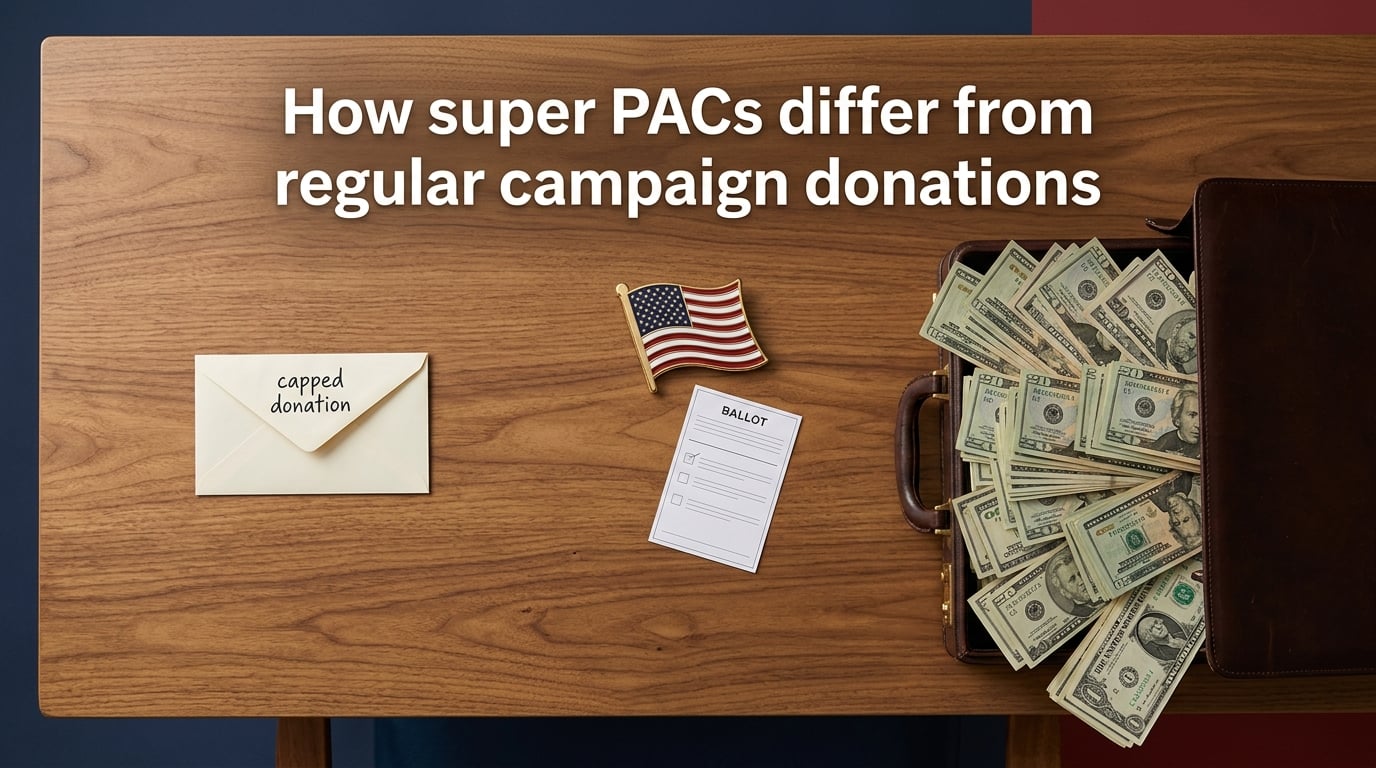
When Americans hear about money in politics, the term “super PAC” gets thrown around constantly, especially during election season. Yet most voters don’t actually know how super PACs differ from regular campaign donations, and that confusion matters because the rules shape who gets a megaphone and who doesn’t. In the 2026 election cycle, outside groups have already reported spending totals that dwarf what individual campaigns can legally raise.
Here’s the quick version: a regular campaign donation goes directly to a candidate’s campaign and is capped at a few thousand dollars per donor under federal election commission rules. A super PAC, by contrast, raises unlimited money from corporations, unions, and individuals but is barred from giving money directly to candidates. Both are forms of political spending, but they live on opposite sides of a wall built by the courts in 2010.
If you want a one-glance summary before we dig into the details, here are the four things that set super PACs apart from regular campaign donations:
Contribution limits: Regular donations to a candidate are capped per donor per election. Super PAC contributions are unlimited.
Direct candidate giving: Campaigns can receive regular donations. Super PACs cannot give a single dollar to a candidate.
Coordination: Candidates and their campaigns work closely with regular donors. Super PACs must operate independently from any campaign they support.
Disclosure: Both file FEC reports, but super PACs must also list every donor who gives more than $250 in a year.
The rest of this guide unpacks each of those differences, the legal history that created super PACs, and what it means for anyone who wants to follow the money in 2026.
Table of Contents
How Super PACs Differ From Regular Campaign Donations
The clearest way to see how super PACs differ from regular campaign donations is to put them side by side. The table below covers the four most important legal and practical distinctions: how much money each can accept, whether money can flow directly to a candidate, whether campaigns and outside groups are allowed to coordinate, and what donor information must be disclosed publicly.
| Feature | Regular Campaign Donation | Super PAC |
|---|---|---|
| Contribution limit per donor (2025-2026) | $3,500 per election to a candidate | Unlimited |
| Can give directly to a candidate? | Yes | No |
| Can coordinate with a campaign? | Yes (it’s the candidate’s own donor) | No (independent expenditure only) |
| Who can donate? | U.S. citizens and green-card holders only | U.S. citizens, green-card holders, corporations, and labor unions |
| Donor disclosure threshold | Itemized above $200 | Itemized above $250, monthly reports to FEC |
| Typical spending vehicle | Candidate committee | Independent expenditure-only committee |
Each row of that table is backed by decades of statutes, court rulings, and FEC regulations. Let’s walk through the four core differences one at a time, because the rules behave very differently in practice.
Contribution Limits: Capped vs. Unlimited
Regular campaign donations to a federal candidate are hard money, and they are subject to strict dollar limits that the FEC adjusts every two years based on inflation. For the 2025-2026 cycle, an individual may give up to $3,500 per election to a candidate committee, $43,100 per year to a national party committee, and $133,400 per year to other political action committees combined. Those numbers come straight from the FEC’s official contribution limits schedule.
A super PAC, by contrast, can accept unlimited contributions from any lawful source. A single donor can write a check for $5 million, $50 million, or more, and the super PAC can spend that money on independent political advertising without ever touching the candidate’s bank account. That single feature is what makes super PACs the dominant vehicle for outside spending in modern federal elections.
Direct Candidate Giving: Banned vs. Allowed
Regular campaign donations are the lifeblood of any candidate committee. Donations to candidates are governed by the Federal Election Campaign Act and capped at the per-election amounts above. A candidate can raise that money through direct mail, online fundraising, dinners, and high-dollar events.
Super PACs are legally prohibited from contributing money or anything of value to federal candidates. The restriction is explicit: a super PAC is registered as an “independent expenditure-only committee,” and the moment it coordinates spending with a campaign it would be considered an in-kind contribution and would violate federal law. This is why super PACs must operate at arm’s length from the candidates they support.
Coordination Rules: Allowed vs. Prohibited
Regular donors can talk freely with the candidates they support. A person who gives the legal maximum to a campaign is free to call the campaign, attend strategy meetings, and offer feedback. That direct line of communication is a big reason small-dollar donors sometimes feel more connected to a candidate than big-dollar ones.
Super PACs have no such line. Federal rules prohibit any coordination between a super PAC and a federal candidate, including sharing polling data, targeting information, advertising content, or campaign strategy. The FEC’s coordination rules define an array of “firewall” practices that super PACs must follow to remain genuinely independent. Violations can result in felony charges under federal campaign finance law.
Disclosure Requirements: Annual vs. Monthly
Campaign committees file regular FEC reports disclosing itemized contributions from donors who give more than $200 in a calendar year. These reports are publicly searchable on the FEC website and on independent trackers like OpenSecrets.
Super PACs disclose more frequently and in more detail. Independent expenditure-only committees must file monthly reports with the FEC, list every donor who contributes more than $250, and report their independent expenditures within 48 hours when made close to an election. That higher disclosure frequency is the trade-off the courts pointed to when they allowed super PACs to raise unlimited money in the first place.
What Is a Regular Campaign Donation?
A regular campaign donation is a contribution made directly to a federal candidate’s authorized campaign committee. It is sometimes called “hard money” because it is subject to the strictest set of rules under federal law. The donor must be a U.S. citizen or lawful permanent resident, the contribution must come from personal funds (not corporate treasury money), and the amount is capped per election by the FEC.
For the 2025-2026 cycle, the per-election limits for individual donors to candidates are:
$3,500 per election to a House or Senate candidate (primary plus general counts as two elections)
$43,100 per year to a national political party committee
$13,250 per year to a state, district, or local party committee
$133,400 per year combined to other political action committees and political committees
These limits are inflation-adjusted every two years. They were set under the Federal Election Campaign Act and are enforced by the FEC, which can fine candidates and refer serious violations to the Department of Justice. Donations above the legal limit, or donations from prohibited sources such as foreign nationals or corporate treasuries, are illegal.
What Is a PAC?
A political action committee, or PAC, is a federal political committee organized for the purpose of raising and spending money to influence federal elections. PACs existed for decades before super PACs appeared. The most common type, called a “separate segregated fund,” is typically connected to a corporation, labor union, trade association, or membership organization and can solicit contributions only from that group’s restricted membership.
There are three main flavors of traditional PACs worth knowing:
Connected PACs (separate segregated funds): Sponsored by a corporation, labor union, or trade group. They can solicit contributions from the organization’s restricted class of stakeholders, such as executives, shareholders, or union members.
Nonconnected PACs: Not tied to any single employer or union. They raise money from a broad base of individual donors and often align with a particular ideological or policy cause.
Leadership PACs: Founded by a current or former officeholder. These are technically candidate-related PACs and can be used to support other candidates, fund travel, or pay political staff.
Traditional PACs can contribute up to $5,000 per election to a federal candidate, $15,000 per year to a national party committee, and $5,000 per year to another PAC. They can also make independent expenditures, but they operate under much tighter fundraising caps than super PACs. A multicandidate PAC that has been registered for more than six months, has received contributions from more than 50 people, and has contributed to at least five federal candidates can give up to $5,000 to a candidate per election.
The big takeaway: traditional PACs sit between regular campaign donations and super PACs. They can both support candidates directly and run independent ads, but they are constrained by contribution limits that super PACs simply do not face.
What Is a Super PAC?
A super PAC is officially known as an “independent expenditure-only committee.” It is a political committee registered with the FEC whose sole purpose is to raise and spend unlimited money on independent expenditures that expressly advocate for or against federal candidates. The defining feature of a super PAC is what it cannot do: it cannot contribute money to candidates, and it cannot coordinate its spending with any candidate or party committee.
In exchange for those restrictions, super PACs can raise unlimited sums from individuals, corporations, labor unions, and even other PACs. They can run television ads, online ads, mailers, robocalls, and voter outreach programs, all without ever consulting the campaigns they aim to help. That independence is the legal fiction that makes super PACs possible under the First Amendment as the Supreme Court currently interprets it.
Most super PACs focus on a single race, a slate of races, or a policy theme. The Senate Leadership Fund, for example, is aligned with Senate Republican leadership and has reported raising and spending hundreds of millions of dollars in recent cycles. Its counterpart on the Democratic side, Senate Majority PAC, operates similarly. There are also ideological super PACs such as those associated with the Club for Growth, the National Rifle Association, or labor federations.
What can super PACs spend money on? Practically anything related to political advocacy, with one exception: they cannot give money to candidates. Common spending categories include:
Television, radio, and digital advertising
Polling and research
Direct mail and voter contact
Fundraising and administrative costs
Communications staff and consultants
The Citizens United Decision and Why Super PACs Are Legal
To understand how super PACs came into existence, you have to understand two court rulings. The first is Citizens United v. Federal Election Commission, decided by the U.S. Supreme Court in January 2010. The second is SpeechNow.org v. FEC, decided by the D.C. Circuit Court of Appeals just months later in March 2010. Together, these decisions produced the modern super PAC.
In Citizens United, the Supreme Court struck down a provision of the McCain-Feingold Act that had banned corporations and unions from using their general treasury funds to pay for “electioneering communications” close to an election. The court’s 5-4 majority held that political spending is a form of protected speech under the First Amendment, and that the government cannot restrict political spending by corporations, associations, or unions in independent communications.
Citizens United itself did not create super PACs. What it did was open the door. After the ruling, the nonprofit SpeechNow.org asked the FEC whether it could pool unlimited contributions from individuals to make independent expenditures supporting federal candidates. Citing Citizens United, the D.C. Circuit answered yes in SpeechNow.org v. FEC, ruling that the government could not cap contributions to a group whose only spending would be independent expenditures.
The FEC followed up with Advisory Opinion 2010-11, formally recognizing independent expenditure-only committees. The first super PAC, “Make Us Great Again” supporting Hillary Clinton, registered with the FEC in June 2010. Within a decade, super PACs became the single largest category of outside spending in federal elections, raising and spending billions of dollars across the 2020 and 2024 cycles.
Critics argue that Citizens United tilted the playing field toward wealthy donors and large corporations. Supporters argue that political speech should not be limited based on the speaker’s identity. Either way, the legal foundation is settled for now, and any major change would require either a new Supreme Court ruling or a constitutional amendment.
Transparency and Disclosure Requirements
Both regular campaign donations and super PAC money are publicly disclosed, but the rules differ in important ways. Candidate committees file FEC reports quarterly during non-election years and monthly or weekly during election years, with itemized donor information required for anyone giving more than $200 per election cycle. This data feeds databases like FEC.gov and OpenSecrets.org.
Super PACs file independent expenditure reports with the FEC, list every donor who gives more than $250 per year, and disclose their independent expenditures within 48 hours when made within 20 days of an election. In principle, this means every dollar that flows into a super PAC should be traceable to a named donor or a publicly identifiable organization.
In practice, however, much of the money flowing into super PACs comes through intermediary nonprofits classified under Section 501(c)(4) of the tax code. These “social welfare” organizations are not required to disclose their donors publicly, and they can transfer money to super PACs without identifying the original source. This is what campaign finance reformers call “dark money”: spending that influences elections through organizations whose donors remain anonymous.
The result is a disclosure system that is technically robust for super PACs but easily routed around by donors who want to stay hidden. This is why critics say that Citizens United opened the door to unlimited spending, and dark money groups opened the back door.
How Super PACs Influence Elections
The clearest evidence of how super PACs influence elections is the raw spending data. In the 2024 federal cycle, outside spending by super PACs and other independent expenditure groups ran into the billions. The Senate Leadership Fund, House Majority PAC, Senate Majority PAC, and a handful of allied super PACs reported raising more than $1 billion combined, with most of that money going into television advertising and digital outreach in a small number of competitive Senate and House races.
To take a concrete example, in one recent Senate race, super PACs on both sides reported spending more than $60 million on advertising alone, while the two candidates’ own campaigns spent roughly $40 million combined. The super PAC ads shaped the narrative on policy and character issues well before the campaigns themselves could respond, because super PACs can book ad time, run polling, and produce content without coordinating with the candidate.
There is a legitimate academic debate over how much super PAC spending actually moves votes. Some studies suggest that independent expenditures mostly persuade voters who were already inclined to support the candidate. Other studies find that high-volume super PAC spending can shift small but meaningful numbers of votes in close races. Either way, the visible effect on the political environment is real: a barrage of ads, mailers, and online content funded by donors that voters never see.
Coordination gray areas also matter. While direct coordination is illegal, informal signaling is not. A candidate can praise a super PAC’s work in an interview, share a super PAC ad on social media, or hint at preferred messaging. The line between coordination and public commentary is one the FEC has spent years trying to police, and it remains one of the most contested areas of federal campaign finance law.
How Regular People Can Still Have Political Impact?
The disparity between super PAC fundraising and individual campaign donations is real, and it can feel discouraging. But there are several ways that ordinary voters still shape federal elections despite the rise of super PACs.
Small-dollar donations add up. The ActBlue and WinRed online platforms have processed billions of dollars in donations under $200 from individual donors in recent cycles. Candidates who tap into a large base of small donors face less pressure to bend to a handful of wealthy contributors.
Volunteer time and local organizing. Door-knocking, phone-banking, and voter registration drives are activities that no super PAC money can replace. Campaigns consistently report that personal contact from volunteers is one of the most effective ways to turn out supporters.
Stay informed on FEC filings. Anyone can search FEC.gov and OpenSecrets.org to see where money is flowing in their own district. Looking up super PAC donors and reading disclosure reports is one of the simplest ways to hold outside spenders accountable.
Engage locally. State and local elections often have far less super PAC involvement than federal races. School board, city council, and state legislature seats are frequently decided by voters who show up and by small donors who give what they can.
The bottom line is that super PACs amplify wealthy voices, but they do not cancel out the voices of everyone else. Voters who donate, volunteer, and stay informed still shape the outcomes of every federal election.
Frequently Asked Questions About Super PACs and Campaign Donations
What is the difference between a PAC and a super PAC?
A traditional PAC can contribute up to $5,000 per election directly to a federal candidate and is subject to strict contribution limits. A super PAC, by contrast, can raise unlimited money from corporations, unions, and individuals, but it cannot give any money directly to candidates and must operate independently from any campaign it supports. Both are registered with the FEC and disclose their donors, but they sit on opposite sides of the coordination firewall.
How do super PACs influence elections?
Super PACs influence elections primarily through independent expenditures: advertising, polling, voter outreach, and online messaging that supports or opposes federal candidates. Because they can raise unlimited money, super PACs can run far more paid advertising than the campaigns themselves. The 2024 cycle saw super PACs and other outside groups spend billions of dollars on federal races, with most of that money concentrated in a small number of competitive Senate and House contests.
Why are Super PACs legal?
Super PACs exist because of two court decisions: the Supreme Court’s 2010 ruling in Citizens United v. FEC, which struck down restrictions on independent political spending by corporations and unions, and the D.C. Circuit’s 2010 ruling in SpeechNow.org v. FEC, which held that contributions to independent expenditure-only committees cannot be capped. The FEC followed up with Advisory Opinion 2010-11, formally recognizing this new category of political committee.
Do super PACs have to disclose donors?
Yes. Super PACs must file monthly reports with the FEC and disclose the name, address, employer, and occupation of every donor who contributes more than $250 in a calendar year. They must also report independent expenditures within 48 hours when made within 20 days of an election. However, money that flows into a super PAC through 501(c)(4) nonprofit intermediaries is not always traceable to the original donor, which is the source of the so-called dark money problem.
Can Super PACs donate directly to candidates?
No. Federal law prohibits super PACs from contributing money or anything of value to federal candidates. Super PACs are classified as independent expenditure-only committees and may only spend money on independent political activity. Any coordination with a candidate, including sharing polling data or advertising content, would convert that spending into an illegal in-kind contribution.
What can super PACs spend money on?
Super PACs can spend money on independent expenditures that expressly advocate for or against federal candidates, including television, radio, and digital advertising, direct mail, polling and research, voter outreach, fundraising costs, and administrative expenses. They cannot contribute to candidates or coordinate their spending with any campaign, party committee, or candidate agent.
The Bottom Line on Super PACs vs Regular Campaign Donations
To recap how super PACs differ from regular campaign donations: regular donations to candidates are capped per donor per election and can be coordinated with the campaign; super PACs can raise unlimited money from a wider set of sources but are barred from giving money to candidates and from coordinating their spending. Disclosure is stronger for super PACs on paper, but the dark money loophole through 501(c)(4) groups still lets donors stay anonymous in practice.
If you want to keep tabs on the money flowing through the 2026 cycle, bookmark FEC.gov for official filings and OpenSecrets.org for plain-English summaries of who is funding which super PACs. Reading disclosure reports is the single most effective way to see exactly how super PACs differ from regular campaign donations in real time, and it puts you in a better position to evaluate the ads that show up in your feeds between now and Election Day.