
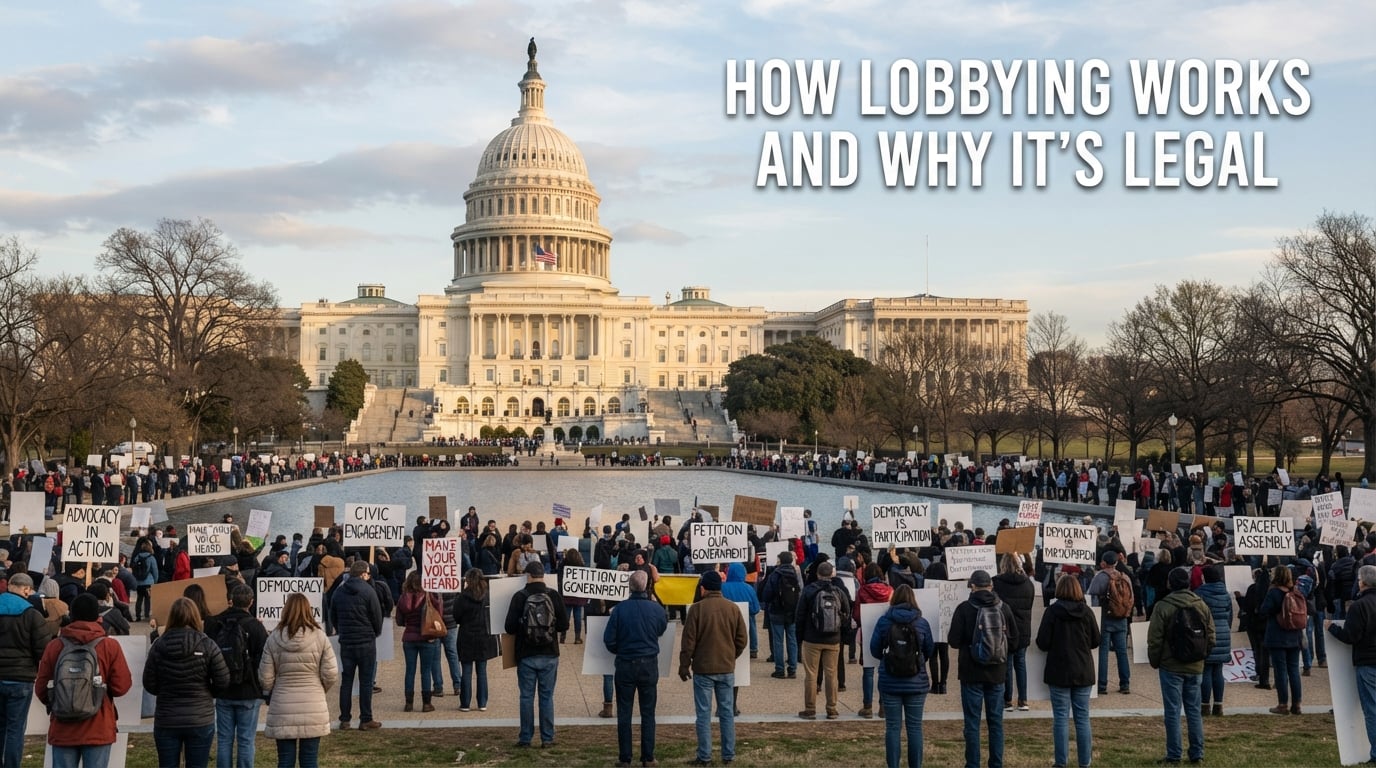
Lobbying is one of those terms that gets thrown around constantly in political debates, yet many people struggle to explain exactly what it means or why it operates within legal boundaries. If you’ve ever wondered how special interests influence government decisions or why corporations can spend billions advocating for policies, you are not alone. Understanding lobbying is essential for anyone who wants to engage meaningfully with American democracy.
This guide breaks down the lobbying process step by step, explains the constitutional protections that make it legal, and addresses the questions that PAA search results show people are asking most. By the end, you will have a clear picture of how lobbying actually works and why it remains a cornerstone of democratic participation in the United States.
Table of Contents
What Is Lobbying: A Clear Definition
Lobbying is a form of advocacy where individuals or organizations attempt to influence government policy decisions. The term originated in the 1800s, when people would wait in the lobbies of legislative halls to speak with lawmakers. Today, lobbying encompasses a wide range of activities designed to shape legislation, regulation, and government actions.
At its core, lobbying involves communicating a position to elected officials or their staff. This can happen directly through meetings, phone calls, or testimony before Congress. It can also happen indirectly through public campaigns that aim to build support for or opposition to specific policies. The key distinction is that lobbying involves advocacy aimed at government decision-makers.
Lobbyists may represent various interests, including corporations, nonprofit organizations, trade associations, labor unions, and even ordinary citizens who band together around a common cause. Contrary to popular belief, lobbying is not exclusively the domain of wealthy corporations. Advocacy groups representing environmental concerns, civil rights, healthcare patients, and countless other interests all engage in lobbying activities to advance their missions.
According to the Harvard Law School’s public interest advising office, a lobbyist is someone who is paid by an organization to promote that organization’s positions before federal and state legislatures. The compensation aspect is important because it distinguishes professional lobbying from ordinary citizen advocacy, though both are protected activities.
Types of Lobbying Activities
Lobbying activities generally fall into two categories: direct lobbying and grassroots lobbying. Direct lobbying involves communicating directly with legislators, agency officials, or their staff about specific legislation or regulations. This includes providing testimony, sharing research, and meeting to discuss policy positions.
Grassroots lobbying, also called indirect lobbying, aims to mobilize the public to contact government officials. This can involve organizing letter-writing campaigns, social media activism, public rallies, and other efforts to generate constituent pressure on lawmakers. Both forms of lobbying enjoy legal protection under the First Amendment.
Some lobbying focuses on the legislative branch, while other efforts target the executive branch. Regulatory agencies like the Environmental Protection Agency or the Food and Drug Administration develop and enforce rules that can have significant impacts on businesses and citizens. Lobbying these agencies involves presenting comments during rulemaking processes and engaging with agency officials on regulatory decisions.
Why Lobbying Is Legal: The Constitutional Foundation
The legality of lobbying in the United States stems directly from the First Amendment to the Constitution. The First Amendment guarantees several freedoms essential to American democracy, including the freedom of speech, the freedom of the press, and the right of the people to petition the government for a redress of grievances. This last protection is the cornerstone of lobbying rights.
When the Framers wrote the Constitution, they specifically included the right to petition because they wanted to ensure that citizens could approach their government to express concerns, request changes, and advocate for their interests. This was not an accidental inclusion but a deliberate response to the grievances that had sparked the American Revolution. The British government had routinely ignored petitions from colonists, and the Framers wanted to guarantee that future generations would have a protected right to make their voices heard.
The Supreme Court has consistently upheld lobbying as a protected form of speech and petition. In the landmark case First National Bank of Boston v. Bellotti, the Court recognized that the First Amendment protects corporate speech and advocacy. Later cases have reinforced that lobbying represents constitutionally protected activity regardless of whether the speaker is an individual citizen, a corporation, or a nonprofit organization.
This constitutional protection means that the government cannot simply ban lobbying or restrict it to certain groups. Any attempt to prohibit or significantly limit lobbying would raise serious First Amendment concerns. The government can, however, impose reasonable disclosure requirements and regulations on lobbying activities to ensure transparency and prevent actual corruption.
Why Money Can Be Involved Without Becoming Bribery
One of the most confusing aspects of lobbying for many people is understanding why money can legally influence politics when it seems like it should be bribery. The key lies in understanding the legal distinction between a campaign contribution or lobbying expenditure and an actual bribe.
Bribery involves directly giving something of value to a public official with the specific intent of influencing that official’s actions in a corrupt manner. The key elements are corrupt intent and a direct quid pro quo. If someone hands a legislator cash with the explicit agreement that the legislator will vote a certain way, that is bribery and it is illegal.
Lobbying, by contrast, involves advocating for policy positions without any direct exchange for specific votes. Lobbyists may donate to political campaigns, but these donations are regulated, disclosed, and come with no direct guarantee of specific legislative action. The Supreme Court has recognized that restricting political spending would effectively restrict speech, which is why campaign finance regulations walk a careful line between preventing corruption and protecting First Amendment rights.
The distinction matters because restricting money in politics would disproportionately limit the speech of those with fewer financial resources. If only wealthy individuals or organizations could afford to speak, the voices of ordinary citizens would be drowned out. By keeping lobbying legal and regulating it through disclosure requirements, the law tries to balance democratic participation with preventing actual corruption.
The Lobbying Disclosure Act of 1995
While lobbying is protected by the Constitution, it is not completely unregulated. The Lobbying Disclosure Act of 1995 established the modern framework for monitoring and disclosing lobbying activities at the federal level. This law requires organizations and individuals who engage in lobbying to register with the government and report their activities regularly.
Under the Act, a lobbyist is defined as someone who spends at least 20 percent of their time representing a client to influence federal legislation or policy. Organizations that employ in-house lobbyists must register and file quarterly reports disclosing how much money they spend on lobbying, which issues they focus on, and which branches of government they target.
The disclosure requirements serve several important purposes. First, they provide transparency so that citizens can see which organizations are trying to influence their government and how much they are spending. Second, they create a public record that makes it harder for lobbying to happen in secret. Third, they help enforcement officials identify potential violations of anti-corruption laws.
In 2007, Congress strengthened these requirements with the Honest Leadership and Open Government Act. This law increased disclosure obligations, placed restrictions on gifts to lawmakers, and required senators and their staff to attend ethics training. These reforms were enacted partly in response to high-profile lobbying scandals that highlighted the potential for abuse.
State-Level Lobbying Regulations
Federal lobbying disclosure applies only to federal activities, but most states have their own lobbying regulations. These vary significantly from state to state, with some having strict disclosure requirements and others having more lenient rules. Some states prohibit certain types of lobbying activities entirely, such as contingency-fee lobbying where lobbyists are paid only if they succeed in influencing legislation.
State lobbying regulations typically address similar concerns as federal law, including registration requirements, disclosure of spending, and limits on gifts or compensation to state officials. Citizens who want to understand lobbying in their own states can usually find disclosure databases on their state government’s website.
How Lobbying Works: The Step-by-Step Process
Understanding how lobbying actually works requires looking at the process that lobbyists and advocacy organizations follow. While specific tactics vary, the general framework follows a recognizable pattern that anyone can understand.
The lobbying process typically begins with issue identification and research. Lobbyists monitor legislative activity, track proposed bills, and identify opportunities to influence policy. They research the potential impact of legislation on their clients and develop arguments for why lawmakers should support or oppose specific measures. This research phase also involves identifying key decision-makers and understanding their priorities and vulnerabilities.
Once an issue is identified, lobbyists often build relationships with relevant legislators and their staff. This relationship-building can take months or even years and involves attending events, providing useful information, and establishing a reputation as a reliable resource. Legislators rely on lobbyists for expertise on complex issues, making relationships with knowledgeable advocates valuable on both sides.
When the time is right, lobbyists communicate their positions directly to lawmakers. This can happen through formal meetings, phone calls, emails, or testimony before congressional committees. Effective lobbying involves presenting compelling arguments backed by data and real-world examples. Lobbyists often provide legislators with research that they can use in debates and explain how legislation would affect their constituents.
Grassroots lobbying campaigns add another dimension to the process. Organizations mobilize their members and supporters to contact legislators directly, generating constituent pressure. When lawmakers hear from hundreds of voters on an issue, they pay attention. This citizen engagement amplifies the message and demonstrates that an issue has broad public support or opposition.
The process also involves monitoring and responding to developments. Lobbyists track amendments, committee votes, and floor debates, adjusting their strategies as legislation moves through the process. Sometimes the goal is to kill a bill entirely; other times it is to modify specific provisions or add favorable language. Lobbying is an iterative process that requires constant attention and flexibility.
The Role of K Street
K Street in Washington, D.C. has become synonymous with the lobbying industry. This is where many of the major lobbying firms and trade associations maintain their offices, putting them within walking distance of Capitol Hill. The term “K Street” is sometimes used as shorthand for the entire lobbying industry, though lobbying firms are scattered throughout the metropolitan area.
The lobbying industry in Washington employs tens of thousands of professionals and generates billions of dollars in revenue annually. Major corporations, trade associations, and interest groups spend substantial resources maintaining their presence in the capital and advocating for their positions. This concentration of lobbying activity near the centers of power reflects the importance of access and relationships in the lobbying process.
Citizen Participation: Can Ordinary People Lobby?
A common question that arises in discussions of lobbying is whether ordinary citizens can participate. The answer is a definitive yes. While corporations and well-funded interest groups certainly dominate lobbying spending, individual citizens have the same constitutional right to advocate for their positions that any organization enjoys.
Grassroots lobbying offers one of the most accessible ways for citizens to make their voices heard. By contacting their elected representatives, signing petitions, attending town hall meetings, and participating in advocacy campaigns, ordinary people can influence government decisions. Many organizations exist specifically to help citizens engage in advocacy on issues they care about, from environmental protection to healthcare reform.
Citizens can also form or join advocacy groups that pool resources and coordinate lobbying efforts. When individuals band together, their collective voice becomes much more powerful. A single constituent complaining about a policy issue might be easily ignored, but a coordinated group of thousands of constituents demanding action commands attention.
Some of the most successful lobbying efforts in American history have come from citizen movements rather than wealthy corporations. The civil rights movement, environmental movement, and disability rights movement all achieved significant policy changes through sustained advocacy and lobbying. These examples demonstrate that effective lobbying is not about money alone but about building coalitions, communicating effectively, and maintaining pressure over time.
How Much Is Spent on Lobbying
Lobbying spending in the United States reaches into the billions of dollars annually. According to data analyzed by Investopedia, total lobbying spending exceeded $4 billion in recent years, with corporations and trade associations accounting for the largest shares. However, these figures represent professional lobbying efforts and do not capture the countless hours that ordinary citizens spend advocating for their positions each year.
The concentration of spending among certain industries reflects economic interests with significant stakes in policy decisions. Healthcare, finance, energy, and technology sectors consistently rank among the highest spenders because government policies can have major impacts on their businesses. This spending does not guarantee policy success, but it does ensure that these interests have a seat at the table when decisions are made.
Lobbying vs. Bribery: Understanding the Legal Difference
One of the most persistent misconceptions about lobbying is that it is essentially just legal bribery. This perception is understandable given the large sums of money involved in political advocacy, but it fundamentally misunderstands both the nature of lobbying and the legal definition of bribery.
The key distinction lies in the presence or absence of a direct exchange. Bribery requires a specific quid pro quo, where something of value is given with the explicit understanding that it will result in a particular official action. If a lobbyist hands a senator $50,000 with the agreement that the senator will vote for a specific bill, that is bribery, regardless of how it is characterized.
Lobbying, by contrast, involves advocacy without guaranteed reciprocity. Campaign contributions are regulated and disclosed, but they do not purchase specific votes. A corporation might donate to a politician who supports its positions, but there is no guarantee that the politician will vote a certain way. This distinction is crucial because it separates protected political speech from criminal corruption.
Critics argue that this distinction is too subtle and that money in politics inherently corrupts the democratic process. Supporters counter that restricting political spending would simply silence certain voices and that disclosure requirements provide enough transparency to prevent the worst abuses. This debate continues in academic, legal, and political circles, but for now, lobbying remains legal precisely because it falls on the speech side of the bribery equation.
Legal Safeguards Against Corruption
While lobbying itself is legal, the law does include safeguards designed to prevent it from crossing the line into corruption. These include prohibitions on certain types of gifts to officials, restrictions on former government employees becoming lobbyists, and requirements for disclosure of lobbying activities.
The Federal Election Campaign Act regulates campaign contributions and prohibits corporations and labor unions from making direct contributions to political candidates. Lobbyists must disclose their clients, their issue areas, and their spending. Former members of Congress face cooling-off periods before they can lobby certain former colleagues.
These regulations are imperfect and critics argue they do not go far enough, but they represent the legal framework that distinguishes legitimate lobbying from illegal corruption. Violations can result in criminal penalties, including fines and imprisonment, which provides some deterrent against the most egregious abuses.
Conclusion
Lobbying works through a combination of direct advocacy, relationship building, grassroots mobilization, and strategic communication aimed at influencing government policy. It is legal because the First Amendment protects the right to petition the government for redress of grievances, and this protection extends to organized advocacy efforts by corporations, organizations, and citizens alike.
Understanding lobbying matters because it is one of the primary ways that policy decisions get made in Washington. Whether you are concerned about healthcare, the environment, taxes, or any other political issue, lobbying shapes the outcomes. By learning how the process works, you can become a more effective participant in democratic governance.
The democratic value of lobbying lies in its ability to amplify voices that might otherwise go unheard. While corporations and wealthy interests certainly have advantages, the system also provides opportunities for ordinary citizens to organize and advocate for their interests. The key to making lobbying work for democracy is transparency, disclosure, and active participation from an engaged citizenry.
Frequently Asked Questions
Why is lobbying even legal?
Lobbying is legal because it is protected by the First Amendment to the United States Constitution. The First Amendment guarantees the right of the people to petition the government for a redress of grievances, which directly encompasses lobbying activities. This constitutional protection means the government cannot ban or significantly restrict lobbying without raising serious free speech concerns.
What would happen if lobbying is illegal?
If lobbying were made illegal, it would effectively silence many voices in the democratic process. Citizens and organizations would lose their constitutional right to advocate for their interests before the government. This would disproportionately harm ordinary citizens and small organizations who rely on collective advocacy to make their concerns heard alongside wealthier interests.
How exactly does lobbying work?
Lobbying works through several steps: identifying issues and researching legislation, building relationships with legislators and their staff, communicating positions directly through meetings or testimony, mobilizing grassroots support through constituent campaigns, and monitoring developments to adjust strategies. Lobbyists provide information, organize advocacy efforts, and help policymakers understand the impact of proposed laws.
Is lobbying basically bribing?
No, lobbying and bribery are legally distinct activities. Bribery involves a direct quid pro quo where something of value is exchanged for a specific official action with corrupt intent. Lobbying involves advocating for policy positions without any guaranteed exchange. Campaign contributions are regulated and disclosed, and while they can influence politics, they do not purchase specific votes. This distinction separates protected First Amendment speech from criminal corruption.