
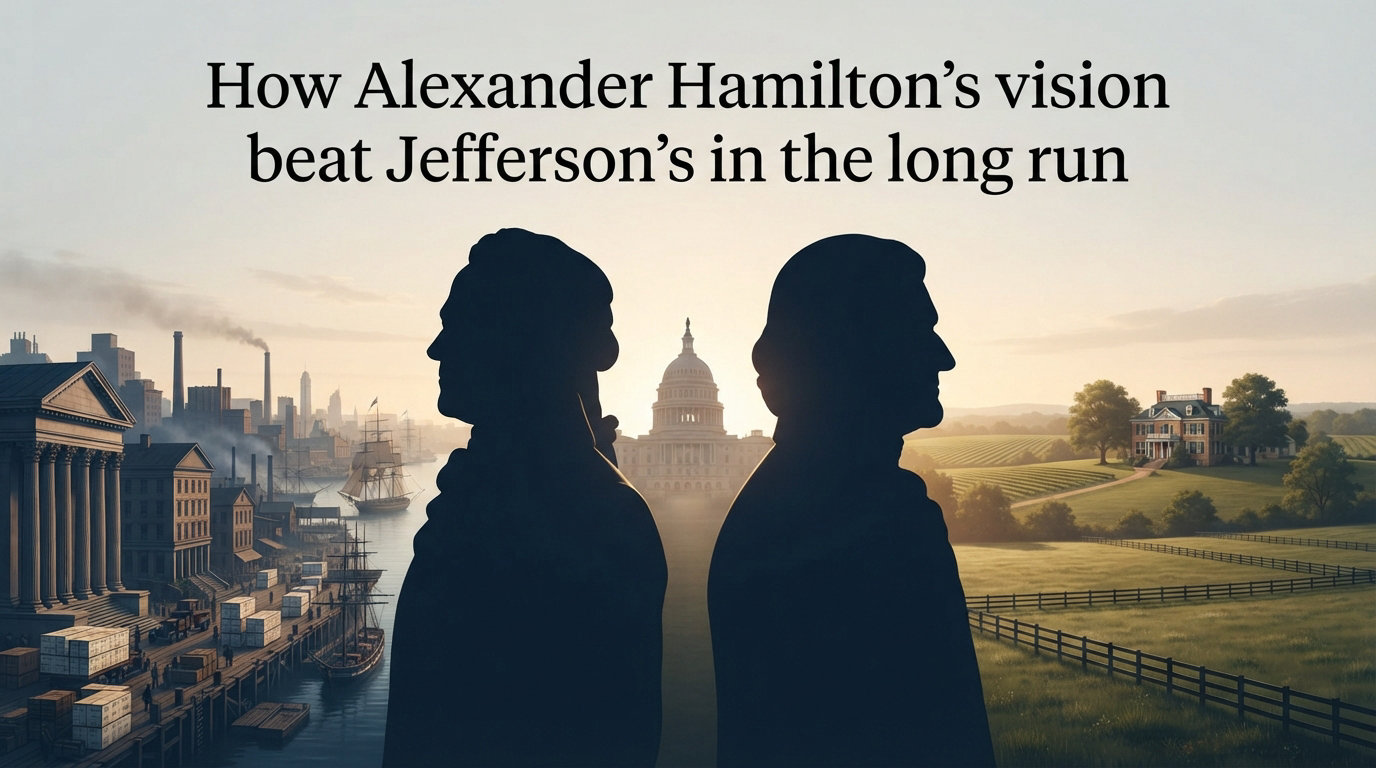
Two men walked out of the Philadelphia Convention of 1787 with two completely different Americas in their heads. Alexander Hamilton pictured factories, banks, ships, and a federal government strong enough to bind thirteen quarrelsome states into one economy. Thomas Jefferson pictured independent farmers on their own land, ruling themselves through state legislatures with Washington as a quiet administrator. They spent the next fifteen years arguing about it in cabinet meetings, in newspapers, and in the kind of whispered gossip that decided who trusted whom in the early Republic.
How Alexander Hamilton’s vision beat Jefferson’s in the long run is not a hard question to settle once you stop treating the two visions as equally valid. It is a question of what America actually became. The country that exists in 2026 looks much closer to Hamilton’s blueprint than to Jefferson’s. The federal government collects taxes, runs a central bank, interprets the Constitution broadly, and props up industry when it must. That is not Jefferson’s America. It is, by any honest accounting, Hamilton’s America. The rest of this article explains exactly how that happened.
I have read the primary sources, the modern reinterpretations, and the Supreme Court records that turned their arguments into binding law. What follows is the throughline from the 1790s to the present day, and the specific decisions, decisions not taken, and constitutional turns that locked in Hamilton’s vision for good.
Table of Contents
Hamilton’s Vision: A Manufacturing Power Built on Federal Authority
Hamilton laid out his program in three reports between 1790 and 1795: the Report on Public Credit, the Report on a National Bank, and the Report on Manufactures. Together they formed a coherent economic vision that the United States has largely followed ever since.
The first report argued that the federal government must assume the war debts of the states, pay them at full face value, and treat that public debt as a source of national strength. Bondholders would become loyal supporters of the federal government. Creditors would tie their fortunes to the survival of the union. This is exactly what happened. The United States has carried federal debt continuously since 1790, and the holders of that debt have, in every generation, been among the strongest defenders of federal authority.
The second report proposed a national bank, owned partly by the federal government, with the power to issue currency, hold government deposits, and regulate state banks. Jefferson hated this idea. He thought it was a monster. Hamilton won the argument, and the First Bank of the United States opened in 1791. Its successor, the Second Bank, chartered in 1816, eventually became the Federal Reserve System in 1913. The Federal Reserve is still with us. Hamilton’s banking idea is still with us.
The third report, on manufactures, proposed tariffs to protect infant American industry and federal subsidies to encourage specific sectors. Congress mostly ignored the subsidies, but kept the protective tariffs. Average tariff rates stayed above 25 percent for most of the 19th century and remained in place until the 1930s. The United States industrialized behind a tariff wall. That wall was a Hamiltonian wall, not a Jeffersonian one.
Underneath these three economic policies sat a constitutional theory: loose construction. Hamilton believed the federal government had not only the powers explicitly listed in Article I, Section 8, but also the implied powers necessary to carry those listed powers into effect. The constitutional text says Congress may pass all laws “necessary and proper” to execute its enumerated powers. Hamilton read that clause as a license for federal action. Jefferson read it as a narrow exception. The Supreme Court eventually sided with Hamilton in McCulloch v. Maryland (1819), and it has never gone back.
The Core of Hamiltonian Thinking
Hamilton believed three things that most Americans now take for granted. First, that a modern economy needs manufacturing, not just farming. Second, that a continental republic needs active federal management of money, credit, and trade. Third, that the Constitution is a living charter of government, not a fixed list of restrictions. None of these ideas were obvious in 1789. All of them are conventional wisdom today.
Jefferson’s Vision: An Agrarian Republic of Independent Farmers
Jefferson’s vision was older, simpler, and more pastoral. In his Notes on the State of Virginia and in thousands of letters, he described a country of small landowners, each working his own field, governing himself through his state, and needing very little from the federal government beyond foreign defense and free trade.
This agrarian ideal was not just an economic preference. It was a theory of virtue. Jefferson believed that farmers made better citizens than city dwellers because they could not be corrupted by employers, banks, or manufacturers. He wrote this explicitly in 1785. He believed that cities were “sores upon the body politic.” He believed that “those who labour in the earth are the chosen people of God.” This is not a small detail. It is the foundation of his entire political philosophy.
To protect this agrarian republic, Jefferson proposed strict construction of the Constitution. If the Constitution did not explicitly grant a power to the federal government, the federal government did not have that power. The national bank was therefore unconstitutional. Federal subsidies to manufacturers were therefore unconstitutional. Federal assumption of state debts was therefore unconstitutional. Jefferson also wanted to rotate citizens through public office frequently, distrusting permanent federal officials as a kind of bureaucratic aristocracy.
Jefferson was not anti-government. He just wanted the government to be local, agricultural, and small. He thought the federal government should mostly handle foreign policy, deliver the mail, and collect a few customs duties. Everything else should be left to the states and to the people.
By the time Jefferson became president in 1801, he had to govern. His most famous presidential act, the Louisiana Purchase of 1803, was a strict construction nightmare. Buying foreign territory was nowhere in the Constitution. Jefferson knew this. He stretched his constitutional principles to breaking point to buy New Orleans and half a continent. The same man who attacked Hamilton’s loose construction in 1791 used looser construction in 1803 to double the size of the country. That episode alone tells you whose constitutional theory was more flexible under pressure.
The Personality Behind Each Vision
Hamilton was a poor immigrant from the Caribbean who rose on talent and energy. He worked at Washington’s side, took abuse in print, and fought duels. Jefferson was a Virginia gentleman, raised on a plantation, secure in his social position from birth. The two men distrusted each other personally almost as much as they disagreed politically. Hamilton thought Jefferson was a sly opponent who pretended to plainness while pulling strings. Jefferson thought Hamilton was a monarchist in disguise, secretly in love with British institutions and British money.
Washington tried to mediate. He usually failed. The cabinet meetings often ended with Washington privately siding with Hamilton, which made Jefferson feel betrayed. Jefferson resigned from the cabinet in 1793. The political fight then moved into the newspapers, where Hamilton wrote the Federalist essays and Jefferson hired Philip Freneau to attack him. That is the world of the musical Hamilton. It is also the world that decided the long-term structure of American government.
Direct Conflicts: The National Bank, Debt, and Constitutional Interpretation
The clearest single fight between the two visions was the national bank debate of 1791. Hamilton proposed the First Bank of the United States. Jefferson drafted an opinion opposing it, arguing that the Constitution listed the powers of Congress and that anything not listed was reserved to the states. Washington sided with Hamilton and signed the bill into law.
This was the moment that defined the two camps. Hamiltonians would, from then on, defend a broad reading of federal power. Jeffersonians would defend a narrow reading. Every later constitutional argument in American history, from the Internal Improvements debates of the 1820s to the Affordable Care Act case in 2012, is a replay of this 1791 argument with different particulars.
The second major fight was assumption of state debts. Hamilton proposed that the federal government take over the unpaid war debts of the individual states. This bound wealthy creditors to the federal government instead of to their states, strengthening the union. It also infuriated states like Virginia, which had already paid off most of its debt. Virginia’s politicians felt they were being forced to subsidize speculators in Massachusetts and New York. Jefferson tried to organize opposition in Congress. He lost. The assumption bill passed. Federal supremacy over state fiscal policy was set.
The third major fight was over federal military force. In 1794, farmers in western Pennsylvania refused to pay the new federal whiskey tax and began attacking tax collectors. Hamilton urged Washington to send troops. Jefferson urged negotiation. Washington sent 13,000 federal soldiers and crushed the Whiskey Rebellion without much bloodshed. The episode established that federal law, once passed, would be enforced by federal force. That principle has been applied continuously since.
Why These Three Fights Matter
Each of these fights ended with Hamilton’s vision winning and Jefferson’s vision losing. The bank became permanent. Assumption became permanent. Federal enforcement became permanent. None of these outcomes were inevitable. In a different political world, Jefferson could have won all three. He didn’t.
Why Hamilton’s Vision Won the Long Run
History answered the Hamilton-Jefferson argument not by some dramatic single event, but through a series of decisions taken by later generations who built on Hamilton’s foundations without necessarily knowing they were doing so.
First, the Industrial Revolution came to America. Jefferson predicted that America would remain agricultural for centuries. Hamilton predicted that manufacturing would become the country’s economic base. By the 1820s, Lowell, Massachusetts was a major textile center. By the 1850s, American iron production was among the largest in the world. By the 1890s, the United States was the leading industrial economy on earth. None of this would have happened as quickly without the protective tariff that Hamilton’s report helped establish and that Congress kept renewing.
Second, the Supreme Court ratified Hamiltonian constitutional theory. In McCulloch v. Maryland (1819), Chief Justice John Marshall, who was himself a Hamiltonian Federalist, ruled that Congress had implied powers under the Necessary and Proper Clause. The case directly quoted Hamilton’s 1791 defense of the national bank. In Gibbons v. Ogden (1824), Marshall used the same reasoning to strike down a state monopoly and open up interstate commerce. Both decisions locked loose construction into constitutional law.
Third, every wartime expansion of federal power followed Hamilton’s blueprint. The War of 1812 required a new national bank. The Civil War required federal income tax and a national currency. World War I required the Federal Reserve to finance it. World War II required the entire economy to be managed by federal planners. Each time the country faced an emergency, it reached for Hamiltonian tools: federal spending, central banking, broad constitutional interpretation. Jeffersonian restraint was a luxury of peacetime.
Fourth, the institutions Hamilton created survived. The Treasury Department he built is still the most powerful cabinet department. The financial system he designed, with central banking, federal debt, and a national currency, is still in place. The constitutional theory he articulated is still the dominant theory taught in American law schools. None of Jefferson’s institutions survived in recognizable form. His agrarian republic never came into existence.
The Slow Triumph of Federal Power
Lincoln was a Hamiltonian. So were Theodore Roosevelt and Woodrow Wilson. So was FDR. So were Eisenhower and Nixon, in their policy practice if not in their rhetoric. The bipartisan Hamiltonian tradition in American governance is one of the strongest patterns in the country’s political history. Jefferson’s strict constructionism survived as a rhetorical style and as a strain of states’ rights politics, but it rarely won in practice.
Modern Relevance: How Hamilton’s Vision Shapes America Today
The country you live in today, in 2026, is recognizably Hamiltonian. The Federal Reserve is a direct descendant of Hamilton’s First Bank. The federal income tax pays for programs Hamilton would have approved of. Federal spending on infrastructure, research, and industrial policy is exactly what Hamilton proposed in his Report on Manufactures. The Supreme Court still uses McCulloch v. Maryland as a foundational precedent.
Even the political parties have Hamiltonian and Jeffersonian wings. The modern Republican Party contains both Hamiltonian nationalists like Henry Cabot Lodge and Jeffersonian libertarians like Ron Paul. The modern Democratic Party contains both Hamiltonian progressives like Woodrow Wilson and Jeffersonian populists like William Jennings Bryan. Both parties use federal power. Both parties have given up on strict construction. The Hamilton-Jefferson debate is now an intra-party debate rather than an inter-party one.
That is the clearest sign that Hamilton won. Jefferson’s vision only survives as a critique of Hamilton’s, not as an alternative program. Americans today argue about how to use federal power, not whether to use it. That is the debate Hamilton wanted us to have. It is not the debate Jefferson wanted us to have.
Conclusion: The Hamiltonian Republic We Actually Inherited
How Alexander Hamilton’s vision beat Jefferson’s in the long run is, in the end, a simple story. Hamilton built the institutions that modern government needs. His central bank became the Federal Reserve. His public credit system became modern federal finance. His tariff policy became the protected market that built American industry. His loose construction became constitutional orthodoxy. His opponents could slow him down, but they could not roll him back.
Jefferson’s agrarian republic remains a powerful image in American political culture. It is the moral vocabulary of small-town America, of the independent citizen, of the self-made man. But it has never been the operational reality. The operational reality has always been Hamilton’s. That is why, in 2026, you pay federal income tax, use Federal Reserve notes, and live in a country with an economy 70 times larger than the one Hamilton inherited. He would recognize it. Jefferson would not.
FAQs
How did Jefferson’s vision of America differ from Hamilton’s?
Jefferson wanted an agrarian republic of independent farmers governed mostly through their states, with strict construction of federal power. Hamilton wanted a manufacturing and commercial republic run by a strong federal government with broad implied powers, a national bank, protective tariffs, and active management of public credit.
Why didn’t Alexander Hamilton like Thomas Jefferson?
Hamilton saw Jefferson as a hypocritical opponent who pretended to plainness while organizing political opposition behind the scenes. Jefferson saw Hamilton as a monarchist with dangerous sympathies for British institutions, British finance, and centralized power. They also represented opposing visions of American society and disagreed in print and in cabinet for more than a decade.
Why did Thomas Jefferson criticize Alexander Hamilton’s vision of government?
Jefferson believed Hamilton’s vision would concentrate power in the hands of wealthy creditors, urban manufacturers, and federal officials, producing a kind of aristocratic corruption that he thought would destroy the liberty of ordinary farmers. He opposed the national bank, federal assumption of state debts, and the loose reading of the Constitution that Hamilton used to justify both.
Did Washington like Hamilton or Jefferson better?
Washington relied on Hamilton as his chief policy adviser, agreed with most of Hamilton’s economic proposals, and signed the national bank and assumption bills into law despite Jefferson’s opposition. Washington treated Jefferson with respect but was more cautious and less aligned with him on policy. Washington often confided in Hamilton privately and tried, usually unsuccessfully, to keep peace between the two men.