
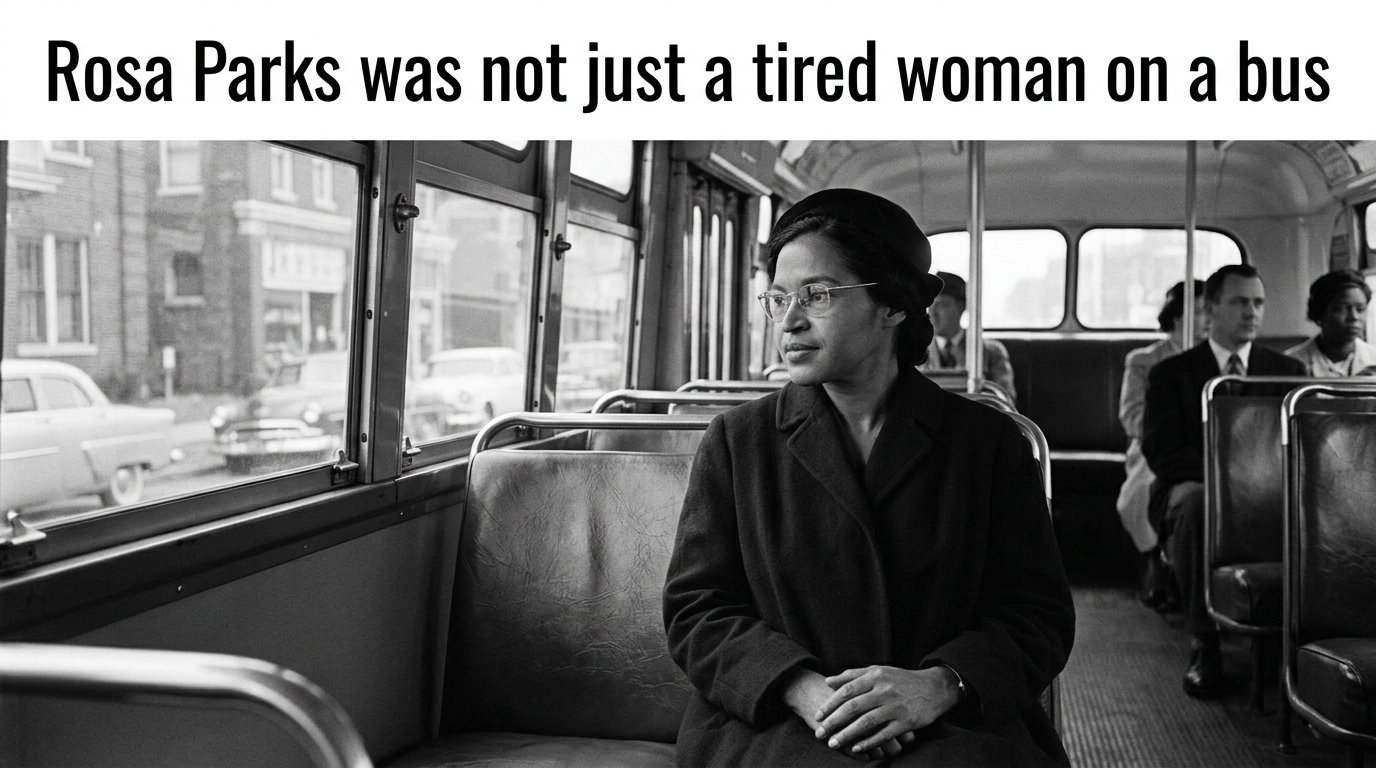
The most common story about Rosa Parks skips the most important part of who she was. On December 1, 1955, in Montgomery, Alabama, a Black seamstress refused to give up her bus seat to a white passenger. Most textbooks leave it there, framing her as a tired older woman who had simply had enough that day.
Rosa Parks wanted the world to know that story was wrong. In her own words: “People always say that I didn’t give up my seat because I was tired, but that isn’t true. I was not tired physically, or no more tired than I usually was at the end of a working day. I was not old, although some people have an image of me as being old then. I was forty-two. No, the only tired I was, was tired of giving in.”
That single sentence, “tired of giving in,” reshapes everything most people think they know about why Rosa Parks refused on that bus. Her act was not a moment of exhaustion. It was a calculated decision made by a seasoned civil rights activist who had been organizing against racial injustice for more than a decade before she ever boarded that Cleveland Avenue bus.
Table of Contents
The Myth of the Tired Seamstress
The simplified “tired seamstress” narrative took hold because it is easy to teach. It compresses a long, intentional movement for civil rights into a single spontaneous moment and removes all the planning behind it.
That framing flattens Rosa Parks into a passive figure who stumbled into history by accident. It also hides the truth about her age. Parks was only 42 years old when she was arrested, not the elderly woman many Americans picture in their minds.
Reddit users in history forums often voice frustration at how schools continue to teach the tired version of events. One commenter noted that “treating her like just some tired lady takes so much of her strength out of the story,” while others point out that the myth “makes people think change happens accidentally.”
The myth matters because how a society tells its civil rights stories shapes who people think can create change. A tired woman is a symbol of desperation. A trained organizer who said “tired of giving in” is a symbol of resistance, agency, and strategy.
What Parks Actually Said About December 1, 1955
Rosa Parks spent decades setting the record straight before her death. She repeatedly emphasized that she was not physically exhausted and that her refusal was intentional.
In her autobiography and in interviews, she explained that she had been thinking about the humiliation of segregation for years before that Tuesday evening. The bus incident was the day she chose to act, not a day when her body finally gave out.
Rosa Parks Had Decades of Activism Before the Bus
Rosa Parks was already a veteran activist by the time she sat down on that bus in 1955. Her resistance did not begin in her forties. It began in her childhood and grew steadily through every decade of her life.
Born Rosa Louise McCauley on February 4, 1913, in Tuskegee, Alabama, she grew up on a farm outside Montgomery. Her grandfather’s home sat in front of the house where the Ku Klux Klan once gathered, a detail she recalled in her autobiography as a sharp lesson about the reality of white supremacy in her daily surroundings.
She attended the Industrial School for Girls in Montgomery, then built on her education at Alabama State Teachers College, now Alabama State University. She eventually moved north briefly to live with family and finish her schooling, but returned to the South to do the work she believed in.
By the time she met Raymond Parks in 1931, her commitment to racial justice was already formed. Raymond was a barber, a numbers runner, and most importantly an active member of the NAACP. They married in 1932, and through him, Rosa began the formal organizing work that would define her life.
What She Learned About Racial Violence Early On
Parks and her husband lived during a period of aggressive racial terror in the South. She investigated cases of racial violence as part of her NAACP duties, including violent incidents that other civil rights organizations had largely ignored.
She was involved with the case of the Scottsboro Boys, nine Black teenagers falsely accused of raping two white women in Alabama in 1931. That experience shaped her belief in the power of organized legal and political resistance to Jim Crow injustice.
She also served as a secretary for the Montgomery NAACP branch, a role that put her in the middle of fights over voting rights, segregation in public spaces, and police brutality against Black residents throughout the 1940s and early 1950s.
Her Role as NAACP Secretary: 12 Years of Organizing
Rosa Parks joined the Montgomery chapter of the NAACP in 1943 and was elected secretary the same year. She held that role for 12 years, through the entire stretch of organizing that produced the conditions for the bus boycott.
The NAACP secretary in the segregated South was not an honorary position. The job meant typing case notes by hand, corresponding with the national office, meeting with families whose relatives had been killed by mobs, and documenting every act of discrimination the branch could pursue.
She helped register Black voters in the rural Black Belt counties around Montgomery, where many residents were prevented from casting ballots by literacy tests, poll taxes, and intimidation. She coordinated with branch leaders to track down witnesses, testify in court, and press legal challenges that often took years to resolve.
In 1954, Parks attended the interracial workshop at the Highlander Folk School in Monteagle, Tennessee, just months before her arrest. Highlander was one of the few places where Black and white Southerners could strategize together about segregation. The training there on nonviolent direct action would become critical during the 381-day bus boycott that followed her arrest.
Why This Experience Made Her the Right Person for the Moment
By December 1955, Rosa Parks had spent more than a decade building the legal, organizational, and personal infrastructure for exactly the kind of fight her bus refusal would launch. Her activism was not a single brave act by a private citizen. It was the latest action of someone trained for this work.
NAACP leaders later explained that Parks was chosen as the face of the test case because she was calm, steady, well-known in the community, and had the experience to withstand the pressure of a public legal battle. Her decades of organizing made her the ideal plaintiff for the legal challenge they hoped to win.
December 1, 1955: What Really Happened on That Bus
On the evening of December 1, 1955, Rosa Parks boarded the Cleveland Avenue bus in downtown Montgomery after a long day at work as an assistant at a department store in the city. The bus filled up quickly during the shift change.
Under Montgomery’s segregation laws, the front rows were reserved for white passengers and the back rows for Black passengers. When the bus got crowded, Black riders were required to give up their seats for white riders, even if they had already taken them.
The bus driver that night was James F. Blake. Parks had a history with Blake. He had thrown her off a bus 12 years earlier in 1943 for refusing to reboard through the back door after paying at the front. When she saw him driving that evening, she noticed who it was but stayed on the bus.
When the white section filled up, Blake ordered Parks and three other Black riders in the middle row to give up their seats. The three others complied. Rosa Parks did not. She said simply, “No.” Blake called the police, and she was arrested for violating the city’s segregation code.
What Happened After Her Arrest
Parks was taken to the Montgomery City Jail, booked, fingerprinted, and held overnight. Local NAACP leaders posted her bail the next morning and quickly recognized that her case could become the legal vehicle they had been looking for to challenge bus segregation directly.
Her calm, polite refusal, in front of witnesses, on a city bus, recorded in police records, was exactly the kind of clean, defensible test case the NAACP believed could withstand intense public pressure. Her decades of preparation had made her capable of becoming that symbol without being broken by it.
The Montgomery Bus Boycott Was Not Accidental
The Montgomery Bus Boycott that began four days after Parks’ arrest was a coordinated response, not a spontaneous emotional reaction. Local Black leaders had been waiting for the right test case for years, and when Parks was arrested on a Thursday evening, the wheels began to turn before the weekend.
On Friday, December 2, Black community leaders printed and distributed flyers calling for a one-day bus boycott the following Monday, December 5. Word spread by word of mouth, by church networks, and through Black-owned newspapers that reached tens of thousands of Black riders.
The boycott was so successful on that first day that organizers extended it indefinitely. Black residents walked to work, formed carpool networks, and used Black-owned taxis to bypass the city’s segregated buses. The city’s bus company lost a serious percentage of its revenue practically overnight.
By the end of the first week, the Montgomery Improvement Association had been formed to coordinate the boycott, with a 26-year-old pastor named Martin Luther King Jr. as its president. King was chosen partly because he was young, educated, had a solid reputation, and lived in the city. The MIA was a deliberately structured organization, not a protest mob.
The Legal Strategy Behind the Boycott
While buses emptied and carpool networks grew, Black lawyers prepared the federal lawsuit that would ultimately dismantle bus segregation. The case, Browder v. Gayle, was filed in February 1956 and argued that the city’s bus segregation rules violated the Equal Protection Clause of the 14th Amendment.
The case took more than a year to work through the courts. On November 13, 1956, the U.S. Supreme Court affirmed a lower court’s ruling that bus segregation was unconstitutional. The Montgomery buses desegregated on December 21, 1956, exactly 381 days after the boycott began.
None of that legal and organizational infrastructure came together by accident. The boycott was the realization of a strategy that NAACP leaders had been preparing for years, with Rosa Parks at its center.
Why Rosa Parks Was Chosen Over Other Riders Like Claudette Colvin
Rosa Parks was not the first Black passenger to refuse to give up a seat on a Montgomery bus. Claudette Colvin, a 15-year-old high school student, had been arrested in March 1955, nine months before Parks, for a similar refusal.
Local Black leaders considered using Colvin’s case as the legal test case but decided against it for several strategic reasons. She was a minor and unmarried, which the lawyers believed would be harder to defend in court. They also worried about her family’s background and how it might play in segregation-era Alabama courts.
When Parks was arrested in December, NAACP leaders immediately recognized that she was the right kind of plaintiff. She was an adult, married, respected in the community, employed, and well-known as a serious civil rights advocate. They also trusted her temperament and experience to handle the pressure of being the public face of the movement.
Parks was already working with the NAACP before her arrest. She agreed to allow her case to be used, and she worked closely with her lawyer to craft her testimony carefully. Her arrest was not the start of her activism. It was a planned moment within an ongoing campaign.
Beyond Montgomery: Rosa Parks’ Life in Detroit
After the boycott ended, Rosa Parks and her husband Raymond moved to Detroit in 1957, partly because Raymond had health issues and partly because she faced ongoing threats and limited job opportunities in the South.
In Detroit, she continued her activism. She worked for U.S. Representative John Conyers Jr. for more than 20 years, helped investigate police brutality against Black residents, and pushed for fair housing and economic opportunity in the city.
Her decades of service were recognized with the Presidential Medal of Freedom in 1996 and the Congressional Gold Medal in 1999. She kept working for civil rights until late in life and continued to speak publicly about her refusal until her death on October 24, 2005, at the age of 92.
Frequently Asked Questions
Did Rosa Parks say she was tired?
Rosa Parks repeatedly said she was not physically tired when she refused to give up her bus seat. Her own words were clear: ‘I was not tired physically… The only tired I was, was tired of giving in.’ The ‘tired seamstress’ story was a simplification that took hold in textbooks, but Parks spent decades correcting it.
Did Rosa Parks refuse to give up her seat because she was tired?
No. Rosa Parks did not refuse her seat because of physical exhaustion. She was 42 years old and in good health. Her refusal was a deliberate, principled stand against segregation, the result of more than a decade of NAACP organizing. Parks described her motivation as being tired of giving in to unjust laws, not tired in her body.
Was Rosa Parks alone on the bus?
Rosa Parks was not alone when she refused to give up her seat. Three other Black passengers seated in the same row were ordered to move. They complied. Parks was the only one who refused, which is one of the reasons her act stood out as the catalyst for collective action rather than a personal incident.
How old was Rosa Parks when she wouldn’t get off the bus?
Rosa Parks was 42 years old when she refused to give up her seat on December 1, 1955. Despite the common image of her as an elderly woman, she was a working professional in the middle of her life. This age matters because it shows her refusal came at a moment of maturity and political experience, not advanced age.
Was Rosa Parks’ refusal planned or spontaneous?
Rosa Parks’ specific refusal was spontaneous, but it happened inside a larger strategy that was planned for years. Civil rights leaders had been waiting for the right test case to challenge bus segregation, and Parks was chosen specifically for her reliability and experience. Her years as NAACP secretary were the preparation that made the moment possible.
The Real Rosa Parks: A Life of Courage and Conviction
The story of why Rosa Parks was not just a tired woman on a bus is really the story of how the civil rights movement actually worked. Her refusal on December 1, 1955 was not a tired act. It was a strategist’s last move, the moment when years of careful organizing met the legal opening her community had been waiting for.
Parks was 42, well-trained, working as NAACP secretary, and committed to direct action. Her arrest was the spark that turned decades of organizing into the Montgomery Bus Boycott and eventually the Supreme Court decision in Browder v. Gayle that ended bus segregation.
If you only remember her as a tired seamstress, you are missing what her life actually teaches. Real change does not come from one exhausted moment. It comes from people willing to organize for years and to step forward at exactly the right time. Rosa Parks did both, and that is why her story still matters.