
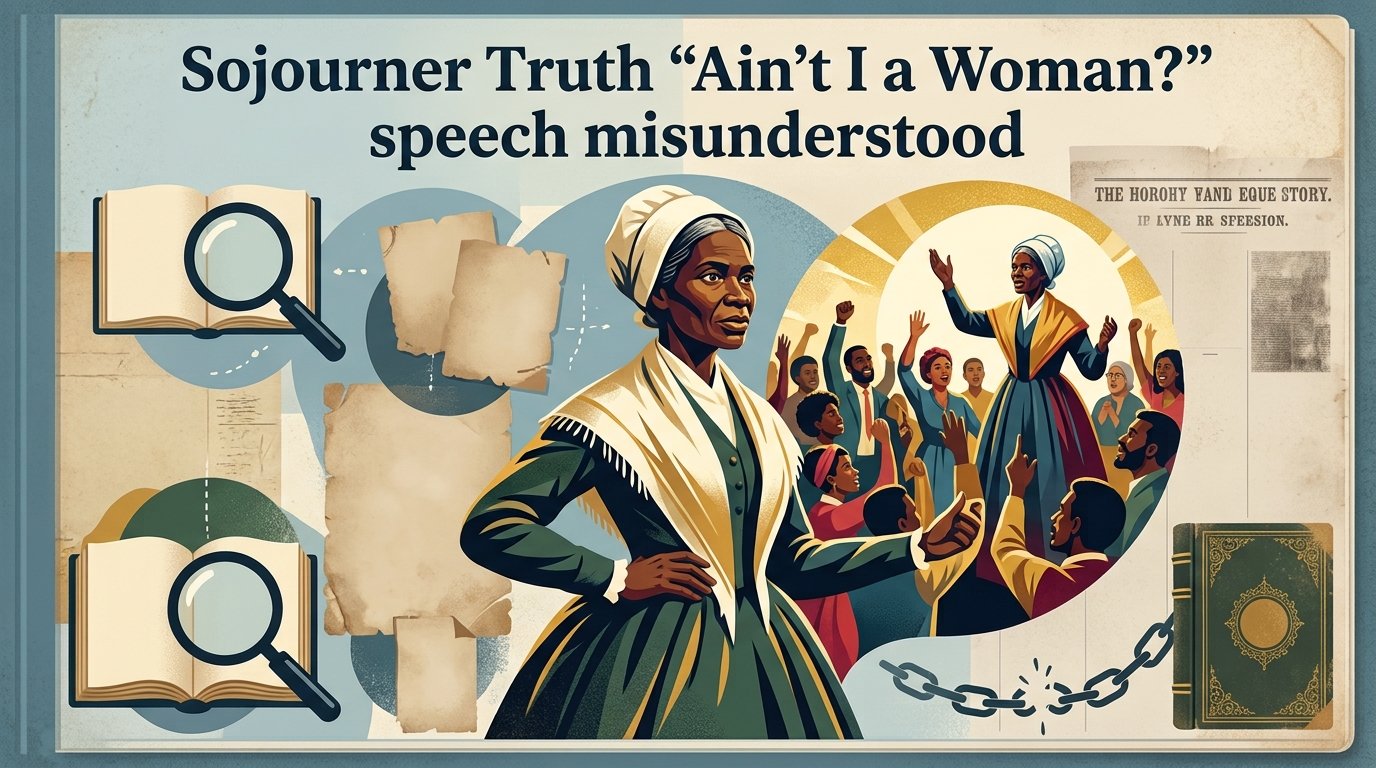
The Sojourner Truth “Ain’t I a Woman” speech misunderstood by most Americans today never actually contained that famous phrase. The words we were taught in school come from a heavily modified version published 12 years after Truth spoke at the 1851 Women’s Rights Convention in Akron, Ohio. A white abolitionist named Frances Dana Barker Gage rewrote the speech in 1863, adding southern slave dialect, fabricating a dramatic introduction, and injecting the repeated refrain “Ain’t I a Woman?” that has echoed through history books ever since.
The authentic version, transcribed by Truth’s friend Reverend Marius Robinson and published in the Anti-Slavery Bugle just weeks after she delivered it, sounds nothing like the famous rendition. It contains no southern dialect. It never asks “Ain’t I a Woman?” And it reflects the speech patterns of a woman raised speaking Dutch in rural New York, not the stereotyped voice of a Southern plantation.
This matters because the misinterpretation erased Sojourner Truth’s actual identity. It replaced her Northern slave experience, her Dutch heritage, and her own voice with a caricature that fit what white audiences in the 1860s expected an enslaved Black woman to sound like. Understanding what made the speech misunderstood means confronting how history gets rewritten, sometimes by people who genuinely believed they were helping.
Table of Contents
Who Was Sojourner Truth?
Sojourner Truth was born Isabella Baumfree around 1797 in Swartekill, New York, a small settlement in Ulster County. She was born enslaved in a Dutch-speaking household, and her first language was Dutch. This fact matters more than most people realize, because it shaped how she spoke for her entire life.
New York state did not abolish slavery until 1827, and Truth spent her first three decades in bondage under a series of owners in the Hudson Valley. She was separated from her parents as a child, sold away from her first love, and forced to marry another enslaved man. She bore five children.
In 1826, a year before emancipation took effect, Truth walked away from her enslaver’s farm with her infant daughter Sophia. She left her other children behind because she could not carry them all. Later, after learning her son Peter had been illegally sold to an owner in Alabama, she became one of the first Black women in the United States to win a court case against a white man when she sued for his recovery.
In 1843, she changed her name to Sojourner Truth. She said God had called her to travel the land and testify to the truth of the hope that was in her. From that point forward, she became an itinerant preacher, abolitionist speaker, and women’s rights advocate who drew crowds across the country. She dictated her autobiography, The Narrative of Sojourner Truth, which was published in 1850.
By the time she arrived in Akron, Ohio, in May 1851, Truth was a seasoned public speaker with a commanding physical presence. Contemporary accounts describe her as tall, deep-voiced, and impossible to ignore. She was not the trembling figure later depictions would suggest. She was a woman who had survived slavery, sued a white man in court, and made a living arguing with audiences who disagreed with her.
The 1851 Women’s Rights Convention in Akron, Ohio
The Women’s Rights Convention held in Akron, Ohio, in late May 1851 was the second national women’s rights gathering organized after the landmark Seneca Falls Convention of 1848. It took place in the Old Stone Church, and it was tense from the start.
Many white women in the audience opposed allowing a Black woman to speak. Some abolitionists worried that connecting women’s rights with Black rights would damage both causes. The convention had already been disrupted by disagreements over whether to seat Black delegates and whether to discuss voting rights at all.
Truth rose to speak on the second day. She was not on the official program. According to those present, she addressed the crowd directly and spoke for only a few minutes. The speech was extemporaneous, delivered in response to comments made by male clergy who had been arguing that women were too weak and delicate to deserve equal rights.
Truth’s central argument cut through that nonsense. She had worked as hard as any man, she said. She had plowed fields, planted crops, and harvested them. No man had ever helped her carry her burdens. The implication was clear: if physical strength was the test for rights, she had passed it many times over. She also addressed the religious arguments head-on, challenging the ministers’ claim that Christ was a man and therefore women should be subordinate.
The Authentic 1851 Version by Marius Robinson
The earliest and most accurate record of Sojourner Truth’s speech comes from Reverend Marius Robinson, a white abolitionist who attended the convention and was a personal friend of Truth. Robinson published his transcription in the Anti-Slavery Bugle on June 21, 1851, barely three weeks after the convention ended.
Robinson’s version is the closest thing we have to a primary source. He was present, he knew Truth personally, and he had no apparent motive to distort her words. His transcription reflects a measured, articulate speaker making logical arguments, not a figure using heavy dialect.
Here are key passages from the Robinson version as it appeared in the Anti-Slavery Bugle:
“Well, children, where there is so much racket there must be something out of kilter. I think that ‘twixt the negroes of the South and the women at the North, all talking about rights, the white men will be in a fix pretty soon.”
“Nobody ever helps me into carriages, or over mud-puddles, or gives me any best place! And ain’t I a woman? Look at me! Look at my arm! I have ploughed and planted, and gathered into barns, and no man could head me! And ain’t I a woman? I could work as much and eat as much as a man – when I could get it – and bear the lash as well! And ain’t I a woman?”
Note what is here and what is not. The phrase “ain’t I a woman?” does appear in Robinson’s version. The dialect is light and reflects standard American speech of the era. There are no exaggerated spellings meant to signal an “authentic” enslaved voice. Truth comes across as sharp, direct, and fully in command of her argument.
Robinson’s transcription ran roughly 450 words. It was reprinted in newspapers and circulated among abolitionist networks. For the first 12 years after the speech, this was the version people knew.
The 1863 Modified Version by Frances Gage
Everything changed in April 1863, when Frances Dana Barker Gage published her own account of the speech in the New York Independent, a leading abolitionist newspaper. Gage had also been present at the Akron convention, but her version, published 12 years after the fact, differed from Robinson’s in ways that would shape how Truth was remembered for the next century and a half.
Gage’s retelling opens with a dramatic scene she almost certainly invented. She describes Truth arriving at the convention and being met with hisses and calls for her to sit down. She claims ministers in the crowd openly mocked Truth and that Truth waited patiently before rising to silence the room. None of this appears in contemporaneous accounts.
The most significant change is in how Gage rendered Truth’s speech. She wrote it in a heavy, exaggerated dialect that drew on minstrel-show conventions familiar to white Northern readers of the 1860s. Robinson had Truth say, “And ain’t I a woman?” Gage had her say, “And a’n’t I a woman?” with the surrounding text saturated in phonetic spellings designed to evoke a Southern enslaved speaker.
Gage also expanded the speech significantly. She added material about motherhood and Christ that does not appear in Robinson’s version. She inserted the famous hypothetical about Christ not being a woman, framing Truth as a naive biblical literalist. And she transformed the tone from a measured political argument into a stirring emotional plea.
Why did Gage do this? Scholars offer several explanations. The Civil War was raging in 1863, and abolitionist publishing was oriented toward rallying Northern white readers. A speech rendered in dialect that confirmed stereotypes about formerly enslaved people may have felt more powerful and authentic to that audience, even if it bore no resemblance to how Truth actually spoke. Gage may also have been writing from imperfect memory and filling in gaps with what she assumed Truth must have said.
Whatever the motivation, Gage’s version became the standard. It was reprinted in textbooks, recited by schoolchildren, and treated as the definitive text of Truth’s speech for over a century. Robinson’s transcription, the one published closest to the event by someone who knew Truth, was largely forgotten until historians revived it in the late 20th century.
What Made the Speech Misunderstood
So what made Sojourner Truth’s “Ain’t I a Woman” speech misunderstood? The answer comes down to a single act of rewriting that replaced a real person with a convenient myth.
First, Gage imposed a Southern dialect on a woman who had never lived in the South. Truth was born in New York, raised in a Dutch-speaking community, and spent her adult life traveling through Northern states. Her actual speech would have carried traces of Hudson Valley Dutch and the speech patterns of upstate New York. Gage’s dialect erased this entirely and substituted a generic “slave” voice drawn from popular entertainment of the era.
Second, the modified version erased Truth’s Dutch heritage. Truth’s first language was Dutch, and even after she learned English, she retained a noticeable accent throughout her life. This detail matters because it places her in a specific historical reality: the often-overlooked institution of slavery in the Northern colonies and states. When we replace her voice with a generic Southern one, we lose the fact that slavery existed in New York until 1827 and that Northern enslavement had its own distinct character.
Third, the Gage version reshaped Truth’s argument. In Robinson’s transcription, Truth makes a logical, pointed case about labor, equality, and religious interpretation. She is debating ministers on their own terms and winning. In Gage’s version, she becomes a figure of emotional pathos, moving the audience to tears rather than defeating them with reason. This shift matters because it changes how we understand Black women’s intellectual contributions to the abolitionist and women’s rights movements.
Fourth, the misunderstanding perpetuates stereotypes about how enslaved people spoke. Every time the dialect version is recited in a classroom, it reinforces the idea that formerly enslaved people were inarticulate or spoke in a cartoonish dialect. The real Truth was a professional speaker who earned her living addressing mixed-race, mixed-gender audiences. She was articulate by any standard.
Side-by-Side: The Two Versions Compared
The clearest way to understand the misunderstanding is to compare the two versions directly. Here is how key passages differ between Robinson’s 1851 transcription and Gage’s 1863 retelling.
Opening line. Robinson: “Well, children, where there is so much racket there must be something out of kilter.” Gage: “Wall, chilern, whar dar is so much racket dar must be someting out ob kilter.”
On labor. Robinson: “I have ploughed and planted, and gathered into barns, and no man could head me.” Gage: “I have ploughed, and planted, and gathered into barns, and no man could head me! And ain’t I a woman?”
On motherhood. Robinson’s version does not include an extended passage about Truth mourning her children sold away into slavery. Gage added this material, writing: “I have borne thirteen chilern, and seen ’em mos’ all sold off to slavery, and when I cried out with my mother’s grief, none but Jesus heard me.”
The historical record is unclear on whether Truth said thirteen children. Most scholars believe she had five. The number thirteen may have been Gage’s invention or a conflation with other abolitionist testimonies.
On religion. Robinson: Truth references Christ briefly and questions the logic of using his maleness to argue against women’s rights. Gage: greatly expanded the religious material, turning it into the emotional climax of the speech.
Tone. Robinson’s Truth is direct, logical, and slightly sardonic. Gage’s Truth is deeply emotional, pleading, and constructed to move a white audience to tears. The difference between these two tones is the difference between a political argument and a performance.
Dialect. Robinson’s transcription uses light dialect, consistent with how a Dutch-influenced Northern speaker might have sounded. Gage’s version uses heavy phonetic dialect drawn from minstrel traditions, creating a voice that bore no resemblance to Truth’s actual speech.
Scholars have compared the two versions extensively. Professor Nell Irvin Painter, whose 1996 biography Sojourner Truth: A Life, a Symbol is considered definitive, concluded that Gage’s version cannot be treated as an accurate record of what Truth said. Painter’s research established that Truth’s real voice and arguments were closer to Robinson’s account and that Gage’s retelling was a creative reconstruction shaped by the racial assumptions of its time.
Why It Still Matters in 2026
The misunderstanding of Sojourner Truth’s speech is not just a historical curiosity. It is a case study in how representation can be distorted even by allies, and how myths can outlive facts for generations.
For over a hundred years, the version of Truth that most Americans encountered was invented by someone else. She was denied her own words, her own voice, and her own intellectual legacy. Students memorized Gage’s dialect version without ever learning that the real Sojourner Truth spoke clearly, argued sharply, and never sounded like the caricature they were taught.
The Sojourner Truth Project, founded to correct this historical record, offers audio recordings of the authentic Robinson transcription read in the Afro-Dutch-inflected English that scholars believe would have reflected Truth’s actual speech. Hearing the real version is a different experience from reading the dialect text. It sounds like a person making an argument, not a symbol being displayed.
Honoring Truth’s actual words matters for how we teach history. It matters for how we understand the role of Black women in the abolitionist and women’s rights movements. And it matters because Truth herself fought her entire life to be heard on her own terms. The least we can do, more than 170 years after she spoke in Akron, is finally listen to what she actually said.
Frequently Asked Questions
What was Sojourner Truth’s Ain’t I a Woman speech about?
The speech addressed the intersection of racial and gender inequality. Truth argued that she had performed the same physical labor as any man, endured the same hardships, and therefore deserved the same rights. She directly challenged male clergy at the 1851 Women’s Rights Convention in Akron, Ohio, who claimed women were too weak and subordinate to deserve equality.
Why did Sojourner Truth repeat Ain’t I a Woman?
The repeated refrain appears in both the 1851 Robinson transcription and the 1863 Gage version, but it functioned differently in each. In the authentic version, Truth used the phrase as a rhetorical question punctuating her accounts of physical labor and hardship. In Gage’s modified version, the refrain was emphasized more heavily and surrounded by dialect that did not reflect Truth’s actual speech.
Was Sojourner Truth missing a finger?
Yes. Sojourner Truth’s right hand was injured during her time in slavery, and she was missing part of a finger. She referenced her physical strength and her hands during the speech, holding up her arm to show the audience that she had done hard manual labor equal to any man’s work.
Did Sojourner Truth give her speech at a women’s rights convention?
True. Sojourner Truth delivered the speech at the 1851 Women’s Rights Convention in Akron, Ohio, held in the Old Stone Church. She was not on the official program and rose to speak on the second day in response to arguments from male clergy that women did not deserve equal rights.
Conclusion
What made Sojourner Truth’s “Ain’t I a Woman” speech misunderstood was a single act of rewriting by Frances Dana Barker Gage in 1863. Gage took the authentic, articulate words that Truth delivered in Akron and replaced them with a dialect-heavy, emotionally heightened version that erased Truth’s Dutch heritage, her Northern slave experience, and her sharp political reasoning.
The Robinson version published in the Anti-Slavery Bugle remains the closest record we have to what Truth actually said. If you want to honor her legacy, read that version. Teach that version. And remember that the real Sojourner Truth was more formidable, more articulate, and more intellectually courageous than the myth that was built around her.