
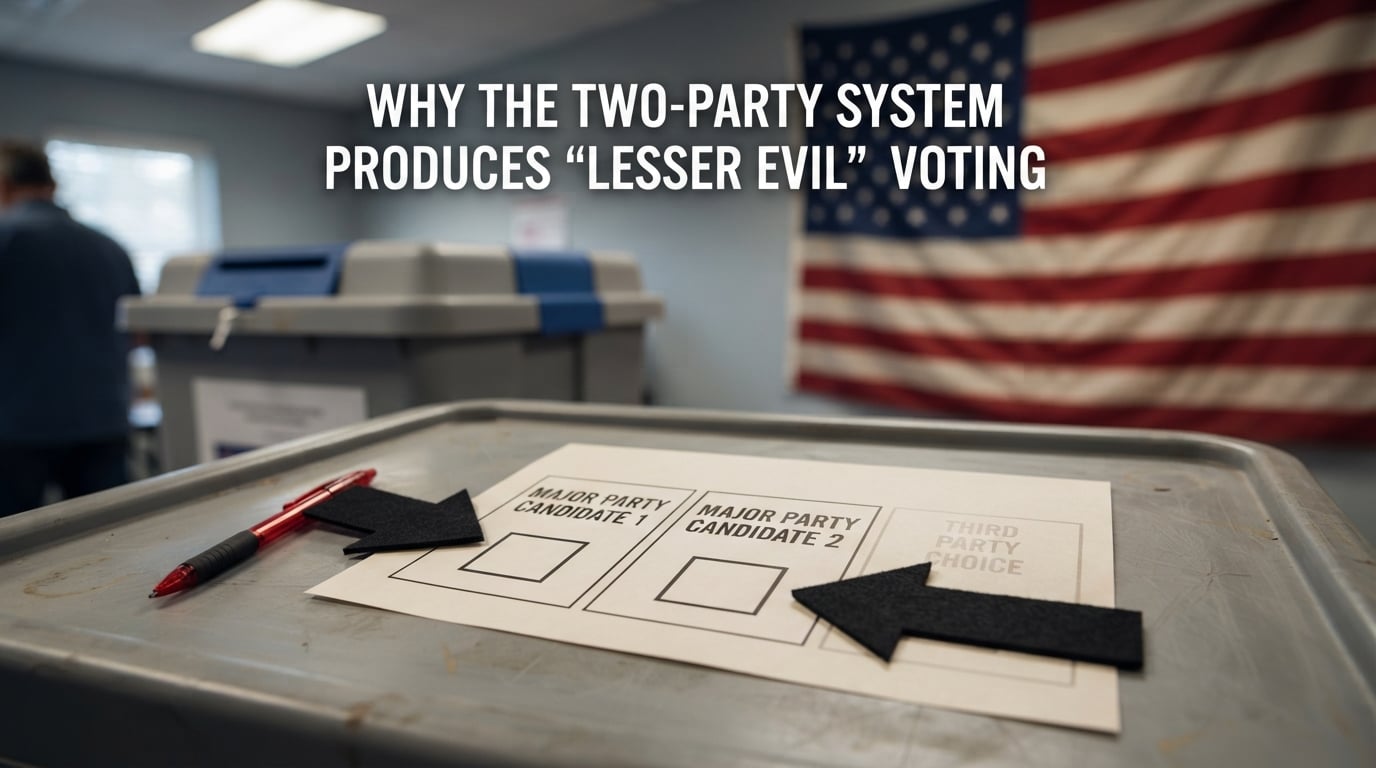
If you have ever walked into a voting booth disliking both major-party candidates, you have already lived the question behind this guide: why does the two-party system produce lesser evil voting? The answer is not about culture, voter ignorance, or campaign strategy. It is built into the math of how Americans elect presidents, senators, and representatives.
The phrase “lesser of two evils” appeared in an 1884 New York Times editorial about that year’s presidential election, and the behavior it describes has been a recurring feature of American democracy ever since. According to a FairVote survey from 2024, 47 percent of voters reported casting a ballot for the “lesser of two evils.” Understanding why the two-party system produces lesser evil voting requires looking at the structural incentives that make strategic compromise feel like the only rational choice.
In this guide, I will walk you through the mechanics, history, arguments, and possible solutions. The goal is not to tell you how to vote. It is to explain why so many voters, across the political spectrum, end up holding their nose at the ballot box, and why that pattern will keep repeating until the underlying system changes.
Table of Contents
What Is Lesser-Evil Voting?
Lesser-evil voting (LEV) is a form of strategic voting in which a voter supports a less-preferred candidate, the “lesser evil,” instead of their actual favorite, because the favorite has no realistic chance of winning. The voter is not endorsing the candidate they choose. They are actively preventing the candidate they fear most from taking office.
This behavior is different from sincere voting, where you simply pick the candidate whose policies you like best regardless of their chances. In a sincere voting world, third-party candidates and minor contenders would receive steady support proportional to how much voters actually liked them. In a strategic voting world, those same voters abandon their favorite once polling shows the race is between two major-party candidates, and shift their support to whichever major-party option they find less harmful.
Real example: a progressive voter in a swing state in 2024 who supported the Green Party candidate in March but voted Democratic in November to block a Republican victory. That voter did not change their policy preferences. They changed their strategy.
That is lesser-evil voting in action, and it is the default behavior for millions of Americans every single election cycle.
Why the Two-Party System Produces Lesser Evil Voting
The two-party system produces lesser evil voting because of one core feature: most American elections use single-member districts with a winner-take-all, first-past-the-post voting system. Under these rules, only the candidate with the most votes in a district wins, regardless of whether they received a majority. Third parties rarely finish first, and votes for them often help the major-party candidate the voter liked least.
Duverger’s Law: The Mechanical Force Behind Two-Party Systems
French political scientist Maurice Duverger identified the pattern in the 1950s, and it is now known as Duverger’s Law. The law states that plurality voting in single-member districts tends to favor a two-party system. It does this through two forces working together.
The first force is the mechanical effect. In a district that elects one winner, smaller parties are structurally disadvantaged because every vote “wasted” on a losing candidate is, in effect, a vote taken away from a major-party candidate with similar views. Over many elections, this whittles down minor parties until only two viable options remain.
The second force is the psychological effect, also called strategic coordination. Once voters learn that third-party candidates cannot win, they stop voting for them and shift their support to one of the two major parties. Voters do this rationally, based on the math, not because of any conspiracy.
They are simply trying to avoid “wasting” their vote. The combined result is a self-reinforcing two-party system: third parties shrink because voters abandon them, voters abandon them because they shrink, and the two major parties grow stronger because they are the only realistic options.
This is the structural foundation that forces lesser-evil voting on the American electorate. It is not a cultural preference or a failure of imagination. It is a rational response to the rules of the game.
First-Past-the-Post Voting Mechanics
First-past-the-post (FPTP) is the specific voting method used in nearly all US elections. The candidate with the most votes wins, even if that is only 35 percent in a three-way race. This creates an immediate incentive to consolidate behind two parties.
Imagine a congressional district where 40 percent of voters prefer the Democratic candidate, 35 percent prefer the Republican, 15 percent prefer the Green candidate, and 10 percent prefer the Libertarian. The Democrat wins outright with 40 percent. But suppose 10 percent of the Green supporters would have preferred the Democrat as their second choice.
In FPTP, that 15 percent is effectively “wasted” because their candidate could not win. If those voters had coordinated and voted Democrat, the result would have been different.
This is exactly what voters think about when they weigh a third-party choice. They do not ask, “Whose policies do I prefer?” They ask, “Which of the two major-party candidates has the best chance of winning, and which of them is closer to my views?” That second question is the lesser-evil calculation in its purest form.
Vote Splitting and the Spoiler Effect
The most visible consequence of FPTP mechanics is the spoiler effect. A third-party candidate with views similar to a major-party candidate can pull enough votes away to swing the election to the major-party candidate those voters least wanted. Ralph Nader’s run in 2000 is the textbook example: many political analysts argue Green Party votes in Florida cost Al Gore the state and the presidency.
The fear of being a spoiler is one of the strongest psychological pressures pushing voters toward lesser-evil choices. Nobody wants to be the person whose vote “caused” the greater evil to win. So voters in swing states especially learn to suppress their sincere preferences and vote strategically.
This is why lesser-evil voting is not just a habit. It is the rational response to a system that punishes third-party support. Until the system changes, voters who care about outcomes have strong incentives to participate in strategic voting.
And every election cycle reinforces the pattern further. The more voters who strategically abandon third parties, the less viable those parties become, which in turn pushes even more voters toward strategic voting. The cycle feeds itself.
The Historical Evolution of Lesser-Evil Voting in America
Lesser-evil voting is not a modern invention. It has shaped American presidential elections since at least the 1830s, when the Whig Party began replacing the National Republican Party and the two-party duopoly re-formed. The pattern repeats every time a third-party movement threatens to crack the system: voters consolidate, third parties fade, and the choice narrows back to two.
The earliest documented popular use of the phrase “lesser of two evils” in American politics appears in the 1884 election. The New York Times used it to describe the choice between Republican Benjamin Harrison and Democrat Grover Cleveland, both of whom struck many voters as flawed. That election went on to produce one of the most corrupt victories in presidential history, with the winning side openly buying votes in Indiana.
The pattern continued through the 20th century. Theodore Roosevelt’s 1912 Bull Moose run split the Republican vote and handed the election to Democrat Woodrow Wilson. Strom Thurmond’s 1948 Dixiecrat run split the Democratic vote and put Harry Truman in the White House. George Wallace’s 1968 American Independent run is widely credited with tipping the close election to Richard Nixon.
In every case, the same dynamic appeared: a third party rises, voters split, and the major party least aligned with the third party’s base wins. The lesson is not that third parties are bad. The lesson is that the system structurally punishes them.
Modern elections have intensified this pattern. The FairVote 2024 poll found that 47 percent of voters described their choice as the “lesser of two evils,” and another large share said they wished they had a stronger option. The 2016 and 2020 elections produced similar findings, with majorities of voters expressing dissatisfaction with both major-party nominees.
The lesson from history is clear. Lesser-evil voting is not an aberration caused by a particular bad election year. It is a built-in feature of the American electoral system that has been operating for nearly 200 years.
Arguments FOR Lesser-Evil Voting
The main argument for lesser-evil voting is harm reduction. When the outcome between two candidates has real-world consequences for rights, the economy, foreign policy, and individual lives, choosing the less harmful option is morally defensible, even when neither option is ideal. Voting is not just expressive. It is instrumental.
Noam Chomsky made the case in his “Eight-Point Brief for LEV” with characteristic directness. Among the points: a Trump victory in 2016, he argued, would threaten vulnerable populations, environmental protections, and the international order. Abstaining or voting third party might feel principled, but the cost of letting the greater evil win falls on people who did not make that choice.
The vote is a tool, and refusing to use it does not protect the people who suffer the consequences. This is the core of the harm-reduction argument.
This argument has special force in swing states, where the outcome is genuinely in doubt. A voter in California or Wyoming can vote their conscience with little effect on national outcomes. A voter in Pennsylvania or Michigan cannot. For them, the question is not, “Which candidate do I prefer?” It is, “Which outcome do I want to live under for the next four years?”
The harm-reduction case is also why lesser-evil voting often intensifies during periods of perceived high stakes. Civil rights, Supreme Court appointments, war and peace, and economic crisis all push voters toward strategic calculations. When the cost of a wrong choice feels very high, voters have strong reasons to choose the less-bad option regardless of their sincere preferences.
Defenders of LEV also point out that most historical third-party presidential runs failed to change policy outcomes. They either drew votes from one major party without changing the result, or they faded quickly after a single election. If the goal is to actually shape who governs, the lesser-evil choice is often the only one that does so.
Arguments AGAINST Lesser-Evil Voting
The main argument against lesser-evil voting is accountability. When voters reward a major party by holding their nose and voting for it, the party has no incentive to nominate better candidates or change its positions. The result is a feedback loop: weak candidates get nominated, voters hold their noses, parties keep nominating weak candidates.
The Cato Institute has long argued this point. From a libertarian perspective, voting for the lesser evil entrenches the two-party duopoly and prevents reform. If Republicans know that libertarians and conservatives will vote for them anyway to block Democrats, why would they ever nominate a candidate who actually represents limited-government principles?
The lesser-evil vote becomes a blank check. Parties learn they can ignore their base because the base has nowhere else to go.
Accelerationist thinkers go further. They argue that continuing to vote for the lesser evil only delays the crisis that would force real change. The longer voters prop up a dysfunctional system, the worse the eventual breakdown will be.
By their logic, allowing the greater evil to win can sometimes be the only way to break the duopoly and create space for genuine alternatives. This is a provocative claim, but it deserves serious engagement rather than dismissal.
There is also a moral critique. Lesser-evil voting asks voters to actively support candidates whose policies they believe are harmful, simply because the alternative is worse. For voters with strong principles, whether rooted in faith, ideology, or personal experience, this can feel like a betrayal of conscience.
Pope Francis himself has weighed in on this dilemma, suggesting that voters must weigh the concrete choices before them rather than abstaining in protest. The tension between pragmatism and principle is real, and no single answer resolves it for everyone.
Finally, the lesser-evil vote can entrench polarization. When the two parties know their bases have nowhere else to go, they have every incentive to mobilize their most extreme supporters rather than appeal to the center. The result is the divisive politics we see today, where each side fears the other more than it respects its own moderates.
Psychological and Cultural Factors
Beyond the structural mechanics, lesser-evil voting is reinforced by powerful psychological and cultural forces. Voters are not just calculating outcomes. They are managing fear, guilt, social pressure, and identity.
The phrase “holding your nose” captures the experience well. Voters who choose the lesser evil often describe physical discomfort at the ballot box, knowing they are supporting someone they do not actually like.
Reddit’s r/changemyview is full of threads from voters wrestling with this exact tension. Many describe years of guilt after voting for a candidate they considered harmful, simply to block a worse one. The emotional weight of the choice lingers long after Election Day.
Fear is the dominant emotion in lesser-evil voting. The South Park “giant douche versus turd sandwich” episode captured this dynamic so well it became a permanent cultural reference. Voters are not just choosing what they want. They are choosing what they fear less. The whole calculation runs on negative motivations.
Community pressure adds another layer. African American communities, for example, have historically faced the strongest pressure to vote strategically, given the civil rights stakes of every presidential election.
In tight races, community leaders frequently make direct appeals to vote for the major-party candidate seen as less harmful. Refusing to comply can mean social ostracism. The result is that LEV is not just an individual choice. It is a collective obligation imposed by community dynamics.
These psychological and cultural factors mean that simply changing the voting system may not be enough to change voter behavior. Even in places that have adopted ranked choice voting, voters still sometimes default to strategic thinking out of habit. Real reform requires both institutional change and a shift in voter expectations.
Alternatives and Electoral Reform
The most commonly proposed alternatives to first-past-the-post are ranked choice voting, approval voting, and proportional representation. Each tries to reduce or eliminate the structural pressure that produces lesser-evil voting.
Ranked Choice Voting
Ranked choice voting (RCV) lets voters rank candidates in order of preference. If no candidate receives a majority of first-choice votes, the last-place candidate is eliminated and their voters’ second choices are redistributed. This continues until one candidate has a majority.
RCV eliminates the spoiler effect because voters can safely support a third-party candidate as their first choice without fear of helping the candidate they like least. If their favorite cannot win, their vote simply transfers to their next preference.
RCV has been adopted in cities like New York, San Francisco, and Minneapolis, and at the state level in Maine and Alaska. Early results suggest it changes campaign dynamics: candidates have incentives to seek second-choice support from rivals’ voters rather than just attacking them.
Critics argue it is confusing for voters and can produce odd results, but most evidence shows it works as designed. The bigger challenge is political resistance from the two parties that benefit from the current system.
Approval Voting
Approval voting lets voters select as many candidates as they “approve” of. The candidate with the most approvals wins. This is simpler than RCV and lets voters express nuanced preferences without ranking.
It allows third-party support without spoiler risk, because voters can vote for both a major-party candidate they tolerate and a minor-party candidate they prefer. Approval voting has been adopted in Fargo, North Dakota and St. Louis, Missouri, with positive early results.
Proportional Representation
Proportional representation (PR) allocates legislative seats in proportion to vote share. A party that wins 15 percent of the vote gets roughly 15 percent of the seats.
Most democracies in Europe, Latin America, and elsewhere use some form of PR for their legislatures. The result is multiparty systems where voters can support smaller parties without “wasting” their vote, because those parties can win seats.
PR is the most thorough reform option, but it would require constitutional changes at the federal level in the United States. State-level adoption for state legislatures is more feasible and could serve as a model.
What Voters Can Do Today
You do not have to wait for federal reform to make a difference. State and local elections determine ballot access rules, voting methods, and redistricting. Supporting candidates who back electoral reform at the state level is one of the highest-leverage actions available.
Joining organizations like FairVote, the National Conference on Citizenship, or state-level reform coalitions can amplify your voice. Reform movements grow when ordinary voters decide the current system is no longer acceptable.
You can also push your primary vote. Choosing better major-party candidates in primaries is one way to reduce the lesser-evil dilemma at the general election. Turnout in primaries is typically much lower than in general elections, so an engaged minority can shape who ends up on the November ballot.
Frequently Asked Questions
Why does the two-party system produce lesser evil voting?
The two-party system produces lesser evil voting because most US elections use single-member districts with first-past-the-post, winner-take-all voting. Under these rules, voting for a third-party candidate who cannot win risks helping the major-party candidate the voter likes least. Voters respond rationally by choosing the less-bad major-party option to block the worse one, a behavior known as strategic voting or lesser-evil voting.
What is Duverger’s Law and how does it relate to two-party systems?
Duverger’s Law is the political science principle that single-member districts with plurality voting tend to produce two-party systems. It works through two forces: a mechanical effect that wastes votes on third parties and a psychological effect that teaches voters to coordinate around two viable options. Together, these forces self-reinforce a two-party duopoly and create the conditions that force lesser-evil voting on the electorate.
What are the arguments for voting for the lesser evil?
The strongest argument is harm reduction. When the choice between candidates has real consequences for rights, policy, and people’s lives, voting for the less harmful option is defensible even when neither candidate is ideal. Voting is instrumental, not just expressive. Noam Chomsky’s Eight-Point Brief for LEV makes this case, especially in swing states where the outcome is genuinely uncertain.
What are the arguments against lesser-evil voting?
The strongest argument against LEV is accountability. When voters always choose the lesser evil, major parties have no incentive to nominate better candidates or change their positions. The Cato Institute argues this entrenchment blocks reform and produces weak nominees. Accelerationists argue that letting the greater evil win can sometimes force real change. There is also a moral critique about compromising conscience.
How has lesser-evil voting evolved historically in America?
Lesser-evil voting has shaped American presidential elections since the 1830s. The earliest documented popular use of the phrase lesser of two evils was an 1884 New York Times editorial. The pattern repeated through the 20th century, with third-party runs in 1912, 1948, and 1968 each splitting votes and altering outcomes. The FairVote 2024 poll found that 47 percent of voters still described their choice as the lesser of two evils.
What alternatives exist to lesser-evil voting?
The main alternatives are ranked choice voting, approval voting, and proportional representation. Ranked choice voting eliminates the spoiler effect by letting voters rank candidates. Approval voting lets voters support multiple candidates without ranking. Proportional representation, used by most democracies outside the US, allocates legislative seats by vote share, making it easier for third parties to win representation without vote splitting.
Conclusion
Understanding why the two-party system produces lesser evil voting means recognizing that the dilemma is structural, not personal. Voters are not failing to find good candidates. The system itself filters out third-party options, rewards strategic compromise, and punishes sincerity at the ballot box.
That is the legacy of first-past-the-post plurality voting combined with single-member districts. The pattern has been repeating for nearly 200 years because the underlying rules have not changed.
Until those rules change, either through ranked choice voting, approval voting, or proportional representation, the lesser-evil dilemma will keep showing up in every presidential election. The 2024 FairVote poll showing 47 percent of voters felt forced into the lesser-evil choice is just the latest confirmation of a structural problem that predates any single election cycle.
What you can do next is engage at the level where the rules are actually set. State and local elections determine voting methods, ballot access, and redistricting. Primary elections determine who ends up on the general election ballot. And joining reform coalitions can amplify your voice.
The structural causes of lesser-evil voting are well understood. The only remaining question is whether enough voters will organize to change them.