
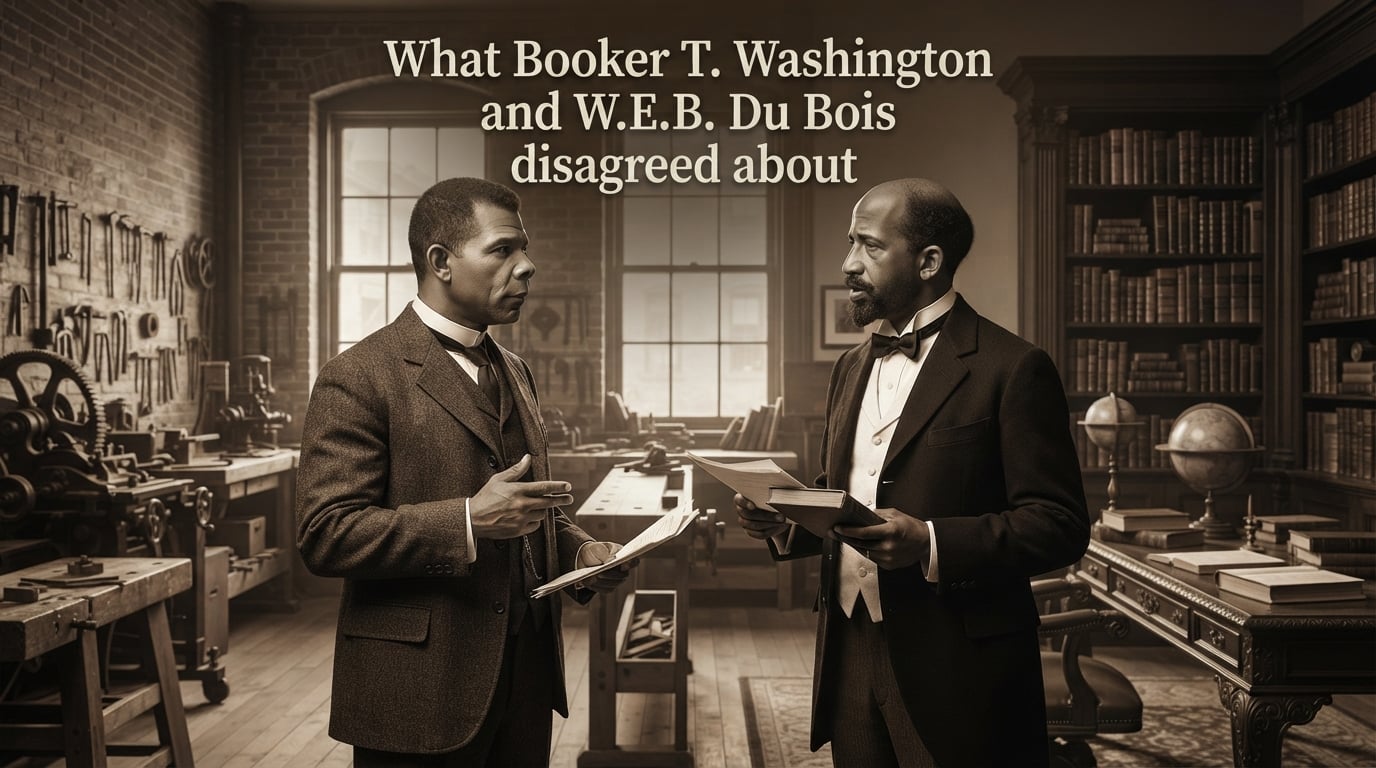
Booker T. Washington and W.E.B. Du Bois disagreed fundamentally about how Black Americans should pursue civil rights and social progress in the Jim Crow era. Washington advocated for vocational training, economic self-sufficiency, and temporary accommodation of segregation, while Du Bois demanded immediate political equality, higher education, and outspoken protest against racial injustice. Their clash, often called the “Great Debate,” defined two competing strategies that shaped the entire civil rights movement in America.
Both men wanted the same end goal: full citizenship and dignity for Black Americans. Where they parted ways was the method. Washington, born into slavery, believed Black Americans should build economic power first and win white respect through hard work and industrial skills. Du Bois, born free and Harvard-educated, believed accepting segregation even temporarily was a dangerous surrender that would entrench white supremacy.
Their debate, which unfolded in speeches, essays, and books between 1895 and 1915, remains one of the most studied disagreements in American intellectual history. Understanding what Booker T. Washington and W.E.B. Du Bois disagreed about means understanding the foundational arguments that still echo through every conversation about racial justice today.
Table of Contents
Two Leaders, Two Backgrounds: How Personal History Shaped Philosophy
The disagreement between Booker T. Washington and W.E.B. Du Bois cannot be understood without examining where each man came from. Their backgrounds were so different that they almost seemed to be speaking about two separate Americas.
Booker T. Washington was born into slavery in 1856 on a Virginia plantation. He walked 500 miles to attend the Hampton Normal and Agricultural Institute, a school dedicated to training Black teachers and tradespeople. After graduating, he founded the Tuskegee Institute in Alabama in 1881, a school that taught bricklaying, farming, carpentry, and domestic sciences alongside basic academics. Washington had lived the brutality of slavery and the daily violence of the post-Reconstruction South. He knew, intimately, what it cost a Black person to challenge white power in states where lynchings were public spectacles.
W.E.B. Du Bois was born in 1868 in Great Barrington, Massachusetts, into a free Black family in a relatively tolerant New England town. He attended Fisk University, then became the first Black person to earn a PhD from Harvard University in 1895. His studies took him to Germany, where he absorbed the rigorous sociological methods of European academia. Du Bois had not grown up under the constant threat of Southern mob violence. His worldview was shaped by scholarship, international travel, and the assumption that educated people of any race deserved full participation in civic life.
These contrasting experiences produced contrasting philosophies. Washington the pragmatist saw survival and gradual progress as the priority. Du Bois the scholar saw the acceptance of second-class citizenship as moral surrender. Neither man was entirely wrong about the world he inhabited, which is what made their disagreement so enduring.
Booker T. Washington’s Accommodationist Philosophy
Booker T. Washington’s strategy centered on what historians call accommodationism: accepting the political and social realities of Jim Crow while quietly building economic power. He laid out this vision most clearly in his 1895 Atlanta Compromise speech, delivered at the Cotton States and International Exposition in Atlanta.
In that address, Washington told a mostly white audience that Black Americans should “cast down your bucket where you are” and pursue agricultural and industrial trades rather than agitate for political office. He famously suggested that “in all things that are purely social we can be as separate as the fingers, yet one as the hand in all things essential to mutual progress.” This was an explicit acceptance of racial segregation in social life, offered in exchange for white cooperation in Black economic advancement.
Washington believed vocational training was the key to Black uplift. Through the Tuskegee Institute, he trained thousands of Black men and women in skilled trades that made them economically self-sufficient. He argued that a Black mechanic or farmer who owned land and supported a family would earn white respect faster than a Black lawyer demanding the right to vote. His philosophy of self-help emphasized dignity through labor rather than through legislation.
Behind the scenes, Washington was more politically active than his public statements suggested. He secretly funded legal challenges to segregation and lobbied against lynching through intermediaries. But publicly, he maintained the posture of cooperation, believing that open confrontation would trigger violent reprisal against Black communities in the South. This double game made him both enormously influential and deeply controversial.
His approach won him the backing of wealthy white philanthropists like Andrew Carnegie and Julius Rosenwald, who poured millions into Black education and community building. It also won him access to presidents, including Theodore Roosevelt, who consulted Washington on political appointments affecting Black Americans. By 1900, Washington was arguably the most powerful Black man in America.
W.E.B. Du Bois’s Demand for Immediate Equality
W.E.B. Du Bois rejected Washington’s accommodationist approach with a force that reshaped the national conversation about race. In his 1903 book The Souls of Black Folk, Du Bois devoted an entire chapter to Washington, arguing that his strategy was surrendering the political, civil, and higher educational rights that Black Americans had fought and died to secure during Reconstruction.
Du Bois countered Washington’s vocational focus with his concept of the Talented Tenth: the idea that the top ten percent of Black Americans, through rigorous college education in the liberal arts and sciences, would become the leaders, teachers, and professionals who would lift up the entire race. He believed Tuskegee’s model of training bricklayers and maids, while useful, could never produce the lawyers, doctors, scholars, and politicians needed to dismantle systemic racism.
Where Washington counseled patience and economic accumulation, Du Bois demanded immediate civil rights and political representation. He argued that the right to vote, to hold office, to serve on juries, and to access equal public facilities were not rewards to be earned through good behavior. They were constitutional rights that had been stripped away through fraud and violence, and they had to be restored through organized protest and legal action.
Du Bois also attacked the moral foundation of Washington’s approach. He argued that accepting segregation, even temporarily, signaled to white America that Black people consented to their own subjugation. Once that consent was given, he warned, there would be no leverage to demand change later. Segregation accepted as a tactic would harden into segregation accepted as a permanent condition.
In 1909, Du Bois and a group of white and Black reformers founded the National Association for the Advancement of Colored People (NAACP), partly as an institutional alternative to Washington’s behind-the-scenes lobbying. The NAACP’s strategy of legal challenges, public campaigns, and political pressure represented everything Washington avoided in his public posture. Du Bois served as editor of the organization’s magazine, The Crisis, from 1910 to 1934, using it as a platform to attack segregation and mobilize Black political action nationwide.
The Core Points of Disagreement Between Washington and Du Bois
What Booker T. Washington and W.E.B. Du Bois disagreed about can be broken into five specific points, each of which represented a real strategic choice with consequences for millions of Black Americans living under Jim Crow.
1. Vocational Training Versus Higher Education
Washington believed industrial education, farming, and skilled trades were the fastest path to Black economic independence. Du Bois argued that limiting Black education to manual skills would permanently exclude Black Americans from the professions, academia, and political leadership needed to challenge white supremacy at its roots.
2. Gradual Economic Progress Versus Immediate Civil Rights
Washington argued that economic self-sufficiency had to come before political demands, because a people without resources could not sustain a fight for rights. Du Bois countered that civil rights were not negotiable and that waiting for economic permission to be treated as a citizen was itself a form of subjugation.
3. Acceptance Versus Rejection of Segregation
Washington’s Atlanta Compromise accepted social separation in exchange for economic opportunity. Du Bois viewed any acceptance of segregation as a moral failure that would normalize second-class status and make eventual equality impossible to achieve.
4. Cooperation Versus Confrontation With White Power
Washington cultivated relationships with white political and business leaders, believing their support was necessary to fund Black institutions and protect Black communities from violence. Du Bois believed relying on white patronage compromised Black autonomy and that direct confrontation with racist systems was the only way to force change.
5. Mass Economic Uplift Versus Talented Tenth Leadership
Washington’s vision was bottom-up: train the masses in useful trades and the community would rise together. Du Bois proposed a top-down model: educate an elite cadre of Black professionals and intellectuals who would then lead and represent the broader community in political and cultural life.
Was Either Man Entirely Right?
The honest answer is that both strategies contained truths the other lacked, and both had blind spots that history has revealed. Modern historians and forum discussions regularly note that Washington is too often dismissed as a sellout without appreciating the violence he was navigating.
Washington was operating in the Deep South, where lynchings averaged over 100 per year during the 1890s, and where any Black leader who publicly challenged white supremacy risked assassination. His accommodationism was, in part, a survival strategy for an entire people living under terrorist conditions. Reddit users in history forums frequently point out that what Du Bois proposed “would absolutely work in the North” but was nearly suicidal for Black communities in Alabama or Mississippi.
Du Bois, however, was right that segregation accepted as a tactic became segregation accepted as a fact. The Jim Crow system Washington publicly tolerated hardened into law and custom that would take another sixty years and a mass movement to dismantle. The NAACP’s legal strategy, which Du Bois championed, eventually produced the Brown v. Board of Education ruling of 1954 that struck down school segregation, vindicating his belief that courts and political pressure could succeed where quiet patience had failed.
Both men also had blind spots. Washington’s focus on male industrial labor left little room for Black women’s intellectual and professional aspirations. Du Bois’s Talented Tenth concept drew criticism, even in his lifetime, for implying that only a college-educated elite could lead a community largely made up of working-class people. Neither leader fully addressed the class divisions within Black America that their competing strategies often mirrored.
Legacy: How Their Debate Shaped the Civil Rights Movement
The disagreement between Washington and Du Bois did not end with their deaths. It became the architectural blueprint for every major debate within the civil rights movement that followed. When Martin Luther King Jr. preached nonviolent integration and economic justice, he drew on both traditions. When Malcolm X rejected gradualism and demanded Black self-determination by any means necessary, he echoed Du Bois’s refusal to accommodate white power while also recalling Washington’s emphasis on Black economic independence.
The NAACP, born directly from Du Bois’s rejection of Washington’s approach, became the most consequential civil rights organization of the twentieth century. Its Legal Defense Fund won the court cases that dismantled segregated schools, overturned white primary elections, and struck down housing discrimination. None of that would have happened if Washington’s behind-the-scenes quietism had remained the dominant Black strategy.
Yet Washington’s legacy also survived in tangible form. The Tuskegee Institute trained the Tuskegee Airmen, the Black fighter pilots who proved Black competence under fire in World War II and helped trigger the desegregation of the armed forces in 1948. The schools he built and the philanthropic networks he cultivated educated generations of Black professionals who became the backbone of the civil rights movement’s middle-class leadership.
In 2026, historians tend to view the Washington-Du Bois debate less as a contest with a winner and more as a tension that every generation of Black leadership must navigate anew. Questions about whether to work within existing institutions or confront them, whether to prioritize economic development or political power, and whether elite leadership or grassroots organizing drives lasting change are not settled. They are the living inheritance of the Great Debate that began in 1895.
FAQs
Why did DuBois and Washington disagree?
Du Bois and Washington disagreed because they held fundamentally different beliefs about how Black Americans should pursue equality. Washington believed economic self-sufficiency through vocational training had to come before political demands, while Du Bois believed accepting segregation and limiting Black education to trades would permanently entrench white supremacy and that civil rights had to be demanded immediately through political action and protest.
What did Booker T and Web disagree on?
Booker T. Washington and W.E.B. Du Bois disagreed on five main points: vocational training versus higher education, gradual economic progress versus immediate civil rights, acceptance versus rejection of segregation, cooperation versus confrontation with white political power, and mass economic uplift versus leadership by a college-educated Talented Tenth.
How did Booker T. Washington and Web Du Bois differ on civil rights?
Washington publicly accepted segregation and focused on building Black economic power through institutions like the Tuskegee Institute, believing civil rights would follow once Black Americans proved their economic value. Du Bois rejected any acceptance of segregation and demanded immediate restoration of voting rights, equal legal protection, and access to public facilities through organized protest, legal challenges, and the founding of the NAACP in 1909.
What was Booker T. Washington criticized for?
Booker T. Washington was criticized for his 1895 Atlanta Compromise speech, in which he appeared to accept racial segregation and tell Black Americans to focus on vocational trades rather than political rights. Du Bois and other critics argued Washington was surrendering Black civil and political rights in exchange for limited white economic cooperation and that his approach gave cover to white supremacists who wanted Black Americans to accept second-class status permanently.
Why did W.E.B. Du Bois oppose Booker T. Washington?
W.E.B. Du Bois opposed Booker T. Washington because he believed Washington’s strategy of accommodation was sacrificing the political rights, civil liberties, and higher educational opportunities that Black Americans needed to achieve true equality. In his 1903 work The Souls of Black Folk, Du Bois argued Washington was asking Black Americans to give up political power, civil rights, and higher education in exchange for economic opportunity that would always remain limited under a segregated system.
Conclusion: Why the Great Debate Still Matters
Understanding what Booker T. Washington and W.E.B. Du Bois disagreed about is understanding the central strategic question that has defined every American movement for racial justice. Washington believed economic power and patient institution-building would eventually force white America to recognize Black citizenship. Du Bois believed that demanding rights immediately, through courts and protest and unflinching criticism, was the only way to prevent those rights from being eroded indefinitely.
Neither man’s vision won cleanly, and neither lost. The civil rights movement that finally dismantled legal segregation drew on Washington’s network of Black colleges, churches, and professional organizations and on Du Bois’s legal strategy, public protest, and refusal to accept anything less than full equality. The tension between their approaches, far from being a settled historical argument, remains the framework through which every new generation decides how to fight for justice.