
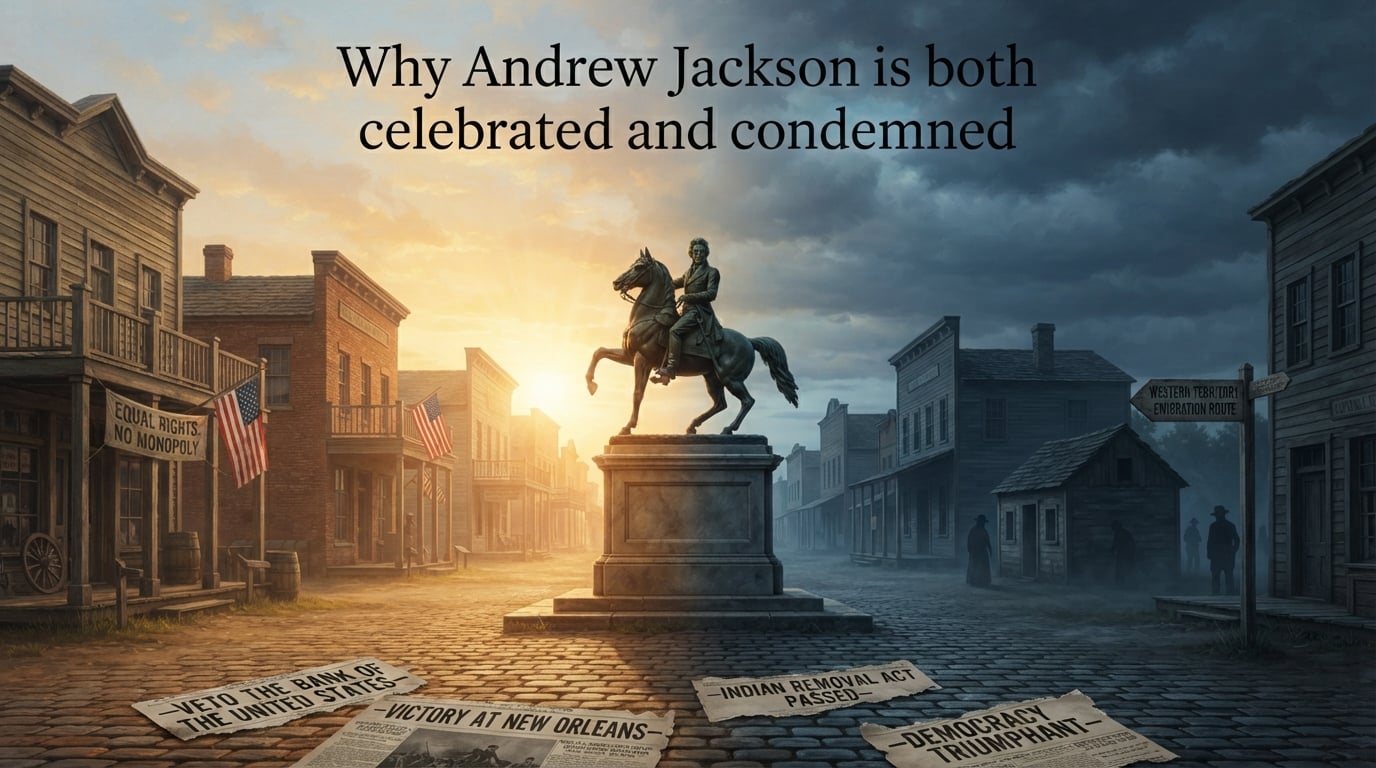
Andrew Jackson was the seventh president of the United States (1829-1837), and his legacy remains one of the most fiercely contested in American history. He is celebrated as a champion of the common man and the founder of the modern Democratic Party. He is condemned as a slaveholder who signed the Indian Removal Act and oversaw the Trail of Tears. This guide walks through exactly why Andrew Jackson is both celebrated and condemned, separating verifiable achievements from documented atrocities so readers can decide for themselves how to weigh his place in history.
I have spent weeks digging through primary sources, university archives, and contemporary scholarship to put this article together. The goal is not to praise or bury Jackson, but to give you a clear, balanced view of a man whose contradictions still shape American political debate in 2026.
Table of Contents
Who Was Andrew Jackson? A Brief Biography
Andrew Jackson was born on March 15, 1767, in the Carolinas, and rose from a destitute frontier childhood to become a national war hero before reaching the White House. He served two terms as president from 1829 to 1837 as the first president elected from a state west of the Appalachians.
Jackson’s early life was defined by the Revolutionary War. Orphaned at 14, he grew up on the South Carolina frontier, studied law, and moved to Tennessee. By the time he was 30 he was serving in the U.S. House and Senate, and within a decade he was on his way to becoming a military celebrity.
His fame came from the War of 1812. He led American forces to a stunning victory over the British at the Battle of New Orleans in January 1815, and the win made him “Old Hickory,” a national symbol of toughness and frontier grit. He followed that with military campaigns against the Creek Nation in 1814 and against the Seminole in 1817-1818, both of which remain deeply contested.
Jackson entered the White House as the first president who did not come from the Virginia-Massachusetts aristocracy that had produced every previous chief executive. That fact alone explains a lot of why Andrew Jackson is both celebrated and condemned. To his admirers, he was a true man of the people. To his critics, his frontier tactics revealed a brutal streak that followed him into the presidency.
Why Andrew Jackson Is Celebrated: The Case for His Legacy
Andrew Jackson is celebrated because he reshaped American democracy to include more white men, built the modern party system, and preserved the union during a major crisis. His supporters see him as the president who finally handed power to ordinary citizens. The celebrations are not propaganda. There are real, measurable reasons he remains popular among a wide range of historians and citizens.
Jacksonian Democracy and the Rise of the Common Man
Jacksonian democracy refers to the political movement that pushed voting rights away from wealthy landowners and toward all white male adult citizens. By the time Jackson took office, most states had dropped or lowered property requirements for voting, and turnout surged to roughly 78% of eligible voters in his 1828 election.
Jackson did not invent this trend, but he made it the defining theme of his presidency. He opposed the National Bank because he argued it benefited wealthy elites. He attacked federal spending programs that, in his view, helped the rich more than the poor. His language was deliberately populist, painting himself as the defender of the farmer and the laborer.
That framing matters. Historians like Sean Wilentz have argued that Jackson’s version of democracy, despite its glaring exclusions, set the template for the participatory politics Americans still practice. The two-party system, mass campaign rallies, and the rhetoric of the common man all trace back to Jackson’s White House years.
The Spoils System and Political Reform
The spoils system is the practice of replacing federal officeholders with political supporters after a new president takes office. Jackson embraced this idea openly, arguing that federal jobs should rotate among ordinary citizens rather than become lifetime sinecures for the wealthy.
Critics called it corruption. Jackson called it rotation in office. Either way, it created a stable career path for Americans outside the old coastal elite. Roughly 919 federal officials lost their jobs in Jackson’s first year, a small number by modern standards but a revolutionary figure at the time.
Military Heroics and National Identity
Jackson’s military record is the foundation of his populist appeal. The Battle of New Orleans in 1815, where his ragtag force defeated 8,000 British troops, turned him into a national celebrity. The victory came after the war’s peace treaty had actually been signed, but news traveled slowly, and Jackson’s battlefield win felt like a defining moment of American independence.
His campaigns against the Creek and Seminole nations, while condemned by modern standards, were also viewed by his contemporaries as proof of toughness against foreign and Native threats. For Americans of the 1820s, Jackson was the man who got things done. That image helped him build the coalition that delivered two presidential victories.
Preserving the Union During the Nullification Crisis
The nullification crisis of 1832-1833 was the most serious threat of disunion before the Civil War. South Carolina declared that federal tariff laws were unconstitutional and could be voided by individual states. Jackson responded with a clear threat of military force, declaring that disunion by armed force was treason.
The crisis ended in compromise, but Jackson’s stand is widely credited with keeping the union intact. He signed a Force Bill authorizing federal troops to collect customs duties, then negotiated lower tariff rates to calm Southern anger. Historians on both sides of the aisle generally rank this as one of his greatest presidential achievements.
Why Andrew Jackson Is Condemned: The Criticisms
Andrew Jackson is condemned because his presidency was marked by policies that caused enormous human suffering, especially to Native Americans and enslaved people. The criticisms are well documented in primary records, not just modern reinterpretations. The criticisms are direct answers to why Andrew Jackson is both celebrated and condemned.
The Indian Removal Act and Trail of Tears
The Indian Removal Act of 1830 authorized the federal government to negotiate treaties that forced Native American nations east of the Mississippi River to relocate west. Jackson had pushed for the law for years, and he signed it into law on May 28, 1830.
The most infamous result was the Cherokee removal. Despite a Supreme Court ruling in Worcester v. Georgia (1832) that affirmed Cherokee sovereignty, Jackson (and his successor Martin Van Buren) forced roughly 16,000 Cherokee to march west in 1838-1839. Around 4,000 Cherokee died from exposure, disease, and starvation along what became known as the Trail of Tears.
The Choctaw, Creek, Chickasaw, and Seminole faced similar forced relocations. The combined death toll from Indian removal under Jackson’s presidency is estimated at well over 10,000 people. That is why historians who otherwise admire his democracy reforms still place him at the center of one of the darkest chapters of U.S. policy toward Native nations.
Slavery and the Treatment of Enslaved People
Jackson owned enslaved people throughout his adult life. By the time he reached the White House, he held around 150 enslaved people at his Tennessee plantation, The Hermitage. He bought and sold human beings as routine business practice and brought enslaved servants to the White House and even to the president’s inaugural ball.
The criticism goes beyond ownership. Historical records, including those preserved at The Hermitage, document physical punishment, separation of families through sale, and the practice of sending enslaved people to the Hermitage from the White House when they misbehaved. One well-documented example is an enslaved boy named Aaron, who was beaten and held in solitary confinement at The Hermitage after an escape attempt from the White House.
Jackson also opposed abolitionist efforts politically. He blocked the abolition of slavery in the District of Columbia and pushed for federal censorship of antislavery literature in the mails. That last effort was called “gag rule” and was carried forward by his allies in Congress for years.
The Bank War and Economic Disruption
The Bank War refers to Jackson’s campaign to destroy the Second Bank of the United States, the country’s main federal financial institution. Jackson viewed the Bank as a corrupt monopoly that benefited Eastern elites at the expense of ordinary Americans. He vetoed its recharter in 1832 and withdrew federal deposits, effectively weakening the institution.
Critics argue this destabilized the U.S. economy. Without the Bank’s regulatory role, state banks issued excessive paper money, leading to speculation in land and ultimately to the Panic of 1837, a depression that hit just after Jackson left office. Whatever the cause, the economic damage was severe. Unemployment climbed, banks failed, and recovery took roughly five years.
Autocratic Behavior and the Spoils of Office
Jackson governed in a way that many contemporaries described as imperial. He used the veto power 12 times, more than all six previous presidents combined. He fired cabinet members who disagreed with him and relied on an informal group of advisors, dubbed the Kitchen Cabinet, to shape policy outside official channels.
He also refused to enforce Supreme Court rulings he disliked, most notably the Cherokee cases. That posture helped him push Indian removal forward despite clear legal barriers. Modern scholars and even some sympathetic historians call this approach autocratic. It is a key part of why Andrew Jackson is both celebrated and condemned, since it shows his willingness to break norms to achieve policy goals.
Comparing the Two Sides: A Side-by-Side Look
Looking at the celebrated and condemned sides side by side makes the contradiction easier to understand. Jackson’s defenders point to real democratic gains. His critics point to real human cost. Both observations can be true at the same time.
On the celebrated side, his tenure expanded voting rights, created the modern party system, defended the union against nullification, and projected military strength that made him a folk hero. On the condemned side, the same presidency produced the Trail of Tears, deepened slavery, weakened the central bank, and normalized executive overreach. These are not separate Jacksons. They are the same person, acting on the same beliefs about who deserved power and who did not.
The clearest test is Indian removal. Jackson argued that removing Native nations was both legal and humane. The historical record shows the opposite: thousands died, entire cultures were displaced, and the Supreme Court was effectively ignored. That contrast captures why Andrew Jackson is both celebrated and condemned in nearly equal measure.
Modern Debates: The $20 Bill and Monument Controversies
Jackson’s contested legacy has produced concrete cultural arguments that are still active today. Two flashpoints stand out: his place on the $20 bill, and the fate of statues honoring him across the country.
During his presidency, Jackson was already considered a populist symbol, and he has appeared on the U.S. $20 bill since 1928. In 2016, the Treasury Department announced plans to replace his portrait with Harriet Tubman, a formerly enslaved abolitionist. The Trump administration reversed that decision, and the $20 bill still carries Jackson’s image as of 2026. Critics argue that keeping Jackson on the bill glorifies a slaveholder. Defenders argue the change is unnecessary.
Monument debates have followed a similar pattern. Andrew Jackson statues in New Orleans, Jacksonville, and Washington D.C. have been removed, vandalized, or formally debated in recent years. Jackson’s supporters point to his democratic achievements. His critics point to slavery and Indian removal. The arguments usually end without resolution, which is exactly what makes the topic so persistent in 2026.
How Historians View Jackson Today
Scholarly opinion on Jackson has shifted significantly over the last 60 years. In the 1940s and 1950s, he was largely celebrated by historians who framed him as a defender of democracy against Eastern elites. Arthur Schlesinger Jr.’s The Age of Jackson (1945) helped cement that view.
Beginning in the 1970s, Native American and African American scholars pushed the conversation in another direction. Works by Michael Rogin, Robert Remini, and others brought slavery and Indian removal back to the center of the analysis. By the time C-SPAN’s 2017 historians’ survey ranked Jackson among the worst presidents, the pendulum had clearly swung.
Today, most academic historians hold a balanced but critical view. Jackson is recognized for democratizing the political system, but he is also recognized for the enormous human cost of his Indian removal and slavery policies. That tension is what most students encounter when they study his presidency in 2026, and it is why the debates continue.
Frequently Asked Questions About Andrew Jackson
Why do we celebrate Andrew Jackson?
We celebrate Andrew Jackson for expanding voting rights to all white adult men, founding the modern Democratic Party, and defending the union during the 1832-1833 nullification crisis. His victory at the Battle of New Orleans also made him a national folk hero who represented ordinary Americans rather than the coastal elite.
Why was Andrew Jackson so controversial?
Andrew Jackson was controversial because the same presidency that expanded democracy also produced the Indian Removal Act and the Trail of Tears. He owned around 150 enslaved people, signed policies that led to roughly 4,000 Cherokee deaths, and ignored Supreme Court rulings on Cherokee sovereignty.
What are the pros and cons of Andrew Jackson?
Pros: expanded suffrage, created the modern party system, defended the union during the nullification crisis, and projected American military strength. Cons: signed the Indian Removal Act, owned and brutally treated enslaved people, weakened the national bank and contributed to the Panic of 1837, and governed with autocratic executive tactics.
How did Andrew Jackson treat his slaves?
Andrew Jackson owned roughly 150 enslaved people at The Hermitage in Tennessee and brought enslaved servants to the White House. Primary records document physical punishment, family separation through sale, and solitary confinement for escape attempts. He also blocked abolition efforts in Congress and pushed the gag rule to silence antislavery petitions.
Final Thoughts on Why Andrew Jackson Is Both Celebrated and Condemned
Andrew Jackson is both celebrated and condemned because both reactions are grounded in fact. He genuinely expanded democratic participation for white American men. He genuinely caused the deaths of thousands of Native Americans and supported a brutal slavery system. Neither half of his legacy can be erased to make the other more comfortable.
Understanding that tension is more useful than picking a side. The country Jackson helped build, with its mass democracy and its violent exclusions, is still the country we live in today. Monument debates, $20 bill arguments, and textbook controversies are all echoes of the original contradictions of his presidency.
For students, voters, and anyone interested in American history, the takeaway is straightforward. Judge Jackson by what he actually did, not by the legend either side has built around him. The real Andrew Jackson is more interesting, more troubling, and more useful to study than either the hero or the villain of partisan memory.