
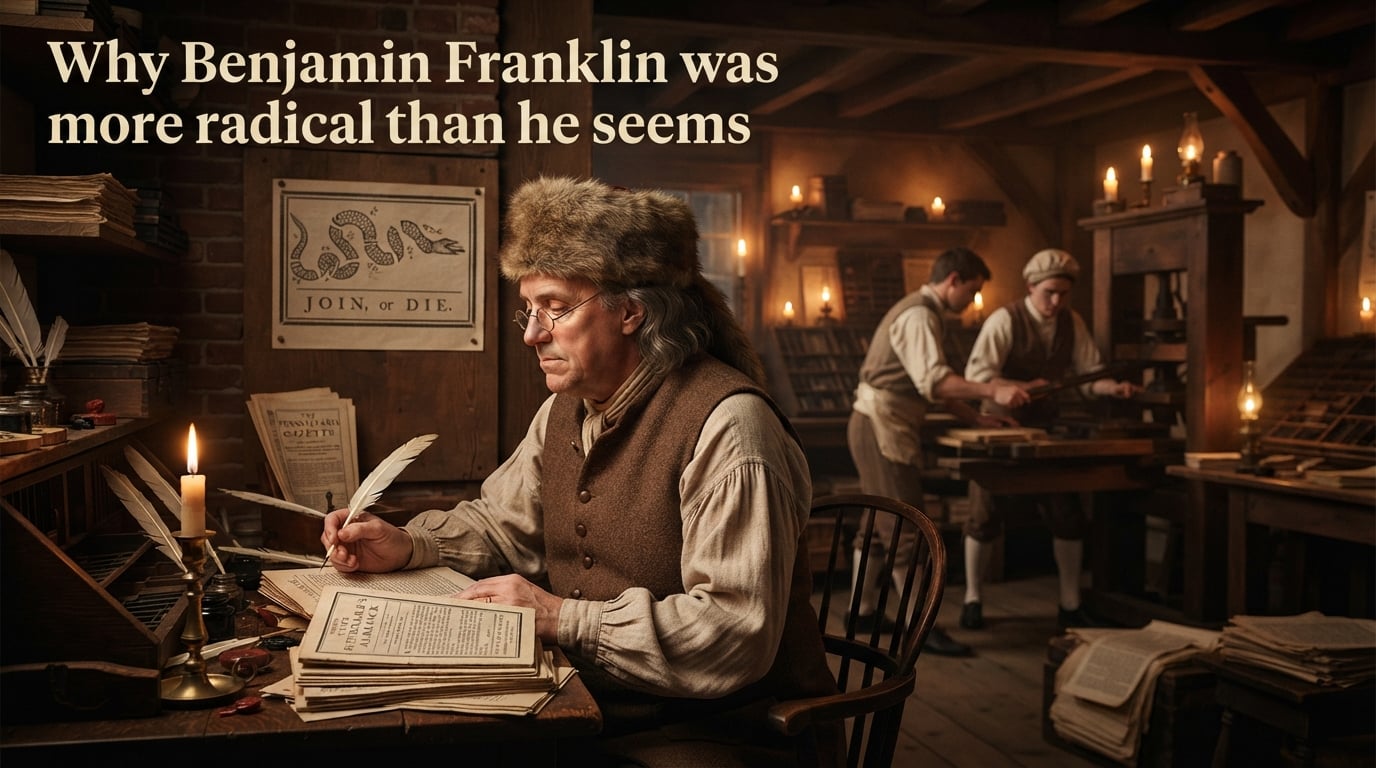
Most people picture Benjamin Franklin as the kindly grandfather of the American Revolution. He is the man with the kite, the bifocals, and a pocket full of homespun wisdom about pennies saved. That image is not wrong, but it is dangerously incomplete.
Beneath that grandfatherly portrait sits one of the most genuinely radical figures in American history. Franklin theorized colonial independence decades before 1776, ran a printing network that spread revolutionary ideas across the Atlantic, owned and then freed himself from slavery, helped design the modern concept of federal government, and personally seduced the French court into bankrolling a war against the world’s strongest empire.
The simplified “wisest American” story obscures a far more interesting truth. Franklin was not a cautious moderate surrounded by hotheads. He was the intellectual infrastructure on which much of the Revolution was built. When you look closely at his actual words, businesses, and political maneuvering, a sharper figure emerges – one who deserves to be called radical without apology.
In this article I want to walk through why Benjamin Franklin was more radical than he seems. We will look at his early rebellions, his blueprint for a united colonies government in 1754, his stunning transformation on slavery, his unconventional religious views, his diplomatic game in Paris, and the painful split with his own son over independence. By the end, the kite-flying cliché will look like the smallest part of his story.
Table of Contents
Why Benjamin Franklin Was More Radical Than He Seems
The reason Benjamin Franklin was more radical than he seems is that his image was deliberately softened after his death. Nineteenth-century biographers reshaped him into a moralizing folk hero – a dispenser of aphorisms rather than a political architect. That sanitized Franklin is easier to teach in elementary school, but it erases the man who was thinking about colonial self-government before George Washington was out of his twenties.
Franklin’s radicalism was also systemic rather than theatrical. Unlike Thomas Paine, who roared in print, Franklin built institutions, networks, and practical systems that made radical change possible. He founded a library, a fire company, a university, a hospital, a philosophical society, and a militia association – all without waiting for government permission. Each institution was a quiet argument that ordinary people could organize themselves without a king.
He also operated on a different timeline than the other founders. Born in 1706, Franklin was a full generation older than Jefferson, Madison, and Hamilton. By the time those men were reading radical Whig theory at college, Franklin had been publishing it for decades. When you understand that timeline, the framing of the Revolution changes. Independence was not improvised in 1776. It had been theorized by men like Franklin since at least the 1750s.
The gap between reputation and reality is exactly what makes him worth revisiting in 2026. Strip away the folklore and you find a man who consistently took positions considered extreme in his own time, then lived long enough to watch them become common sense.
Early Radicalism: The Printer Who Built a Revolution
Franklin’s radicalism started early and it started in print. Born in Boston in 1706 to a candlemaker, he was apprenticed at twelve to his older brother James, a printer who regularly beat him. By sixteen, Franklin was secretly writing satirical essays under the name Silence Dogood, a fictional middle-aged widow, and slipping them under the print shop door at night.
The Silence Dogood letters mocked Harvard elitism, vanity, and religious hypocrisy. They became the most popular pieces in James’s newspaper, and readers had no idea a teenage apprentice was behind them. When James discovered the truth, the relationship collapsed. Franklin broke his indenture – itself an illegal act in 1723 – and fled Boston for Philadelphia with barely any money.
That early defiance mattered because it set a pattern. Franklin did not wait for authority to grant him permission. He forged documents, broke contracts, and ran toward opportunity. He built his own Philadelphia printing shop from nothing, then methodically set up partner print shops across the colonies. By midlife he controlled a network of printers from Newport to Antigua, each one spreading the books and pamphlets he chose.
The intellectual fuel for that network was radical Whig philosophy, especially Cato’s Letters. Written by British journalists John Trenchard and Thomas Gordon, those essays argued that liberty was the natural birthright of all people, that governments were servants rather than masters, and that free speech was non-negotiable. Franklin reprinted, sold, and absorbed those ideas for decades before they became Revolutionary orthodoxy.
He also treated freedom of the press as a personal mission. When rivals tried to suppress his newspapers, he doubled down. His Pennsylvania Gazette became one of the most widely read papers in the colonies, and he used it to spread arguments about liberty, tolerance, and self-government that would have been censored in much of Europe.
That printing network was radical infrastructure hiding in plain sight. It functioned as a colonial nervous system, moving subversive ideas faster than the British Crown could track. Without it, the coordinated Revolution of the 1770s would have been nearly impossible. Franklin built the megaphone that other revolutionaries eventually shouted through.
The Albany Plan of Union: A Radical Blueprint Decades Early
In 1754, Franklin proposed a plan for uniting the American colonies under a single federal government. That was twenty-two years before the Declaration of Independence and thirty-five years before the Constitution was ratified. The very idea was considered absurd at the time, but Franklin put it on paper anyway.
His Albany Plan of Union called for a representative council chosen by colonial assemblies, a president-general appointed by the Crown, and shared systems for defense, taxation, and relations with Native nations. It was, in skeleton form, the federal structure the United States would eventually adopt. Representatives from seven colonies actually debated it at a conference in Albany, New York.
Then everyone rejected it. Colonial assemblies feared losing power. The British government feared gaining too much unity among the colonies. Both sides saw a federated America as a threat to their own authority. They were right to be afraid. Franklin had quietly sketched the political architecture that would, two decades later, be used against Britain itself.
What makes the Albany Plan genuinely radical is not just the timing. It is the underlying assumption that the colonies were already a coherent people capable of governing themselves collectively. Most colonial leaders in 1754 still thought of themselves as loyal British subjects managing local affairs. Franklin was already imagining an American nation.
The famous political cartoon attached to the plan – a snake cut into pieces labeled with colony names, above the words “Join, or Die” – was the first American call for unity under a continental identity. It would be recycled twenty years later during the Revolution, and it started as Franklin’s argument that the colonies belonged together whether the Crown agreed or not.
Franklin himself later said that the Albany Plan was rejected because it was too democratic for the British ministry and too aristocratic for the colonial assemblies. In other words, he had landed on something neither side could tolerate. That is usually a sign you have found a genuinely radical idea.
From Slave Owner to Abolitionist: Franklin’s Greatest Transformation
Few things reveal Franklin’s radicalism more than his transformation on slavery. This is also the part of his life that modern readers find most uncomfortable, because for decades he was complicit in the very system he later attacked.
In the 1740s and 1750s, Franklin owned enslaved people. He ran advertisements for slave sales in his Pennsylvania Gazette. His household in Philadelphia included enslaved workers, and his early writings accepted slavery as a normal part of colonial economy. By the moral standards of his time, he was unremarkable.
The shift began in the 1750s and 1760s. Exposure to Quaker abolitionists, the logical implications of his own liberal philosophy, and direct observation of the Atlantic slave trade began to change his mind. He started publishing antislavery arguments, joined abolitionist organizations, and quietly freed the enslaved people in his household.
By the 1780s, Franklin was no longer a reluctant convert. He was a leader. In 1787, the same year the Constitution was being drafted, he agreed to serve as president of the Pennsylvania Society for Promoting the Abolition of Slavery. He was eighty-one years old and used his enormous public credibility to push a cause that was politically radioactive.
In February 1790, less than two months before his death, Franklin signed and submitted a petition to the very first U.S. Congress calling for the federal abolition of slavery. It was the first antislavery petition Congress had ever received. Southern congressmen reacted with fury, and the petition was tabled, but the precedent was set.
Even sharper was the satire Franklin deployed against pro-slavery arguments. In 1790 he wrote “A Somewhat Humorous Defense of the Enslavement of Christians,” written under the fake persona of an Arab Muslim scholar named Sidi Mehemet Ibrahim. The piece used the exact same biblical and “natural” justifications Americans deployed for African slavery – except applied to the enslavement of white Christians. The satire was savage. By inverting the targets, Franklin made the pro-slavery logic look as absurd as it actually was.
This is not a man who slowly came around on a moral issue. This is a man who publicly converted from one side of the defining American debate to the other, then spent his final years leading the other side. That trajectory is itself a form of radicalism, because it required breaking with money, custom, and political allies.
Diplomatic Radicalism: How Franklin Seduced France
Franklin’s mission to France from 1776 to 1785 was radical diplomacy in action. He arrived in Paris as the representative of a rebellion that might collapse within months. He had no army, no money, and no guarantees. What he had was a carefully constructed personal brand and a profound understanding of human psychology.
At Versailles, the most status-obsessed court in Europe, Franklin refused to dress like a nobleman. He wore a plain brown suit, a fur cap, and spectacles. He played the part of the humble American sage, and the French aristocracy adored it. His portrait hung in shops. Women wore bracelets with his face. He was treated like a celebrity philosopher, not a desperate diplomat from a losing rebellion.
That performance was not vanity. It was strategy. Franklin understood that to win French support, he had to make the American cause feel like a romantic, Enlightenment project worth funding. The rustic wardrobe, the folksy charm, and the public scientific reputation all combined to convince France that backing the Americans meant backing the future.
He also treated French society with a democratic openness that was itself radical. He hosted salons open to aristocrats, scientists, writers, and commoners in the same room. He corresponded with radical thinkers across Europe. He attended Masonic lodges. In the rigidly hierarchical France of Louis XVI, Franklin quietly modeled an egalitarian social order that would terrify the monarchy within a few years.
The result was the 1778 Treaty of Alliance, which brought French money, troops, and naval power into the American war. Without that alliance, Yorktown does not happen, and American independence probably fails. Franklin engineered the foreign intervention that made the Revolution survivable, and he did it through personal charisma and ideological theater.
This is the kind of radicalism that does not show up in manifestos. It is the radicalism of a man who understood that wars are won with relationships as much as muskets.
Scientific Radicalism: Inventions as Democratic Tools
Franklin treated science as a public good, not a private fortune. That stance was itself radical in an era when inventors were starting to lock up their ideas with patents and monopolies.
His list of inventions and discoveries is staggering. The lightning rod, which prevented countless building fires and undercut the theological claim that storms were divine punishment. The Franklin stove, which heated homes efficiently with a fraction of the wood. Bifocals, which let aging readers see near and far without switching glasses. The glass armonica, a musical instrument Mozart and Beethoven later composed for. The flexible urinary catheter, which he designed for his own brother.
He also mapped the Gulf Stream, the ocean current that speeds transatlantic voyages, by measuring water temperatures from ships. His charts shortened sailing times for every nation that used them, and he gave the data away freely.
The radical part is what he refused to do with any of it. Franklin never patented a single invention. When the governor of Pennsylvania offered him a monopoly on the Franklin stove, he turned it down. He argued that since he had benefited freely from the inventions of others, he had no right to restrict access to his own.
That is a genuinely radical view of intellectual property, and it remains controversial today. In a world racing toward enclosure of ideas, Franklin stood for the opposite. Knowledge, in his philosophy, was something to be shared across classes and nations. Innovation was a civic contribution, not a personal empire.
His most famous experiment – flying a kite in a thunderstorm to prove lightning was electricity – was also a political act. By demonstrating that a deadly natural force obeyed understandable physical laws, he was pushing against centuries of religious interpretation. The lightning rod was the practical result, and it stripped clergy of their monopoly on explaining storms.
The Satirist and Prankster: Humor as Radical Weapon
Franklin’s humor was not decoration. It was a weapon, and he wielded it against authority for sixty years.
The Silence Dogood letters were just the beginning. In 1747 he published “The Speech of Miss Polly Baker,” a fictional courtroom defense by a woman prosecuted for having a child out of wedlock. Polly points out that she has raised her children without burdening the state, while the men who fathered them face no punishment. The piece exposed sexual double standards so sharply that many readers assumed it was a real legal transcript.
In the 1750s, when rival printer Samuel Keimer annoyed him, Franklin simply launched a fake competing newspaper, wrote the entire first issue himself as a parody, and used it to humiliate Keimer out of the market. He later bragged about it in his autobiography.
His most famous satirical prank was the 1782 “Supplement to the Boston Independent Chronicle,” a fake newspaper he printed in Paris. It claimed that the British government was paying Native American allies bounties for American scalps, complete with invented letters and a fake order form. The piece was designed to enrage American opinion against Britain and embarrass the Crown in Europe. It worked. The atrocity propaganda circulated widely and was treated as real by many readers.
That kind of humor does real political work. It disarms opponents, spreads ideas past censors, and ridicules power in a way that arguments alone cannot. Franklin understood that laughing at authority was a way of refusing to obey it. His prankster reputation is not at odds with his radicalism. It is one of its main delivery systems.
Religion, Deism, and Unconventional Beliefs
Franklin was a religious radical by the standards of his time. Raised in a strict Puritan Boston household, he walked away from Calvinist orthodoxy as a teenager and never came back.
He described himself as a Deist. Deism, popular among Enlightenment thinkers, held that God created the universe with rational laws but did not intervene in daily affairs through miracles or revelation. That put Franklin at odds with both Puritan predestination and Anglican sacrament, the two dominant religious frameworks in colonial America.
He privately doubted the divinity of Christ. In a famous 1790 letter to Ezra Stiles, the president of Yale, Franklin said he had doubts about Christ’s divinity but saw no harm in believing it if the belief produced good behavior. He did not think salvation depended on getting the theology right. He thought it depended on whether you treated people decently.
He also pushed hard for religious tolerance in practice. He helped raise money to build Philadelphia’s first synagogue and supported the rights of non-Christian communities. He argued that governments had no business policing conscience, a position that was genuinely radical in eighteenth-century Protestant colonies.
His actual ethic was practical morality rather than theology. He kept a personal list of thirteen virtues – temperance, silence, order, resolution, frugality, industry, sincerity, justice, moderation, cleanliness, tranquility, chastity, humility – and tracked his progress with a little notebook. The system had no religious content. It was self-improvement for its own sake.
In an era when public religiosity was expected of any respectable figure, Franklin’s quiet heterodoxy was a form of dissent. He did not preach atheism, but he refused to perform belief he did not hold. That refusal, repeated quietly across a long public life, is its own kind of radicalism.
William Franklin: When Radicalism Split a Family
Few stories capture the cost of Franklin’s radicalism like the rupture with his son William.
William Franklin was born around 1730, the illegitimate son of Benjamin and a woman whose identity remains uncertain. Benjamin raised William in his own household, educated him, took him along on diplomatic trips to London, and launched his political career. The two were close, and William became Royal Governor of New Jersey in 1763.
Then independence split them apart. As the Revolution approached, William stayed loyal to the British Crown. Benjamin committed fully to independence. Father and son argued the issue in person and in letters, and neither would yield.
The break became permanent. During the war, William was arrested by American forces and imprisoned under harsh conditions for more than two years. Benjamin did essentially nothing to ease his confinement. After the war, William went into exile in Britain and Benjamin revised his will to leave William almost nothing except the land he had already given him, with a bitter note that William had nothing to expect from him further.
The two never reconciled. They met briefly in 1784 to settle property issues, but the personal relationship was dead. Benjamin died in 1790 without restoring the bond.
The story matters because it shows that Franklin’s radicalism was not theoretical. It cost him his son. He chose independence over family, and he stuck with that choice for the rest of his life. That is the opposite of a man playing it safe.
Franklin vs. Paine vs. Jefferson: Who Was the Most Radical?
People often ask who was the most radical of the founding fathers. The candidates usually come down to Thomas Paine, Thomas Jefferson, and Franklin himself, and each was radical in a different way.
Paine was the loudest. Common Sense and The Rights of Man attacked monarchy, hereditary privilege, and organized religion in plain language ordinary people could read. But Paine arrived late, in 1774, and Franklin himself had helped bring him to America and published his early work. Franklin was the patron and platform. Paine was the megaphone.
Jefferson was the theorist of equality, but his radicalism had a glaring limit. He wrote that all men are created equal while owning hundreds of enslaved people and fathering children with an enslaved woman he owned. His rhetoric outran his life. Franklin, by contrast, started as a slave owner and ended as the man petitioning Congress for abolition.
Franklin was the most radical in a quieter sense. He combined political theory (the Albany Plan), practical infrastructure (the printing network), diplomatic achievement (the French alliance), scientific egalitarianism (unpatented inventions), and personal moral transformation (slavery to abolition). Few founders matched that range. Paine wrote the manifestos. Jefferson wrote the Declaration. Franklin built the systems that made the manifestos and the Declaration matter.
If radicalism means consistency across a long life, Franklin wins. He was radical at sixteen with the Silence Dogood letters, radical at forty-eight with the Albany Plan, radical at seventy with the French alliance, and radical at eighty-four signing the abolition petition. Few founders can claim that.
FAQs
Was Ben Franklin a radical?
Yes, Ben Franklin was a radical in the truest sense. He theorized a unified colonial government in 1754 with the Albany Plan of Union, ran a transatlantic printing network that spread revolutionary Whig philosophy, refused to patent any of his major inventions, abandoned orthodox Christianity for Deism, and ended his life as president of an abolition society petitioning Congress to end slavery. His radicalism was systemic rather than theatrical, which is why it often gets overlooked.
Who was the most radical of the founding fathers?
Thomas Paine was the most vocally radical founding father, attacking monarchy and organized religion in plain language. Thomas Jefferson contributed the most radical rhetoric in the Declaration. But Benjamin Franklin arguably combined the widest range of radical actions: political theory, press freedom, diplomatic subversion of France, scientific egalitarianism, religious heterodoxy, and a personal transformation from slave owner to abolitionist leader. Different founders were radical in different ways.
What was Benjamin Franklin’s opinion on slavery?
Franklin’s opinion on slavery changed dramatically over his life. In the 1740s and 1750s he owned enslaved people and ran slave-sale ads in his newspaper. By the 1760s he began shifting toward abolitionist views. In 1787 he became president of the Pennsylvania Society for Promoting the Abolition of Slavery, and in 1790 he signed and submitted the first antislavery petition ever received by the U.S. Congress, calling for federal abolition of slavery.
Did Benjamin Franklin believe in women’s rights?
Franklin held views that were progressive for his era but limited by modern standards. He supported the education of women, helped publish works by female authors, and wrote satirical pieces like ‘The Speech of Miss Polly Baker’ that attacked sexual double standards. He corresponded with several prominent intellectual women in America and Europe. He did not, however, advocate for political equality or voting rights for women, which was virtually unheard of even among radicals in the eighteenth century.
What were some important inventions of Benjamin Franklin?
Benjamin Franklin invented or developed the lightning rod, the Franklin stove, bifocals, the glass armonica musical instrument, a flexible urinary catheter, and maps of the Gulf Stream ocean current. Crucially, he refused to patent any of these inventions, arguing that since he had benefited freely from the inventions of others he had no right to restrict access to his own. He treated innovation as a public good rather than a private fortune.
Was Ben Franklin ahead of his time?
Yes, Ben Franklin was ahead of his time on nearly every major issue he touched. He proposed colonial federation in 1754, decades before the Constitution. He theorized self-government, free press, and representative institutions long before the Revolution made them mainstream. He abandoned orthodox religion for Deist tolerance, refused to patent his inventions, and ended his life leading the abolition movement. He was a full generation older than most founders and had been publishing radical ideas before they entered politics.
Conclusion
The kite, the bifocals, and the aphorisms are real, but they are the smallest part of Franklin’s story. The fuller record shows a man who theorized an American nation before anyone else believed it was possible, built the printing infrastructure that made Revolution communicable, seduced the French court into bankrolling a war, refused to patent his inventions, abandoned the religion he was raised in, and ended his life leading the abolition movement against the very institution he had once participated in.
Understanding why Benjamin Franklin was more radical than he seems matters because it changes how we read the American founding itself. The Revolution was not the work of cautious moderates pushed into extremes by British misrule. It was theorized, built, and bankrolled by people who had been thinking about colonial self-government for decades. Franklin was their infrastructure.
If you want to go deeper, read his actual words. His Autobiography, the Silence Dogood letters, the Albany Plan documents, and his 1790 antislavery petition are all freely available. The grandfatherly image fades quickly once you start reading, and the radical underneath takes his place.