
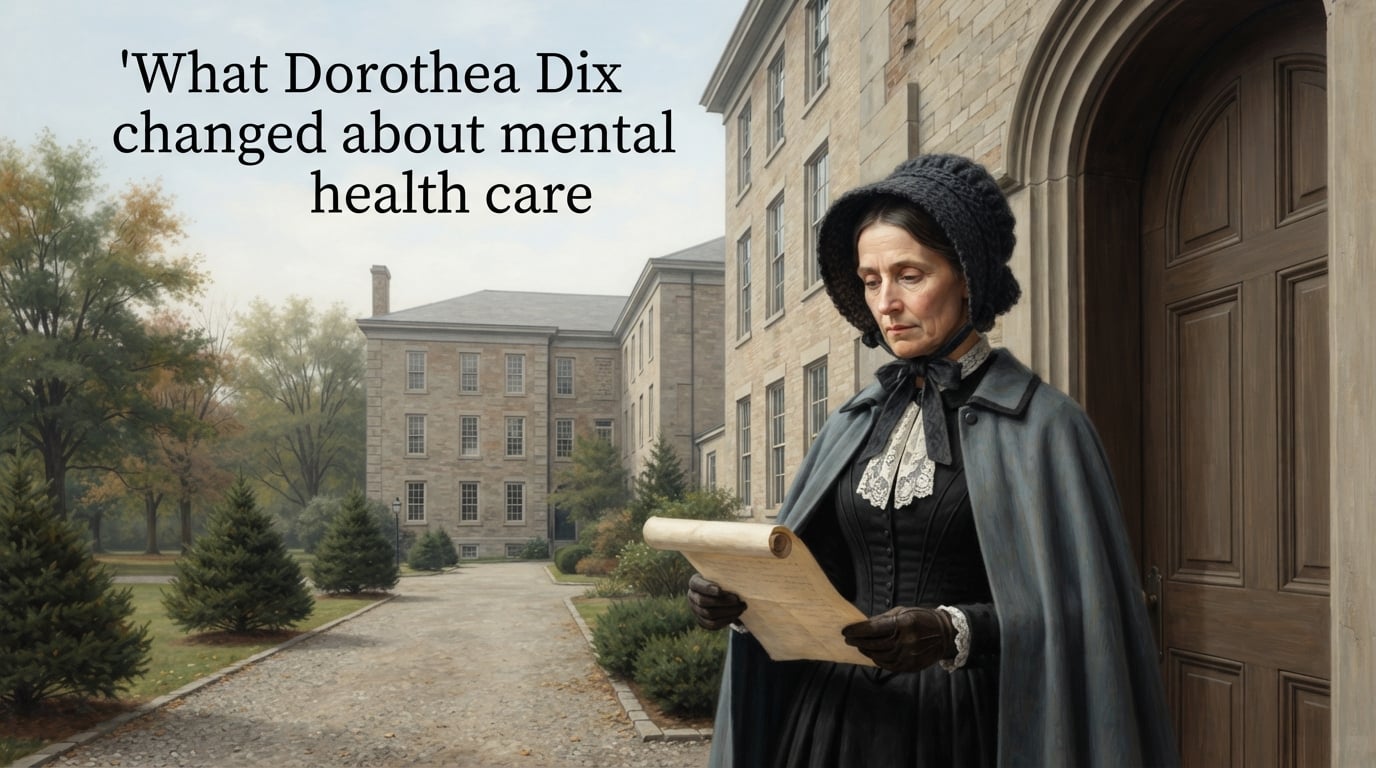
Dorothea Dix was a 19th-century American activist who changed the mental health care system by exposing the inhumane treatment of people with mental illness and pushing state legislatures to build dedicated hospitals. Between 1841 and the late 1850s, she personally investigated jails, poorhouses, and almshouses across more than 15 states. Her lobbying helped found or expand over 30 hospitals for the mentally ill and fundamentally shifted public opinion on what humane mental health care should look like.
I have spent years studying American social reformers, and Dorothea Dix stands out because she did not just write essays or give speeches. She walked into the worst snake pits of her era, took detailed notes, and then sat down with legislators until they voted to build something better. In this guide, I will walk you through exactly what Dorothea Dix changed about mental health care, how she did it, and why her work still shapes what we argue about in 2026.
Table of Contents
Early Life and Background
Dorothea Lynde Dix was born on April 4, 1802, in Hampden, Maine. Her childhood was harder than most people realize. Her father, Joseph Dix, was an alcoholic preacher who frequently left the family in financial ruin. Her mother, Mary, suffered from what we would today recognize as chronic depression. Young Dorothea took on the role of caretaker for her siblings, and she later escaped her home at age 12 to live with her grandmother in Boston.
By age 14, she had already opened a school for girls in Worcester, Massachusetts. By her early twenties, she ran a respected girls’ school and had authored several textbooks on child-rearing and conversation. Teaching gave her a public voice, but it also exposed her to the suffering of poor children and their families. Many of those families included members struggling with mental illness who had nowhere to turn.
Between 1836 and 1840, Dix suffered a serious physical and mental health collapse of her own. She experienced depression, fatigue, and what doctors of the era called “nervous prostration.” She traveled to Europe to recover. This personal brush with mental illness became a quiet fuel for the work she would later do. She understood, from the inside, what it felt like to be unable to advocate for yourself.
The Discovery That Started Everything
In March 1841, Dix volunteered to teach a Sunday school class at the East Cambridge Jail in Massachusetts. The visit was supposed to be routine. It was anything but. Inside the jail she found people with mental illness locked in cages, closets, cellars, and pens. Some were chained naked to walls. Others had been beaten with rods and lashed into obedience. Several were confined in unheated stalls meant for animals.
What she saw in those rooms was not an isolated accident. It was the standard American approach to mental illness. People who could not function in society, or who could not pay for private care, ended up in prisons, poorhouses, or in the basements of town halls. Local officials treated them as criminals, nuisances, or worse. Nobody was documenting it.
Dix decided to document it herself. Over the next 18 months she traveled across Massachusetts, visiting every jail and almshouse she could reach. She recorded the conditions in detail, gathered sworn testimonials from doctors and townspeople, and compiled statistics on how many people with mental illness were being held in each facility. Her notes were precise, factual, and damning.
The 1843 Memorial to the Massachusetts Legislature
In January 1843, Dorothea Dix presented her findings to the Massachusetts state legislature in a document she called a “memorial.” It ran for dozens of pages and laid out, county by county, the conditions she had witnessed. She described men and women confined in cold rooms without clothing, fed on scraps, and left to die of neglect.
The memorial asked the legislature to set aside land and funding for a state hospital specifically designed to treat the mentally ill. This was not a small request. At the time, Massachusetts had no institution dedicated to humane psychiatric care. Her argument was that mental illness was a medical condition, not a moral failing, and that the state had a duty to provide treatment rather than punishment.
The response was extraordinary. Lawmakers were shocked. The Massachusetts legislature voted to fund what became the State Lunatic Hospital at Worcester, which opened in 1833 (and continued under expanded Dix-inspired reforms through the 1840s). The hospital adopted a model of “moral treatment” that emphasized fresh air, daily routines, kind staff, and therapeutic conversation instead of restraints.
European Influences on Her Reform Model
Dix did not invent the idea of humane mental health care from scratch. While in Europe recovering from her illness, she visited institutions in France and England that had already begun treating patients with dignity. The most important was the York Retreat in England, founded by the Society of Friends (Quakers) in 1796. The Retreat used kindness, routine, and structured activity as therapy, with impressive results.
She also studied the work of French physician Philippe Pinel, who in 1793 had famously ordered the chains removed from patients at Bicêtre Hospital in Paris. Pinel’s approach, called “moral treatment,” was based on the belief that people with mental illness could recover if treated with respect. Dix brought these ideas back to America and adapted them for state-level reform.
One of her key allies in England was William Rathbone, a philanthropist who later helped found district nursing, a model that influenced Florence Nightingale. That connection between mental health reform and nursing reform would later shape Dix’s role during the Civil War.
Lobbying Across the Nation
After her success in Massachusetts, Dix did not stop. Over the next decade she traveled to state after state, repeating the same pattern: investigate conditions, write a memorial, lobby legislators. Between 1843 and 1854, she personally presented memorials to legislatures in New York, New Jersey, Pennsylvania, Ohio, Indiana, Illinois, Kentucky, Tennessee, Missouri, Mississippi, Louisiana, Alabama, South Carolina, North Carolina, Maryland, and others.
Most of these efforts produced results. Rhode Island built a state hospital in 1848. New York expanded its facilities at Utica. Pennsylvania founded the Harrisburg State Hospital. New Jersey, Ohio, and Indiana all passed bills establishing or enlarging state institutions during this period. By 1854, Dix had been directly involved in the founding or expansion of more than 30 hospitals in the United States.
In 1854, she tried to take her reform to the federal level. She drafted a bill to set aside 5 million acres of public land for the mentally ill. Congress passed the bill, but President Franklin Pierce vetoed it on the grounds that social welfare was a state, not federal, responsibility. The veto was a major setback, but it did not stop the state-by-state movement Dix had set in motion.
Hospital Founding: A New System of Care
The hospitals Dix championed were not simply warehouses for the sick. They were built around the moral treatment philosophy she had absorbed in Europe. Patients received regular meals, warm clothing, clean rooms, and access to grounds for walking. Staff were trained, however imperfectly, to use conversation and activity instead of physical punishment. Doctors who specialized in mental illness, known as “alienists,” gained new professional status.
Before Dix’s reforms, almost no dedicated state-funded mental hospitals existed in America. The facilities that did exist were either private and expensive, or extensions of prisons and poorhouses. By the early 1860s, more than 30 state institutions had been built, and most states had at least one place where a poor person with mental illness could be treated with some degree of humanity.
This represented a complete shift in how America thought about mental illness. The old model treated people with psychiatric conditions as outcasts, sinners, or criminals. The new model, championed by Dix, treated them as patients who deserved medical care. That shift is the core of what Dorothea Dix changed about mental health care.
Civil War Nursing Role
In June 1861, the Union Army appointed Dorothea Dix as Superintendent of Army Nurses, making her the first woman to hold a federal military appointment in that role. She set strict standards for nurse recruitment. Nurses had to be over 30, plain-looking, and morally upright. She rejected applicants whom she considered too attractive or too young, believing that battlefield nursing required seriousness, not glamour.
Despite the strict rules, her nursing corps served in every major Union army camp and treated thousands of wounded soldiers. She was famously difficult, stubborn, and exacting, but she also delivered results. Mortality rates in wards she oversaw were lower than in many other facilities.
Her work during the Civil War is the direct answer to the question of how Dorothea Dix changed nursing. She professionalized the role, set standards, and demonstrated that women could lead large-scale medical operations in a way that influenced nursing education for the next century.
Criticisms, Controversies, and Complex Legacy
No honest account of Dix’s legacy can ignore her contradictions. Her views on slavery were complicated. She lived in Washington, D.C., where slavery was legal, and at one point worked with Jefferson Davis on plans for a proposed mental health facility for the South. Some historians argue she remained quiet on slavery out of political calculation. Others note that she sometimes paid a salary to a formerly enslaved woman named Dorethea while exploiting her labor, an arrangement that has been sharply criticized by modern scholars.
She also resisted the women’s suffrage movement of her era. She feared that tying mental health reform to women’s rights would damage her cause with male legislators. As a result, she worked almost entirely within the gender conventions of her time, even though she personally held more power than most men in her network.
The Dorothea Dix Hospital in Raleigh, North Carolina, named after her, has its own dark chapter. The hospital operated from 1856 until 2012. Over those years, patients reported overcrowding, understaffing, physical abuse, and preventable deaths. By the late 20th century, the institution had become a symbol of everything wrong with the asylum model. It closed in 2012 after years of federal investigations, leaving a 308-acre property that is now Dorothea Dix Park. Visitors and former patients describe the site as both historical and haunting, which is why it is one of the most commonly searched topics about her today.
What Dorothea Dix Changed About Mental Health Care Today
The mental health care debate we have in 2026 is still shaped by the trade-offs Dix helped create. The state hospital system she championed expanded dramatically through the late 1800s and early 1900s. By 1955, more than 550,000 patients lived in American state mental hospitals. Then came deinstitutionalization, the policy shift of moving patients into community care that accelerated after the Community Mental Health Act of 1963 and the introduction of new psychiatric medications.
Many of those old Dix-era state hospitals closed over the following decades. Communities argue about what to do with the empty buildings. Some became parks, like the Dorothea Dix Park in Raleigh. Others became condos, museums, or simply sat abandoned. Critics of deinstitutionalization argue that closing hospitals left many patients without adequate care, which echoes the very crisis Dix tried to solve in 1841.
What Dorothea Dix changed about mental health care, then, was not just the building of hospitals. It was the principle that people with mental illness are full human beings who deserve care, dignity, and the attention of the state. That principle is still unfinished work, which is why her name keeps coming up every time a state debates new mental health funding, a new psychiatric facility, or a new community care program.
FAQs
How did Dorothea Dix change nursing?
Dorothea Dix changed nursing by serving as the first Superintendent of Army Nurses during the Civil War, where she set professional standards for nurse recruitment and oversaw thousands of wounded soldiers. Her strict requirements and her ability to run a large-scale medical operation as a woman set a precedent that shaped nursing education for the next century.
How did Dorothea Dix improve asylums?
Dorothea Dix improved asylums by personally investigating jails, poorhouses, and almshouses, then lobbying state legislatures to fund dedicated hospitals that used moral treatment instead of chains, cages, and beatings. Her advocacy led directly to the founding or expansion of more than 30 state mental hospitals across the United States.
What did Dorothea Dix see when she visited jails?
When Dorothea Dix visited jails, she saw mentally ill people locked in cages, cellars, closets, and pens, often naked, chained, beaten with rods, or lashed into obedience. Some were confined in unheated stalls meant for animals, fed scraps, and left to die without medical attention.
What is the Dorothea Dix Hospital dark history?
The Dorothea Dix Hospital dark history refers to the long record of overcrowding, understaffing, patient abuse, and preventable deaths at the Raleigh, North Carolina facility that operated from 1856 to 2012. Federal investigations documented serious failures, and the hospital closed in 2012, with the property later becoming Dorothea Dix Park.
Why did Dorothea Dix Hospital shut down?
Dorothea Dix Hospital in Raleigh shut down in 2012 after years of federal and state investigations into unsafe conditions, chronic understaffing, and patient neglect. Closure was part of the broader shift away from large psychiatric institutions toward community-based mental health care, though critics argue the transition left many patients without adequate support.
What happens during a 72 hour psych hold?
A 72 hour psych hold, sometimes called an involuntary psychiatric hold, allows a hospital or designated facility to detain a person who is considered a danger to themselves or others for up to 72 hours for evaluation and stabilization. During this period, mental health professionals assess the patient, provide emergency treatment if needed, and decide whether longer involuntary commitment is required. The rules vary by state, but the 72 hour window exists to balance patient safety with civil liberties.
Final Thoughts on Dorothea Dix and Modern Mental Health Care
So what did Dorothea Dix change about mental health care? She changed the legal status of the mentally ill from prisoners to patients. She changed the physical reality from chains and cages to hospitals with grounds and routines. She changed nursing from volunteer work into a profession with standards. She also changed the public conversation, putting mental illness on the agenda of every state legislature she could reach.
Her reforms were not perfect. Many of the hospitals she helped build eventually became overcrowded and abusive. The modern move toward community care has its own serious problems. But the foundation she laid, that people with mental illness deserve humane, state-funded medical care, still guides how we think about this issue in 2026.
If you want to go deeper, I recommend reading her original 1843 memorial, available in full through university libraries, or visiting the National Museum of Mental Health Project archives. The documents read like a shock to the system, which is exactly the reaction she wanted legislators to have nearly 200 years ago.