
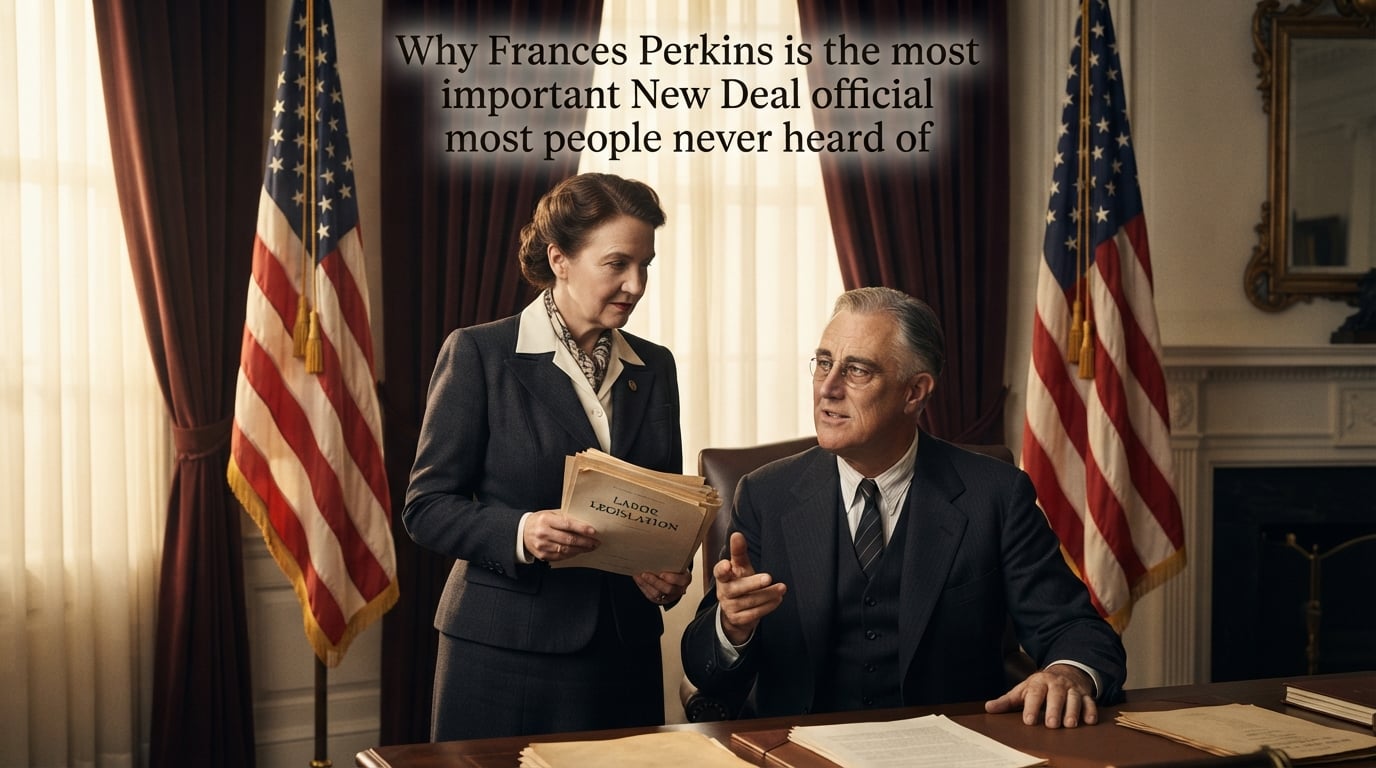
If I asked you to name the most important New Deal official, you would probably say Franklin Roosevelt. Maybe you would mention Harry Hopkins or Henry Wallace. You might even remember Harold Ickes.
I would bet my next paycheck that Frances Perkins would not make your list. And that is one of the great failures of how we tell American history. Frances Perkins was the first woman to serve in a U.S. presidential cabinet. She served as Secretary of Labor for 12 years, longer than anyone else in history. She personally built the political coalition that created Social Security. More than 65 million Americans collect Social Security benefits today. Almost every single one of them owes a check to Frances Perkins.
So why have most of us never heard of her? That is the question I want to answer here, because her story is also the story of modern America.
Table of Contents
Who Was Frances Perkins? The Woman Behind the Cabinet Door
Frances Perkins was the first woman to serve in a U.S. presidential cabinet and the longest-serving Secretary of Labor in American history. She was born Fannie Coralie Perkins in 1880 in Boston, Massachusetts, and educated at Mount Holyoke College, where she studied economics and witnessed firsthand how industrialization reshaped ordinary lives.
After college, she moved to New York and threw herself into settlement house work. She earned a master’s degree in political science from Columbia University. By her early thirties, she was leading the New York Consumers League, where she lobbied for safer working conditions and better wages. New York Governor Franklin Roosevelt noticed her talent and appointed her to the state Industrial Commission. When Roosevelt won the presidency in 1932, he asked Perkins to be his Secretary of Labor.
Roosevelt’s offer came with a warning. Perkins would have to accept the lowest salary in the cabinet. She would also face fierce opposition from labor unions who did not want a woman, and a social worker at that, speaking for them. Perkins accepted both conditions without flinching. She later described her service as working for “FDR, God, and the American people.”
The Triangle Shirtwaist Factory Fire Changed Everything
You cannot understand Frances Perkins without understanding the Triangle Shirtwaist Factory fire of March 25, 1911. Perkins watched the disaster unfold from a street in lower Manhattan. She saw 146 garment workers, mostly young immigrant women, die because factory owners had locked the fire exits to prevent theft and unauthorized breaks.
The horror of that day reshaped her life. Perkins spent the next two decades championing workplace safety laws, fire codes, and workers’ compensation. She served on the Factory Investigating Commission that documented unsafe conditions across New York State. Her work led to some of the strongest workplace safety laws in the country at the time.
That moment also gave her a resolve that would define the rest of her career. She once said the dead were “going to be with me” whenever she had to make a difficult decision. They were. When the New Deal faced opposition, Perkins remembered Triangle. When Social Security seemed impossible, she remembered the women who had no safety net at all.
How Frances Perkins Built the New Deal
The New Deal was not a single law. It was a wave of legislation that reshaped the relationship between Americans and their government. Frances Perkins was the chief engineer of much of it. Here is what she personally built or drove.
The Social Security Act of 1935 is the most famous. Perkins organized the cabinet-level Committee on Economic Security that designed the program. She then rallied Congress, business leaders, and the public to support it. Without her, Social Security might never have passed.
The Fair Labor Standards Act of 1938 was her other signature achievement. It created the federal minimum wage. It banned child labor. It established the 40-hour work week and time-and-a-half overtime. These were ideas Perkins had championed since her Consumers League days. Now they became the law of the land.
She also expanded unemployment insurance, grew the Bureau of Labor Statistics, and pushed for public works programs that put millions of Americans back to work during the Depression. The Civilian Conservation Corps and the Works Progress Administration both reflected her belief that government had a duty to provide economic security.
Social Security: Her Most Enduring Legacy
Social Security is the program Frances Perkins is most remembered for, and for good reason. About 65 million Americans collect Social Security benefits today. Roughly 180 million more pay into the system through payroll taxes. Almost every working American is touched by the program Perkins designed during the depths of the Great Depression.
Building Social Security was a political fight unlike anything else in the New Deal. Conservative critics called it socialism. Business groups warned it would destroy jobs. Some members of Roosevelt’s own cabinet opposed it. Perkins handled all of them. She made the moral case that an elderly person should not have to choose between food and medicine. She made the economic case that retired workers with predictable incomes would stabilize the economy.
She won. Roosevelt signed the Social Security Act on August 14, 1935. The program has paid out benefits every month since, including through pandemics, recessions, and wars. The Committee on Economic Security Perkins chaired became the model for how the United States would design social programs for the next century.
Moral Courage: Perkins and the Refugee Crisis
Frances Perkins was not a perfect person, but she was a brave one. During World War II, she publicly broke with the Roosevelt administration over its refusal to admit Jewish refugees fleeing Nazi persecution. She chaired the War Refugee Board and pushed the State Department to loosen visa restrictions.
This was not a small thing. Going against the president you serve takes real courage. Perkins believed the moral stakes were higher than political loyalty. She helped save thousands of lives by advocating for refugees when most of Washington wanted to look away. Her work on refugee rescue is now recognized as one of the most principled stands of her career.
She also advocated for women workers, immigrant workers, and the rights of laborers to organize. The Department of Labor under Perkins was not just a passive agency. It actively shaped how Americans lived and worked.
Why Most Americans Don’t Know Her Name
If Frances Perkins accomplished so much, why does almost no one recognize her name? There are a few reasons.
First, Perkins deliberately avoided the spotlight. She believed her job was to make Franklin Roosevelt look good, not herself. She rarely gave interviews and almost never sought personal credit. In a media culture that rewards self-promotion, her style was almost designed to be forgotten.
Second, the history of the New Deal has usually been told through the lens of FDR. Roosevelt was a charismatic public figure. Perkins was a policy wonk. Historians naturally wrote about the man who gave the speeches.
Third, gender bias in American history has erased many of the women who shaped policy. Textbooks crowded with presidents and generals rarely had room for a cabinet secretary who worked behind the scenes.
Finally, the very success of her programs made her invisible. Americans who collect Social Security, earn a minimum wage, and work a 40-hour week usually take these benefits for granted. They do not ask who built the system. Frances Perkins built it.
How to Learn More About Frances Perkins
If you want to dig deeper into Perkins’ life, a few good places to start exist. The Frances Perkins Center in Newcastle, Maine, maintains the family homestead and offers educational programs. Kirsten Downey’s biography “The Woman Behind the New Deal” is widely recommended by readers and historians. The FDR Presidential Library and Museum and the U.S. Department of Labor’s own history pages both have primary source material.
You can also visit the Frances Perkins National Monument in Trenton, Maine. Designated in 2024, it preserves the home where Perkins spent her later years and wrote about her life. It is the first national monument named after a woman.
Reading about Perkins is not just an exercise in nostalgia. Her story raises questions we still argue about today. What is the role of government in protecting workers? Should the wealthy pay more to support the elderly and the poor? How do we balance economic freedom with economic security? Perkins spent her life answering these questions. We are still living with her answers.
Frequently Asked Questions About Frances Perkins
Why was Frances Perkins significant?
Frances Perkins was significant because she was the first woman to serve in a U.S. presidential cabinet and the longest-serving Secretary of Labor in history. She personally built the political coalition that created Social Security, the Fair Labor Standards Act, and many other New Deal programs that still shape American life in 2026.
What did Frances Perkins do for the New Deal?
Perkins drove the New Deal’s most important labor legislation. She organized the Committee on Economic Security that created Social Security. She championed the Fair Labor Standards Act, which established the federal minimum wage, banned child labor, and created the 40-hour work week. She also expanded unemployment insurance and public works programs.
Why was the New Deal so significant?
The New Deal was significant because it redefined the relationship between Americans and their federal government. It created Social Security, labor protections, banking reforms, and public works programs during the worst economic crisis in modern history. Many of these programs still exist today, including Social Security and the minimum wage.
Why were people critical of the New Deal?
Critics of the New Deal argued that its programs expanded the federal government too much and violated individual economic liberty. Business groups warned that minimum wage laws and Social Security taxes would destroy jobs. Some on the political left felt the New Deal did not go far enough to help poor and working Americans. These debates continue in 2026.
How did Frances Perkins die?
Frances Perkins died on May 14, 1965, in New York City, at the age of 85. She spent her later years writing, teaching at Cornell University, and advocating for the causes she believed in. She had suffered a stroke years earlier but continued her public service work for years afterward.
The Woman Behind the Law Still Worth Remembering
Frances Perkins is the most important New Deal official most people have never heard of because she made a deliberate choice to put service ahead of celebrity. She built the systems that millions of Americans rely on every day, then let other people take the credit. In 2026, when a senior citizen opens her Social Security check, when a teenager is told she cannot work until she is older, when a worker gets time-and-a-half for overtime, Frances Perkins is still there.
Her story matters because it shows how lasting change actually happens. It is rarely built by one charismatic leader standing in the spotlight. More often, it is built by skilled, principled people doing unglamorous work year after year. Perkins once said that courage was not a trait you were born with. It was a decision you made, day after day, when the work was hard and the cameras were elsewhere.
The next time you read about the New Deal, look for Frances Perkins. She is there, in every Social Security card, every paycheck stub, every labor poster on a factory wall. She is the most consequential New Deal official most Americans will never hear of, and she built the country we live in.