
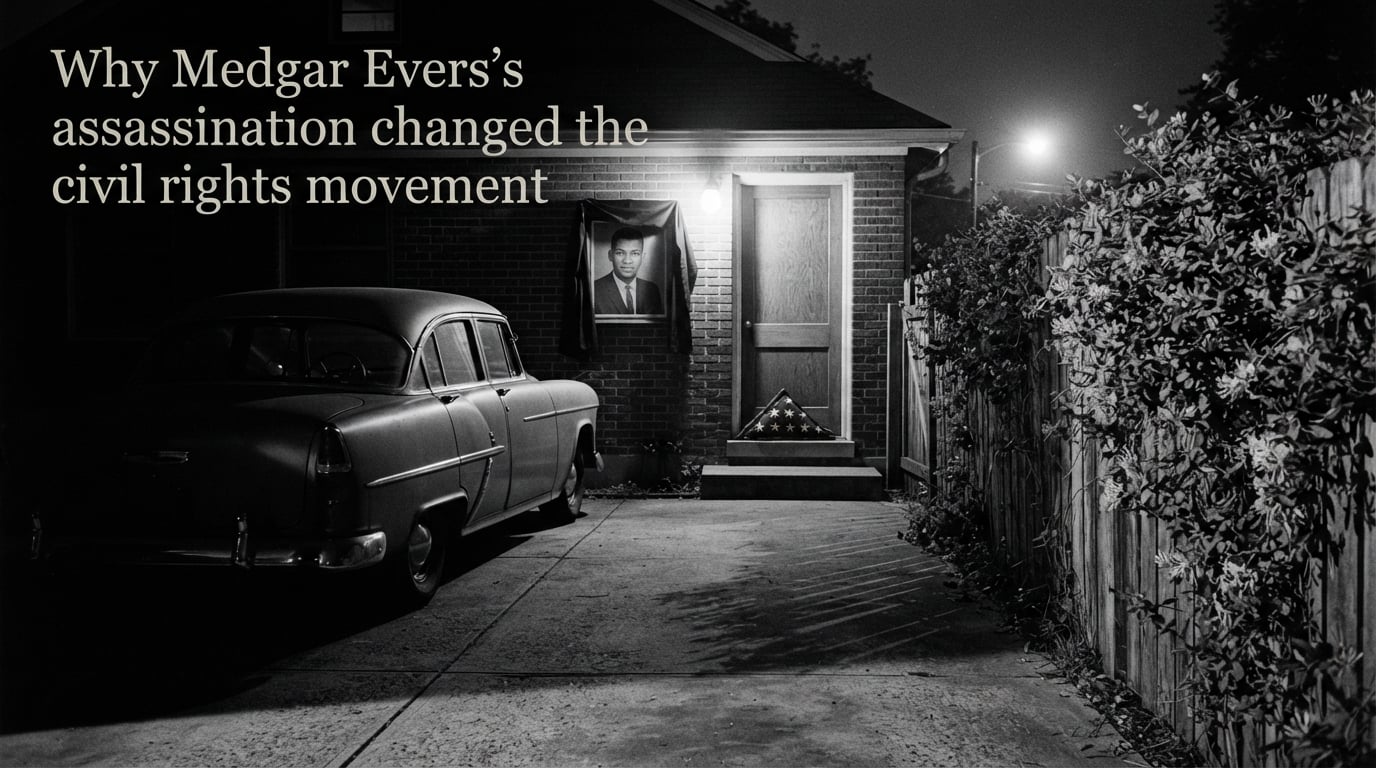
Medgar Evers, the NAACP’s first field secretary in Mississippi, was assassinated on June 12, 1963, by white supremacist Byron De La Beckwith. Shot in his own driveway just hours after President Kennedy’s landmark civil rights address, Evers’s murder at age 37 galvanized the civil rights movement and helped build the public momentum that led to the Civil Rights Act of 1964. His death became a turning point because it turned abstract statistics about racial violence into a single, unforgettable act of terror that the entire nation could not ignore.
I have spent years studying civil rights history, and Evers’s story stands out for one reason. He was working in the most dangerous state in America for Black Americans, and he never stopped showing up. When I sat down to write this guide, I wanted to give you the full picture of who he was, what happened that night in Jackson, and why his death changed everything.
Table of Contents
Who Was Medgar Evers?
Medgar Wiley Evers was born on July 2, 1925, in Decatur, Mississippi. He grew up in a state where the rules of American citizenship were denied to him because of the color of his skin. By the time he died at 37, he had become one of the most important civil rights leaders in American history.
From Mississippi Roots to WWII Battlefields
Evers grew up watching his parents work the cotton fields of central Mississippi. He attended segregated schools and learned early what Jim Crow laws meant in daily life. When the United States entered World War II, he volunteered for the U.S. Army and served with the 3rd Infantry Division, fighting in Europe and earning an honorable discharge in 1946.
When Evers returned home from the war, he tried to register to vote in his hometown. A group of armed white men blocked him and other Black veterans at the courthouse. That moment shaped the rest of his life. A man who had fought for his country overseas could not exercise the most basic democratic right at home. He attended Alcorn A&M College (now Alcorn State University), earned his degree, and began organizing voter registration drives in the Delta region.
NAACP’s First Field Secretary in Mississippi
In 1954, the NAACP appointed Evers as its first field secretary in Mississippi. He was 29 years old. The role gave him one job, and it was the hardest job in the civil rights movement. He had to challenge the most entrenched white power structure in America.
His work covered everything. He organized boycotts of businesses that refused to hire Black workers. He investigated lynchings and mob violence, including the murder of Emmett Till in 1955. He pushed for school desegregation after the Supreme Court’s Brown v. Board of Education decision the same year he took the job. He helped coordinate legal challenges to Mississippi’s segregated university system, and his work paved the way for James Meredith’s admission to the University of Mississippi in 1962.
Evers also organized economic boycotts in Jackson and helped register Black voters across a state where armed intimidation was the norm. By the early 1960s, he had become the most visible target of the Citizens’ Council, the White Citizens’ League, and the Mississippi Sovereignty Commission, all of which tracked his movements and passed information to white extremists.
The Assassination of Medgar Evers on June 12, 1963
By the spring of 1963, the threats against Evers had become routine. His car had been burned. His home had been firebombed in May 1963, just weeks before his death. A cross had been burned on his lawn. He knew he was a marked man, and his family knew it too.
Hours After Kennedy’s Historic Civil Rights Speech
On the evening of June 11, 1963, President John F. Kennedy delivered his now-famous civil rights address on national television. He called civil rights “a moral issue” and proposed landmark civil rights legislation. That same night, Medgar Evers attended a local NAACP meeting in Jackson, Mississippi. He worked late, then drove home in the early hours of June 12.
The timing mattered. The country had just watched Kennedy ask for the most ambitious civil rights bill in American history. In Mississippi, the most dedicated organizer for those very rights was making his way home. Byron De La Beckwith, a member of the White Citizens’ Council and a fertilizer salesman with ties to segregationist groups, was waiting.
Murder in His Own Driveway
Around 12:15 a.m. on June 12, 1963, Evers stepped out of his car in the driveway of his home at 2332 Medgar Evers Boulevard (later renamed in his honor). Beckwith fired a single shot from an Enfield rifle concealed in a nearby honeysuckle hedge. The bullet struck Evers in the back. He collapsed on the driveway, keys still in his hand.
His wife, Myrlie Evers, heard the shot and ran outside with their three young children, Darrell, Reena, and James. Medgar lay bleeding on the ground. An ambulance rushed him to the University of Mississippi Medical Center, but the hospital initially refused to admit him because he was Black. Only after the NAACP contacted hospital administrators was he finally treated. He died less than two hours later.
He was 37 years old. His children were 9, 6, and 3.
Why Medgar Evers’s Assassination Changed the Civil Rights Movement
Evers had been a regional leader. After his death, he became a national symbol. The reason his assassination changed the civil rights movement is that it forced America to see, in a single moment, what Black Americans in the South lived with every day.
The National Shockwave
When news spread, the response was overwhelming. More than 5,000 people attended Evers’s funeral service at the Masonic Temple in Jackson. The streets were lined with mourners. Mourners included the young Mississippi NAACP leader Charles Evers, Medgar’s older brother, who gave the eulogy. Medgar was buried with full military honors at Arlington National Cemetery, one of the first civil rights activists to receive that distinction.
President Kennedy sent federal troops to protect the funeral and personally met with Myrlie Evers at the White House. The New York Times ran Evers’s photograph on its front page. International media covered the killing in detail. For a movement that had long struggled to get national attention for the daily violence inflicted on Black Southerners, this moment was different.
Galvanizing a Movement at Its Pivotal Moment
Evers’s death came at a precise inflection point in American history. Just over two months later, on August 28, 1963, the March on Washington for Jobs and Freedom would bring 250,000 people to the National Mall. Many of the speakers, organizers, and foot soldiers at that march pointed to Evers as their martyr.
His assassination did three things at once. It hardened the resolve of Black activists across the South. It shocked white moderate opinion in the North into a new awareness of what segregation really meant. And it gave journalists and political leaders a single, powerful story to anchor their calls for federal action.
In Mississippi, Medgar’s brother Charles Evers returned from military service to take over his brother’s work. He did not slow down. He ran for office. He kept registering voters. He continued the organizing that had cost Medgar his life.
The Path to the Civil Rights Act of 1964
The direct line from Evers’s assassination to the Civil Rights Act of 1964 is one of the clearest cause-and-effect chains in American legislative history. President Kennedy had already proposed civil rights legislation on June 11, 1963, hours before Evers was shot. After Kennedy’s own assassination in November 1963, President Lyndon Johnson used the political capital of national mourning to push the bill forward.
Johnson signed the Civil Rights Act of 1964 on July 2, 1964. That date was almost exactly one year and twenty days after Medgar Evers’s death. The Act outlawed segregation in public accommodations, banned employment discrimination, and gave the federal government real tools to enforce voting rights. It would not have passed when it did without the moral urgency that Evers’s killing created.
Lyndon Johnson himself understood the connection. In a private moment after Evers’s funeral, Johnson told an aide, “We have to do something about Mississippi before that whole rotten state goes to hell.” Evers’s murder made the cost of inaction visible to leaders who had previously preferred delay.
Justice Delayed: The 30-Year Fight for Conviction
Byron De La Beckwith was arrested on June 23, 1963, eleven days after the murder. He was tried twice in 1964 for the killing of Medgar Evers. Both trials ended in hung juries. In both cases, the all-white male Mississippi juries could not reach a unanimous verdict. Beckwith walked free. For three decades, Myrlie Evers and the Evers family lived with the knowledge that his killer was a free man.
The 1964 Hung Juries
The 1964 trials exposed the depth of Mississippi’s segregationist establishment. Beckwith was a member of the White Citizens’ Council and had ties to the Mississippi Sovereignty Commission, a state-funded spy agency created to undermine the civil rights movement. Documents later revealed through investigative reporting and court filings showed that state officials worked behind the scenes to influence jury selection and shield Beckwith from conviction.
His defense attorneys openly argued that Evers’s civil rights activism had put him in harm’s way and that Black men were dangerous. Witnesses described seeing Beckwith’s car near the Evers home on the night of the murder, and ballistics matched the bullet to his rifle. None of it was enough to overcome the racial solidarity of Mississippi juries at the time.
Conviction at Last: The 1994 Retrial
Thirty years after Evers’s death, a Mississippi prosecutor named Mike Moore reopened the case. New evidence surfaced showing jury tampering by the Mississippi Sovereignty Commission, including attempts to stack the original juries with segregationists. Witnesses came forward who testified that Beckwith had bragged about the killing in the days after it happened. Ballistics evidence was re-examined with modern methods and confirmed the original match.
In February 1994, a jury of eight Black and four white jurors convicted Byron De La Beckwith of murder. He was sentenced to life in prison. He died behind bars in January 2001 at the age of 80, never having expressed remorse for killing Medgar Evers.
Medgar Evers’s Lasting Legacy
Evers did not live to see the Civil Rights Act he helped make possible. He did not live to see his killer convicted. But his legacy has grown stronger every year since his death.
Medgar Evers College, part of the City University of New York, was founded in 1970 and is named in his honor. The U.S. Navy christened a military sealift command ship, the USNS Medgar Evers, in 2009. Jackson-Evers International Airport in Mississippi carries his name. A statue of Evers stands in downtown Jackson, just minutes from where he was shot.
Perhaps his most powerful legacy is Myrlie Evers-Williams, who became chairwoman of the NAACP in 1995 and spent decades keeping her husband’s case in the public eye. She delivered the invocation at President Barack Obama’s second inauguration in 2013, exactly fifty years after her husband died. Her refusal to let the case die made the 1994 conviction possible.
Evers also became a touchstone for historians, filmmakers, and writers. Bob Dylan wrote “Only a Pawn in Their Game” about Evers’s murder at the 1963 Newport Folk Festival, just months after his death. The case became a key episode in the documentary film “Eyes on the Prize” and has been retold in books and films ever since.
Final Thoughts
Medgar Evers’s assassination changed the civil rights movement because it removed any remaining doubt about the cost of Jim Crow. Before June 12, 1963, many Americans could dismiss racial violence in the South as distant, exaggerated, or unrelated to their own lives. After Evers was gunned down in his driveway hours after the president of the United States called for civil rights legislation, that excuse was no longer available.
His death did not create the civil rights movement. The movement was already building, with Black churches, local NAACP chapters, and student activists pushing every day for the rights Evers died defending. What his assassination did was accelerate that movement, harden its resolve, and force the country to act. The Civil Rights Act of 1964 is the most visible result, but the deeper change is the way his story is taught and remembered.
If you want to learn more about Medgar Evers and the civil rights movement, start with the Mississippi civil rights curriculum at your local library, the Medgar and Myrlie Evers Institute, or the FBI’s published history of the case. His story deserves to be read in full.
FAQs
How did Medgar Evers change society?
Medgar Evers changed society by expanding the NAACP’s presence in Mississippi at a time when doing so was a death sentence. He organized voter registration drives, investigated racial violence, helped bring national attention to the murder of Emmett Till, and laid the groundwork for James Meredith’s admission to the University of Mississippi. His assassination in 1963 became a turning point that helped build momentum for the Civil Rights Act of 1964.
Did Medgar Evers work with MLK?
Medgar Evers and Dr. Martin Luther King Jr. operated in parallel networks. Both worked with the NAACP and SCLC on civil rights campaigns in the early 1960s, and both supported the 1963 March on Washington. They were not close personal collaborators in the way some historians describe the friendship between King and other leaders, but their work advanced the same goals. Evers focused on Mississippi, while King focused on Alabama and the national stage.
Was Medgar Evers a civil rights activist?
Yes. Medgar Evers was one of the most important civil rights activists of the 1950s and early 1960s. As the NAACP’s first field secretary in Mississippi, he organized boycotts, investigated hate crimes, registered voters, and pushed for school desegregation. He risked his life daily for more than a decade.
Why was Medgar Evers assassinated?
Medgar Evers was assassinated because his civil rights work made him the most prominent target for white supremacists in Mississippi. He was shot by Byron De La Beckwith, a member of the White Citizens’ Council, who believed killing Evers would slow the movement. It had the opposite effect.
How old was Medgar Evers when he died?
Medgar Evers was 37 years old when he was assassinated on June 12, 1963. He left behind his wife Myrlie Evers and three children: Darrell, Reena, and James.