
Walk into any American political argument and you’ll hear both words within minutes. Someone insists “we’re a republic, not a democracy.” Another insists the opposite. The confusion is so widespread that even seasoned voters mix the two terms up.
Here’s the honest answer: a democracy is a system where power rests with the people. A republic is a system where the people govern through elected representatives operating under a constitution. The two ideas overlap heavily, and the United States is both at the same time. In this guide, I’ll walk you through the real democracy vs republic distinction, where each word comes from, and why the difference still shapes how we govern ourselves in 2026.
Table of Contents
What Is a Democracy? Definition and Origins
A democracy is a form of government in which supreme power is held by the people, either directly or through elected representatives. The word itself comes from the ancient Greek term dēmokratia, a compound of dēmos (people) and kratos (power or rule).
The Greeks gave us the first working model around 508 BCE in Athens. There, free male citizens voted directly on laws and policies in the Ekklesia, the assembly that met on a hillside outside the city. That experiment proved that ordinary people could collectively govern themselves without a king.
The core principle of any democracy is the consent of the governed. Power flows upward from the citizen body. Elections, voting rights, and majority rule are the practical tools that make that principle real in modern states.
The Two Main Types of Democracy
Modern democracies come in two basic flavors that every voter should understand.
- Direct democracy: Citizens vote on laws and policies themselves, with no intermediaries. Switzerland still uses this model for many national issues through referendums.
- Representative democracy: Citizens elect representatives who then make laws and run the government on their behalf. The United States, the United Kingdom, and India all follow this model.
What Is a Republic? Definition and Origins
A republic is a state in which power rests with the body of citizens entitled to vote, and which is led by elected officials chosen through a process defined by law, rather than by a monarch. The word descends from the Latin res publica, which translates to “public affair” or “public matter.”
Rome used the term starting in 509 BCE after overthrowing its kings. For Romans, a republic was any government organized for the public good, with no single ruler claiming ownership of the state. Senators and tribunes governed through written laws and shared institutions.
The defining feature of a republic is that the government operates according to a framework of law, usually a written constitution, rather than the personal will of a ruler. That law defines how leaders are chosen, what powers they hold, and how those powers can be checked.
Direct Democracy vs. Representative Democracy
The direct vs. representative distinction is where most everyday confusion begins. Both are democracies, but they hand power to citizens in different ways.
In a direct democracy, every eligible voter can weigh in on every major law. Ancient Athens, modern Swiss cantons, and certain U.S. states (through ballot initiatives and referendums) use variations of this approach. It works best in small, homogenous communities.
In a representative democracy, citizens choose representatives who then debate, draft, and vote on laws. The American Founders chose this model because they believed direct democracy in a large country would be impractical and prone to passion-driven decisions.
Most modern democracies, including the United States, blend both. You vote for representatives, then those representatives may also send ballot questions back to you for a final say.
Democracy vs Republic: The 5 Core Differences
The real difference between these two ideas is how each one handles power, law, and minorities. Here are the five contrasts that matter most.
1. Source of Sovereignty
In a pure democracy, the people themselves are sovereign and act directly. In a republic, the people are also sovereign, but their authority is exercised through representatives and law. The source of power is the same; the path it travels is different.
2. Mechanism of Lawmaking
A direct democracy can pass laws by majority vote of the citizen body. A republic channels lawmaking through elected officials operating inside an institutional framework, typically a legislature.
3. Constitutional Limits
A republic is defined by constitutional limits on what government can do. A pure democracy, by contrast, has no built-in ceiling on majority decisions unless one is added by law.
4. Protection of Minority Rights
Republics are explicitly designed to shield minorities from the “tyranny of the majority.” Constitutional rights, independent courts, and written guarantees do this work. Direct democracies historically did not protect minority rights, and ancient Athens excluded women, slaves, and foreigners from voting.
5. Head of State
A republic does not have a monarch. Its head of state is either elected (as in the U.S.) or ceremonial (as in many parliamentary republics). A democracy can theoretically have a monarch, as long as the people hold real power, as in the United Kingdom and other constitutional monarchies.
Historical Roots: Athens and Rome
The American system of government borrows directly from two ancient experiments: Athenian democracy and the Roman Republic.
Athens gave us the word, the assemblies, and the conviction that ordinary people are capable of self-rule. Its failure to extend that right to women, enslaved people, and immigrants is the cautionary tale that shaped every modern constitution since.
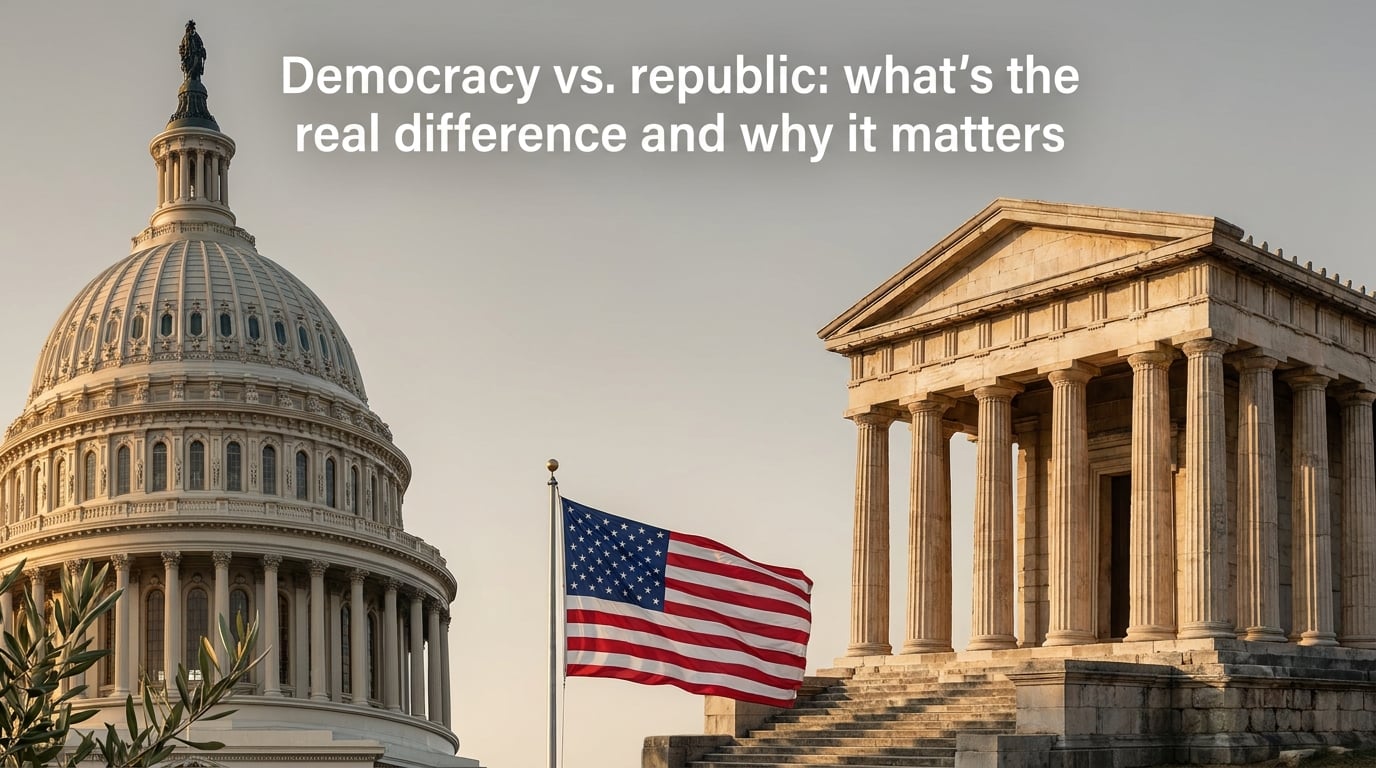
Rome gave us the institutional vocabulary. Senators, consuls, tribunes of the plebs, written law, and fixed terms in office are all Roman concepts. The U.S. Senate and the architecture of the Capitol building reflect that inheritance.
When the American Founders argued about what kind of government to build, they read both histories carefully. They wanted the democratic energy of Athens without its chaos, and the institutional structure of Rome without its collapse into empire.
Is the United States a Democracy or a Republic?
The United States is both a democracy and a republic, and it always has been. The two words describe different features of the same system.
America is a republic because power is exercised through elected representatives operating under a written constitution, and there is no monarch. The Founders deliberately chose this structure to protect individual rights from majority overreach.
America is also a democracy because the people hold ultimate sovereign authority and choose their leaders through free elections. The Constitution itself uses the word “republican” in Article IV, Section 4, guaranteeing every state “a republican form of government.”
So when someone says, “we’re a republic, not a democracy,” they’re describing only half the picture. The accurate statement is that the United States is a constitutional democratic republic.
Why This Distinction Matters Today
The distinction matters because it shapes how we argue about political power and individual rights in practical, day-to-day ways.
First, understanding that America is a republic explains why minority rights, like free speech, gun ownership, and religious liberty, are protected even when majorities would prefer to restrict them. The Bill of Rights is the republic side of the system at work.
Second, knowing the difference between direct and representative democracy clarifies debates about ballot measures, voter ID laws, and how electoral colleges function. Each is a representative-democracy choice, not a departure from democratic principles.
Third, when political figures claim that the United States is “not a democracy,” they are usually trying to justify restricting voting access or concentrating power. Recognizing that claim for what it is helps voters see through the rhetoric.
Common Misconceptions Debunked
A few popular beliefs about this topic are simply wrong. Here are the most common ones I hear and why they don’t hold up.
“Republic Means Anti-Democracy”
False. A republic is simply a state without a monarch. Most republics in the world today are also democracies. The two concepts work together, not against each other.
“America’s Founders Rejected Democracy”
Partly false. They rejected direct democracy as a full operating model, but they deeply valued democratic self-government. The Constitution opens with “We the People,” which is a fundamentally democratic statement.
“China Is a Democracy Because It’s Called the People’s Republic”
False. The word “republic” only tells you the form of government. The People’s Republic of China is a republic in structure but not a democracy in practice, since citizens do not freely choose their leaders.
“The Words Were Always Separate”
Partly false. At the time of the founding, many writers used “democracy” and “republic” interchangeably. The sharper distinction we use today hardened only in the 19th and 20th centuries, especially in American political debate.
Frequently Asked Questions
What’s the real difference between a democracy and a republic?
A democracy is a system where power rests with the people and is exercised either directly or through elected representatives. A republic is a state governed by elected officials operating under a written constitution, with no monarch. Most modern democracies are also republics, so the two ideas usually overlap rather than conflict.
Is the United States a democracy or a republic?
The United States is both. It is a republic because its head of state is elected rather than inherited, and because power is limited by the Constitution. It is also a democracy because citizens hold ultimate sovereign authority and choose their leaders through free elections.
What does u0022res publicau0022 mean?
Res publica is Latin for u0022public affairu0022 or u0022public matter.u0022 Romans used the phrase to describe government organized for the common good, in contrast to rule by a single monarch. The modern word republic descends directly from this term.
What is the difference between direct and representative democracy?
In a direct democracy, citizens vote on laws and policies themselves. In a representative democracy, citizens elect representatives who then make laws on their behalf. Most large modern democracies, including the United States, use the representative model.
Why does the democracy vs republic distinction matter?
The distinction matters because it determines how power is actually exercised. A republic’s constitutional limits protect minority rights and individual freedoms from majority overreach, while democratic participation keeps the government accountable to the people.
Is a constitutional republic the same as a democracy?
A constitutional republic is a specific type of democracy. It combines democratic elections with constitutional limits on government power. The United States, Germany, and India are all constitutional democratic republics.
The Bottom Line on Democracy vs Republic
The democracy vs republic debate confuses people because the two words describe overlapping features of the same kind of government, not opposing systems. A republic tells you the form (no monarch, governed by law); a democracy tells you the source of power (the people).
Every time you cast a vote, you are participating in a democracy. Every time the Bill of Rights blocks a popular policy, you are feeling the republic’s constitutional limits. The genius of the American system is that it gives you both at once, and that’s the real reason this distinction matters in 2026 and beyond.