
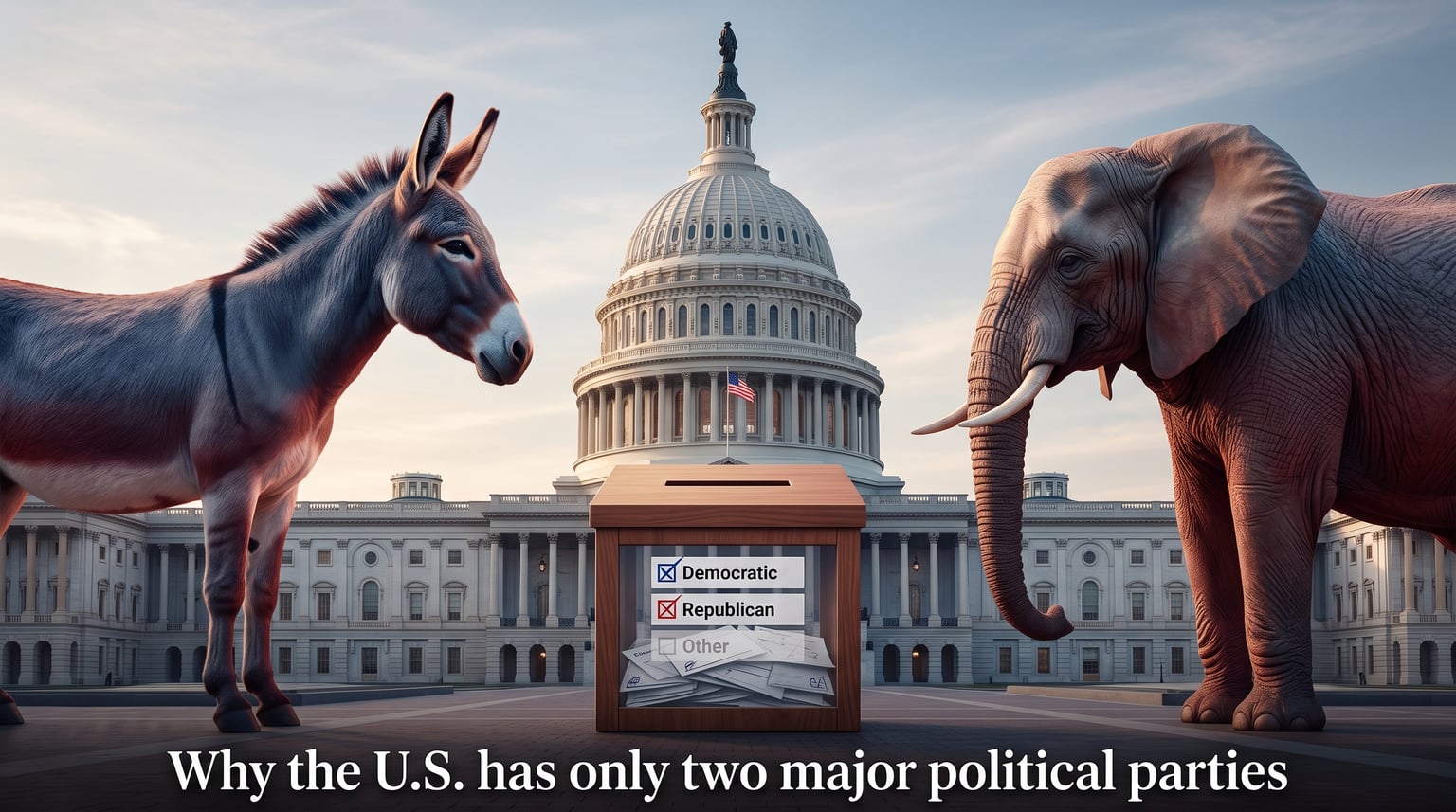
Why does the U.S. have only two major political parties? The short answer is that American elections use a winner-take-all system built on single-member districts, so any candidate who finishes second gets nothing. Combined with a principle political scientists call Duverger’s Law, this structure pushes the country toward two dominant coalitions – Democrats and Republicans – and makes it nearly impossible for a third party to break through.
I dug into the history, the math, and the political science behind this question because the answer is more interesting than most people realize. It is not just tradition or culture. The two-party system is engineered into how we vote, and that is what we will unpack in this guide.
Table of Contents
The Short Answer: Winner-Take-All Elections
The core reason the U.S. has only two major political parties is the winner-take-all electoral system, also known as plurality voting. In nearly every congressional, state legislative, and presidential election, the candidate with the most votes wins the entire seat. Second place does not earn a share of representation.
This system differs sharply from proportional representation, which most European parliamentary democracies use. In a proportional system, if a party wins 15 percent of the vote, it gets roughly 15 percent of the seats. That mathematical fairness gives smaller parties a real path into government, which is why countries like Germany, the Netherlands, and Sweden routinely have five, seven, or even ten parties in their legislature.
In a single-member district with winner-take-all rules, however, splitting the vote is a death sentence for a minor party. Imagine a libertarian candidate earns 12 percent of the vote in a U.S. House race. They get zero seats, zero committee power, and zero legislative influence. The Democratic and Republican candidates split the remaining 88 percent and one of them walks away with the entire district.
That mechanic is the engine of two-party dominance in America. It punishes voters who support third parties and rewards voters who concentrate their support behind one of the two major parties. Over decades and centuries, it has produced exactly the system we see today.
What Is Duverger’s Law?
Duverger’s Law is the political science principle that explains why single-ballot plurality elections tend to produce two-party systems. French sociologist Maurice Duverger first formalized it in the 1950s, and it has held up remarkably well across democracies worldwide.
The law works through two effects. The mechanical effect is straightforward: in a winner-take-all district, only one party can win. Smaller parties are structurally disadvantaged because their supporters could “waste” their vote helping the major party they like least. The psychological effect is more subtle but equally powerful. Voters who know third parties cannot win often engage in strategic voting, picking the major-party candidate they prefer rather than the third-party candidate they actually like.
Georgetown University political science professor Hans Noel has pointed out that this dynamic is not unique to America. Any democracy that uses single-member plurality districts tends to converge on two parties. Canada, the United Kingdom, and India all follow the same pattern, even when their cultures, histories, and ideologies differ wildly.
The U.S. takes this dynamic to an extreme because almost every elected office – from the presidency to the House, the Senate, and state legislatures – uses single-member districts with plurality winners. There are no proportional seats anywhere in the federal system, which is unusual among major democracies.
How the Two-Party System Developed in the United States
The two-party system in America is older than the Constitution itself. Within a few years of George Washington’s presidency, the political class had already fractured into two camps.
Federalists vs. Anti-Federalists (1789-1800)
The very first Congress split between Federalists, who wanted a strong central government and a commercial economy, and Anti-Federalists, who feared centralized power and wanted states to keep most authority. Alexander Hamilton led the Federalists. Thomas Jefferson and James Madison led the opposition. This was the original two-party divide in U.S. history.
Democratic-Republicans and the Era of Good Feelings (1800-1824)
By 1800, the Anti-Federalists had reorganized as the Democratic-Republican Party under Jefferson. The Federalists faded, and for a brief stretch in the 1810s, the Democratic-Republicans were so dominant that the era earned the nickname “Era of Good Feelings.” But even during that one-party stretch, factions began forming within the Democratic-Republicans, and the party eventually split.
The Whigs and the Rise of the Democrats (1828-1854)
Andrew Jackson’s coalition reorganized as the Democratic Party in 1828, while opponents formed the Whig Party. For about 25 years, Democrats and Whigs alternated in power, much like today’s Republicans and Democrats. The Whigs collapsed in the 1850s primarily over slavery, which fractured the party along regional lines.
The Birth of the Republican Party (1854)
Anti-slavery Whigs, Free-Soilers, and northern Democrats merged in 1854 to form the Republican Party. Within six years, Abraham Lincoln was elected president. This was the last time a third party effectively replaced one of the major two – and it happened under extraordinary historical pressure.
Party Realignments (1860s through New Deal)
Since the Civil War, the Republican and Democratic labels have remained, but their coalitions have shifted dramatically. The 1932 New Deal realignment moved white Southern voters from Democrat to Republican over several decades, while African American voters moved from Republican to Democrat. Each of these realignments kept the two-party structure intact while transforming what each party actually stood for.
This is one of the most striking features of American political history: the names stay the same, but the parties keep reinventing themselves. That stability is itself a product of the electoral system, which makes new party names costly and hard to launch.
Why Third Parties Fail in the U.S.
Third parties fail in America for a predictable combination of structural, legal, and psychological reasons. None of these barriers exist in isolation. They reinforce each other and form a closed loop that crushes outside movements.
Strategic Voting
The biggest barrier is also the simplest: voters do not want to waste their vote. When a voter in Ohio faces a choice between a Democrat, a Republican, and a Green Party candidate, they often pick the major-party option they dislike less. Even voters who strongly prefer the Green candidate may vote Democratic because they fear “spoiler” effects that help the Republican win.
Ballot Access Laws
Every state has its own ballot access rules, and most are written by the two major parties to favor themselves. A third-party candidate may need tens of thousands of petition signatures just to appear on the ballot in some states, while major-party candidates get on the ballot automatically. These rules are not unconstitutional, and courts have generally upheld them, but they create a real cost for any new party.
Sore Loser Laws
Many states also have “sore loser” laws that prevent candidates who lost a primary from running as independents or third-party candidates in the general election. This stops popular politicians from defecting from their party and running on an independent line, which keeps the major parties more unified than they would otherwise be.
Lack of Proportional Representation
Without proportional representation, there is no mechanism for a third party to win seats even when it has meaningful support. The Libertarian Party has polled between 1 and 4 percent in most presidential elections for decades and has won exactly zero Electoral College votes. That track record makes it hard for any voter to take third parties seriously.
Big-Tent Party Coalitions
Finally, both major parties operate as “big tent” coalitions that absorb diverse viewpoints. The modern Democratic Party includes progressive activists, moderates, labor unions, environmentalists, and many business interests. The Republican Party includes libertarians, social conservatives, defense hawks, and free-market advocates. Anyone dissatisfied with the current direction of a major party can try to shift it from within through primaries, rather than splitting off.
Primary Elections as a Pressure Valve
The U.S. primary system is the safety valve that keeps dissent from breaking the two-party structure. When voters are unhappy with the direction of a major party, they typically try to change it through primaries rather than by forming a new party.
Primaries work as intraparty elections that pick each party’s candidate for the general election. Open primaries allow any registered voter to participate, while closed primaries limit participation to registered party members. Either way, primaries give activists and dissatisfied voters a real channel to influence who represents each major party.
Recent history offers strong examples. The Tea Party movement that swept the 2010 and 2012 elections did not form a third party. Instead, it captured Republican primaries and pushed the GOP further right. Similarly, the progressive wing of the Democratic Party has influenced presidential primaries behind Bernie Sanders in 2016 and 2020. In both cases, frustrated voters used the existing system rather than building something new.
This is a feature, not a bug, of the two-party system. It absorbs pressure that, in a parliamentary democracy, would almost certainly produce new parties. By keeping factions inside the tent, primaries preserve the broader two-party architecture.
Comparing the U.S. System to Parliamentary Democracies
The clearest way to understand why the U.S. has only two major political parties is to look at systems that do not. Parliamentary democracies with proportional representation routinely support five or more competitive parties.
Germany is a useful comparison. The Bundestag includes the Christian Democrats, the Social Democrats, the Greens, the Free Democrats, and the Left Party, among others. Each party wins seats roughly in proportion to its share of the national vote. Smaller parties can still play a decisive role because no single party usually wins a majority, so coalitions are required to govern.
The Netherlands takes this further. Its parliament has routinely included ten or more parties, and governments require complex multi-party coalitions. Israel’s Knesset is similarly fragmented. In these systems, voters know that even a small party can have outsized influence by becoming part of a governing coalition.
The U.S. has no equivalent of coalition government. The president is elected separately from Congress, and there is no formal mechanism for forming coalitions after an election. That structural feature removes most of the incentive voters in other countries have to support smaller parties.
Of course, parliamentary systems have their own problems. Coalition governments can be unstable, and small parties can sometimes extract disproportionate concessions by threatening to collapse a coalition. But the comparison makes clear that the choice between two parties and many parties is largely a product of electoral design, not national character.
Could the U.S. Ever Have More Than Two Parties?
Calls for breaking the two-party duopoly are louder than they have been in years. Elon Musk announced a plan to launch the “America Party” in 2026, and independent candidacies like those of Ross Perot in 1992 and Robert F. Kennedy Jr. in 2024 have fueled the conversation. But structural barriers remain formidable.
Several reforms could weaken the two-party grip. Ranked-choice voting, already adopted in Maine, Alaska, and several cities, lets voters rank candidates in order of preference and eliminates the spoiler problem. Proportional representation could be introduced for House seats, with multimember districts that allocate seats by vote share. Open primaries could reduce the power of party insiders.
None of these reforms would change American politics overnight. Each faces political opposition from the very parties that benefit from the current system. But they show that the two-party outcome is not inevitable. It is the product of specific institutional choices that could, in principle, be made differently.
For now, Democrats and Republicans remain the only viable choices for federal office in nearly every U.S. election. Anyone hoping to change that is really hoping to change how Americans vote, which is a much bigger project than launching a new campaign.
Frequently Asked Questions
Why does the U.S. only have two major political parties?
The U.S. has only two major political parties because its single-member district, winner-take-all electoral system mechanically rewards larger parties and punishes smaller ones. Duverger’s Law explains that this structure produces a two-party equilibrium in nearly every democracy that uses it.
What is Duverger’s Law?
Duverger’s Law is a political science principle, first articulated by French sociologist Maurice Duverger in the 1950s, which holds that single-ballot plurality electoral systems tend to produce two-party dominance through both mechanical effects (only one winner per district) and psychological effects (voters gravitate toward major-party candidates to avoid wasting their vote).
How did the two-party system develop in the United States?
The two-party system developed gradually from the Federalist versus Anti-Federalist split in the 1790s, through the Democratic-Republican and Federalist era, the Whig and Democrat period, and finally the modern Republican Party founded in 1854. Party labels have remained stable while internal coalitions have repeatedly realigned, especially during the New Deal era in the 1930s.
Why do third parties fail in the United States?
Third parties fail in the U.S. because of winner-take-all elections, restrictive ballot access laws, sore loser laws, strategic voting by the electorate, and the absence of proportional representation. These structural barriers are reinforced by the major parties functioning as big-tent coalitions that absorb diverse viewpoints before they can split off into new movements.
Can you start a new political party in the United States?
Yes, you can start a new political party, but it must clear significant hurdles including collecting petition signatures to gain ballot access in each state, building name recognition against entrenched parties, and overcoming strategic voting by the electorate. No truly new third party has won a U.S. presidential election since Abraham Lincoln’s Republicans in 1860.
What are the main U.S. political parties?
The two major U.S. political parties are the Democratic Party and the Republican Party. Both have dominated federal elections since the 1850s. Several minor parties exist, including the Libertarian Party, the Green Party, and the Constitution Party, but they have not won any presidential or congressional races in the modern era.
Final Thoughts on the U.S. Two-Party System
Why the U.S. has only two major political parties comes down to three reinforcing factors: a winner-take-all electoral system, Duverger’s Law, and historical path dependence. The system was not designed to produce two parties, but it has reliably done so for over 170 years.
If you want to understand American politics better, focus less on the personalities and more on the institutional design. Parties are downstream of how votes are counted, and U.S. votes are counted in a way that almost guarantees only two serious contenders. Any serious effort to change that would require changing how elections actually work.
Until then, every presidential race, every House race, and most state-level contests will come down to a choice between a Democrat and a Republican. The two-party system is durable because the rules make it durable, and changing those rules is exactly the kind of structural reform that has historically been very hard to achieve.