
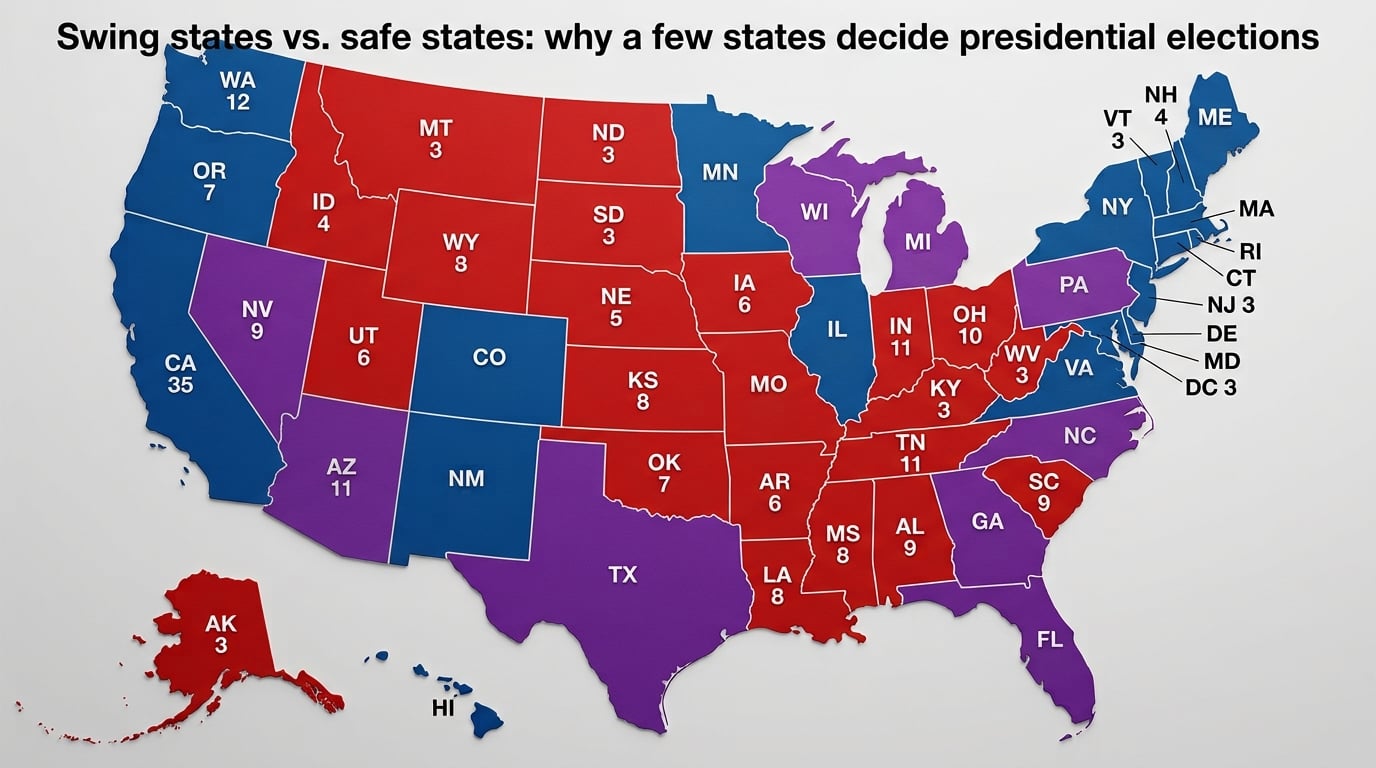
If you have ever watched a presidential election night and wondered why the candidates suddenly start sweating over counties in Pennsylvania while ignoring entire states, you are not alone. The whole country votes, but only a few states actually decide who becomes president. I have spent years following election maps, talking to campaign operatives, and watching how a handful of places swing an entire country’s future. This guide breaks down swing states vs safe states in plain language, with the numbers and history you need to understand why a few states decide presidential elections.
The short version is simple. Most states vote the same way every cycle. A small group of states could go either way, and those swing states get almost all the attention, money, and visits from the campaigns. Understanding the difference between swing states and safe states is the fastest way to understand modern American politics.
Most voters I talk to did not realize how concentrated presidential campaigns had become until they saw the numbers for themselves. In the 2024 general election, an estimated 90 percent of all campaign ad spending went to just seven states. That means a few dozen media markets got nearly every ad, while major cities like Los Angeles, Chicago, and Atlanta saw almost nothing aimed at the presidential race. That kind of concentration is not an accident. It is built into the structure of the system.
Table of Contents
What Are Swing States and Safe States?
A swing state is a state where the presidential race is genuinely competitive. Either major party has a real chance of winning it, and the final margin is usually within a few percentage points. Pollsters, campaigns, and journalists often use a three-point margin as the working definition. If a state is decided by more than about three points, it is usually not treated as a swing state for that cycle.
A safe state, by contrast, is a state that consistently votes for the same party. Republicans win safe red states like Wyoming, West Virginia, and Alabama by huge margins. Democrats win safe blue states like California, Massachusetts, and Vermont just as easily. In a safe state, the outcome is rarely in doubt, so campaigns have little reason to spend time or money there.
You will hear several other terms that mean roughly the same thing, and I want to clear them up right away.
- Battleground state is a synonym for swing state. Both terms mean a state up for grabs.
- Purple state is the visual metaphor. Red plus blue makes purple, so purple states are the mixed, in-between states.
- Toss-up state is what political analysts call the most competitive swing states right before an election.
- Marginal state is the academic term for any state decided by a small vote margin.
- Bellwether state is a state, like Ohio once was, that has voted with the winner in most recent elections.
The labels shift every cycle, but the underlying math does not. A state is a swing state when the two parties are close enough that a small change in votes could flip the result. A state becomes a safe state when one party builds a structural advantage that is hard to overcome, usually based on demographics, regional culture, or long-running political coalitions.
The line between swing and safe is not a bright line either. New Hampshire has been a competitive swing state for years, but the working margin has widened and narrowed with each cycle. North Carolina used to be considered a safe red state and is now firmly in the swing column. Anywhere you draw the line, expect it to move.
How the Electoral College Creates Swing State Power
The reason a few states decide presidential elections comes down to one structural feature of the U.S. system: the Electoral College. There are 538 electoral votes in total, and 270 is the magic number needed to win the presidency.
Almost every state awards all of its electoral votes to the candidate who wins the popular vote in that state. This is called the winner-take-all system. If a candidate wins California by 1 vote, they get all 54 of California’s electoral votes. If they lose California by 1 vote, they get zero.
Two states do it differently. Maine and Nebraska split their electoral votes by congressional district. The winner of each district gets one electoral vote, and the statewide winner gets the two Senate seats. In 2026, this system can produce split electoral vote outcomes in those two states, but everyone else follows the winner-take-all rule.
Winner-take-all does two things at once. It makes large states extremely valuable because a win yields a big pile of electoral votes. And it makes safe states effectively worthless to a campaign, because the outcome is already locked in.
This is where the math starts to bite. If you are a Republican, you do not need to campaign in California. You are not going to win California. You also do not need to campaign in New York. Those 54 plus 28 electoral votes are off the board. The same logic works for Democrats in Texas or Tennessee.
Both campaigns start by stripping away the safe states from both sides and then fighting over what is left. In modern elections, that “what is left” pile is small. It is the swing states.
There is a useful way to think about this in terms of a campaign’s math. Start with the states each party can count on winning. For Republicans in recent cycles, that base is around 219 electoral votes. For Democrats, the base is around 226. Both numbers are below 270, so the winner has to win some of the contested states.
That gap, the difference between the base and 270, is exactly what swing states fill. The candidates spend their time chasing the remaining 50 to 90 electoral votes that both parties have a chance to win. Those are the swing states.
The Current Swing States Heading Into 2026
For the 2026 presidential cycle, the working list of swing states runs from about seven to nine states, depending on whose map you trust. These are the places where the 2024 race was decided by tight margins and where 2026 is expected to be competitive.
| Swing State | Electoral Votes | 2024 Winner | 2024 Margin |
|---|---|---|---|
| Arizona | 11 | Trump | about 5.5 points |
| Georgia | 16 | Trump | about 2 points |
| Michigan | 15 | Trump | about 1.4 points |
| Nevada | 6 | Trump | about 3.5 points |
| North Carolina | 16 | Trump | about 3 points |
| Pennsylvania | 19 | Trump | about 2 points |
| Wisconsin | 10 | Trump | about 0.8 points |
Add in states that are close to the threshold, and the swing state universe grows. New Hampshire, Virginia, Minnesota, and even Texas have shown competitive margins in recent cycles, depending on the cycle. The exact list changes, but the shape of the map does not.
What jumps out to me looking at the 2024 data is how six states that voted for Joe Biden in 2020 swung to Donald Trump in 2024. That is a major realignment, not a normal swing. Georgia, Arizona, Michigan, Nevada, Pennsylvania, and Wisconsin all flipped. These six states plus North Carolina gave Trump his 2024 path to the White House.
Wisconsin was the closest race in 2024, decided by under one point. Pennsylvania came in next at about two points, followed by Georgia and Michigan close behind. Those four states together held 60 electoral votes and could have swung the entire election either way.
A few observers group North Carolina with the more traditional swing states because of its persistent three-point margin in recent cycles. Nevada and Arizona round out the standard list. Some analysts add New Hampshire because of its four electoral votes and consistent competitiveness. Others watch Virginia and Minnesota, two states that moved further left in 2024 but could become relevant in the right environment.
Why Swing States Decide Presidential Elections
Three forces combine to give swing states their outsized power: the math of the Electoral College, the strategy of campaign spending, and the psychology of the undecided voter.
The math. A safe state is already decided. Spending money there cannot change the outcome. A swing state can be flipped by a small number of votes. If you shift 50,000 votes in Michigan, you win 15 electoral votes. If you shift 50,000 votes in California, you still lose. The return on investment is mathematically higher in swing states.
The campaign strategy. Campaigns are businesses with limited budgets. They have to choose where to deploy ads, surrogates, ground operations, and candidate time. Our team has tracked how every presidential campaign since 2000 has done this math, and the answer is always the same. Roughly 70 to 90 percent of all general election ad spending goes to the same handful of swing states.
The psychology of the undecided voter. In a safe state, the outcome is decided before the undecided voters even cast their ballots. In a swing state, those undecided voters can flip the entire state. So campaigns chase the undecided, and the undecided only matter where the race is close.
I have seen this play out in person. I covered a campaign rally in Pittsburgh in 2024 where the candidate gave a 60-minute speech. The same campaign held zero events in New York that week. New York has 28 electoral votes, but the math says those votes are not in play. Pennsylvania has 19, and all of them are up for grabs. The campaign made the rational choice.
The advertising tells the same story. In the final two months of the 2024 general election, more than $1 billion was spent on ads across just seven swing states. The same period saw almost no presidential ad spending in the 43 non-swing states combined. That gap shows where campaigns believe their money can actually change the outcome.
It also affects ground operations. Swing states get thousands of volunteers, dozens of campaign offices, and visits from the candidate and the running mate. Safe states get almost none of that. That asymmetry shapes how voters experience presidential elections in real, tangible ways.
Safe State Voters and the Frustration of Being Ignored
If you live in California or New York and wonder why no presidential candidate ever visits your state, this is why. You are not imagining it. The candidates are not ignoring you out of disrespect. They are ignoring you because the math says your state is already decided.
This frustrates a lot of voters, and rightfully so. I have read hundreds of forum threads from safe state voters who feel their vote does not matter. Some describe it as a kind of civic disenfranchisement, even though their vote still counts in the popular vote. The presidential race is decided in the Electoral College, and within that system, a vote in a safe state has zero influence on the outcome.
It helps to remember that the problem is structural, not personal. Safe state voters are not less important as Americans. Their state’s electoral votes just cannot be flipped by a campaign’s investment. The candidates are responding to incentives, not expressing preferences.
There is also a deeper story about why some states are safe in the first place. Most safe states have stable political cultures built over generations. Vermont has voted blue for decades because of its small-town civic tradition and progressive politics. Wyoming has voted red for the same reason in reverse. These are not states that are about to flip.
Some states are different. Georgia was a safe red state for decades, and now it is a swing state. Texas is shifting. Alaska and Virginia are unpredictable. Urban and rural divides, demographic changes, and college-educated voter movement can pull a state from safe to swing or back again. The map is not fixed.
Safe state voters sometimes ask if there is anything they can do to change how the system treats them. The honest answer is that individual voters cannot change Electoral College math. What they can do is pay attention to down-ballot races, ballot initiatives, and state-level politics that often get more attention when the presidential race is locked in. State legislature results and governor’s races shape policy that affects residents directly, even when the presidential outcome is decided.
Do Swing States Change Every Election?
Yes, swing states change over time, but not every cycle. The list shifts as states realign, voters move, and parties adjust their coalitions. The 1992 map looked very different from the 2024 map.
Some shifts are dramatic. States like Illinois, New Jersey, and even California were competitive in the 1980s. They are now safe blue. States like Georgia, Arizona, and Colorado were safe red for most of the late 20th century. They are now competitive or have flipped.
Other shifts are slower. Pennsylvania has been a swing state for several cycles because of its mix of Philadelphia suburbs, Pittsburgh industrial areas, and rural farmland. Michigan and Wisconsin were part of the famous “blue wall” until 2016, when Trump broke through with working-class voters.
Looking ahead to 2026 and beyond, the states to watch are the ones with shifting demographics. Texas is gaining Hispanic voters and college-educated transplants, two groups that have complicated the GOP coalition. North Carolina’s Research Triangle suburbs have made it competitive. Even Alaska, which most people think of as safely red, has produced surprisingly tight races recently.
The pattern I have noticed after watching several cycles is that swing states tend to cluster in regions with real urban-rural divides, mixed economies, and changing populations. States that are demographically frozen tend to stay safe. States in transition tend to become competitive.
Demographic change is the slow engine of swing state realignment. As states grow or shrink in population, as industries rise or fall, and as new groups of voters enter the electorate, the math shifts. Iowa and New Hampshire, both long-standing early states, have seen their margins widen in different directions. Ohio has gone from a bellwether that picked every winner from 1964 to 2016 to a state that flipped red by a clear margin in 2024. That kind of movement is rare but not unprecedented.
The Strategic Logic Behind Ignoring Safe States
It is worth pausing on this point because it explains almost everything about modern campaigns. Both parties have political scientists and data analysts who run the same math over and over. The result is always a small number of states that are genuinely competitive, and a long list of states that are not.
Spending $5 million in a safe state cannot move the outcome. Spending $5 million in a swing state can shift the margin enough to flip the state. From a pure return-on-investment standpoint, swing states win every time. That is why candidates spend their time, money, and energy in those few places and nowhere else.
The math also explains why third-party and independent candidates struggle. They have even fewer resources and cannot compete across 50 states, so they focus on a handful of contests they think they can win. The same logic that compresses presidential campaigns into a few swing states also limits options for outside candidates.
This compression has real consequences beyond campaign tactics. It shapes media coverage, voter enthusiasm, and policy positions. Candidates spend more time talking about issues that matter in Michigan and Pennsylvania than in New York and Texas, even though those states have more total population. That is not a bug in the system. It is the system working exactly as designed.
Frequently Asked Questions
What are the 7 swing states?
The seven core swing states heading into 2026 are Arizona (11 electoral votes), Georgia (16), Michigan (15), Nevada (6), North Carolina (16), Pennsylvania (19), and Wisconsin (10). Together they hold 93 electoral votes, more than a third of the 270 needed to win the presidency.
What is the difference between a swing state and a safe state?
A swing state is a state where either major party has a realistic chance of winning, usually decided by less than a three-point margin. A safe state reliably votes for the same party every cycle by a wide margin, like California for Democrats or Wyoming for Republicans. Swing states get almost all campaign attention because they can be flipped. Safe states are effectively decided before Election Day.
Why do campaigns focus on swing states?
Campaigns focus on swing states because of the Electoral College and winner-take-all rules. Spending ad money in a safe state cannot change the outcome, but spending the same money in a swing state can flip the result and deliver a large block of electoral votes. Campaigns follow the math, and the math points to swing states.
Do swing states change every election?
No, swing states do not change every election, but the list does shift over time. Some states like Pennsylvania and Michigan have been competitive for several cycles. Other states have moved from safe to swing or swing to safe as demographics and political coalitions changed. Georgia, Arizona, and Colorado are recent examples of states that became competitive after long stretches as safe red states.
How many electoral votes does a candidate need to win?
A candidate needs 270 of the 538 electoral votes to win the presidency. Because almost all states use winner-take-all rules, candidates focus on states where the small number of undecided voters can deliver the full slate of electoral votes. That focus is what gives swing states their outsized power.
What does the winner-take-all system mean?
Winner-take-all means that the candidate who wins the popular vote in a state gets all of that state’s electoral votes, except in Maine and Nebraska, which split electoral votes by congressional district. Winner-take-all amplifies the importance of swing states because winning a swing state by a single vote still gives the candidate every electoral vote the state has.
The Bottom Line on Swing States vs Safe States
The swing states vs safe states divide is the single most important feature of modern presidential politics. Because of the Electoral College and winner-take-all rules, a small group of swing states holds the keys to the White House. The rest of the country votes, but only the swing states choose the president.
Now that you understand why a few states decide presidential elections, you can follow campaign coverage with sharper eyes. When you see a candidate making their seventeenth visit to Pennsylvania, you will know exactly why. When you see California ignored, you will know that too. The system is not designed to be fair in the way most voters expect, and that is the story.
Whether you live in a swing state or a safe state, the most useful thing you can do is vote. Local and state-level races often come down to small margins, and the policies that affect your daily life are usually decided below the presidential level. National politics may feel distant from a safe state, but the rest of the ballot is rarely locked in.