
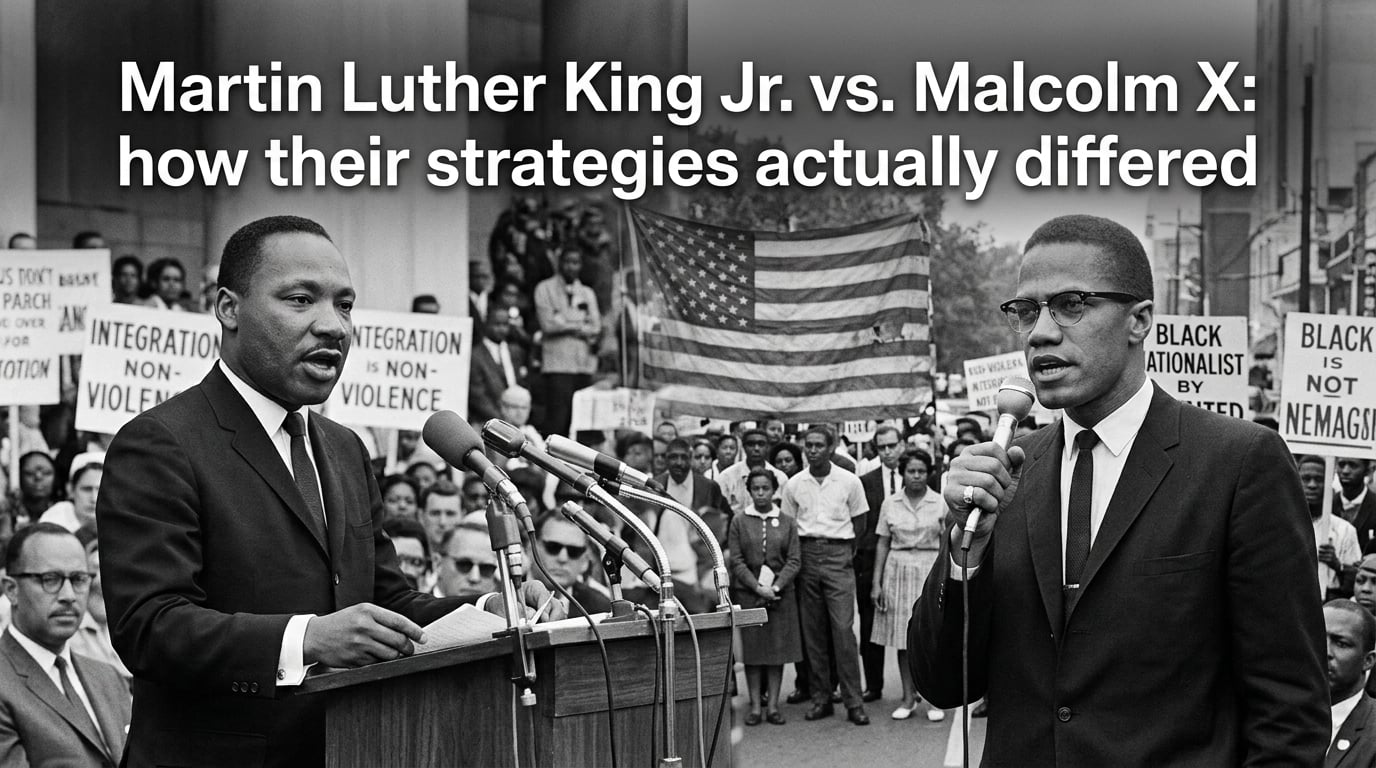
Martin Luther King Jr. and Malcolm X were the two most recognizable leaders of the American civil rights movement, and the Martin Luther King Jr. vs. Malcolm X strategies comparison still shapes how Americans understand Black political thought. They shared a goal—ending racial oppression and securing freedom for Black Americans—but they pursued it through radically different tactics, philosophies, and institutions.
King championed non-violent civil disobedience modeled on Gandhi, working within the existing American system to dismantle segregation through moral persuasion. Malcolm X, after his break with the Nation of Islam, pushed for Black self-determination, self-defense, and an international human rights framework that went beyond integration. I have spent years reading their speeches side by side, and what stands out is not just their disagreements but how each man’s biography pushed him toward his method.
This guide breaks down exactly how their strategies actually differed, where they overlapped, and why understanding both is essential for anyone studying the civil rights movement in 2026.
Table of Contents
How Their Early Lives Shaped Martin Luther King Jr. and Malcolm X
The two men’s early lives explain almost everything about their later strategies. King grew up in a stable, middle-class Black household in Atlanta, the son of a Baptist preacher and himself a pastor at Ebenezer Baptist Church by age 25. He absorbed Christian theology, the language of forgiveness, and the moral authority of the Black church from birth.
Malcolm Little—later Malcolm X—lost his father to a suspicious streetcar death, watched his family broken apart by state welfare agencies, and ended up in foster care after his mother was institutionalized. He dropped out of school, ran numbers in Harlem and Boston, and served time in prison, where he converted to the Nation of Islam.
These different starting points shaped everything that followed:
- King entered the movement through the Black church and Southern Christian Leadership Conference (SCLC), surrounded by allies who could mobilize congregations.
- Malcolm X entered through the Nation of Islam and its strict moral code, preaching Black pride, self-discipline, and economic independence.
- King had access to formal education (Morehouse, Crozer, Boston University) and built coalitions with white liberal allies.
- Malcolm X had almost no formal higher education but built a powerful platform through street oratory, mosque networks, and media appearances.
One came to activism through Sunday sermons. The other came through prison study and nighttime rallies. That contrast is the seed of every tactical difference between them.
Philosophical Foundations: Non-Violence vs Self-Defense
Their philosophical foundations defined the strategy gap most clearly. King grounded his approach in Christian love and Gandhian non-violent resistance. He believed that publicly accepting suffering without retaliation exposed the moral bankruptcy of segregation and forced white America to confront its own conscience.
Malcolm X grounded his approach in Black nationalism and self-defense. He believed non-violence was a tactic Black people had been forced into, not a moral virtue. When asked about violence, he consistently distinguished between initiating it and responding to it, arguing that the Constitution’s Second Amendment applied to Black Americans just as it did to anyone else.
Three philosophical pillars separated them:
- On violence: King rejected it absolutely, even in self-defense, as a tool of social change. Malcolm X supported self-defense as a legitimate right and criticized King’s pacifism as something white liberals asked Black Americans to practice alone.
- On integration: King wanted Black Americans fully integrated into American society on equal terms. Malcolm X, at least in his Nation of Islam phase, advocated separation—Black people controlling their own communities, schools, and economies.
- On identity: King emphasized the shared humanity of Black and white Americans. Malcolm X emphasized Black distinctiveness, pride, and the cultural links to Africa and the diaspora.
It is important to note that Malcolm X’s views shifted dramatically after he left the Nation of Islam in 1964 and made the hajj. After that, he spoke of cooperation across races and the possibility of brotherhood. King, by contrast, moved in the opposite direction in his final years, becoming more critical of American capitalism and the Vietnam War. Their trajectories crossed just as both were killed.
Martin Luther King Jr. vs. Malcolm X Strategies: The Core Tactical Split
The Martin Luther King Jr. vs. Malcolm X strategies comparison comes down to this: King tried to convert white America through moral witness; Malcolm X tried to fortify Black America through independent power. Here is the core tactical split in detail.
King believed the federal government was the lever of change. His tactics—boycotts, sit-ins, marches, voter drives—aimed at producing newspaper images of police brutality against peaceful protesters, then winning federal legislation. The Civil Rights Act of 1964 and the Voting Rights Act of 1965 are direct results of his strategy.
Malcolm X believed the federal government was structurally hostile to Black interests. His tactics—rallies, mosque organizing, building Black-owned businesses, international advocacy through the Organization of Afro-American Unity—aimed at creating parallel institutions and an international audience that could pressure the U.S. on human rights grounds.
| Dimension | Martin Luther King Jr. | Malcolm X |
|---|---|---|
| Core strategy | Non-violent civil disobedience | Self-defense and Black self-determination |
| View of government | Reformable through moral pressure | Hostile; needed external pressure |
| View of integration | Ultimate goal | Rejecting integration as the only path |
| Primary audience | American public and federal officials | Black community worldwide |
| Key organizations | SCLC, Montgomery Improvement Association | Nation of Islam, OAAU |
| Iconic phrase | “Let us not seek to satisfy our thirst for freedom by drinking from the cup of bitterness and hatred” | “By any means necessary” |
King’s famous 1963 March on Washington and the “I Have a Dream” speech were designed to win the hearts of middle America. Malcolm X’s 1964 “Ballot or the Bullet” speech was designed to awaken Black political power and warn that patience had limits. They were aiming at different audiences with different tools.
Tactical Approaches in the Civil Rights Movement
In practice, their day-to-day tactics looked very different. King organized people into public, visible campaigns with maximum media exposure. Malcolm X built independent institutions and trained people to resist quietly and defend themselves.
Key examples make the contrast concrete:
- Montgomery Bus Boycott (1955–1956): King helped lead a 381-day economic boycott that integrated Montgomery’s buses. It was a mass, non-violent, coordinated action.
- Birmingham campaign (1963): King deliberately provoked arrests and police dogs to create national outrage, leading to the Birmingham desegregation agreement.
- Selma to Montgomery March (1965): King organized a direct-action march for voting rights that ended with “Bloody Sunday” and ultimately the Voting Rights Act.
- Malcolm X’s rallies: He filled Harlem’s Hotel Theresa and other venues with audiences who heard sharp critiques of integration, white liberals, and non-violence.
- Malcolm X’s organizing: He founded the Organization of Afro-American Unity to bring Black international pressure to the United Nations and linked African American freedom to anti-colonial movements in Africa and the Caribbean.
King’s rhetorical strategies were also distinctive. He used biblical cadence, allusions, and anaphora—”I have a dream,” “Let freedom ring,” “Now is the time”—to deliver messages of reconciliation. Malcolm X used direct, sometimes confrontational language, sarcasm, and historical analogy to deliver messages of resistance. Their rhetoric mirrored their tactics.
How Their Views Actually Evolved and Converged
A common myth is that they were always locked in opposition. In reality, their views converged as both matured. King became more outspoken about economic justice, poverty, and U.S. foreign policy. Malcolm X became more willing to consider integration and cooperation after leaving the Nation of Islam.
The two men met only once, on March 26, 1964, in the U.S. Capitol building, during a Senate debate on the Civil Rights Act. According to multiple witnesses, they spoke for about a minute. Malcolm X later said he respected King, disagreed with his methods, and believed King’s non-violence strategy had proven white moderates could be persuaded. King, for his part, recognized Malcolm X’s ability to reach people that the SCLC could not.
Peniel Joseph, the scholar behind much of the recent rethinking of this period, has argued that Malcolm X functioned as King’s “alter ego”—pushing King to consider more militant tactics while King pushed Malcolm X toward coalition politics. By 1965, both had moved closer to the center of each other’s positions.
Legacy and Modern Relevance
Both men were assassinated within three years of each other—Malcolm X on February 21, 1965, and Martin Luther King Jr. on April 4, 1968. Their deaths cut short the kind of practical cooperation their late-career evolution suggested might be possible.
Today, both legacies shape American debates about race. King’s dream is invoked during national commemorations and Supreme Court rulings. Malcolm X’s call for self-determination informs the rhetoric of the Black Lives Matter movement, prison reform advocates, and Pan-African organizing. Many younger organizers consciously blend King’s non-violent direct action with Malcolm X’s emphasis on Black economic power, mutual aid, and self-defense.
Understanding both is not about choosing one. It is about seeing how each leader’s life circumstances produced a strategy—and how the civil rights movement needed both.
Frequently Asked Questions
How did the tactics of Martin Luther King and Malcolm X differ?
Martin Luther King Jr. used non-violent civil disobedience—boycotts, marches, and moral appeals—to pressure the federal government and white moderates. Malcolm X used self-defense rhetoric, Black nationalist organizing, and international human rights advocacy to build independent Black power and warn that patience had limits.
What was the difference between Malcolm X and Martin Luther King?
King was an integrationist Christian minister who believed non-violence could redeem American democracy. Malcolm X was a Black nationalist who, in his Nation of Islam phase, rejected integration as a goal and supported self-defense and economic independence for Black communities.
Was Martin Luther King Jr. or Malcolm X more effective?
By direct legislative measures, King was more effective in the short term—the Civil Rights Act of 1964 and Voting Rights Act of 1965 followed his campaigns. Malcolm X was more effective in shifting how Black Americans saw themselves and laid the foundation for Black Power, modern Pan-Africanism, and human-rights-based advocacy.
What rhetorical strategies did Martin Luther King use?
King used biblical allusions, anaphora (repetition of phrases like I have a dream), and references to American founding documents to frame civil rights as a fulfillment of national ideals. He paired moral appeals with vivid images of injustice to win over white moderates.
Final Thoughts on Martin Luther King Jr. vs. Malcolm X Strategies
The Martin Luther King Jr. vs. Malcolm X strategies comparison is not a contest between a pacifist and a firebrand. It is a study of how two very different American experiences—the protected Black South and the abandoned Black North—produced two equally necessary tactical visions. King won legislation. Malcolm X won self-respect. Modern movements need both.
If you want to dig deeper in 2026, start with the speeches themselves: King’s “Letter from Birmingham Jail” and Malcolm X’s “The Ballot or the Bullet.” They are short, sharp, and they make the strategic difference clearer than any textbook.