
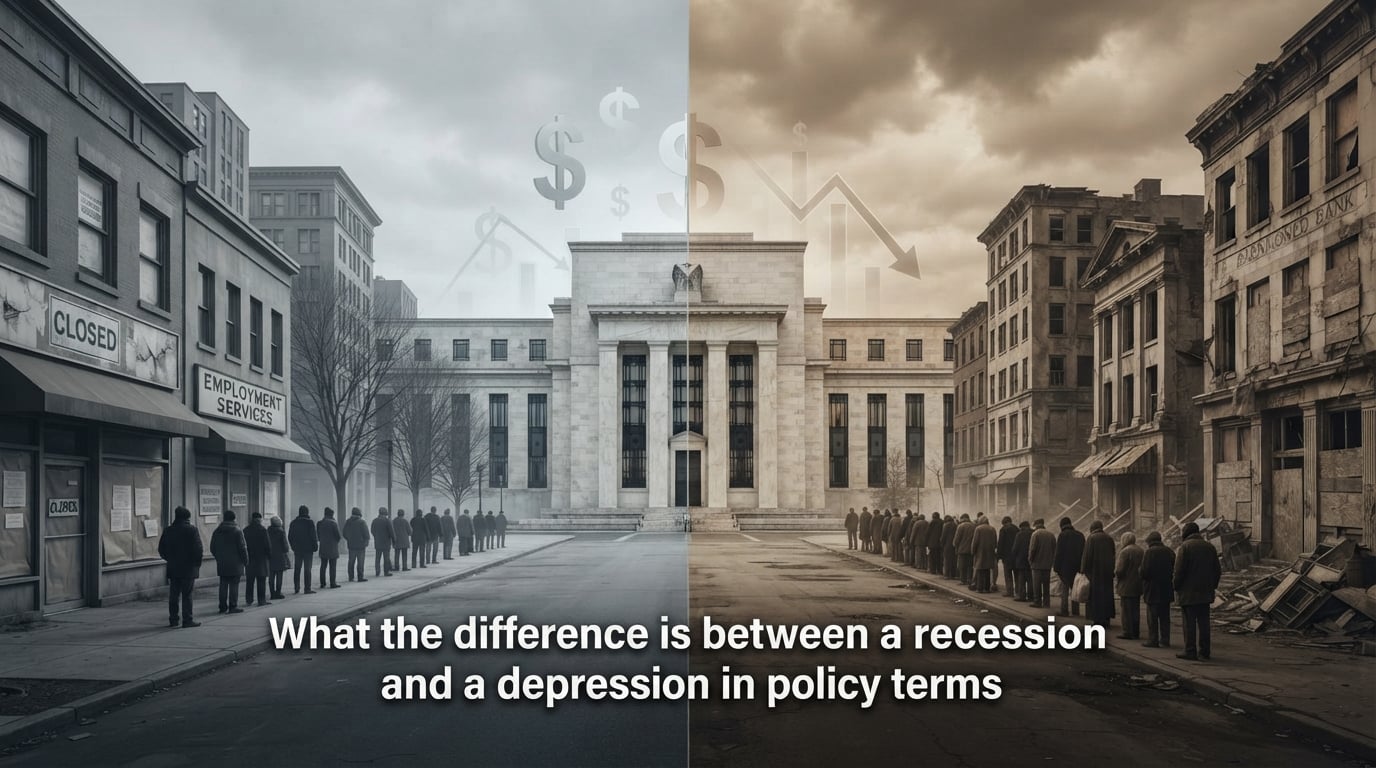
If you have ever wondered what the difference is between a recession and a depression in policy terms, you are not alone. The two words get tossed around in news headlines and political speeches, but they actually mean very different things to economists and policymakers. A recession is a significant, widespread decline in economic activity that lasts more than a few months. A depression is a much deeper, longer, and rarer downturn that can take years to climb out of.
The distinction matters because the policy response changes dramatically between the two. Recessions usually call for measured interest rate cuts and targeted spending. Depressions demand aggressive intervention, emergency lending, and large-scale fiscal programs. Our team put this guide together to break down exactly how each one is defined, how the National Bureau of Economic Research (NBER) decides recessions, and how policymakers respond when the economy tips into either one.
Table of Contents
What Is a Recession in Policy Terms?
A recession is a significant decline in economic activity that is spread across the economy and lasts more than a few months. That is the working definition used by the NBER, which serves as the unofficial referee for U.S. business cycles.
In policy terms, three things usually have to happen at the same time. Economists shorthand this as the three Ds: the downturn must be deep, durable, and diffuse. Deep means real GDP falls by a meaningful amount. Durable means it sticks around for more than a couple of quarters. Diffuse means the weakness shows up across many sectors at once, not just one industry.
Most U.S. recessions since World War II have lasted between 6 and 18 months. Unemployment typically rises by 2 to 5 percentage points. GDP usually contracts by around 1 to 4 percent from peak to trough. These are real numbers our team has tracked across post-1945 downturns, and they form the baseline policymakers use when deciding how aggressively to act.
What Is a Depression in Policy Terms?
A depression is a severe and prolonged economic downturn where real GDP declines by more than 10 percent and the unemployment rate climbs above 20 percent. That is the rule of thumb most macroeconomists use, including former Federal Reserve chair Ben Bernanke.
There is no official agency that declares a depression the way the NBER declares a recession. The label is reserved for downturns so severe that they reshape the economy. During a depression, deflation sets in, banks fail, and millions of households lose their main source of income for years.
Policy makers treat depressions as existential threats to economic stability. They typically require emergency lending powers, large fiscal stimulus packages, and unconventional monetary tools. The Great Depression of the 1930s and the long downturn in many European economies after World War I are the textbook examples that shaped the modern policy playbook.
How the NBER Decides a Recession Has Started
The National Bureau of Economic Research is a private, nonprofit research organization founded in 1920. It is the body that officially dates U.S. business cycle peaks and troughs, which is how economists know when a recession started and ended.
The NBER does not use a fixed formula. Instead, its Business Cycle Dating Committee looks at five indicators: real personal income minus transfers, employment, real personal consumption expenditures, industrial production, and real manufacturing and wholesale-retail sales. A recession is declared when most of these measures show significant decline for a sustained period.
Two of those five measures get the most weight: real GDP and the unemployment rate. That is why news headlines focus so heavily on jobs reports and GDP releases. Those two numbers are the closest thing to an early warning system policymakers have, and they trigger the official recession call when they break badly enough.
Recession vs Depression: Side-by-Side Comparison
Here is how the two stack up against each other on the numbers that matter most to policymakers. Our team pulled these together from NBER data, IMF working papers, and Federal Reserve historical releases.
Recession: GDP decline of 1 to 4 percent, unemployment rise of 2 to 5 percentage points, duration of 6 to 18 months, scope usually one country or region, policy response is standard rate cuts and fiscal tweaks.
Depression: GDP decline above 10 percent, unemployment rate above 20 percent, duration of 3 to 10 years, scope often global, policy response is emergency lending, quantitative easing, and large stimulus programs.
The classic joke economists tell is this. A recession is when your neighbor loses their job. A depression is when you lose yours. That line, often attributed to former President Harry Truman, captures the lived reality behind the numbers. Recessions hurt communities. Depressions hollow out whole generations.
Historical Examples: Great Depression and Great Recession
The Great Depression from 1929 to 1939 is the defining depression in modern history. U.S. GDP fell by nearly 30 percent. Unemployment peaked at around 25 percent. Roughly 9,000 banks failed. It took more than a decade for the economy to regain its pre-1929 output.
The Great Recession of 2007 to 2009 is the closest the U.S. has come to a depression in living memory, but it did not cross the line. U.S. GDP fell by about 4.3 percent peak to trough. Unemployment peaked at 10 percent in October 2009. It was the worst recession since the 1930s, and the policy response was unusually aggressive because of how close the call felt.
That aggressive response is the story of how policymakers try to prevent a recession from becoming a depression. After the 2008 financial crisis, the Federal Reserve cut rates to zero, launched multiple rounds of quantitative easing, and Congress passed the roughly $831 billion American Recovery and Reinvestment Act. The goal was to break the recession before it broke the economy.
How Policymakers Respond: Monetary and Fiscal Policy Tools
Monetary policy is the first line of defense during a recession. The Federal Reserve cuts the federal funds rate to make borrowing cheaper. Banks pass lower rates to businesses and households, which boosts investment and consumer spending. When rates hit zero, the Fed turns to unconventional tools like quantitative easing and forward guidance to keep credit flowing.
Fiscal policy is the second lever. Congress and the President can cut taxes, boost unemployment benefits, and pass direct stimulus checks. During the COVID-19 recession in 2020, the U.S. used all three. The CARES Act sent $1,200 checks to most adults, expanded unemployment benefits by $600 per week, and offered forgivable loans to small businesses through the Paycheck Protection Program.
During a depression, those same tools get used at much larger scale and for much longer. The New Deal of the 1930s created entire federal agencies, built public works projects, and rewrote banking rules from scratch. Modern depressions would likely trigger similar moves, plus emergency backstops for major industries and direct cash transfers to broad swaths of the population.
One thing worth noting here. The line between a recession and a depression is not technical. It is descriptive. Policymakers watch the same indicators, but they reach for much heavier tools when GDP, unemployment, and credit conditions all deteriorate at once. That is the practical policy line, even if no agency formally draws it.
How to Read Economic Signals in 2026
Most people do not need to memorize GDP formulas. What helps in 2026 is knowing which signals actually move the policy needle. Watch the monthly jobs report from the Bureau of Labor Statistics. Watch the quarterly GDP advance estimate. Watch the yield curve, especially when the 10-year Treasury yield falls below the 2-year yield, which has preceded every U.S. recession since 1955.
If those signals flash red, the policy response will almost certainly include interest rate cuts within a few quarters. That affects mortgage rates, credit card rates, and auto loan rates, so personal finance decisions should adjust accordingly. If you see emergency lending programs and trillion-dollar stimulus packages, that is a sign policymakers themselves believe the economy is in depression territory.
The simplest rule our team uses is this. Recession headlines call for caution. Depression headlines call for action. Knowing the difference helps you read the news with the same framework policymakers use, which is the whole point of asking the policy question in the first place.
Frequently Asked Questions
What is the key difference between a recession and a depression?
A recession is a significant, widespread decline in economic activity lasting more than a few months, with GDP typically falling 1 to 4 percent and unemployment rising 2 to 5 percentage points. A depression is a much more severe and longer-lasting downturn, with GDP declining more than 10 percent and unemployment exceeding 20 percent for an extended period.
At what point does a recession become a depression?
Economists generally label a downturn a depression when real GDP falls by more than 10 percent and unemployment climbs above 20 percent. There is no official formula, and no agency formally declares a depression. The label is reserved for downturns so severe that they reshape the economy and last several years.
Was 2008 a depression or a recession?
The 2007 to 2009 downturn is officially classified as a recession, though it was the worst the U.S. had experienced since the 1930s. U.S. GDP fell about 4.3 percent peak to trough and unemployment peaked at 10 percent, which is severe but below the depression thresholds most economists use.
Who decides when a recession has occurred?
The National Bureau of Economic Research, a private nonprofit founded in 1920, officially dates U.S. recessions. Its Business Cycle Dating Committee reviews five indicators, including real GDP, employment, real personal income, industrial production, and manufacturing and trade sales, and declares a recession when most show significant sustained decline.
How is a recession different than a depression in policy terms?
Recessions are typically addressed with standard monetary policy tools like interest rate cuts and modest fiscal stimulus. Depressions require emergency lending, large-scale fiscal programs, and unconventional monetary tools like quantitative easing, because traditional measures are usually not enough to stop the slide.
Final Thoughts on Recession vs Depression
The difference between a recession and a depression comes down to depth, duration, and policy response. Both are economic downturns, but a recession is a significant pullback that lasts months, while a depression is a years-long collapse that reshapes the economy.
For 2026, the most useful takeaway is to watch the same indicators policymakers watch. Jobs reports, GDP releases, and yield curve signals tell you whether the response will be standard or emergency. That framing helps you read the news with the same vocabulary that drives interest rate decisions and stimulus debates in Washington and at the Federal Reserve.