
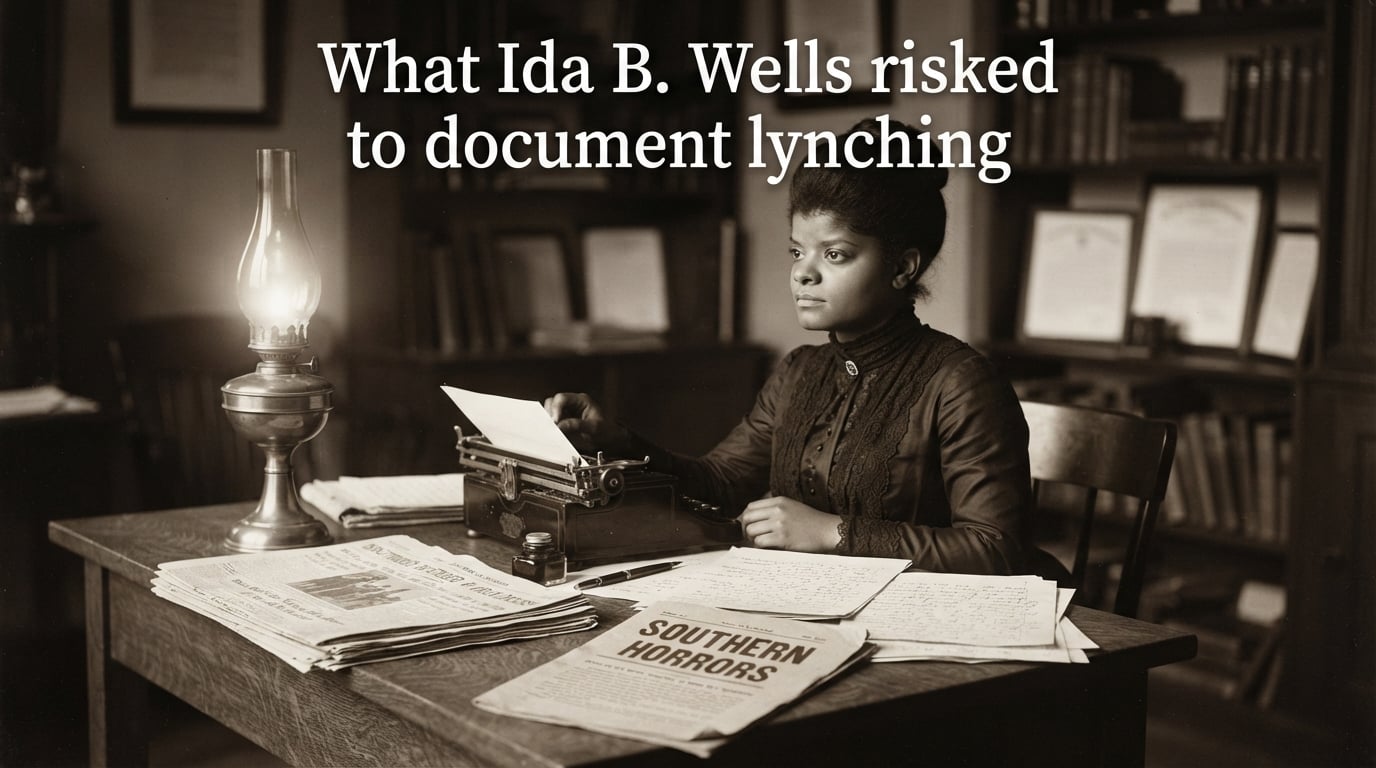
Ida B. Wells risked her newspaper press, her home, her personal safety, and ultimately her place in the country she was born in to document lynching in America. In the 1890s she watched a white mob murder her closest friend, burn her printing press, and send her into permanent exile. She answered with statistics, eyewitness testimony, and two of the most important anti-lynching texts ever published.
When I read her pamphlets for the first time, I was struck by how calm the prose is. There is no shouting. There are dates, names, places, and a careful accounting of white mob violence across the American South. That restraint is part of the risk. She was certain the truth, properly documented, was more dangerous to the lynchers than any weapon.
Table of Contents
What Ida B. Wells risked to document lynching: a direct answer
Ida B. Wells risked her life, her livelihood, her community, and her country to document lynching. A white mob destroyed her Memphis newspaper press in 1892. Death threats forced her into permanent exile from the South. Her close friend Thomas Moss and two other Black businessmen were lynched in March 1892, the same year she published Southern Horrors. She catalogued 241 lynchings in A Red Record in 1895, then carried her findings to Britain to keep speaking when no American platform would protect her.
If you came here looking for a single sentence, here it is: she paid for the truth with her press, her home city, and years of living under credible death threats.
Early life and the foundation of her courage
Ida B. Wells was born in Holly Springs, Mississippi in 1862, months before the Emancipation Proclamation. Her parents were enslaved when she arrived. Both died of yellow fever when she was sixteen, and she raised her younger siblings while teaching school to keep the family together.
She attended Fisk University in Nashville and later Rust College, training that sharpened her research instincts. Before turning to journalism she had already won a legal fight against a Chesapeake & Ohio Railroad conductor who tried to remove her from a first-class seat in 1884. She sued in Memphis court and won. The Tennessee Supreme Court later reversed the ruling, but the episode taught her something she would use again and again. Documentation, persistence, and a refusal to stay quiet could move institutions, even when those institutions preferred silence.
That background matters because it shows her courage was not sudden. By the time lynching became her subject, she had already lost parents, raised a family, and won a courtroom battle most Black women in the 1880s would have been told to walk away from.
The 1892 catalyst: the lynching of Thomas Moss
On March 9, 1892, a white mob in Memphis pulled Thomas Moss, Calvin McDowell, and Henry Stewart from their jail cells. The three young Black men co-owned the People’s Grocery Company, a co-op that had drawn the fury of a white-owned grocery store nearby. They had been arrested on a pretext. Within hours, the mob shot them to death.
Moss was a close friend of Wells. He was the godfather of her daughter. She had invested in the People’s Grocery herself. The murders were personal, public, and almost completely unpunished. In the days that followed, local white papers openly defended the killings, and a Daily Commercial editorial argued that Black entrepreneurs were to blame for the violence aimed at them.
That editorial is what pushed her from grief to investigation. Wells wrote later that it was the moment she decided to “give the truth a chance to speak for itself.” She returned to Memphis, packed her notebooks, and began gathering evidence from across the South.
How she investigated lynchings in the South
Wells was not a theorist writing from a desk. She was a working journalist who used what we would now call data journalism. After Moss’s murder, she took a two-week rail journey through Mississippi, Tennessee, and Alabama, recording what she found.
Her investigative methods were ahead of their time and included several distinct techniques.
- Eyewitness interviews: She traveled to lynching sites to speak with the families of victims, neighbors, and survivors.
- Court and newspaper records: She pulled official charges, trial transcripts, and competing local reports to triangulate the facts.
- Statistical tabulation: She counted cases by year, region, alleged offense, and outcome, then published the tables in full.
- Eyewitness testimony: She quoted relatives of victims directly so their voices could not be dismissed as rumor.
- Photographs and clippings: She preserved mastheads, posters, and photographs of victims as primary evidence.
This was investigative reporting that treated Black lives as worthy of the same scrutiny any major paper would give to a financial scandal. White Southern presses routinely refused to do that work. She did it alone, paid for it out of her own pocket, and published it in defiance of the people who had just murdered her friend.
The destruction of her newspaper and forced exile
While Wells was on her investigative trip in 1892, a white mob in Memphis marched to the office of the Memphis Free Speech and Headlight, her co-owned newspaper. The mob smashed the printing press, scattered the type, and warned that anyone who tried to replace it would share Moss’s fate.
The attack was not random. Her May 1892 editorial about the Moss lynching had called out the Memphis Commercial Appeal by name and accused the white press of inciting the mob. Destroying her press was the predictable reply. She had built the paper to give Black Memphis a voice, and that voice was now physically gone.
When Wells returned to Memphis, she was handed a written death threat. Friends urged her not to stay. She left for New York, wrote a final column explaining that she would not return to the South, and effectively entered permanent exile.
That exile cost her everything ordinary life in the South would have offered. It also freed her to write the pamphlets that no Southern publisher would print and to take her case to a national and then an international audience.
Southern Horrors (1892) and the rape myth exposed
Southern Horrors: Lynch Law in All Its Phases was published in late 1892. It was a short pamphlet, only about 100 pages, and it did something no mainstream American publication had attempted.
Wells catalogued specific lynchings, named the accused offenses, and laid out who had actually been killed and why. She then made a careful statistical argument. In case after case, the alleged offense was either unproven, minor, or fabricated. Where rape was claimed, she showed that the accusation often appeared after the lynching, not before it, as a way to launder an extrajudicial killing into a story about community defense.
Her conclusion was blunt. Lynching, she wrote, was not a response to crime. It was a tool of racial terror designed to enforce economic and political control over Black Southerners. The rape myth was not the cause of lynching. It was the cover story.
This was the most dangerous thing she had written yet. Southern presses had already destroyed her press over her editorials. Now she was on the record, in print, with names, dates, and statistics. The threats that followed were not abstract. They were specific promises to do to her what had been done to Moss.
A Red Record (1895) and the 241 documented lynchings
Three years later Wells published A Red Record, a longer, more systematic book that expanded her data set. She documented 241 lynchings between 1892 and 1894, broken down by state, race, alleged offense, and the response of local authorities. She included tables, newspaper excerpts, and eyewitness testimony.
The book did three things at once. It confirmed the conclusions of Southern Horrors. It provided a reference work future activists and journalists could cite. And it put a number, 241 human beings, on the scale of the violence in a way that no one could wave away as isolated incidents.
Southern Horrors was the indictment. A Red Record was the ledger. Together they are the foundation of modern anti-lynching scholarship and one of the earliest sustained examples of fact-based investigative reporting on racial violence in the United States.
Death threats, exile, and the European campaign
By the mid-1890s, Wells could not safely live in the South, speak in most Northern cities, or print in most American newspapers without protection she did not have. She was a Black woman journalist living under the kind of threat that would, in our own time, be called targeted harassment.
She did not stop. She wrote for the New York Age. She spoke at Black women’s clubs and white reform associations when they would host her. When American platforms closed, she took the case abroad. In 1893 and 1894 she traveled to Britain, where she spoke to audiences shocked by what she described. British anti-lynching petitions went back to the United States, signed by people who had heard her speak and trusted her numbers.
She also helped found the National Association of Colored Women’s Clubs in 1896 and was one of the original signatories of the call that led to the founding of the NAACP in 1909. Exile did not silence her. It widened her stage.
Legacy: how her risks changed journalism and America
The risks Wells took are still visible in the way serious journalism is done today. Her combination of eyewitness interviews, statistical tables, primary source clippings, and named victims is the same toolkit used by civil rights reporters, war correspondents, and accountability journalists more than a century later. She was a pioneer of the methods we now call data journalism and human rights documentation.
She also reframed the national conversation about lynching. Before Southern Horrors and A Red Record, the loudest public defense of lynching was the claim that it protected white women. Wells did not argue that Black men were saints or that sexual violence did not happen. She argued, with documented cases, that the rape claim was being used as a cover for terrorism, and that the numbers did not support the story.
That argument did not end lynching. Lynchings continued for decades and continued to be defended by people willing to lie about them. But it made the lie harder to repeat without being challenged, and it gave future generations of activists, scholars, and journalists a body of work to build on.
Wells lived until 1931. She never lived safely in the South again. The Pulitzer Prize committee awarded her a posthumous citation in 2020, more than a century after her pamphlets first appeared. The medal was overdue. The risks she took were never theoretical.
Frequently asked questions
What did Ida B. Wells risk to document lynching?
She risked her life, her newspaper press, her home city, and her personal safety. A white mob destroyed her Memphis Free Speech and Headlight press in 1892, death threats drove her into permanent exile from the South, and she lived for years under credible threats to her life.
How did Ida B. Wells document lynching?
Wells used investigative journalism methods that included eyewitness interviews, court and newspaper records, statistical tabulation, primary source clippings, and on-the-ground reporting during a two-week rail journey through the South in 1892.
What event pushed Ida B. Wells to investigate lynching?
The lynching of her close friend Thomas Moss and two other Black businessmen, Calvin McDowell and Henry Stewart, on March 9, 1892 in Memphis pushed Wells to begin her investigation. A Memphis newspaper editorial defending the killings confirmed that she needed to respond with documented evidence.
How many of Ida B. Wells’ friends were lynched?
Wells was personally close to Thomas Moss, who was the godfather of her daughter and a co-investor in her friend’s grocery co-op. Three of her close associates, Moss, McDowell, and Stewart, were lynched by a white mob in Memphis in March 1892.
How did Wells expose the myth that rape caused lynchings?
In Southern Horrors (1892) and A Red Record (1895), Wells catalogued individual lynchings and showed that the rape accusation often appeared after the killings, that it was rarely substantiated, and that white mobs used it to launder racial terrorism into a story about community protection.
Why was Ida B. Wells forced into exile?
After her 1892 editorial on the Moss lynching, a Memphis white mob destroyed her newspaper press and delivered written death threats against her. Friends and family urged her to leave, and she moved to New York, never returning to live in the South.
How many lynchings did Ida B. Wells document?
Wells documented 241 lynchings in A Red Record in 1895, focusing on cases between 1892 and 1894 and breaking them down by state, alleged offense, race, and outcome.
What impact did Ida B. Wells have on American journalism?
Wells pioneered a combination of eyewitness reporting, statistical tabulation, and primary source verification that became a template for civil rights and accountability journalism. She is widely credited as an early model for modern investigative and data journalism on racial violence.
Conclusion
The short answer to what Ida B. Wells risked to document lynching is that she risked almost everything a working person has to lose. She lost her newspaper press, her home city, and years of physical safety. She did not lose her voice, because she kept writing in pamphlets, in lectures, in the New York Age, and on stages in Britain.
More than 130 years later, the answer to what Ida B. Wells risked is still being read into the record. Her pamphlets are still cited in courtrooms, classrooms, and newsrooms. Her methods are still being taught. And the 241 names in A Red Record are still being counted as evidence of what racial terror costs a country. The risks she took did not end lynching in her lifetime. They made it impossible for history to pretend it did not happen.
If you want a single line to remember her by, the one she wrote in 1892 still does the work: she did it to give the truth a chance to speak for itself, knowing exactly what that truth would ask of her.