
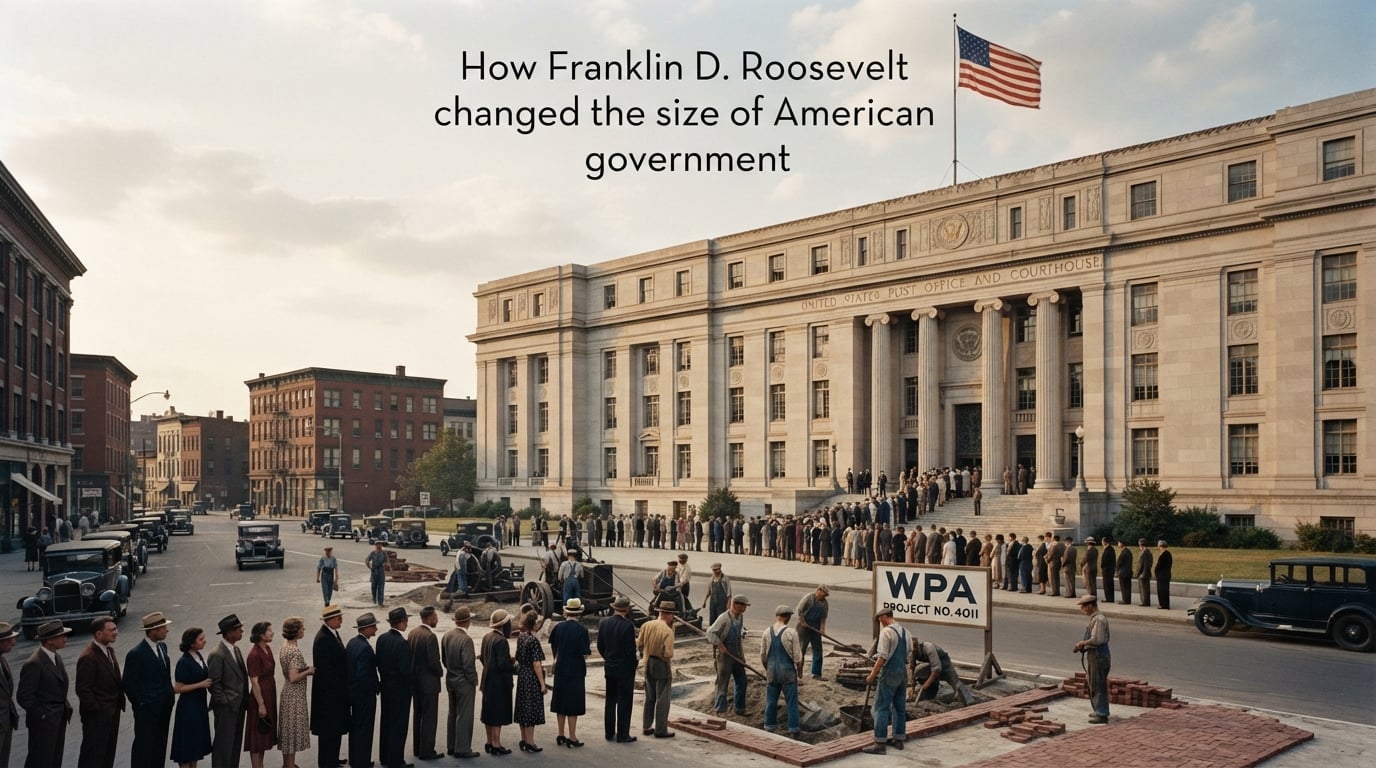
When Franklin D. Roosevelt stepped into the Oval Office on March 4, 1933, the United States was a country on its knees. Banks were failing at a pace of four per day. Unemployment stood at nearly 25 percent. The federal government itself was a relatively small operation, with limited reach into the daily lives of ordinary Americans.
I have spent the past several weeks studying how FDR changed the size of American government, and what I found is striking. In the span of just over a decade, Roosevelt reshaped the federal government from a modest institution focused on defense, postal service, and basic commerce into a powerful force in the economy, in social welfare, and in the lives of working Americans.
In this guide, you will learn exactly what changed, the specific laws and agencies that drove the expansion, the actual numbers behind the growth, and which of these programs still shape American life in 2026. Whether you are a student, a history enthusiast, or someone who simply wants to understand how the modern American government came to be, this is the article for you.
Table of Contents
What American Government Looked Like Before FDR
Before FDR, the American federal government was small, limited, and largely uninvolved in the daily economic life of ordinary citizens.
To appreciate how dramatically FDR expanded the federal government, we first need to understand how small it actually was. The contrast is the story.
In 1929, on the eve of the Great Depression, federal spending totaled just $3.1 billion, roughly 3.1 percent of gross domestic product. For most of the 1920s, the federal government ran a small surplus and shrank its workforce. The federal civilian workforce numbered only about 600,000 employees in 1933, including postal workers. Many of the regulatory agencies we now take for granted simply did not exist.
President Herbert Hoover, FDR’s predecessor, was widely associated with a philosophy of voluntarism and limited federal intervention. When the stock market crashed in October 1929 and the banking crisis unfolded, Hoover’s response was widely viewed as too cautious. He signed the Reconstruction Finance Corporation Act in 1932, but the agency was structured to lend money indirectly through banks rather than provide direct relief to individuals.
By the time of the 1932 election, the American public was ready for a fundamental shift. Roosevelt won in a landslide, carrying 42 of 48 states. His message was clear and direct: I pledge myself to a new deal for the American people. That phrase would give its name to one of the most ambitious reform agendas in American history.
The First Hundred Days: FDR’s Rapid Expansion
FDR’s First Hundred Days were the most concentrated burst of peacetime lawmaking in American history.
The First Hundred Days of FDR’s presidency, from March 9 to June 16, 1933, remains the most concentrated burst of lawmaking in American history. Roosevelt pushed through more major legislation in that single window than most presidents pass in a full term.
The pace was intentional. FDR understood that public patience was running out and that bold action would signal competence. He convened a special session of Congress and used his first fireside chat to explain the bank holiday. Within days, the Emergency Banking Act was law.
Here are the key pieces of First Hundred Days legislation:
Emergency Banking Act (March 9, 1933): Reopened solvent banks and gave the federal government authority over banking operations.
Economy Act (March 20, 1933): Cut federal salaries and reduced spending to balance the budget.
Civilian Conservation Corps Reforestation Relief Act (March 31, 1933): Created the CCC, which eventually employed 3 million young men in conservation work.
Federal Emergency Relief Act (May 12, 1933): Provided federal funds to states for direct relief to the poor.
Agricultural Adjustment Act (May 12, 1933): Paid farmers to cut production and raise crop prices.
Tennessee Valley Authority Act (May 18, 1933): Created the TVA, a federally owned corporation to bring electricity and flood control to the Tennessee Valley.
Emergency Railroad Transportation Act (June 16, 1933): Coordinated railroad operations under federal authority.
Glass-Steagall Act (June 16, 1933): Separated commercial and investment banking.
National Industrial Recovery Act (June 16, 1933): Suspended antitrust laws and established industry codes for wages, prices, and production.
By the end of June 1933, FDR had created more new federal agencies than every previous president in American history combined. The scope of this expansion is hard to overstate. We are not talking about a small adjustment at the margins. We are talking about a wholesale reimagining of what the federal government does.
Major New Deal Programs That Built Modern Government
The New Deal created the institutional foundation of the modern American administrative state, and most of those institutions still exist today.
The First Hundred Days was just the opening act. Over the next eight years, FDR continued to push legislation through Congress at a remarkable pace. The so-called Second New Deal of 1935 to 1936 introduced even more sweeping changes.
Here are the major New Deal programs that shaped the modern American government:
Works Progress Administration (WPA, 1935): Employed 8.5 million Americans building roads, schools, hospitals, and public buildings.
Social Security Administration (1935): Created old-age pensions, unemployment insurance, and aid to the disabled and dependent children.
National Labor Relations Board (NLRB, 1935): Enforced workers’ rights to organize and bargain collectively.
Securities and Exchange Commission (SEC, 1934): Regulated the stock market and protected investors from fraud.
Federal Housing Administration (FHA, 1934): Insured home mortgages and made middle-class homeownership accessible.
Public Works Administration (PWA, 1933): Funded large-scale infrastructure projects including the Hoover Dam.
Rural Electrification Administration (REA, 1935): Brought electricity to American farms.
Fair Labor Standards Act (1938): Established federal minimum wage, the 40-hour workweek, and banned child labor.
Many of these agencies and programs are still with us today. Social Security, the SEC, the FHA, the NLRB, the REA, and the Federal Trade Commission’s expanded powers all trace directly back to the New Deal. The modern American administrative state is, in a real sense, the New Deal’s institutional legacy.
Federal Spending: The Numbers Behind the Expansion
FDR’s expansion is best measured in cold, hard numbers, and those numbers show the most dramatic peacetime growth in American history.
Federal spending in 1929, before the Depression hit hard, was roughly 3.1 percent of GDP. By 1936, FDR’s third year, federal spending had climbed to about 9 percent of GDP even without a major war. By 1945, at the end of World War II, federal spending peaked at nearly 44 percent of GDP. Even after demobilization, federal spending never returned to pre-New Deal levels.
The federal civilian workforce tells a similar story. In 1933, there were about 600,000 federal civilian employees. By 1945, that number had grown to roughly 3.7 million. That is a more than six-fold increase in just twelve years.
The national debt grew alongside these programs. Federal debt stood at about $22 billion in 1933 when FDR took office. By the end of World War II, it had ballooned to roughly $260 billion. Adjusted for inflation, the debt tripled even before the war began.
For comparison, federal debt had only grown from about $1 billion in 1916 to $25 billion during World War I, then declined sharply back to $16 billion by 1930. The New Deal and World War II era broke that pattern of post-war drawdown entirely.
Building the Social Welfare Safety Net
The Social Security Act of 1935 created the federal government’s first permanent commitment to the economic security of American citizens.
Before FDR, there was no federal social safety net. If you were elderly and poor, you depended on family, local charities, or county poorhouses. If you lost your job, you had no unemployment insurance. If you were disabled, you had no guaranteed federal support.
The Social Security Act of 1935 changed all of that. It created three core programs: old-age insurance (what we now call Social Security), unemployment insurance, and aid to dependent children. For the first time in American history, the federal government took direct responsibility for the economic security of its most vulnerable citizens.
This represented a philosophical shift as much as a policy one. FDR himself framed it in his 1935 message to Congress: We have tried to meet the crisis by reform in taxation, in the regulation of private industry, in the control of foreign trade, in the distribution of national income. We have failed in none of these. We have succeeded in some. But the greater part of the new foundation must be built from the bottom up.
The legacy is profound. Social Security has paid benefits to over 65 million Americans and remains one of the most popular federal programs in 2026. Without FDR, there is simply no federal commitment to the economic security of older Americans.
Labor Reforms and Workers’ Rights
FDR’s labor reforms gave American workers the legal right to unionize and established the first federal minimum wage and 40-hour workweek.
Labor law was another area where FDR fundamentally changed the relationship between American workers and the federal government. Before 1935, the Supreme Court had repeatedly struck down laws protecting union organizing. Employers could fire, blacklist, or even physically assault workers who tried to form unions.
The National Labor Relations Act of 1935, often called the Wagner Act, changed that. It guaranteed workers the right to organize and bargain collectively through representatives of their own choosing. It created the National Labor Relations Board to enforce those rights and to prevent unfair labor practices by employers.
Three years later, the Fair Labor Standards Act of 1938 established a federal minimum wage (initially $0.25 per hour), set the 40-hour workweek as a national standard, and banned most forms of child labor. For the first time, the federal government set basic rules for the employer-employee relationship in the private sector.
The result was a dramatic rise in union membership. In 1933, only about 3 million American workers belonged to unions. By 1940, union membership had grown to roughly 8.5 million, peaking at over 14 million in the late 1940s. Union contracts became standard in major industries, raising wages for millions of workers, both union and non-union.
The Expanding Presidency and Executive Branch
FDR transformed the presidency itself, growing the White House staff and formalizing the Executive Office of the President.
FDR did not just expand the federal government. He expanded the presidency itself. When he took office in 1933, the White House staff was tiny by modern standards. There were roughly a dozen people working directly in the Executive Office.
By the end of his presidency in 1945, the White House had grown into a substantial operation with hundreds of staff members and a more structured hierarchy. The Executive Reorganization Act of 1939, which FDR pushed through Congress, formalized the creation of the Executive Office of the President, including what would become the modern National Security Council.
FDR also changed how presidents communicated with the public. His fireside chats, radio addresses designed to explain policy in plain language, set a new standard for presidential communication. About 60 million Americans tuned in for some of his chats, an enormous audience in an era before television.
The court-packing controversy of 1937 also revealed how far FDR was willing to push presidential power. After the Supreme Court struck down key New Deal programs, Roosevelt proposed adding up to six new justices to the Court. The plan was widely viewed as a constitutional overreach and failed in Congress, but it sent a clear message about executive ambition.
World War II and the Permanent Expansion
World War II built on the New Deal’s institutional framework and ensured that the expanded federal government never shrank back to pre-1933 levels.
World War II cemented the federal government’s expanded role. The New Deal had built the institutional framework, and the war mobilized it at unprecedented scale. Federal spending exploded from about 10 percent of GDP in 1940 to nearly 44 percent at the war’s peak in 1944.
Agencies created or expanded during the New Deal were repurposed for wartime. The WPA’s workforce was absorbed into wartime production. The TVA’s electrical grid supported aluminum and plutonium production. The SEC regulated wartime securities markets. The NLRB enforced labor rules in defense plants.
After the war, the GI Bill (Servicemen’s Readjustment Act of 1944) extended federal responsibility into higher education and housing for returning veterans. The Bretton Woods agreement, negotiated in 1944, put the American government at the center of the post-war global economic order. None of this would have been possible without the New Deal’s institutional infrastructure.
When the war ended, the federal workforce did not shrink back to pre-New Deal levels. Americans had grown accustomed to federal involvement in healthcare, education, infrastructure, banking, and labor markets. The federal government never returned to its 1929 size. That is the most important fact about FDR’s expansion.
Critiques and Limitations of FDR’s Expansion
FDR’s expansion came with real costs and real exclusions, and an honest look at his record must acknowledge both.
No honest look at FDR’s record would be complete without acknowledging the critiques. He remains a controversial figure, and for good reason.
The most obvious critique is the debt. Federal debt grew roughly twelve-fold during FDR’s presidency. Some economists, including those at the University of Chicago, argued that New Deal policies prolonged the Depression by creating uncertainty for businesses. The debate over whether the New Deal ended the Depression or whether World War II did is still genuinely unsettled.
Constitutional concerns are also legitimate. The Supreme Court struck down several key New Deal programs, including the National Industrial Recovery Act and the first Agricultural Adjustment Act. FDR’s court-packing plan was widely seen as an attempt to circumvent the judiciary. The expansion of executive power raised questions that remain relevant in 2026.
It is also important to acknowledge the racial dimensions of the New Deal. Many New Deal programs, including Social Security, initially excluded agricultural and domestic workers, who were disproportionately Black. FDR did not push for federal anti-lynching legislation despite pressure from civil rights leaders. The New Deal helped build the modern American state, but it left many Americans behind.
FAQs
How did Franklin D. Roosevelt expand the power of the Presidency?
FDR expanded presidential power by pushing more major legislation through Congress in his first 100 days than any previous president had in years, by creating a professional White House staff and the Executive Office of the President in 1939, and by using his famous fireside chats to communicate directly with Americans. He also proposed adding justices to the Supreme Court in 1937, the so-called court-packing plan, which failed but signaled executive ambition. By the end of his tenure, the presidency was a much larger and more powerful office than it had been in 1933.
Which president expanded the federal government the most?
Most historians credit Franklin D. Roosevelt with the largest peacetime expansion of the federal government in American history. Federal spending grew from 3.1 percent of GDP in 1929 to nearly 10 percent by 1936, the federal civilian workforce grew from about 600,000 to 3.7 million by 1945, and the national debt grew from $22 billion to $260 billion. While Lyndon B. Johnson later created Medicare, Medicaid, and the Great Society programs, FDR’s New Deal built the underlying institutional infrastructure of the modern administrative state.
Did the New Deal increase government spending?
Yes, dramatically. Federal spending rose from about 3.1 percent of GDP in 1929 to nearly 10 percent by the late 1930s, then exploded to about 44 percent during World War II. Federal spending in absolute terms grew from about $3.1 billion in 1929 to over $92 billion by 1945. Even adjusting for inflation, this represents one of the largest sustained increases in peacetime federal spending in American history, and federal spending never returned to its pre-New Deal share of the economy.
What did Roosevelt do to improve the American economy?
FDR’s economic program can be grouped into the three Rs: relief for the unemployed and poor, recovery of the economy to normal levels, and reform of the financial system. Relief came through the CCC, WPA, and Federal Emergency Relief Administration. Recovery came through public works, agricultural support, and industrial codes. Reform came through banking regulation (Glass-Steagall, SEC), labor law (Wagner Act, Fair Labor Standards Act), and the Social Security Act. Together these programs employed millions, regulated Wall Street, and created the modern social safety net.
How did the role of the federal government change during the New Deal?
Before the New Deal, the federal government’s role was largely limited to national defense, foreign policy, the postal service, and basic regulation of interstate commerce. After the New Deal, the federal government took on direct responsibility for the economic security of individual citizens, the regulation of financial markets, the welfare of farmers and workers, and the management of large parts of the economy. This represented a shift from a passive federal government to an active one that intervened directly in markets and citizens’ lives.
What programs from FDR’s era still exist today?
Many of the most important programs FDR created are still operating in 2026. Social Security is the most prominent, providing retirement, disability, and survivor benefits to millions of Americans. The Securities and Exchange Commission still regulates stock markets. The Federal Housing Administration still insures mortgages. The Tennessee Valley Authority still provides electricity. The Federal Deposit Insurance Corporation still insures bank deposits. The National Labor Relations Board still enforces labor law. These are not historical curiosities. They are part of how America works today.
The Lasting Legacy of FDR’s Government Expansion
FDR changed the size of American government more than any peacetime president, and his legacy shapes American life in 2026.
How Franklin D. Roosevelt changed the size of American government is not just a question about 1933 to 1945. It is a question about 2026. Every time you receive a Social Security check, every time your paycheck is governed by federal labor law, every time you deposit money in an FDIC-insured bank, you are experiencing the legacy of FDR’s expansion.
Let me summarize the key changes that have stuck. Federal spending as a share of GDP never returned to pre-New Deal levels. The federal government took on direct responsibility for the economic security of elderly, disabled, and unemployed Americans. Banking and financial markets became permanently regulated by federal agencies. Workers gained federal protection for union organizing and basic labor standards. The presidency itself became a much larger office with a professional staff.
Not all of FDR’s changes were permanent. The National Industrial Recovery Act was struck down. The court-packing plan failed. Some programs, like the CCC and the WPA, were discontinued. But the core institutional changes survived.
Debates about FDR’s legacy continue to shape American politics in 2026. Critics point to debt growth, constitutional concerns, and the New Deal’s racial exclusions. Supporters point to the tens of millions of Americans lifted out of poverty by Social Security, the financial stability created by SEC regulation, and the labor protections that built the American middle class.
Both views have merit. What is not up for debate is the scale of the transformation. FDR changed the size of American government more than any peacetime president before or since. Understanding how he did it, and why, remains essential to understanding modern America.