
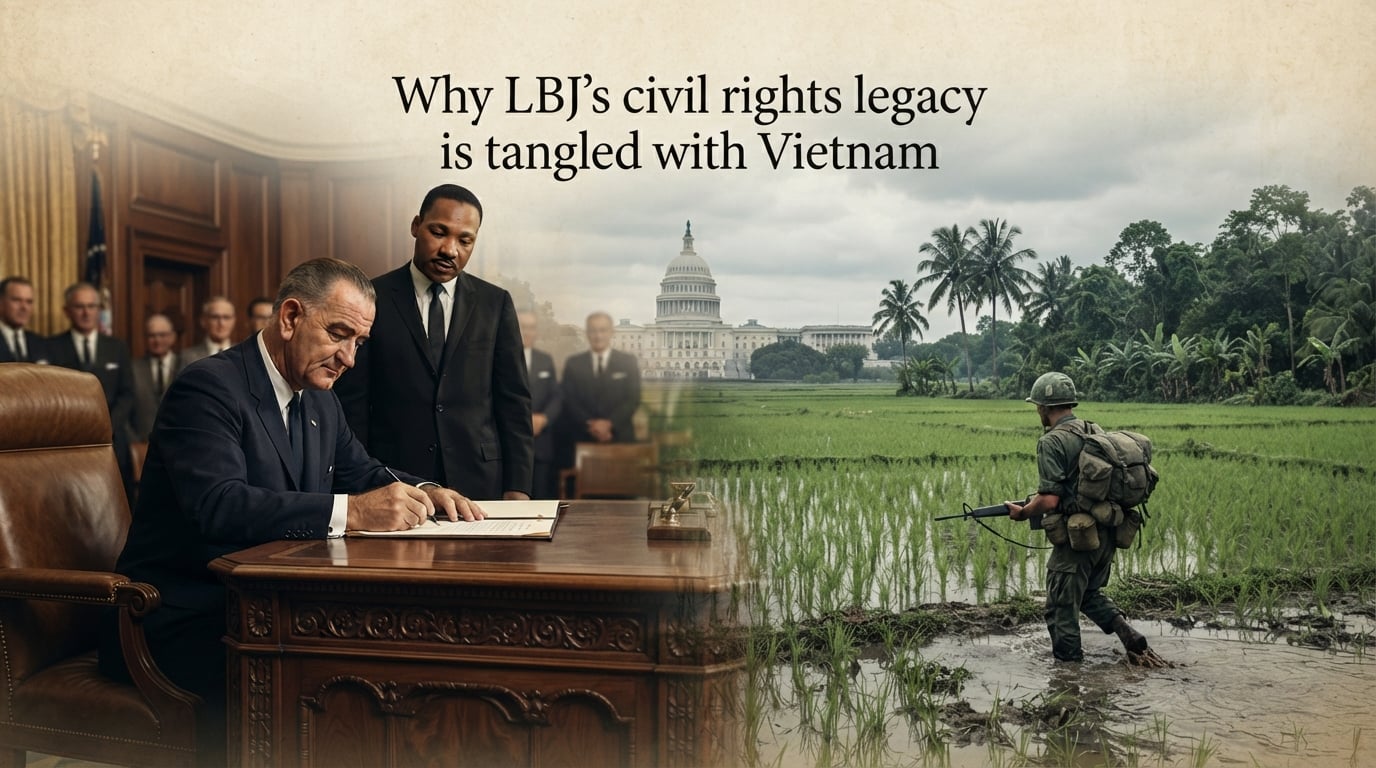
Lyndon Baines Johnson signed the Civil Rights Act of 1964, the Voting Rights Act of 1965, Medicare, Medicaid, Head Start, and roughly two dozen Great Society programs into law. Then, in the same stretch of years, he sent over 500,000 American troops into Vietnam. That overlap is the reason LBJ’s civil rights legacy is tangled with Vietnam — every modern presidential ranking, every barroom debate about his greatness, and every history lecture on the 1960s pulls on both threads at once.
I spent weeks digging into the White House recordings, the congressional vote tallies, and the political reporting of the era to understand how a president could deliver the most ambitious domestic reform program since the New Deal while his name became synonymous with a losing war. What I found is less a story of contradiction than a story of one man trying to do both at the same time, with the second job quietly killing the first.
The core tension is simple to state and brutal to live with. Johnson believed he needed to look hawkish on foreign policy as a Southern-born Democrat to protect his flank from conservative critics. That belief drove him to escalate Vietnam even as he was signing legislation that fundamentally transformed American society. The war and the Great Society were not parallel projects. They were competitors for the same dollars, the same votes, and the same political capital — and the war won almost every round.
If you want to understand why historians still argue about whether Johnson was a great president or a tragic failure, this tangle is where the argument lives. Let me walk you through the civil rights record, the Vietnam escalation, the political calculus that bound them together, and the modern reassessment that has slowly pushed his stock upward.
Table of Contents
What Was LBJ’s Civil Rights Legacy?
The domestic record is large enough to fill several presidencies on its own. On July 2, 1964, Johnson signed the Civil Rights Act, the most consequential piece of civil rights legislation since Reconstruction. The law ended legal segregation in public accommodations — restaurants, hotels, theaters, buses — and banned employment discrimination on the basis of race, color, religion, sex, or national origin. It created the Equal Employment Opportunity Commission to enforce the bans.
A year later, on August 6, 1965, he signed the Voting Rights Act of 1965. This law federalized voter registration in jurisdictions with documented histories of discrimination, banned literacy tests as a qualification to vote, and authorized federal examiners to register voters directly. Within five years, Black voter registration in Mississippi jumped from under 7 percent to nearly 60 percent. The number of Black elected officials in the South multiplied tenfold within a decade.
Johnson used his legendary Senate-floor arm-twisting to get both bills through Congress. The Civil Rights Act passed the Senate 73-27 after a 75-day filibuster led by Southern Democrats. Johnson personally called, threatened, cajoled, and bargained with senators for weeks, breaking the filibuster by peeling off enough Republican votes to overcome the procedural blockade.
Beyond the two landmark civil rights laws, Johnson pushed through Medicare and Medicaid (1965), Head Start, the Elementary and Secondary Education Act, the Fair Housing Act (1968), the Immigration and Nationality Act (1965), the creation of the Department of Housing and Urban Development, the National Endowment for the Arts, the National Endowment for the Humanities, and the Public Broadcasting Act that created PBS and NPR. He gave four major speeches between November 1963 and May 1964 laying out the vision he called the Great Society.
My favorite personal detail comes from Johnson’s phone call with Martin Luther King Jr. shortly after the Selma march in early 1965. Johnson told King: “I want you to know that if it’s symbols you want, I’m your man.” He then turned around and used his mastery of congressional procedure to deliver the votes King needed. King himself privately told aides that no president since Lincoln had done more on civil rights.
That record is why most professional historians rank Johnson near the top of the all-time list. The 2026 C-SPAN Presidential Historians Survey placed him sixth all-time, ahead of both John Adams and John Quincy Adams. Civil rights leaders, including the late Congressman John Lewis, repeatedly credited Johnson as the most consequential president on racial justice since Lincoln.
How Did LBJ Get Pulled Into Vietnam?
Vietnam was already Johnson’s inheritance before he had any chance to set his own course. When Kennedy was assassinated in November 1963, there were roughly 16,000 U.S. military advisors in South Vietnam, supporting the government of Ngo Dinh Diem (who had himself been assassinated in a CIA-supported coup just three weeks before Kennedy’s death). Johnson had publicly warned against expanding the commitment as a senator, telling an audience in 1957 that “theoretically and historically” Americans had no business fighting land wars in Asia.
Once he was in the Oval Office, three forces pushed him toward escalation. Hawks inside his own administration — including Defense Secretary Robert McNamara, National Security Advisor McGeorge Bundy, and Secretary of State Dean Rusk — argued relentlessly that a communist South Vietnam would fall without U.S. ground forces. They warned that the entire domino theory would play out across Southeast Asia if Saigon collapsed.
Foreign policy elites and Republican critics hammered any president who looked “soft” on communism. Barry Goldwater, Johnson’s 1964 Republican opponent, openly suggested using low-yield nuclear weapons on Vietnam. The conservative press painted Democrats as the party that had “lost China” in 1949 and would now “lose Vietnam.” Johnson felt he could not let that attack stick.
His own political instinct told him a Democratic president could not afford to look weak on defense. Johnson had watched the right-wing “China Lobby” destroy Democrats in the 1950s. He had watched Truman get hammered for “losing China” and for firing Douglas MacArthur during the Korean War. He had watched Eisenhower survive McCarthyism by being unimpeachably tough on communism. As a Southern Democrat leading a Northern liberal program, Johnson calculated that any perception of weakness on foreign policy would give his congressional opponents the pretext to gut the entire domestic agenda.
The Gulf of Tonkin incident in August 1964 changed the math entirely. After reported (though partly disputed) attacks on U.S. Navy destroyers in international waters, Congress passed the Gulf of Tonkin Resolution with only two dissenting votes in the Senate and zero in the House. Johnson now had a blank check to use military force in Southeast Asia without a formal declaration of war — a constitutional shortcut he would later admit he regretted.
By March 1965, Johnson approved Operation Rolling Thunder, the sustained bombing campaign against North Vietnam that would drop more ordnance than the entire U.S. bombing effort in the Pacific during World War II. By June 1965, he had committed the first U.S. ground combat troops to defend air bases. By the end of 1965, there were 184,000 American troops in Vietnam. By 1968, the number was over 535,000.
By the time Johnson left office in January 1969, more than 31,000 Americans had died in the war, along with an estimated 250,000 South Vietnamese military personnel and roughly 1.1 million North Vietnamese and Viet Cong fighters and civilians. The total cost in lives would climb much higher before the war finally ended in 1975.
Why LBJ’s Civil Rights Legacy Is Tangled With Vietnam
The short answer is political math. Johnson believed — and he knew how to count votes better than anyone in Washington — that had he backed away from Vietnam in 1965, there would have been no Great Society. That sentence comes from historian Michael H. Hunt, and it is the cleanest summary of Johnson’s strategy I have found in the entire scholarly literature.
Johnson treated Vietnam as a credibility tax he had to pay in cash. He had to demonstrate toughness on communism to his conservative critics in order to buy the political space to push through Medicare, civil rights, and the rest of his domestic agenda. Every vote for the Great Society, in his calculation, depended on him not giving the right wing a “soft on communism” cudgel to swing at wavering members of Congress.
There was also a hidden fiscal cost that bound the two legacies together mechanically, not just chronologically. The war consumed budget resources that otherwise would have funded the Great Society in full. Between 1965 and 1968, federal spending on the war climbed from near zero to roughly $30 billion per year in then-current dollars. Johnson refused to raise taxes to pay for the war while it was being fought, so the spending borrowed from the same fiscal space the Great Society wanted to fill.
When inflation finally forced Johnson to ask for a tax surcharge in 1968, he had to accept spending cuts to get it through Congress. The cuts fell disproportionately on the Great Society programs he had just created. Head Start was scaled back. Model Cities funding was reduced. Job training programs were trimmed. The Congressional Budget Office later estimated that the war absorbed roughly $170 billion in 1960s dollars over its full course — money that, in a counterfactual without Vietnam, could have funded the Great Society at the levels Johnson originally promised.
Civil rights leaders saw the trade-off in real time and began splitting with Johnson. Martin Luther King Jr. broke publicly with the administration on April 4, 1967, with his “Beyond Vietnam” speech at Riverside Church in New York. King argued that Johnson’s war machine was being built on the backs of Black and poor Americans drafted into a conflict they had not chosen. He famously called the U.S. government “the greatest purveyor of violence in the world today” — a line that cost him mainstream political support but cemented the moral case against the war.
The 1967 Kerner Commission Report on civil disorders warned that America was “moving toward two societies, one black, one white — separate and unequal.” Johnson commissioned the report himself after the Newark and Detroit riots. When the report recommended roughly $30 billion in anti-poverty spending, Johnson quietly shelved it. He told aides that the country could not afford both the war and the report’s recommendations — and the war came first.
This is the part most casual readers miss. The two legacies are not just linked because they happened at the same time. They are linked mechanically. Each decision to send more troops reduced the political and financial space for the next civil rights victory. Each delay of a Great Society program because of war spending created a paper trail that historians would later cite as evidence of broken promises. The tangle is structural, not coincidental.
Timeline of LBJ’s Key Decisions (1963-1968)
Reading the timeline compressed into a single list is the fastest way to see how fast Johnson moved on both fronts at once. Several of these decisions happened within weeks of each other — and several of the most consequential foreign policy choices were made in the same months as the most consequential domestic legislation.
November 22, 1963 — Johnson becomes president after Kennedy’s assassination; inherits 16,000 military advisors in Vietnam and a fragile South Vietnamese government.
January 8, 1964 — Johnson declares “unconditional war on poverty” in his first State of the Union address, launching the Great Society.
July 2, 1964 — Signs the Civil Rights Act of 1964 after a 75-day Senate filibuster.
August 2-4, 1964 — Gulf of Tonkin incident; reported attacks on U.S. destroyers in international waters.
August 7, 1964 — Congress passes the Gulf of Tonkin Resolution 98-2 in the Senate, 416-0 in the House.
March 2, 1965 — Operation Rolling Thunder begins; sustained bombing of North Vietnam lasts until November 1968.
March 8, 1965 — First U.S. Marine combat troops arrive at Da Nang air base.
July 30, 1965 — Signs Medicare and Medicaid into law, the largest expansion of health care coverage in U.S. history.
August 6, 1965 — Signs the Voting Rights Act of 1965, federalizing voter registration across the South.
October 3, 1965 — Signs the Immigration and Nationality Act, ending national-origin quotas that had governed U.S. immigration since 1924.
1966-1967 — Anti-war movement grows; draft resistance intensifies; civil rights leaders including MLK publicly break with Johnson over Vietnam.
April 4, 1967 — MLK delivers “Beyond Vietnam” speech at Riverside Church, breaking with the Johnson administration.
January 31, 1968 — Tet Offensive begins; Viet Cong and North Vietnamese forces attack over 100 cities across South Vietnam.
February 27, 1968 — Walter Cronkite editorializes that the war will end in stalemate, turning mainstream opinion against the war.
March 31, 1968 — Johnson announces he will not seek re-election and partially halts the bombing of North Vietnam.
April 11, 1968 — Signs the Fair Housing Act of 1968, one of his final major legislative acts.
Did LBJ Regret Vietnam?
The direct answer: yes, but only privately, and only late in his presidency. Johnson refused to apologize publicly or to admit error on camera. The most-quoted moment of regret comes from the White House audio recordings that historian Michael Beschloss later published. Speaking with Senator Russell Long in 1967, Johnson said: “I don’t think the American people are going to want a war to go on for another year with 1,000 casualties a month.”
His closing paragraph of his November 1967 Man of the Year interview with Time magazine ended with the line: “I’m not going to be the president who saw Southeast Asia go the way China went.” That was hubris dressed up as destiny — the same hubris that had driven the escalation in the first place.
His wife, Lady Bird Johnson, summed up the private cost in language that has become the most quoted line in modern Johnson biographies. In a taped diary entry from August 1964, she wrote that Vietnam was “a bitch of a war that killed the lady he really loved — the Great Society.” That single sentence captures the entire tragedy of Johnson’s presidency in fewer than 20 words.
By the time he announced his withdrawal from the 1968 race on March 31, 1968, Johnson was reported by his aides to be drinking heavily, smoking constantly, and meeting with the Joint Chiefs only when forced. His press secretary George Reedy described him as “a man who knew the war was lost but could not admit it to the country.” Longtime aide Bill Moyers, who had left the administration in 1966, later said Johnson was “eaten alive by Vietnam” in his final two years in office.
There is also the question of what Johnson said after he left office. In retirement at his Texas ranch, Johnson reportedly told friends that if he had it to do over, he would have cut the war short in 1966. He never said this on the record. He died of a heart attack on January 22, 1973, at age 64, just one day before the Paris Peace Accords that formally ended U.S. involvement in Vietnam were signed.
Why FDR’s Legacy Isn’t Stained by WWII, but LBJ’s Is by Vietnam
This is one of the most common questions on Reddit’s r/Presidents subreddit, and it is a genuinely good one. Both presidents led the country through wars, both presided over massive expansions of the federal government, both are routinely ranked in the top five presidents by historians. Yet FDR’s war is universally remembered as a necessary, noble cause, while Johnson’s is remembered as a tragic mistake that consumed his legacy. Why the difference?
First, the wars ended differently. World War II ended with unconditional surrender, ticker-tape parades, and a clear moral victory against fascism. Vietnam ended with a Communist victory in 1975, humiliating helicopter images from the U.S. embassy roof in Saigon, and a final casualty count that purchased nothing lasting. A war you win is remembered as the price of leadership. A war you lose is remembered as a waste.
Second, the moral framing was different. WWII was fought against Nazi Germany and Imperial Japan — regimes that had invaded their neighbors and built death camps. Vietnam was fought against a nationalist independence movement that, despite its Communist leadership, had broad popular support inside Vietnam. The moral case for WWII has aged well. The moral case for Vietnam has aged badly.
Third, the domestic policies were different in scale and visibility. The New Deal built dams, roads, bridges, and Social Security — every American used them. The Great Society was more redistributive (Medicare, civil rights enforcement, education aid), and its beneficiaries were often the very people Johnson was failing to protect on race and class lines, not the median white voter who built the politically decisive coalition of the era.
Fourth, the personal cost felt different. FDR hid his paralysis from the public but earned sympathy and the country rallied around him. Johnson was visibly worn down by Vietnam in a way that aged him on television. Walter Cronkite’s famous February 27, 1968 editorial — “It seems now more certain than ever that the bloody experience of Vietnam is to end in a stalemate” — turned the country against the war inside three weeks and is widely regarded as the moment Johnson lost the American middle.
The counterfactual many historians explore: if Johnson had cut his losses in 1966, redirected war spending toward anti-poverty programs, and handed the presidency over to Humphrey in 1968, would his legacy be untarnished? The best evidence suggests yes. But the political cost of cutting the war in 1966 was enormous enough that even Douglas MacArthur, Dwight Eisenhower, and General William Westmoreland all warned Johnson publicly that withdrawal meant losing all of Southeast Asia. Johnson chose to believe them. History did not.
Modern Reassessment of LBJ’s Place in History
Presidential rankings have been trending up over the past 20 years, and Johnson has been one of the biggest gainers. The C-SPAN 2000 inaugural survey had Johnson at 10th. By 2009 he was 11th. By 2017 he was back at 10th. By 2021 he had climbed to 10th. By the most recent 2026 survey he was 6th, just behind Truman and the two Roosevelts. The same slow climb happened in the Siena College poll and in the American Political Science Association rankings.
Two forces are at work. A wave of recent scholarship — Robert Caro’s final volume, Mark Updegrove’s reporting on the White House recordings, and ongoing reassessments from scholars such as Joshua Zeitz and Kyle Longley — has rehabilitated the domestic record by showing just how much Johnson actually delivered under impossible political conditions. The civil rights coalition has also insisted that civil rights achievements be counted more heavily than military failures, a reweighting that favors Johnson almost by definition.
Today’s political calculations echo Johnson’s in ways he would have recognized. Liberal presidents worry about looking soft on defense. Conservative presidents worry about overreach abroad. The same dual loyalty between domestic mandate and foreign commitment that broke Johnson in 1968 is the structural tension of every modern presidency that tries to do too much at once — from Obama’s struggle with Afghanistan and the Affordable Care Act, to Biden’s balancing act between Ukraine funding and domestic spending.
FAQs
Why did LBJ support the Vietnam War?
LBJ supported Vietnam because he believed a Democratic president could not afford to appear weak on communism without losing the political cover needed for his Great Society programs. Hawks in his administration, the Cold War consensus, and his own experience watching the right attack Truman in Korea all pushed him toward escalation after the Gulf of Tonkin Resolution in August 1964.
Why did LBJ pass civil rights legislation?
LBJ passed the Civil Rights Act of 1964 and the Voting Rights Act of 1965 because he saw it as a moral imperative after Kennedy’s assassination, a strategic way to lock in the Black vote for a generation, and a personal commitment to Martin Luther King Jr. He used his years as Senate Majority Leader to count votes and pressure reluctant Southern Democrats.
Why was LBJ unpopular?
LBJ’s approval collapsed from 74 percent in July 1965 to 36 percent by August 1968 because the Vietnam War escalated, civil unrest grew after the 1965 Watts and 1967 Detroit riots, and the cost of living rose. The Tet Offensive in early 1968 confirmed public doubts that the war could be won.
Did LBJ regret the Vietnam War?
Yes, privately. In recorded White House conversations, Lady Bird Johnson’s diary, and interviews with longtime aides after he left office, Johnson expressed regret that Vietnam had drained resources and political capital from his Great Society. He said it was the worst mistake of his presidency, but he never said so on camera before March 1968.
Conclusion
Why LBJ’s civil rights legacy is tangled with Vietnam is a question with one core answer: by choice, not by accident. The choice to escalate Vietnam in 1965 was the same choice to keep his domestic coalition intact. The choice to keep the coalition intact was the reason the Great Society’s full promise was never funded. Modern historians weigh civil rights more heavily than the war, which is why LBJ’s stock has climbed to sixth in 2026 rankings — but the two threads will never fully separate for any honest reading of his presidency.
For deeper reading, Robert Caro’s multi-volume biography “The Years of Lyndon Johnson” and Joshua Zeitz’s recent reassessments are the two best modern sources. They reach different verdicts on whether LBJ had any realistic alternative to the war. Both are worth your time if you want to understand why the tangle endures — and why no single ranking will ever fully resolve the question.