
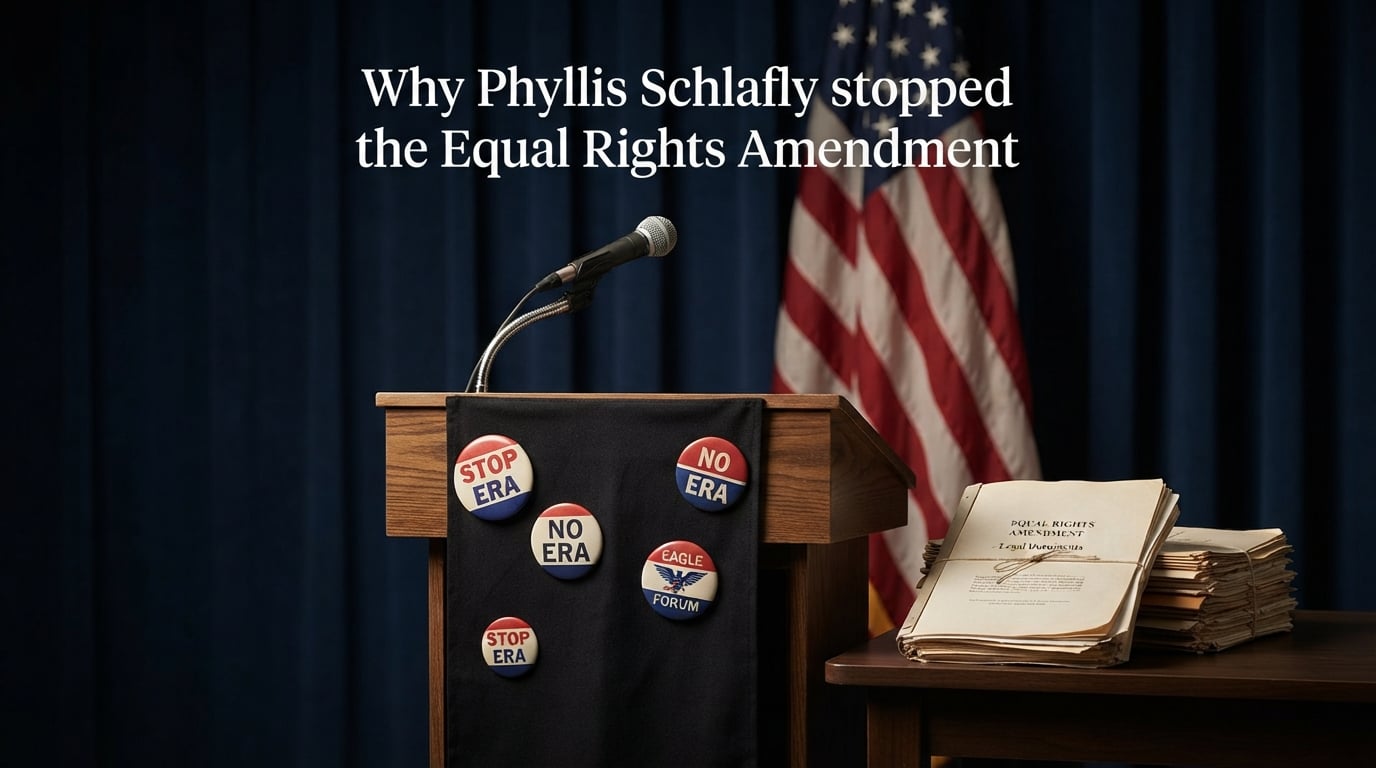
Phyllis Schlafly stopped the Equal Rights Amendment by building a grassroots army of conservative women who believed the amendment would strip away legal protections they already enjoyed. She argued that equal treatment under the law would mean drafting women into combat, eliminating alimony, and forcing unisex bathrooms across America. Her STOP ERA campaign turned a near-certain constitutional win into a decade-long political fight that ended in failure.
The amendment had sailed through Congress in 1972 with bipartisan support and seemed unstoppable. Within a year, 30 of the needed 38 states had ratified it. Then Schlafly entered the picture. By the time the 1982 ratification deadline expired, the ERA was three states short and politically toxic. Her success redefined the conservative movement and gave birth to the Religious Right.
Understanding why Phyllis Schlafly stopped the Equal Rights Amendment means looking at her specific arguments, her organizing genius, and the cultural moment she exploited. This is the full story of how one woman halted what millions thought was inevitable.
Table of Contents
Who Was Phyllis Schlafly Before the ERA Fight?
Phyllis Schlafly was not a political newcomer when she turned her attention to the ERA. Born Phyllis Stewart in St. Louis, Missouri, in 1924, she grew up in a working-class Catholic family during the Great Depression. She worked her way through Washington University, earned a master’s degree in political science from Radcliffe College in 1945, and began her career in conservative politics almost immediately.
Her first taste of national attention came from her 1964 book A Choice, Not an Echo. The self-published paperback argued that Republican elites repeatedly nominated moderate presidential candidates who lost to Democrats because grassroots conservatives had no real voice. The book sold over three million copies and made Schlafly a star on the right. She campaigned for Barry Goldwater’s presidential bid and built a network of contacts that would later become the backbone of her anti-ERA effort.
Before STOP ERA, Schlafly had already run for Congress twice and lost both times. She served as a delegate to several Republican National Conventions and chaired the Illinois Federation of Republican Women. She was a defense hawk who wrote extensively on national security, even publishing a newsletter called The Phyllis Schlafly Report in 1967 that would later become her primary organizing tool against the amendment.
What set Schlafly apart from other conservative voices was her discipline and her ability to translate complex policy into simple, emotionally resonant language. She was a polished public speaker, a prolific writer, and a tireless organizer. These skills would prove devastating when she turned them against the feminist movement.
What Was the Equal Rights Amendment and Why Did It Matter?
The Equal Rights Amendment is deceptively simple. Its core text reads: “Equality of rights under the law shall not be denied or abridged by the United States or by any State on account of sex.” First written by suffragist Alice Paul in 1923, the amendment spent nearly five decades stuck in congressional committees while the women’s rights movement fought for piecemeal legislative reforms.
The political climate shifted dramatically in the early 1970s. Second-wave feminism had become a mainstream force, and politicians on both sides of the aisle wanted to demonstrate their support for women’s equality. The U.S. Senate approved the ERA on March 22, 1972, by a vote of 84 to 8. The House had already passed it 354 to 24. It looked like a done deal.
Once sent to the states for ratification, the amendment moved fast. Hawaii ratified it within minutes of congressional approval. Twenty-two states had signed on by the end of 1972, and the total reached 30 by the close of 1973. Only eight more states were needed. Congress had set a deadline of March 22, 1979, later extended to June 30, 1982. The finish line was in sight.
Supporters argued the ERA would guarantee equal pay for equal work, end sex discrimination in employment and education, and create a constitutional foundation for women’s rights that could not be rolled back by future legislatures. They pointed out that existing laws like the Equal Pay Act and Title VII had loopholes and weak enforcement. A constitutional amendment would settle the matter permanently.
That momentum is exactly what Phyllis Schlafly decided to stop. She saw the ERA not as harmless symbolism but as a radical restructuring of American society that would eliminate protections women already had.
What Arguments Did Phyllis Schlafly Use Against the ERA?
Schlafly built her case against the ERA on a foundation of fear about what women would lose. She did not argue that women were inferior or undeserving of respect. Instead, she insisted the amendment would erase the special privileges that women enjoyed under existing law. Her arguments were specific, practical, and designed to resonate with average housewives who felt alienated by the feminist movement.
Her most powerful argument was the military draft. In 1972, the United States still had the memory of Vietnam fresh in mind, and the selective service system registered only men. Schlafly argued that the ERA would force women to register for the draft and serve in combat on equal terms with men. She painted vivid pictures of mothers being sent to the front lines while their children waited at home. This argument struck fear into millions of families, and it was the centerpiece of her messaging.
She also warned that the amendment would eliminate alimony and child support obligations. Under the legal reasoning she promoted, any law that treated husbands and wives differently would become unconstitutional. That meant dependent spouse benefits under Social Security would vanish, along with the traditional presumption that mothers received custody of children in divorce cases. Working-class and middle-class women who depended on these protections heard her warnings and took them seriously.
Schlafly argued that the ERA would lead to unisex bathrooms, same-sex marriage (decades before that became a mainstream political fight), and the elimination of all-female schools and organizations. She warned that protective labor laws limiting women’s working hours would be struck down, forcing women into dangerous industrial jobs. None of these predictions were outlandish to her audience. They followed logically from the amendment’s broad language.
Her rhetorical strategy was to frame the ERA as something that would benefit a small elite of professional career women while harming the vast majority of women who were homemakers, part-time workers, or depended on their husbands’ incomes. She famously argued that feminists were trying to “make homemakers feel like non-persons” and that the ERA would “downgrade the American woman to the level of the American man.” The message was clever because it turned the language of liberation against itself.
Schlafly also leaned heavily on religious arguments. She framed her opposition as a defense of Judeo-Christian civilization and traditional family values. She argued that God had created men and women with different roles and that the ERA was an attempt to override divine law with secular ideology. This religious framing helped her build alliances with Catholic bishops, Protestant evangelicals, and Mormon leaders who mobilized their congregations against ratification.
How Did Schlafly Build the STOP ERA Campaign?
The genius of Schlafly’s campaign was not her arguments alone. It was her organizing. She founded STOP ERA in 1972, just months after Congress sent the amendment to the states. The name stood for “Stop Taking Our Privileges,” and it was a direct response to the ERA’s claim that women needed more rights. Schlafly’s message was that women already had plenty of privileges and the amendment would take them away.
Her primary weapon was The Phyllis Schlafly Report, a monthly newsletter that reached tens of thousands of subscribers. Each issue broke down the ERA’s consequences in plain language and provided talking points that activists could use when lobbying state legislators. Schlafly understood that most state lawmakers had not read the amendment carefully and had no idea what arguments existed against it. She filled that vacuum.
STOP ERA operated as a grassroots army of volunteers, not a top-down lobbying firm. Schlafly recruited women through church networks, Republican women’s clubs, and local civic organizations. She trained them to attend legislative hearings, write letters to editors, and visit their elected representatives in person. These volunteers brought homemade bread and apple pies to state capitols as a symbol of traditional homemaking, presenting themselves as concerned mothers rather than political operatives.
This bread-and-pie strategy was theatrical and effective. When reporters covered ERA hearings, they saw tables of smiling women in modest dresses offering baked goods alongside their political literature. The visual contrast with feminist activists, who were often portrayed as angry and confrontational, played directly into Schlafly’s narrative. She made opposition to the ERA seem wholesome and patriotic.
In 1975, Schlafly expanded her operation by founding the Eagle Forum, a national organization dedicated to defending traditional family values. Eagle Forum served as the permanent infrastructure of her movement, with chapters in all 50 states. It hosted annual conferences, published educational materials, and coordinated lobbying efforts across state lines. The organization gave STOP ERA activists a sense of belonging to something larger than a single-issue campaign.
Schlafly also forged alliances with groups that had their own reasons to oppose the ERA. The Mormon Church mobilized its members in Utah and surrounding states. The Catholic Church provided moral and institutional support. Protestant evangelical leaders like Jerry Falwell, who would later found the Moral Majority, recognized Schlafly as a key figure in the emerging Religious Right. She was one of the first activists to unite these disparate religious communities around a shared political goal.
Her coalition extended beyond religious groups. She worked with conservative legal organizations that challenged the amendment’s constitutionality and with business interests that worried about new employment regulations. She built relationships with sympathetic legislators who delayed ratification votes, attached amendments that gutted the ERA’s purpose, and eventually voted to rescind earlier ratifications. This multi-pronged approach overwhelmed the ERA’s supporters, who were not nearly as organized at the state level.
Where Were the Key State Battles Against the ERA?
The fight over the ERA happened in state capitols, not Washington. By early 1973, the amendment’s supporters believed they were on a glide path to 38 states. Then the victories stopped coming, and several states that had already ratified began reconsidering their votes. Schlafly focused her resources on the states where the fight was closest and where her organizers could make the biggest difference.
Illinois became the central battleground. Schlafly lived in Alton, Illinois, and she turned her home state into a fortress against the ERA. The Illinois legislature voted on the amendment repeatedly throughout the late 1970s and early 1980s, and each time Schlafly’s volunteers flooded the statehouse in Springfield. She maintained a constant presence at hearings, and her newsletter kept Illinois activists coordinated and informed. The state never ratified, and its refusal became the symbolic heart of the ERA’s defeat.
Florida was another critical loss for the amendment’s supporters. The state legislature considered ratification multiple times but consistently fell short. Schlafly’s Eagle Forum chapters in Florida organized phone banks, letter-writing campaigns, and in-person lobbying that proved decisive in close votes. The fact that a large, politically diverse state like Florida refused to ratify undercut the amendment’s claim to national consensus.
Several states that had ratified early actually voted to rescind their ratifications. Oklahoma, Nebraska, Tennessee, Idaho, Kentucky, and South Dakota all passed rescission resolutions between 1973 and 1979. The legal status of these rescissions was unclear, since the Constitution does not specify whether states can take back a ratification, but their political impact was enormous. They signaled that momentum had reversed and gave cover to other states considering a no vote.
Schlafly also targeted specific legislators who were wavering. Her volunteers researched committee assignments, voting records, and personal backgrounds. They identified which lawmakers were most likely to oppose the ERA if given political cover, then mobilized constituents to apply pressure. This targeted approach was far more efficient than the broad public campaigns run by the amendment’s supporters, who often treated ratification as inevitable rather than something that needed to be fought for.
Why Did the Equal Rights Amendment Finally Fail?
The Equal Rights Amendment failed because it ran out of time and political oxygen. When Congress extended the ratification deadline from 1979 to 1982, supporters hoped the extra three years would be enough to win the remaining states. Instead, the extension itself became a political liability. Schlafly argued that Congress was changing the rules mid-game and that desperate tactics proved the amendment could not win on its merits.
No new states ratified during the extension period. The amendment’s supporters watched state after state vote no or refuse to bring the matter to a vote at all. By the time June 30, 1982, arrived, the ERA stood at 35 ratifications, three short of the 38 required. The campaign was over. The amendment that had passed Congress with overwhelming bipartisan support a decade earlier was dead.
Several factors converged to produce this outcome. The feminist movement overestimated its grassroots strength and underestimated the depth of conservative opposition. State-level ERA campaigns were often run by volunteers with limited resources and little experience in hardball politics. They could not match the discipline and coordination of Schlafly’s organization.
The broader political environment also shifted against the amendment. The 1970s economic stagnation made voters skeptical of social experimentation. The rise of the Religious Right, which Schlafly helped catalyze, created a powerful new voting bloc that opposed the ERA on moral grounds. Ronald Reagan’s election in 1980 signaled a conservative turn in national politics that made ratification even less likely.
Perhaps most importantly, Schlafly succeeded in reframing the debate. Instead of arguing about whether women deserved equality, she forced a conversation about what equality would actually cost. Her specific predictions about the draft, alimony, and unisex bathrooms made the ERA feel risky and unpredictable rather than obviously just. Once that frame took hold, the burden of proof shifted to the amendment’s supporters, and they never fully recovered.
Was Phyllis Schlafly a Hypocrite? The Personal Contradictions
One of the most persistent critiques of Phyllis Schlafly is that her personal life contradicted her political message. She argued that women should embrace homemaking as their highest calling, yet she spent decades as a full-time political organizer, author, and public speaker. She held a graduate degree from an Ivy League institution and built a national organization, all while telling other women that careers outside the home were a feminist betrayal of family values.
Her critics on Reddit and in academic literature return to this contradiction repeatedly. The popular FX miniseries Mrs. America, which dramatized the ERA fight with Cate Blanchett playing Schlafly, highlighted this tension in almost every episode. The show depicted a woman who traveled constantly, managed a political empire, and relied on a network of volunteers and staff, all while insisting that the natural place for women was in the kitchen.
Schlafly’s defenders argue that she never said women could not have careers. She said that women should not be forced to abandon homemaking and that the law should not punish women who chose family over work. From this perspective, her own career was proof that women could do both, and her opposition to the ERA was about protecting choices rather than limiting them.
The famous quiche incident of 1983 captures the theatrical nature of her movement. After the ERA’s defeat, Schlafly was speaking at a college campus when a feminist protester smashed a pie in her face. The moment became symbolic of the raw anger her campaign had generated. She turned even that into political capital, using the incident to argue that ERA supporters were hostile and undemocratic.
Whether Schlafly was a hypocrite depends on how you interpret her message. What is undeniable is that she was a brilliant political strategist who understood how to weaponize her own biography. Her identity as a wife and mother gave her credibility with the women she was organizing, even as her career undermined the simple domestic ideal she claimed to defend.
What Was Schlafly’s Lasting Legacy on American Politics?
Schlafly’s defeat of the ERA reshaped the Republican Party. Before 1972, both major parties supported the amendment in their national platforms. After her campaign succeeded, the Republican Party dropped its endorsement and adopted language defending traditional family values. The party that nominated Barry Goldwater, a supporter of women’s rights, became the party that nominated Ronald Reagan, who owed much of his coalition to the Religious Right Schlafly helped build.
The Eagle Forum continues to operate today as a conservative advocacy organization. It opposes abortion, same-sex marriage, and what it describes as radical gender ideology. Schlafly remained active in politics until her death in 2016 at the age of 92, endorsing Donald Trump for president in her final months and publishing her newsletter right up until the end.
Her organizing model also influenced generations of conservative activists. The combination of grassroots volunteer networks, simple messaging, religious coalition-building, and targeted legislative lobbying became the template for the pro-life movement, the Tea Party, and other right-wing mobilizations. She proved that a disciplined minority could defeat a popular cause by controlling the narrative and working the political process at the state level.
The ERA itself has never fully died. In recent years, three additional states, Virginia, Illinois, and Nevada, ratified the amendment, claiming to reach the 38-state threshold. Legal battles continue over whether those ratifications count and whether the original deadline can be overridden. But the political landscape Schlafly created makes a successful ERA revival unlikely, and her name remains inseparable from the amendment’s failure.
FAQs
What was the reason why the Equal Rights Amendment failed?
The Equal Rights Amendment failed because Phyllis Schlafly’s STOP ERA campaign organized grassroots opposition in unratified states, arguing the amendment would eliminate women’s legal protections and draft women into the military. By the June 1982 deadline, only 35 of the required 38 states had ratified, leaving the amendment three states short of passage.
Who stopped the Equal Rights Amendment?
Phyllis Schlafly is widely credited with stopping the Equal Rights Amendment. She founded the STOP ERA campaign in 1972 and built a national coalition of conservative women, religious groups, and Republican activists who lobbied state legislatures to reject or rescind ratification.
Who tried to stop the Equal Rights Amendment?
Phyllis Schlafly and her STOP ERA campaign were the primary organized opposition. She was joined by the Eagle Forum, the Mormon Church, the Catholic Church, conservative Protestant leaders, and a network of volunteers who mobilized in state capitals to pressure legislators against ratification.
Why did people not support the Equal Rights Amendment?
Opponents argued the ERA would force women into the military draft, eliminate alimony and dependent wife benefits under Social Security, abolish child custody preferences for mothers, mandate unisex bathrooms, and strike down protective labor laws. These practical concerns resonated with millions of women who felt the feminist movement did not represent their interests.
Did Phyllis Schlafly change her mind about the ERA?
No. Schlafly opposed the ERA from 1972 until her death in 2016 and never publicly reversed her position. She continued leading the Eagle Forum and campaigning against what she saw as radical feminist policies, including abortion and same-sex marriage, for the rest of her life.
Final Thoughts on Why Phyllis Schlafly Stopped the ERA
The story of why Phyllis Schlafly stopped the Equal Rights Amendment is a case study in political power. She did not have more money than the feminist movement or more institutional support. What she had was a clear message, an organized grassroots network, and the ability to frame the debate on her own terms. She turned a question about equality into a question about what women stood to lose, and that shift in framing proved decisive.
Her victory had consequences that extended far beyond a single amendment. It helped launch the Religious Right as a political force, realigned the Republican Party around social conservatism, and demonstrated that motivated activists working at the state level could defeat causes that seemed unstoppable nationally. Whether you see her legacy as a triumph of democracy or a setback for women’s rights depends on your political perspective, but her impact on American history is impossible to deny.
The ERA fight also offers a warning that remains relevant in 2026. Popular causes are not inevitable, and political momentum can reverse quickly when a disciplined opposition emerges. Schlafly understood that better than anyone, and the amendment that looked certain to pass in 1972 never crossed the finish line. Her story is a reminder that in politics, the side that organizes hardest usually wins.